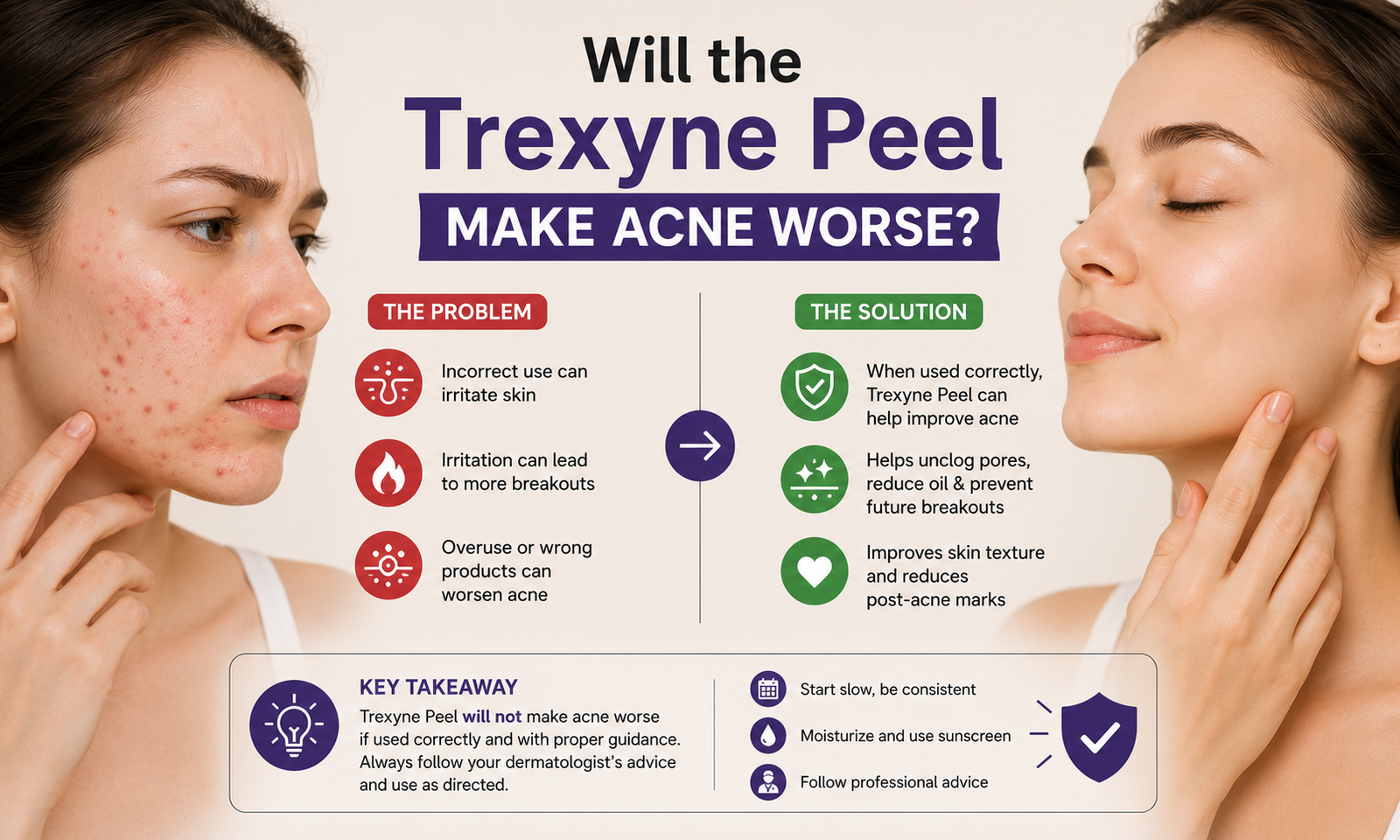
Will the Trexyne Peel Make Acne Worse?
Applied to the wrong skin at the wrong time, any resurfacing treatment can aggravate acne. That is true regardless of the mechanism used. Applied correctly, at an appropriate point in the skin’s cycle and with a suitable protocol, professional resurfacing can support skin renewal and texture refinement in acne-prone clients without provoking further breakouts. The key distinction is timing and clinical assessment, not the treatment itself. The Trexyne Peel works through a mechanical mechanism using marine-algae spicules, with no acids involved at any stage. For practitioners working with acne-prone clients, this mechanical approach offers a different risk profile to acid-based resurfacing options, particularly when it comes to the inflammatory response that resurfacing can trigger in reactive skin.
The Honest Answer: It Depends on Timing
The straightforward clinical answer is that the Trexyne Peel, like any professional resurfacing treatment, should not be applied to actively inflamed or broken-out skin. Resurfacing during an active breakout risks spreading bacteria across the treatment area, disrupting active lesions, and generating an inflammatory response that can worsen both the breakout and the post-inflammatory pigmentation that often follows acne.
This is not a limitation specific to the Trexyne Peel. It reflects a basic principle of responsible resurfacing practice that applies across all treatment types. The practitioner’s assessment at each appointment should determine whether the skin is in a suitable state to proceed, and a treatment should be deferred when active, inflamed lesions are present.
Where the Trexyne Peel becomes a genuinely relevant option for acne-prone clients is during the periods between breakouts, when the skin is less inflamed and better placed to tolerate and benefit from professional resurfacing.
Why Acne-Prone Skin Is Particularly Complex to Treat
Acne-prone skin presents a distinct clinical challenge because it is simultaneously in need of regular cell turnover support and highly reactive to the very interventions often used to provide it. The skin tends to be sensitised, with a compromised barrier in many cases, and it is prone to inflammation that can be triggered by products and treatments that would not affect a more resilient skin type.
Many acne-prone clients also carry a burden of post-inflammatory hyperpigmentation from previous breakouts. These are the dark marks that remain long after the active lesion has healed, and they are often the concern that drives clients to seek professional treatment in the first place. Addressing this pigmentation requires a resurfacing approach that can support cell turnover and skin renewal without restimulating the inflammatory pathway that created the marks.
This is where the mechanism of resurfacing matters. A treatment that generates a significant inflammatory response as part of its mode of action carries a higher risk of triggering further melanin overproduction in skin that is already prone to responding this way.
How the Mechanical Mechanism Changes the Risk Profile
The Trexyne Peel creates controlled micro-channels in the skin surface through the physical action of marine-algae spicules. No chemical exfoliation is involved at any stage. The resurfacing effect is achieved through a purely physical interaction rather than through a chemical reaction within the skin.
For acne-prone skin, the absence of a chemical inflammatory trigger is clinically relevant. The skin still undergoes resurfacing and cell turnover is still stimulated, but without the chemical reaction that acid-based treatments generate as part of their mechanism. In a skin type that already has a heightened inflammatory response to stimulus, reducing the inflammatory load from the resurfacing process itself can make a meaningful difference to how the skin responds in the days following treatment.
This does not make the Trexyne Peel a treatment for active acne. It means that when used on acne-prone skin at the right time, its mode of action is less likely to generate the kind of chemical inflammatory response that can act as an additional trigger for breakout activity in susceptible skin.
The Role of Vitamin E in Post-Treatment Recovery for Reactive Skin
Acne-prone skin that is also sensitised or barrier-compromised benefits particularly from recovery support following any resurfacing treatment. The recovery phase is where much of the risk lies for reactive skin types. If the skin cannot manage its repair process efficiently, it can become more reactive during recovery, which increases the risk of a breakout or an inflammatory response in the days following treatment.
The Trexyne Peel includes stabilised tocopherol, a form of Vitamin E, which supports the skin’s recovery phase from the first application. For acne-prone clients who need their skin to recover efficiently and without unnecessary inflammation, this recovery-supportive component of the formulation works alongside the skin’s natural repair processes rather than placing additional demands on them.
Why Recovery Management Matters More for Acne-Prone Clients
A client with acne-prone skin is often managing several competing concerns simultaneously: active or residual breakout activity, post-inflammatory pigmentation from previous breakouts, uneven texture from scarring, and a barrier that may be compromised from years of topical treatments or previous aggressive interventions. The recovery window after resurfacing is a period of particular vulnerability for this skin profile.
A treatment that supports recovery from the outset, rather than simply applying a resurfacing stimulus and leaving the skin to manage the aftermath alone, is a more responsible option for this client group. The clinical benefit is not just comfort. It is the reduction of recovery-phase inflammation that might otherwise trigger new breakout activity or worsen existing pigmentation.
A Tiered Protocol That Responds to How the Skin Presents
Acne-prone skin does not present consistently. A client may arrive for their third session with a breakout they did not have at their second, or they may go through a period of relative clarity during which the skin is far better placed to tolerate resurfacing. A protocol that locks in a fixed intensity regardless of how the skin presents on the day of treatment is not well suited to this variability.
The Trexyne Peel is built around a tiered protocol that allows the practitioner to match intensity to the skin’s current condition at each appointment. If the skin is showing signs of increased reactivity or early breakout activity on a treatment day, intensity can be reduced or the session deferred. If the skin is clear and well-tolerated, the protocol can be advanced appropriately.
This responsiveness is not possible with a fixed-concentration chemical treatment where the depth of effect is determined by the chemistry of the product rather than the practitioner’s real-time assessment. For acne-prone clients whose skin fluctuates, that adjustability is a practical clinical advantage.
The Consultation and Assessment Process
Thorough consultation is particularly important for acne-prone clients considering professional resurfacing. A detailed skin history, including the frequency and severity of breakouts, any current or recent topical treatments, a history of post-inflammatory pigmentation, and any previous resurfacing experiences, gives the practitioner the context needed to build an appropriate treatment plan.
It is also important to establish whether the client is currently using any topical or oral prescription treatments for acne. Certain prescription treatments affect skin sensitivity and barrier function in ways that may influence how the skin tolerates resurfacing at any given time. This is clinical information the practitioner needs before proceeding, and it demonstrates a level of professional thoroughness that clients with complex skin histories genuinely value.
Practitioners who want to explore how the Trexyne Peel fits into their treatment protocols for acne-prone skin can browse the full range via the Trexyne shop, or get in touch with the team directly through the Trexyne contact page.
Setting Realistic Expectations With Acne-Prone Clients
Acne-prone clients often have high expectations and significant previous experience of treatments that did not deliver what was promised. Managing expectations honestly from the outset protects the practitioner-client relationship and positions the treatment course accurately.
Key points to communicate clearly include that resurfacing works progressively across a course of sessions, not dramatically in a single appointment. Post-inflammatory pigmentation from acne tends to respond gradually to cell turnover support, with visible improvement building session by session. Breakout activity during a treatment course may vary, and sessions may occasionally need to be deferred or reduced in intensity based on how the skin presents. Daily SPF use between sessions is essential for protecting results and preventing new pigmentation.
Clients who understand these realities are significantly more likely to commit to and complete a full treatment course, which is where meaningful, visible results are achieved.
After Treatment: What Acne-Prone Clients Need to Know
The aftercare period following resurfacing is where acne-prone clients are most likely to develop concerns about their skin. Any superficial peeling or temporary redness in the days after treatment can be mistaken for the early signs of a breakout, particularly by clients who are already vigilant about their skin’s behaviour.
Clear, written aftercare instructions that explain what to expect, what is normal, and what to do if they have concerns can prevent unnecessary anxiety and premature product interventions. Clients should be advised to keep their home-care routine simple in the days immediately following treatment, avoiding any actives or new products that could provoke unnecessary reactivity. They should maintain daily SPF and resist the temptation to use additional exfoliating products at home between professional sessions.
More information on Trexyne’s professional botanical resurfacing approach is available on the Trexyne website.
Conclusion
The Trexyne Peel will not make acne worse when used correctly, at the right time in the skin’s cycle, by a trained practitioner with a thorough understanding of the client’s skin history. Like all professional resurfacing treatments, it is not suitable for use on actively inflamed or broken-out skin, and clinical assessment at each appointment should determine whether the skin is in a suitable state to proceed. For acne-prone clients between breakouts, particularly those managing post-inflammatory pigmentation, the Trexyne Peel offers a mechanical resurfacing mechanism that avoids the chemical inflammatory response associated with acid-based treatments. With stabilised Vitamin E supporting the recovery phase and a tiered protocol that adapts to the skin’s condition at each session, it may help support progressive skin renewal and a more even-looking complexion for clients whose acne-prone skin needs a carefully managed resurfacing approach.
FAQs
Q: Will the Trexyne Peel make my acne worse?
Applied to actively inflamed or broken-out skin, any resurfacing treatment carries a risk of aggravating acne. The Trexyne Peel should not be used during an active breakout. For acne-prone skin that is between breakouts, its mechanical mechanism and the absence of chemical exfoliants can make it a more suitable resurfacing option than acid-based treatments for susceptible skin.
Q: Can acne-prone skin have a professional resurfacing treatment safely?
Yes, with appropriate timing and clinical assessment. Acne-prone skin can benefit from professional resurfacing during periods when breakout activity is low or absent. The practitioner’s assessment at each appointment determines whether the skin is in a suitable state to proceed, and the treatment intensity should be matched to the skin’s current condition.
Q: Is the Trexyne Peel suitable for acne scarring and post-inflammatory pigmentation?
The Trexyne Peel supports progressive skin renewal through a mechanical resurfacing mechanism, which can contribute to gradual improvements in texture and tone over a course of treatments. For post-inflammatory hyperpigmentation left by acne, consistent resurfacing combined with daily SPF use may help support visible improvement over time.
Q: Why is the Trexyne Peel’s mechanical mechanism better for acne-prone skin than acid-based peels?
Acid-based peels generate a chemical reaction in the skin that involves a degree of inflammatory response. For acne-prone skin that already has a heightened inflammatory baseline, this additional inflammatory stimulus can increase the risk of triggering further breakout activity or post-inflammatory pigmentation. The Trexyne Peel resurfaces through marine-algae spicules with no chemical reaction involved, which reduces this particular risk.
Q: How many sessions of the Trexyne Peel will I need for acne-related pigmentation?
Visible improvement in post-inflammatory pigmentation typically builds gradually across a course of treatments. The number of sessions depends on the depth of pigmentation, how consistently aftercare and SPF use are maintained, and how the skin’s breakout activity is managed during the treatment course. A practitioner assessment at each appointment guides the protocol progression.
Q: Can I have the Trexyne Peel if I am using prescription acne treatments?
This is a clinical question that needs to be addressed at consultation. Some prescription acne treatments affect skin sensitivity and barrier function in ways that are relevant to how resurfacing is planned and timed. A thorough consultation before beginning any treatment course is essential for clients currently using topical or oral prescription medications.
Q: Where can practitioners find out more about using the Trexyne Peel for acne-prone skin?
Practitioners can explore the full product range through the Trexyne shop or speak directly with the Trexyne team via the contact page for guidance on incorporating botanical resurfacing into protocols for acne-prone and post-acne pigmentation clients.