Can the Trexyne Peel Be Used Alongside Retinol?
Yes, retinol can be used alongside a Trexyne Peel course, but the timing and management of the two requires care. The short version is that retinol should be paused in the days immediately before and after each professional session, then reintroduced gradually during the intervals between treatments. The longer version is more clinically interesting: retinol and professional resurfacing share the goal of accelerating cell turnover, and when managed well, they can complement each other across a treatment course. The challenge is that retinol thins the stratum corneum and increases skin sensitivity, which means arriving at a professional session with retinol still actively influencing the skin can produce a stronger than expected response and a longer, more difficult recovery. The Trexyne Peel is a professional treatment administered exclusively by trained practitioners, who can advise on exactly how to manage retinol use around each session based on the individual’s skin response and the intensity of treatment selected.
What Retinol Does to the Skin
Retinol is a vitamin A derivative that works by binding to receptors in the skin cells and influencing gene expression in ways that accelerate cell turnover, stimulate collagen production, and regulate sebum production. When used consistently, it produces a progressive thickening of the viable epidermis alongside a thinning of the stratum corneum, the outermost layer of dead skin cells. The net effect over time is skin that renews more efficiently, looks more refined and even-toned, and has a stronger structural support from increased collagen.
In the shorter term, retinol use produces skin sensitivity, flaking, and a degree of irritation particularly in the early weeks of use when the skin is adjusting to the accelerated turnover it induces. This adjustment phase, sometimes called retinol purging or the retinisation process, typically settles within several weeks as the skin adapts. Once adapted, most clients can use retinol without significant ongoing irritation.
The relevant clinical characteristic of retinol for practitioners is that it consistently increases skin sensitivity to other treatments and stimuli. Skin that has been using retinol recently is more reactive, more permeable, and more vulnerable to over-treatment than the same skin would be without recent retinol use.
Why Retinol and Professional Resurfacing Interact
Professional resurfacing and retinol both stimulate cell turnover, which is why they can complement each other in a combined approach to skin renewal. However, this shared mechanism is also why their timing relative to each other needs to be managed carefully. Two simultaneous cell turnover stimuli can produce a response that exceeds what the skin can manage comfortably, particularly if the skin is already in a sensitised state from recent retinol use at the time of the professional session.
The specific risk of applying a resurfacing treatment to skin that has been recently using retinol is that the thinned stratum corneum provides less of the usual protective barrier between the resurfacing mechanism and the living skin layers beneath. This can produce a response that is more intense than the selected treatment intensity would be expected to create, a more difficult recovery, and a higher risk of barrier disruption and post-inflammatory complications in susceptible skin types.
This is not unique to the Trexyne Peel. It applies to any professional resurfacing treatment applied to retinol-sensitised skin. The solution is straightforward: pause retinol for an appropriate period before each professional session, allow the skin to return to a less sensitised baseline, and reintroduce retinol gradually after the recovery window has passed.
How Long to Pause Retinol Before a Trexyne Peel Session
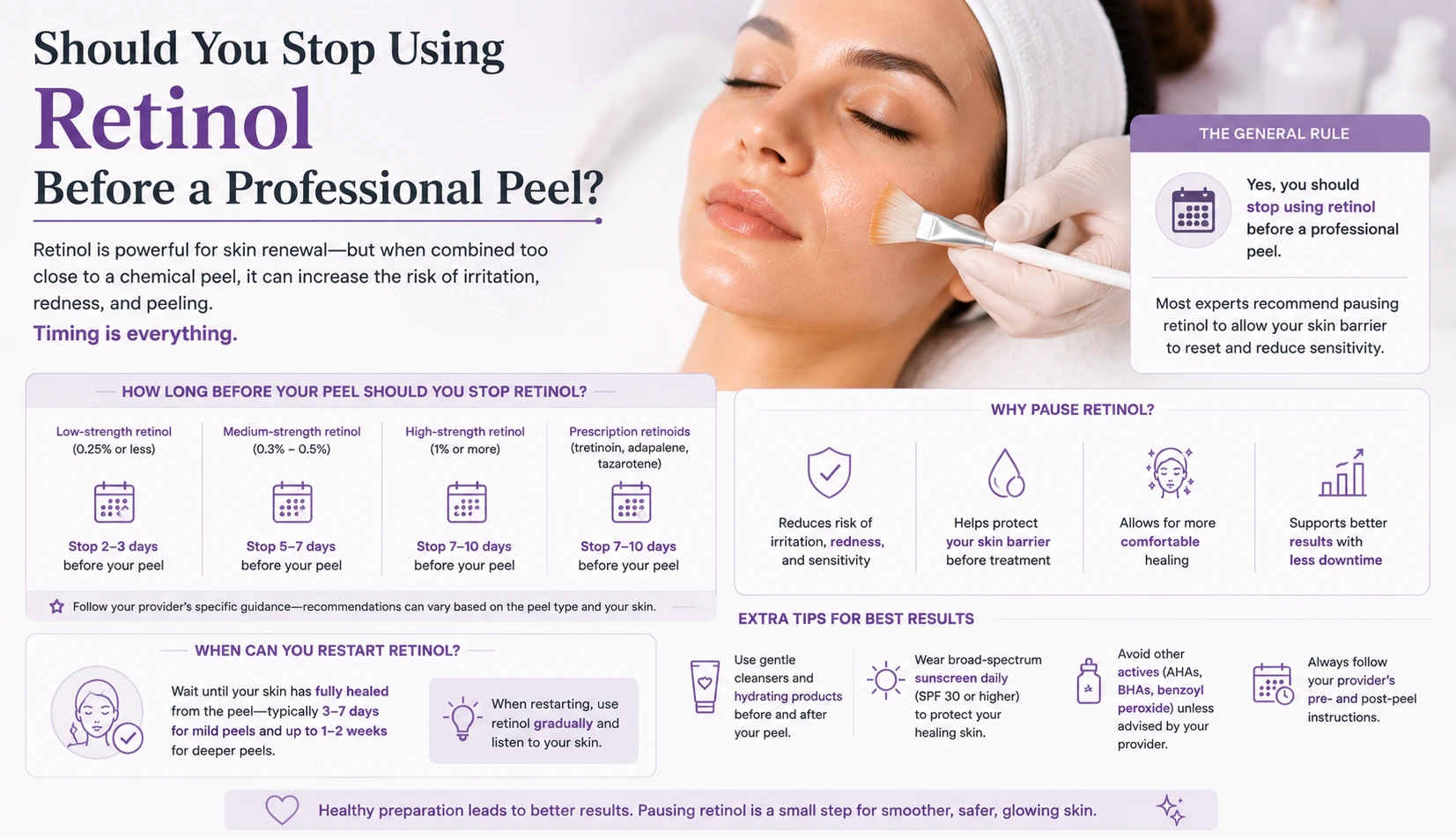
The length of the retinol pause before a professional session depends on the strength of the retinol being used and how recently it was applied. As a general clinical guideline, pausing retinol for five to seven days before a professional resurfacing session is appropriate for most clients using over-the-counter retinol formulations.
Clients using prescription-strength retinoids, such as tretinoin, should pause for a longer period, typically at least seven to ten days before a session, and this should be discussed with the prescribing clinician if the retinoid is being used for a medical indication. Prescription retinoids produce a significantly greater effect on stratum corneum thickness and skin sensitivity than over-the-counter retinol, and the required pause reflects this greater influence.
The practitioner should ask about retinol and retinoid use at every consultation and pre-session assessment. Clients who do not consider their retinol a relevant piece of information to disclose may not volunteer it, and the practitioner’s direct enquiry is the reliable way to ensure the session proceeds with accurate information about the skin’s current state.
How Long to Wait Before Reintroducing Retinol After a Session
After a Trexyne Peel session, retinol should not be reintroduced until the skin has fully settled from the treatment’s recovery phase. For most clients, this means waiting until any redness and superficial shedding has resolved, typically within seven to ten days of the session depending on the intensity level used within the tiered protocol.
Reintroduction should be gradual rather than an immediate return to the full pre-treatment frequency. Starting at a lower frequency than before the session, for example every third evening rather than every evening, and building back to the previous frequency only as the skin demonstrates it is fully recovered and tolerating the retinol well, protects against over-treating skin that has only just returned to a settled baseline.
This gradual reintroduction is particularly important for clients who use retinol at a relatively high frequency or strength, where returning to full use too quickly after a resurfacing session creates an overlap of recovery and retinol-induced sensitisation that can produce ongoing redness and irritation extending well beyond the expected recovery window.
How to Structure Retinol Use Between Sessions
Between professional sessions, retinol can be used in a way that complements rather than compromises the resurfacing course. The general principle is that retinol use during the inter-session period, at an appropriate frequency and paused again in the days before the next appointment, contributes to the overall cell turnover benefit being built by the professional sessions without creating the over-treatment risk that comes from using retinol right up to the day of treatment.
A practical framework for clients undergoing a Trexyne Peel course alongside retinol use might look like this: complete the professional session and its recovery window, reintroduce retinol gradually once the skin has settled, maintain retinol use at an appropriate frequency during the inter-session period, pause retinol again five to seven days before the next scheduled session, attend the session, and repeat the cycle.
This rhythm allows both the professional resurfacing and the retinol to contribute their respective benefits to the skin’s renewal without their timing creating a combined over-treatment effect. Clients who manage this cycle consistently typically see better sustained improvement across the course than those who either use retinol inconsistently or fail to pause it adequately before sessions.
Does Retinol Make the Trexyne Peel More Effective?
This is a question clients sometimes ask, reasoning that if both retinol and resurfacing accelerate cell turnover, using them together might produce faster results. The answer is nuanced. Retinol used consistently during the inter-session period does contribute to the overall cell turnover activity between professional sessions, which may support cumulative improvement in skin quality, texture, and pigmentation across a course.
However, the benefit of retinol in this context comes from its consistent use between sessions rather than from its presence in the skin at the time of the professional treatment. The professional session provides a more significant and directed cell turnover stimulus than retinol’s daily contribution. Retinol’s role is to maintain the skin’s renewal activity between sessions, not to amplify the treatment effect of the session itself.
The Trexyne Peel is effective in its own right without retinol use alongside it, and some clients may choose not to use retinol at all during a treatment course, either because their skin is sensitive to it or because the simplicity of a stripped-back routine during the course period suits them better. Both approaches can produce good results. The key is managing whatever routine the client is using in a way that does not compromise the professional sessions.
Retinol Strength and Its Relevance to Treatment Planning
Not all retinoids carry the same level of skin sensitisation, and the clinical guidance around pausing and reintroducing should reflect the strength being used. Over-the-counter retinol is converted in the skin through a multi-step process to the active form, retinoic acid, which means its activity level is lower than prescription formulations that deliver retinoic acid directly. The sensitisation produced by over-the-counter retinol, while real, is generally less profound than that produced by prescription tretinoin or other prescription retinoids.
Clients using adapalene, a retinoid available in both prescription and, in some markets, lower-strength over-the-counter formats, should discuss its management around professional sessions with their practitioner. Adapalene’s skin sensitisation profile differs somewhat from traditional retinol and tretinoin, and the appropriate pause period may vary.
Practitioners interested in how the Trexyne Peel integrates into broader skincare protocols including retinoid management can explore the full product range via the Trexyne shop, or contact the team directly through the Trexyne contact page.
What to Tell Clients About Managing Both
Clear, practical guidance given at the initial consultation and reinforced before each session is the most reliable way to ensure clients manage retinol and professional resurfacing appropriately across a course. Verbal guidance is less reliable than written guidance, particularly for clients who are managing a multi-step protocol over several months.
The most important points to communicate are the specific pause period required before each session, how to reintroduce retinol after the recovery window, the frequency of use that is appropriate during the inter-session period, and the importance of disclosing retinol and retinoid use at every assessment rather than assuming the practitioner already knows. Clients who have this information clearly and in writing are significantly more likely to manage their routine appropriately than those who receive it only verbally in the context of a busy appointment.
More information on the Trexyne approach to professional botanical resurfacing is available on the Trexyne website.
Conclusion
The Trexyne Peel can be used alongside retinol with appropriate management of timing across the treatment course. Retinol should be paused for five to seven days before each professional session and reintroduced gradually after the recovery window has passed, typically seven to ten days post-treatment. Between sessions, retinol use at an appropriate frequency can complement the cell turnover stimulated by the professional sessions. The critical clinical principle is avoiding the combination of retinol-sensitised skin and professional resurfacing at the same time, which can produce a stronger than expected response and a more difficult recovery. The Trexyne Peel is administered by trained practitioners who can advise on the specific management approach based on the individual’s skin condition, the retinoid strength being used, and the intensity selected within the tiered protocol. With appropriate timing, both retinol and professional resurfacing can contribute to a brighter, more even-looking complexion as complementary tools within a well-managed skin renewal programme.
FAQs
Q: Can I use retinol while having a course of Trexyne Peel treatments?
Yes, with appropriate timing management. Retinol should be paused five to seven days before each professional session and reintroduced gradually after the recovery window has passed. Between sessions, retinol can be used at an appropriate frequency to maintain the cell turnover benefit. The key is avoiding retinol-sensitised skin at the time of the professional treatment.
Q: How long before a Trexyne Peel should I stop using retinol?
For over-the-counter retinol formulations, pausing five to seven days before a session is appropriate. Prescription-strength retinoids such as tretinoin require a longer pause of at least seven to ten days. The practitioner should be informed of any retinoid use at every pre-session assessment, as this directly influences the appropriate intensity and approach for that session.
Q: When can I restart retinol after a Trexyne Peel session?
Retinol should not be reintroduced until the skin has fully settled from the recovery window, typically seven to ten days after a session depending on the intensity used. Reintroduction should be gradual, starting at a lower frequency than before the session and building back only as the skin demonstrates full recovery and tolerance.
Q: Does retinol make the Trexyne Peel work better?
Retinol used consistently during the inter-session period can contribute to ongoing cell turnover between professional sessions, which may support cumulative improvement across a course. However, the benefit comes from its consistent use between sessions rather than from its presence at the time of treatment. Retinol-sensitised skin at the time of a professional session increases risk rather than benefit.
Q: Can I use prescription tretinoin alongside the Trexyne Peel?
Prescription-strength retinoids including tretinoin produce greater skin sensitisation than over-the-counter retinol and require a longer pause period before professional sessions. Clients using tretinoin should discuss the management of their retinoid use around professional sessions with both their prescribing clinician and their aesthetic practitioner to ensure an appropriate and safe approach.
Q: Is it safe to use retinol at the same time as having professional resurfacing?
Used at the same time as a professional session, retinol can produce a stronger than expected response due to the thinned stratum corneum and increased skin sensitivity it creates. Managed correctly with an appropriate pause before each session and gradual reintroduction after recovery, the two can be combined safely across a treatment course. The risk lies in timing rather than in the combination itself.
Q: What should I do if I forget to pause retinol before a Trexyne Peel session?
Contact your practitioner before your appointment and let them know. The practitioner can then adjust the planned treatment intensity to account for the retinol-sensitised state of the skin, or advise whether deferring the session by a few days is more appropriate. Proceeding at a standard intensity without disclosing recent retinol use risks a more difficult recovery than expected.