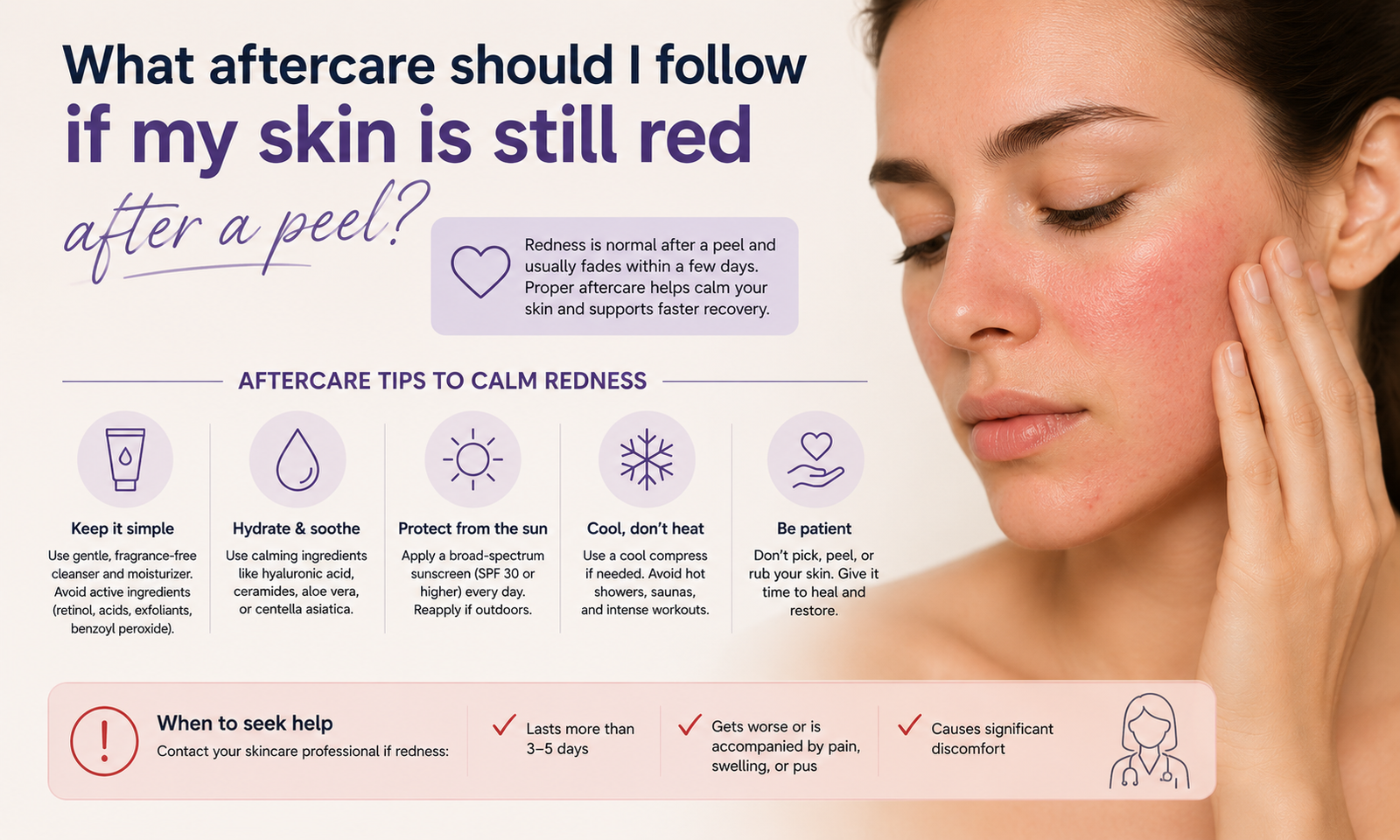
What Aftercare Should I Follow if My Skin Is Still Red After a Peel?
If your skin is still red after a peel, the priority shifts immediately from treatment to recovery. The steps you take in the days and weeks following a resurfacing session have a direct influence on how quickly redness settles, how well the skin barrier rebuilds, and whether the underlying concern the peel was meant to address actually improves. The core principles are consistent: strip back your routine, protect the barrier, apply SPF every day without exception, and avoid anything that restimulates inflammation while the skin is still reactive. For practitioners supporting clients through a difficult post-treatment period, and for clients themselves trying to manage prolonged redness at home, understanding the reasoning behind each step matters as much as the steps themselves. Choosing a gentler resurfacing approach next time, such as the Trexyne Peel, is also worth discussing once the skin has fully settled.
Why Post-Peel Redness Happens
Before addressing what to do, it helps to understand what is actually happening in the skin when post-peel redness persists. Resurfacing treatments work by disrupting the outermost layers of the skin to stimulate renewal. As part of this process, localised inflammation is generated. In most cases this settles within a few days as the skin moves through its repair cycle.
When redness extends beyond the first week, it generally means one of three things. The treatment intensity exceeded what the skin’s barrier could manage without a prolonged inflammatory response. Post-treatment care introduced additional irritants that kept the inflammatory cycle running. Or UV exposure during the recovery window triggered further skin reactivity before the barrier had fully recovered.
Understanding which of these applies to a specific situation informs what the aftercare priority should be, and it gives both the client and the practitioner a clearer picture of what to avoid going forward.
Step One: Simplify Everything
The most important immediate step when skin is still red after a peel is to remove complexity from the home-care routine entirely. This is not the time for actives, treatment serums, or products that promise accelerated results. Every additional ingredient the skin encounters during recovery is a potential irritant, and a skin that is already inflamed has significantly less tolerance for chemical stimulus than it would in a settled, healthy state.
A simplified recovery routine should include only the following:
- A gentle, fragrance-free cleanser that rinses away without stripping moisture
- A straightforward fragrance-free moisturiser that supports barrier hydration without heavy occlusives that can trap heat or provoke congestion
- A broad-spectrum SPF of at least factor 30, applied every morning and reapplied if outdoors
That is all. No vitamin C, no retinoids, no exfoliating acids, no toners with alcohol, no essential oils, no new products of any kind. The goal is to give the skin the calmest possible environment while it completes its repair cycle.
How Long to Maintain a Stripped-Back Routine
The length of time a simplified routine should be maintained depends on how the skin progresses. A useful marker is consistency: once redness has settled to a stable baseline for at least a week with no fluctuation, the skin is generally ready to reintroduce one product at a time. Reintroduce slowly, monitoring the skin’s response before adding anything further. Any product that triggers redness or stinging during this phase should be removed again immediately.
Step Two: SPF Is Non-Negotiable
UV exposure is one of the most common reasons post-peel redness is prolonged or worsens. Freshly resurfaced skin has a reduced barrier and an increased sensitivity to UV stimulus. Even on overcast days, UV radiation reaches the skin and can restimulate the inflammatory response that was beginning to settle.
Broad-spectrum SPF applied every morning is not optional during recovery. For clients who have been inconsistent with sun protection in the past, the post-peel period is the moment when the consequences of skipping SPF are most immediately visible. Redness that has nearly settled can be set back by a single day of unprotected outdoor exposure.
Physical SPF formulations, which sit on top of the skin rather than relying on a chemical reaction to absorb UV, are often better tolerated on reactive, post-treatment skin than chemical sunscreen formulations. The practitioner should specify this at aftercare briefing, particularly for clients with a history of sensitivity.
Step Three: Avoid Heat in All Forms
Heat is an underestimated trigger for prolonged post-peel redness. Blood vessels close to the skin surface dilate in response to warmth, which worsens visible flushing and can extend the period during which the skin looks and feels reactive. During the recovery period following a peel, clients should avoid:
- Hot showers or baths: use lukewarm water only when cleansing the face
- Saunas and steam rooms
- Intense cardiovascular exercise that significantly raises body temperature
- Direct sun exposure, even when wearing SPF
- Hot drinks held close to the face for extended periods
Some clients find that cold compresses applied briefly to the face help soothe visible redness in the short term. This can offer temporary comfort, but it does not address the underlying barrier disruption that needs to resolve for redness to settle permanently.
Step Four: Do Not Pick, Rub, or Over-Cleanse
Picking at peeling skin, rubbing the face vigorously to cleanse or dry it, or over-cleansing in an attempt to accelerate the process all disrupt the skin’s natural repair cycle and extend the period of visible redness. The skin sheds in its own time as part of the renewal process, and interfering with that sequence physically is one of the most reliable ways to produce uneven results and prolong recovery.
Clients who are accustomed to thorough cleansing routines may find it difficult to adjust to a gentler approach during recovery. Framing simplicity as active, intentional skin management rather than neglect helps maintain compliance. The skin is working hard to repair itself. Supporting that work means doing less, not more.
Step Five: Protect the Barrier With Appropriate Hydration
A compromised barrier loses moisture faster than healthy skin, and inadequate hydration slows the repair process. Keeping the skin appropriately moisturised during recovery without overloading it is a balance worth getting right. A simple, unfragranced moisturiser applied morning and evening provides the hydration the barrier needs to rebuild without introducing unnecessary ingredients that could provoke further reactivity.
Clients should avoid very thick, occlusive products if their skin is also congested or prone to breakouts, as these can trap heat and worsen both redness and comedone formation. A lighter barrier-supportive formulation applied consistently is more effective for most clients than a heavy cream applied occasionally.
When to Seek Professional Advice During Recovery
Most cases of post-peel redness will settle with appropriate aftercare management and do not require urgent attention. However, clients should be instructed to contact their practitioner promptly if they experience any of the following:
- Redness that worsens rather than plateauing or improving over time
- Swelling, blistering, or weeping in the treated area
- Significant pain or burning that does not correspond to visible skin disruption
- Any signs that could suggest an infection, such as increasing warmth, pus, or fever
These presentations are uncommon, but they require clinical assessment rather than home management. A practitioner who briefs clients clearly on what to look out for protects both the client’s outcome and the professional relationship.
Rethinking the Next Treatment After Prolonged Redness
Once the skin has fully settled and a follow-up consultation is booked, the occurrence of prolonged post-peel redness is a useful piece of clinical information. It tells the practitioner that the previous treatment, whether in terms of intensity, mechanism, or timing, exceeded what the skin could manage without a difficult recovery. That information should directly shape what happens next.
For clients whose skin reacted strongly to a chemical resurfacing treatment, a mechanical alternative may carry a meaningfully lower risk of the same outcome. The Trexyne Peel resurfaces through marine-algae spicules using a purely mechanical mechanism, with no acids involved at any stage. Because it does not generate a chemical reaction within the skin, the inflammatory burden on a recovering or reactive skin is reduced compared to acid-based options. Stabilised Vitamin E supports the skin’s recovery from the first application, actively working with the skin’s repair processes rather than leaving them to manage the aftermath alone.
Matching Intensity to the Skin’s Current Condition
Returning to resurfacing after a difficult recovery requires particular care around intensity. The Trexyne Peel‘s tiered protocol allows practitioners to begin at a conservative intensity and progress only as the skin demonstrates its tolerance. For a client whose skin has been through an extended recovery, this graduated approach is far more appropriate than restarting at the same intensity that provoked the previous reaction.
Practitioners interested in incorporating a botanical resurfacing treatment into their post-recovery protocols can view the full range via the Trexyne shop, or reach out to the team through the Trexyne contact page.
Setting Better Expectations Before the Next Peel
The post-recovery consultation is also the right moment to revisit client expectations. Clients who experience prolonged redness often come away from the episode with understandably reduced confidence in resurfacing treatments. Rebuilding that confidence requires transparency: explaining clearly what caused the reaction, what has changed in the planned approach, and what the realistic recovery profile looks like for the next treatment based on their specific skin type and history.
Written aftercare instructions sent to clients before their appointment, rather than verbally delivered afterwards, give clients time to prepare properly and reduce the likelihood of aftercare mistakes during the recovery window. Specific, practical guidance about SPF use, heat avoidance, and routine simplification is more useful than general advice to “take care of your skin.”
Further information on Trexyne’s approach to professional botanical resurfacing is available on the Trexyne website.
Conclusion
Prolonged redness after a skin peel calls for a focused, consistent aftercare response built around barrier support, daily SPF, heat avoidance, and a stripped-back routine free from active or potentially irritating ingredients. The skin’s ability to recover depends heavily on what happens in the days and weeks following treatment, and appropriate aftercare can meaningfully shorten the recovery timeline and reduce the risk of complications such as post-inflammatory pigmentation. For clients and practitioners reassessing the resurfacing approach after a difficult recovery, the Trexyne Peel offers a mechanical alternative that avoids the chemical inflammatory response associated with acid-based peels. With stabilised Vitamin E supporting the recovery phase and a tiered protocol that can be matched to the skin’s current condition, the Trexyne Peel may offer a more predictable and better-tolerated path to a brighter, more even-looking complexion for clients whose skin needs a gentler resurfacing approach going forward.
FAQs
Q: What should I do immediately if my skin is still red after a peel?
Simplify your routine to a gentle cleanser, an unfragranced moisturiser, and daily broad-spectrum SPF. Remove all actives, retinoids, and treatment products until the skin has fully settled. Avoid heat sources, vigorous rubbing, and any new products. If redness worsens rather than stabilising or improving, contact your practitioner.
Q: How long should post-peel redness last?
Mild redness for the first few days after a resurfacing treatment is expected. Redness that extends beyond one to two weeks, or that worsens rather than improving, is beyond the expected recovery window for most standard treatments and warrants a review of both the treatment and the aftercare being followed.
Q: Does SPF actually help with post-peel redness?
Yes. UV exposure on compromised post-peel skin can restimulate the inflammatory response that is causing the redness, extending the recovery period. Daily broad-spectrum SPF is one of the most effective aftercare steps for limiting further UV stimulus while the skin is healing. Physical SPF formulations are often better tolerated on reactive skin than chemical sunscreen options.
Q: Can I use active skincare products while my skin is still red after a peel?
No. Active skincare products including retinoids, vitamin C, acids, and exfoliating treatments should be paused until the skin has fully settled from its post-peel recovery. Introducing actives while the skin is still reactive risks prolonging the inflammatory response and worsening redness rather than resolving it.
Q: When is it safe to have another peel after post-peel redness?
It is important to allow the skin to return to a stable, settled baseline before considering further resurfacing. This can take several weeks depending on the severity of the initial reaction. A follow-up consultation should assess the skin’s current condition before any next steps are planned, and the approach for the subsequent treatment should reflect what the previous reaction indicated about the skin’s tolerance.
Q: Is the Trexyne Peel a better option for skin that has reacted badly to previous peels?
For skin that has experienced prolonged redness or a difficult recovery following acid-based resurfacing, a mechanical alternative may carry a lower risk of provoking the same response. The Trexyne Peel uses marine-algae spicules with no acids involved and includes stabilised Vitamin E to support recovery. Its tiered protocol allows intensity to be matched to the skin’s current condition, making it a more considered option for clients whose skin does not tolerate aggressive resurfacing well.
Q: What signs after a peel should prompt me to contact my practitioner?
Contact your practitioner promptly if you experience redness that is worsening rather than improving, swelling, blistering, weeping, significant pain, or any signs that could suggest infection such as increasing warmth or fever. Most post-peel recovery is straightforward, but these signs require clinical assessment rather than continued home management.