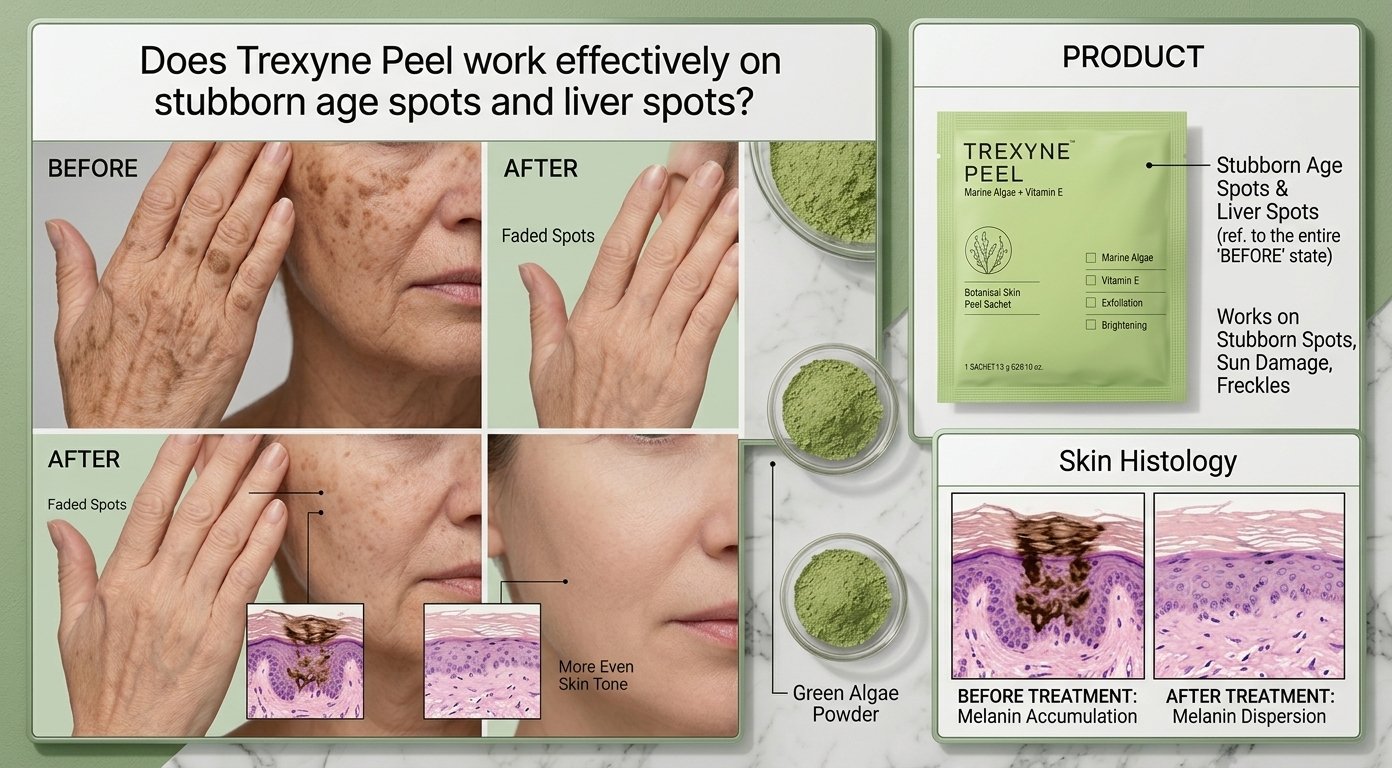
Does Trexyne Peel Work Effectively on Stubborn Age Spots and Liver Spots?
Age spots and liver spots are among the most common pigmentation concerns that practitioners encounter, and they are also among the most persistent. Unlike post-inflammatory hyperpigmentation, which often fades with time and appropriate care, UV-induced pigmentation that has accumulated over years tends to sit deeper in the skin and respond more slowly to treatment. The Trexyne Peel can form part of a considered professional protocol for this concern, supporting visible skin renewal through a mechanical resurfacing mechanism that encourages cell turnover without relying on acid-based exfoliation. For practitioners looking for a more predictable, better-tolerated route to addressing age spots, particularly in clients whose skin does not respond well to aggressive chemical options, this distinction matters considerably.
What Age Spots and Liver Spots Actually Are
The terms age spots and liver spots are often used interchangeably, and both refer to the same thing: areas of concentrated melanin that develop primarily from cumulative UV exposure over years and decades. Despite the name, they have no connection to liver function. The term arose historically from a mistaken association, and it has persisted in common use.
Clinically, these spots are known as solar lentigines. They develop when melanocytes in a specific area have been repeatedly stimulated by UV radiation over time, eventually producing a localised deposit of melanin that becomes visible as a defined, flat spot. They most commonly appear on the face, the backs of the hands, the forearms, and the décolleté, all areas with high cumulative sun exposure over a lifetime.
Unlike freckles, which are genetically determined and often fade in winter, solar lentigines tend to be stable or to gradually deepen with continued UV exposure. They do not fade on their own without intervention, and they are more resistant to treatment than many other forms of hyperpigmentation because the melanin is often distributed through multiple layers of the epidermis rather than sitting close to the surface.
Why Age Spots Are Particularly Resistant to Treatment
The depth and density of pigment in established solar lentigines is the main reason they can be so stubborn. Surface-level interventions that address only the outermost layers of the skin may produce some initial lightening, but the deeper pigment remains and the spot tends to return to its original appearance within weeks.
Effective treatment of age spots requires consistent, sustained cell turnover that gradually brings the deeper pigment to the surface and supports the skin’s renewal process over a course of sessions. This is not a one-session correction. It is a progressive process that works incrementally with each treatment to shift the accumulated pigmentation upward and outward as new skin cells replace the pigmented ones.
This is why a single resurfacing session, regardless of the treatment type, rarely produces dramatic or lasting results on established age spots. The realistic pathway to visible improvement is a planned course of treatments, supported by consistent SPF use to prevent further UV stimulus between sessions.
Who Typically Presents With This Concern
Clients presenting with age spots tend to be in their forties, fifties, and beyond, though practitioners working with clients who have had significant sun exposure throughout their lives will encounter them earlier. Skin types with lower natural melanin levels, particularly Fitzpatrick types I and II, are generally more susceptible to developing solar lentigines than darker skin types, though they can occur across the full Fitzpatrick scale.
These clients often have skin that has changed considerably over time. Reduced collagen density, slower cell turnover, and a less robust barrier than younger skin all contribute to a skin profile that needs treatment options calibrated with care. Aggressive resurfacing on ageing skin carries a higher risk of barrier disruption and uneven results. A controlled, adjustable protocol suits this client group better than a fixed high-intensity approach.
Realistic Expectations From the Outset
Setting honest expectations before treatment begins is particularly important for clients presenting with established age spots. These clients often carry significant frustration from previous attempts to address the concern, whether through topical products that produced minimal results or treatments that delivered short-lived improvement followed by recurrence.
Explaining clearly that visible improvement builds across a course of sessions, that consistent SPF use is non-negotiable to prevent new stimulus, and that depth of pigmentation directly influences how many sessions will be needed goes a long way towards building trust and securing the kind of long-term treatment commitment that produces meaningful results.
How the Trexyne Peel Approaches Age Spot Treatment
The Trexyne Peel resurfaces through a mechanical mechanism using marine-algae spicules that create controlled micro-channels in the skin’s surface. This stimulates the skin’s natural renewal process, accelerating cell turnover and supporting the gradual displacement of pigmented cells with fresh, unpigmented ones.
Because the mechanism is purely physical rather than chemical, the treatment does not rely on a chemical reaction that can be difficult to control uniformly across a treatment area. The practitioner’s technique and the tiered protocol determine the intensity of the resurfacing, which gives considerably more flexibility when working on ageing skin that may have variable thickness, texture, or barrier integrity across different areas of the face.
For solar lentigines specifically, the key clinical benefit of mechanical resurfacing is the ability to support consistent, progressive cell turnover without generating the inflammatory stimulus that can complicate treatment on skin that is already photodamaged and more reactive than younger skin.
The Role of Vitamin E in Supporting Ageing Skin Through Treatment
Ageing skin typically has a reduced capacity for rapid recovery compared to younger skin. The renewal processes that younger skin completes efficiently take longer and require more support as the skin ages. For clients with established solar lentigines, this means the recovery phase between treatment sessions matters as much as the treatment itself.
The Trexyne Peel includes stabilised tocopherol, a form of Vitamin E, which supports the skin’s recovery phase from the first application. In the context of treating age spots on ageing skin, this recovery-supportive ingredient profile is a clinically relevant feature of the formulation. It works with the skin’s own repair processes rather than leaving a compromised barrier to manage recovery unaided, which can reduce the risk of prolonged sensitivity or uneven healing between sessions.
Building a Treatment Course for Stubborn Pigmentation
Solar lentigines that have been present for years will rarely respond to two or three sessions. A realistic treatment course for established age spots typically involves a sustained series of sessions, with assessment between each to monitor progress and adjust intensity as the skin’s response develops.
The tiered protocol within the Trexyne Peel framework allows practitioners to begin at an appropriate intensity based on the client’s current skin condition and to increase incrementally as the skin demonstrates its tolerance and as the treatment area responds. This incremental approach tends to produce more reliable results on stubborn pigmentation than committing to a single intensity level throughout the course.
It also allows for variation between different areas of the face. Photodamaged skin often presents unevenly, with some areas more compromised than others. A protocol that can be adjusted area by area within a single session is a practical advantage when treating clients with complex or widespread age spots.
The Importance of Treatment Spacing
Treatment spacing within a course also influences outcomes. Allowing sufficient time between sessions for the skin to complete its renewal cycle before the next resurfacing stimulus is applied tends to produce more progressive and visible results than high-frequency treatments that do not give the skin time to respond and recover. The practitioner’s assessment of the skin at each appointment is the most reliable guide to appropriate spacing, and the Trexyne Peel’s adjustable protocol supports this case-by-case judgement.
What Clients Need to Do Between Sessions
Home care between professional sessions plays a direct role in how well age spots respond over a treatment course. For this client group, the key commitments are straightforward but require consistent follow-through.
Daily broad-spectrum SPF use is the most critical. UV exposure between sessions actively restimulates the melanocytes in the treated areas, which can slow visible progress or counteract the cell turnover the professional treatment is working to support. For clients with solar lentigines on the hands or forearms as well as the face, SPF protection needs to cover those areas too.
A simple, barrier-supportive home-care routine that does not overload ageing skin with competing active ingredients supports recovery between sessions. Clients should also avoid picking at any superficial flaking in the days after treatment, as this can disrupt the orderly shedding process and potentially cause uneven results.
Practitioners looking to incorporate a professional botanical peel into an age spot treatment protocol can explore the full range via the Trexyne shop, or speak with the team directly through the Trexyne contact page.
Positioning Trexyne Peel Within a Broader Age Spot Strategy
Professional resurfacing is most effective when it forms part of a broader clinical strategy rather than a standalone intervention. For clients with age spots, this typically means combining the Trexyne Peel treatment course with thorough photoprotection guidance, appropriate home care, and a realistic long-term maintenance plan to protect results once the initial course is complete.
Maintenance sessions at extended intervals following the main treatment course can help sustain the improvement achieved, particularly for clients who continue to spend time outdoors. This longer-term view of the client relationship, rather than a one-off treatment event, is what produces the most visible and lasting results for stubborn, accumulated pigmentation.
The Trexyne Peel is sold exclusively to verified practitioners and clinics, which means it is always used within a professional clinical context. Practitioners can find more information on the brand and the treatment approach through the Trexyne website.
When to Refer On
While solar lentigines are benign and do not require medical treatment, practitioners should maintain the habit of assessing any pigmented lesion carefully at consultation. Any spot that does not fit the expected appearance of a solar lentigo, that has irregular borders, variable colour within a single lesion, has changed in size or character recently, or that the client reports as itching or bleeding should be referred for dermatological assessment before any resurfacing treatment is considered. Clinical diligence at this stage protects both the client and the practitioner, and it is a basic component of responsible aesthetic practice.
Conclusion
Age spots and liver spots are the result of cumulative UV exposure that has repeatedly stimulated melanocytes in specific areas of the skin over years, producing stable, defined deposits of pigment that do not resolve without professional intervention. Their resistance to treatment stems from the depth and density of accumulated melanin, which requires consistent, progressive cell turnover across a sustained course of sessions rather than a single high-intensity approach. The Trexyne Peel resurfaces through marine-algae spicules with a purely mechanical mechanism, offers recovery support through stabilised Vitamin E, and gives practitioners the flexibility of a tiered protocol suited to the variable skin conditions that come with age-related photodamage. Used consistently alongside daily SPF and appropriate home care, it may support a gradual and visible improvement towards a brighter, more even-looking complexion for clients managing stubborn solar pigmentation.
FAQs
Q: Can the Trexyne Peel effectively treat stubborn age spots on the face? The Trexyne Peel supports skin renewal through a mechanical resurfacing mechanism that encourages progressive cell turnover, which can help address the accumulated pigmentation associated with solar lentigines over a course of professional treatments. Because it resurfaces without acids, it is well suited to the more variable skin conditions often seen in clients with age-related photodamage.
Q: How many Trexyne Peel sessions are needed for age spots? Established age spots typically require a sustained course of sessions rather than a single treatment, because the melanin is often distributed through multiple layers of the epidermis. The number of sessions depends on the depth and density of the pigmentation, the individual’s skin response, and how consistently aftercare including daily SPF is maintained between appointments.
Q: Why do age spots come back after treatment? Age spots can recur after treatment if UV exposure continues to stimulate melanocytes in the treated areas between sessions or after a treatment course is complete. Consistent daily broad-spectrum SPF use is essential both during and after a treatment course to prevent further UV stimulus and protect the improvement achieved.
Q: Is the Trexyne Peel suitable for older skin that is more sensitive? The Trexyne Peel uses a mechanical resurfacing mechanism with no acids involved and includes stabilised Vitamin E to support recovery. Its tiered protocol allows the practitioner to match intensity to the individual skin’s condition, which makes it a considered option for ageing skin that may be more reactive or variable in its barrier function than younger skin.
Q: What is the difference between an age spot and a freckle? Freckles are genetically determined, tend to be smaller and paler, and often fade during winter months when UV stimulus is lower. Age spots, or solar lentigines, develop from cumulative UV exposure over time, tend to be more defined and stable, and do not fade without professional intervention. Both involve melanin concentration but they have different causes and different responses to treatment.
Q: Can I use the Trexyne Peel at home for age spots? No. The Trexyne Peel is a professional treatment sold exclusively to verified practitioners and clinics. It is designed for use by trained aesthetic professionals who can assess skin suitability, select the appropriate protocol intensity, and provide clinical oversight throughout the treatment course.
Q: Where can practitioners find out more about using the Trexyne Peel for age spot treatment? Practitioners can explore the full product range and purchase options through the Trexyne shop, or contact the team directly via the Trexyne contact page for further information on incorporating the treatment into an age spot or solar pigmentation protocol.