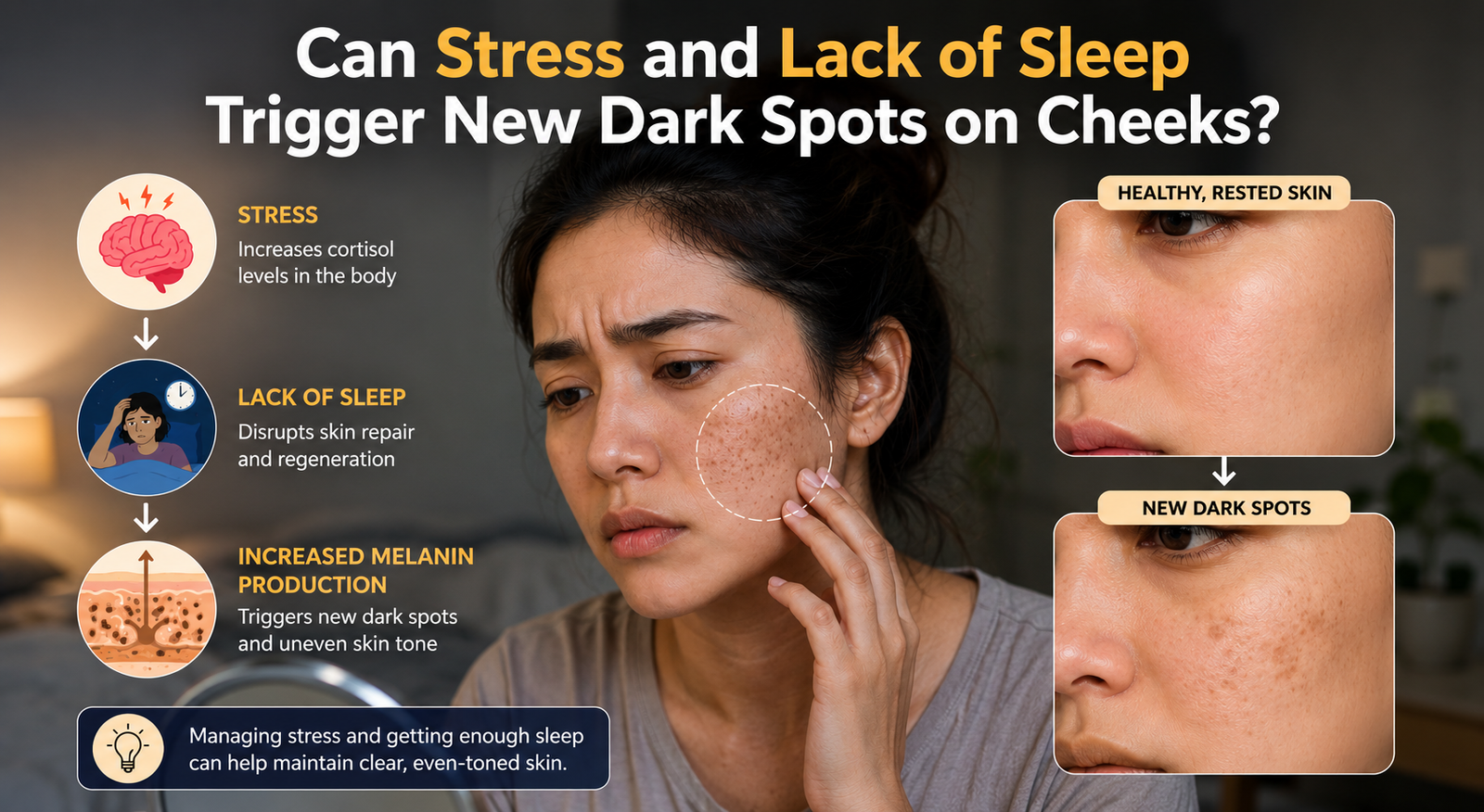
Can Stress and Lack of Sleep Trigger New Dark Spots on Cheeks?
Yes, both chronic stress and poor sleep can contribute to the development of new dark spots, particularly on the cheeks. The connection is not always obvious because it does not involve direct sun exposure or a visible skin injury. Instead, it works through a series of internal physiological changes that elevate inflammation, disrupt the skin barrier, and heighten melanocyte activity over time. Clients who notice dark patches appearing during periods of high stress or sustained sleep deprivation are not imagining the link. The skin is responding to the same hormonal and inflammatory signals that stress generates throughout the body. Understanding why this happens helps practitioners tailor treatment protocols appropriately, and options such as the Trexyne Peel can form part of a considered clinical response once the underlying triggers are managed.
How Stress Affects the Skin at a Physiological Level
Stress activates the hypothalamic-pituitary-adrenal axis, prompting the adrenal glands to release cortisol. In short bursts, cortisol is useful. It sharpens alertness and manages the immediate demands of a perceived threat. The problem arises when stress becomes chronic and cortisol levels remain persistently elevated. At that point, the effects on the skin become tangible and cumulative.
Raised cortisol disrupts the skin barrier by reducing the production of ceramides and other lipids that maintain the integrity of the stratum corneum. A compromised barrier loses moisture faster, becomes more reactive to environmental triggers, and struggles to manage the inflammatory signals it encounters on a daily basis. For pigmentation-prone skin, this compromised state lowers the threshold at which melanocytes respond to stimulus.
Cortisol also stimulates the production of pro-inflammatory cytokines, which are signalling molecules that can directly influence melanocyte behaviour. Inflammation and pigmentation are closely linked in the skin. When inflammatory activity rises, the risk of uneven melanin production rises with it.
The Role of Cortisol in Melanin Overproduction
There is a direct hormonal link between elevated cortisol and melanocyte-stimulating activity that is worth understanding in clinical terms. The precursor molecule to cortisol, proopiomelanocortin, also gives rise to melanocyte-stimulating hormone. When chronic stress keeps the adrenal system working hard, the entire pathway stays active, and melanocyte-stimulating hormone can rise alongside cortisol.
This means that periods of prolonged stress are not just damaging to the barrier and inflammatory regulation of the skin. They can actively prompt melanocytes to produce more pigment, even in the absence of UV exposure as a direct trigger. For clients who are already predisposed to hyperpigmentation, whether through skin type, hormonal history, or previous pigmentation concerns, this hormonal route can be enough to generate new dark spots on the cheeks and across the central face.
Why the Cheeks Are Particularly Affected
The cheeks are one of the most common sites for stress-related pigmentation, and this is not coincidental. The central face, including the cheeks, forehead, and upper lip, is the area most associated with hormonal pigmentation patterns such as melasma. It is also the area with the highest density of melanocytes in some individuals, making it more reactive to internal hormonal signals. When stress hormones elevate melanocyte activity, the cheeks are frequently where that activity first becomes visible.
What Poor Sleep Does to the Skin
Sleep deprivation compounds the effects of stress on the skin, and in many cases the two go hand in hand. During sleep, the body carries out a significant proportion of its repair and renewal activity. Cellular regeneration, immune regulation, and the correction of oxidative damage all occur primarily during rest. When sleep is consistently poor or insufficient, these processes are disrupted and the cumulative damage accumulates faster than the skin can address it.
Sleep deprivation also raises cortisol levels independently of stress, creating a second hormonal route to elevated melanocyte activity. It impairs barrier function through reduced synthesis of the proteins and lipids the skin needs for structural integrity. And it increases systemic oxidative stress, which can trigger localised inflammatory responses in the skin that further raise the risk of post-inflammatory pigmentation.
For clients managing both high stress and poor sleep simultaneously, the combined effect on pigmentation can be more pronounced than either factor alone would produce.
Inflammation as the Common Thread
Whether the trigger is stress, poor sleep, or a combination of both, inflammation is the shared mechanism that connects these factors to dark spot development. Post-inflammatory hyperpigmentation occurs when the skin’s melanocytes respond to an inflammatory event by overproducing melanin in the affected area. That inflammatory event does not have to be a visible injury or a chemical reaction on the skin surface. It can be driven entirely by internal signals.
This is why lifestyle-related pigmentation can be puzzling for clients who cannot identify a specific cause. They are not noticing the inflammation because it is not presenting as obvious redness or irritation in many cases. It is operating at a low, chronic level that gradually shifts the skin’s behaviour over weeks and months.
Understanding this helps practitioners explain why a purely topical approach may not fully address the concern unless the lifestyle factors driving internal inflammation are also addressed alongside professional treatment.
Why These Clients Need a Different Treatment Approach
Clients presenting with pigmentation linked to chronic stress or sleep deprivation often have skin that is simultaneously dull, reactive, and prone to sensitivity. Their barrier is typically compromised to some degree, and their inflammatory baseline is higher than average. This skin profile calls for a resurfacing approach that can support renewal and address pigmentation without adding to the inflammatory load that is already driving the problem.
This is where the mechanism of the resurfacing treatment matters significantly. The Trexyne Peel resurfaces through marine-algae spicules that create controlled micro-channels in the skin through a purely mechanical process. No acids are involved at any stage. Because the treatment does not generate a chemical inflammatory response, it places less demand on a barrier that is already under strain. Stabilised tocopherol, the form of Vitamin E included in the formulation, actively supports the skin’s recovery phase from the first application, providing the recovery support that a compromised, stress-affected skin particularly benefits from.
Matching Treatment Intensity to the Client’s Skin Condition
For clients whose pigmentation is linked to stress and lifestyle factors, the skin’s condition at the point of treatment may vary considerably between appointments. A client who has had a period of better sleep and lower stress may present with a more resilient skin than the same client following a difficult few weeks. A tiered protocol that allows treatment intensity to be matched to the skin’s current condition, rather than applying a fixed intervention regardless of how the skin presents on the day, is a more responsive and appropriate approach.
The Trexyne Peel’s tiered protocol gives practitioners exactly this flexibility. Beginning at a conservative intensity with clients whose skin is clearly reactive or compromised, and progressing as the skin’s tolerance and condition improve, produces more reliable outcomes than committing to a single intensity level from the outset. It also reduces the risk of triggering a post-inflammatory response in skin that is already operating with a raised inflammatory baseline.
Timing Treatment Around the Client’s Lifestyle
It is worth discussing timing openly with clients who are managing significant stress or sleep disruption. Beginning a resurfacing course during a period of acute stress, when cortisol is at its highest and the skin is most reactive, may not produce the best results. Helping the client understand the connection between their internal condition and their skin’s behaviour empowers them to participate in their own outcome, rather than leaving them frustrated when results are slower than expected during difficult periods.
Home Care That Supports the Treatment Course
Between professional sessions, the right home-care routine plays a meaningful role in managing pigmentation that is driven by lifestyle factors. Clients with stress-related dark spots benefit from a simplified, barrier-supportive routine that reduces external irritation and maintains adequate hydration without overloading compromised skin with active ingredients it may not currently tolerate.
Daily broad-spectrum SPF use is non-negotiable. Even when UV exposure is not the primary trigger for a client’s pigmentation, UV light remains a significant amplifier of melanocyte activity. Without consistent SPF, professional treatment results are more vulnerable to being undermined by incidental sun exposure.
Practitioners interested in incorporating a botanical resurfacing treatment into their protocols for this client group can explore the full range through the Trexyne shop, or speak to the team directly via the Trexyne contact page.
Addressing the Lifestyle Conversation in the Clinic
Practitioners are not lifestyle coaches, and it is not appropriate to overreach into areas outside clinical expertise. However, explaining the physiological link between stress, sleep, and pigmentation in plain, accessible terms is a legitimate and useful part of client education. Clients who understand that their internal state has a direct effect on their skin’s behaviour are better equipped to make informed choices about both their treatment plan and their daily habits.
This conversation also helps set realistic expectations. Clients managing chronic stress or persistent sleep deprivation may find that their pigmentation responds more slowly or less predictably than clients without these factors. Framing this as a physiological reality rather than a treatment limitation protects the practitioner-client relationship and encourages a longer-term view of progress.
More information on Trexyne’s approach to professional botanical resurfacing is available on the Trexyne website.
When Pigmentation Needs Further Investigation
Most stress and sleep-related dark spots on the cheeks are benign, represent a predictable skin response to internal disruption, and can be addressed through the combination of lifestyle management, appropriate home care, and professional resurfacing. However, practitioners should maintain a habit of assessing any pigmentation concern carefully at consultation.
If a client presents with pigmentation that is rapidly changing in size, shape, or colour, sits alongside other unexplained skin changes, or does not fit the pattern expected of post-inflammatory or hormonally driven hyperpigmentation, onward referral to a dermatologist is the appropriate course. This level of clinical diligence is not overly cautious. It is basic good practice that protects clients and reinforces the credibility of the practitioner.
Conclusion
Chronic stress and poor sleep can both trigger new dark spots on the cheeks through shared physiological pathways: elevated cortisol and melanocyte-stimulating hormone, a compromised skin barrier, and a raised inflammatory baseline that prompts melanocytes to overproduce pigment without any obvious external trigger. Clients presenting with this pattern often have reactive, barrier-compromised skin that needs a resurfacing approach calibrated to their condition rather than a fixed, aggressive intervention. The Trexyne Peel resurfaces through marine-algae spicules with no acids involved, includes stabilised Vitamin E to support the recovery phase, and offers a tiered protocol that allows intensity to be matched to the skin’s current state. For clients navigating stress-related pigmentation, this combination may support a gradual return to a brighter, more even-looking complexion when used alongside appropriate lifestyle measures and consistent daily SPF.
FAQs
Q: Can stress really cause dark spots on the cheeks? Yes. Chronic stress elevates cortisol and melanocyte-stimulating hormone, both of which can increase melanin production in the skin. Combined with the barrier disruption and inflammation that prolonged stress causes, this can lead to new dark spots developing, particularly on the cheeks and central face, even without significant UV exposure as a direct trigger.
Q: Why do I get dark patches on my face when I am not sleeping well? Sleep deprivation raises cortisol independently, impairs the skin’s barrier repair processes, and increases systemic oxidative stress. All three of these effects can raise melanocyte activity and increase the risk of uneven pigmentation developing over time, particularly on areas of the face that are already prone to hyperpigmentation.
Q: Will dark spots caused by stress fade on their own? Stress-related dark spots can fade as the skin’s inflammatory baseline reduces, particularly with improved sleep, better stress management, and consistent SPF use. However, established patches often benefit from professional treatment to support more visible and sustained improvement. The rate of fading depends on the depth of the pigmentation and how consistently aftercare is maintained.
Q: What is the best professional treatment for stress-related dark spots? For skin that is already reactive and barrier-compromised from chronic stress, a resurfacing treatment that does not add further inflammatory stimulus tends to suit this client group better. The Trexyne Peel uses a mechanical resurfacing mechanism with marine-algae spicules and no acids, and includes stabilised Vitamin E to support recovery. Its tiered protocol allows intensity to be adjusted based on how the skin presents at each appointment.
Q: Does SPF help with dark spots caused by stress? Daily SPF use does not address the internal hormonal triggers of stress-related pigmentation, but it does prevent UV exposure from amplifying the problem. UV light significantly stimulates melanocyte activity, so even when stress is the primary driver, consistent sun protection helps limit how much further pigmentation develops between professional treatment sessions.
Q: Can I have the Trexyne Peel if my skin is reactive from stress? The Trexyne Peel is a professional treatment assessed and administered by trained practitioners, who will evaluate the skin’s condition at each appointment before proceeding. The tiered protocol allows intensity to be reduced when the skin is presenting as more reactive, making it possible to continue a treatment course even during more demanding periods, subject to the practitioner’s clinical judgement.
Q: How long does it take to see results from treating stress-related dark spots with the Trexyne Peel? Visible improvement typically builds across a course of treatments rather than appearing after a single session. Clients managing ongoing stress or sleep disruption may find progress is more gradual, since the internal triggers remain partially active. Consistent treatment combined with daily SPF and appropriate lifestyle measures is associated with the most reliable outcomes over time.