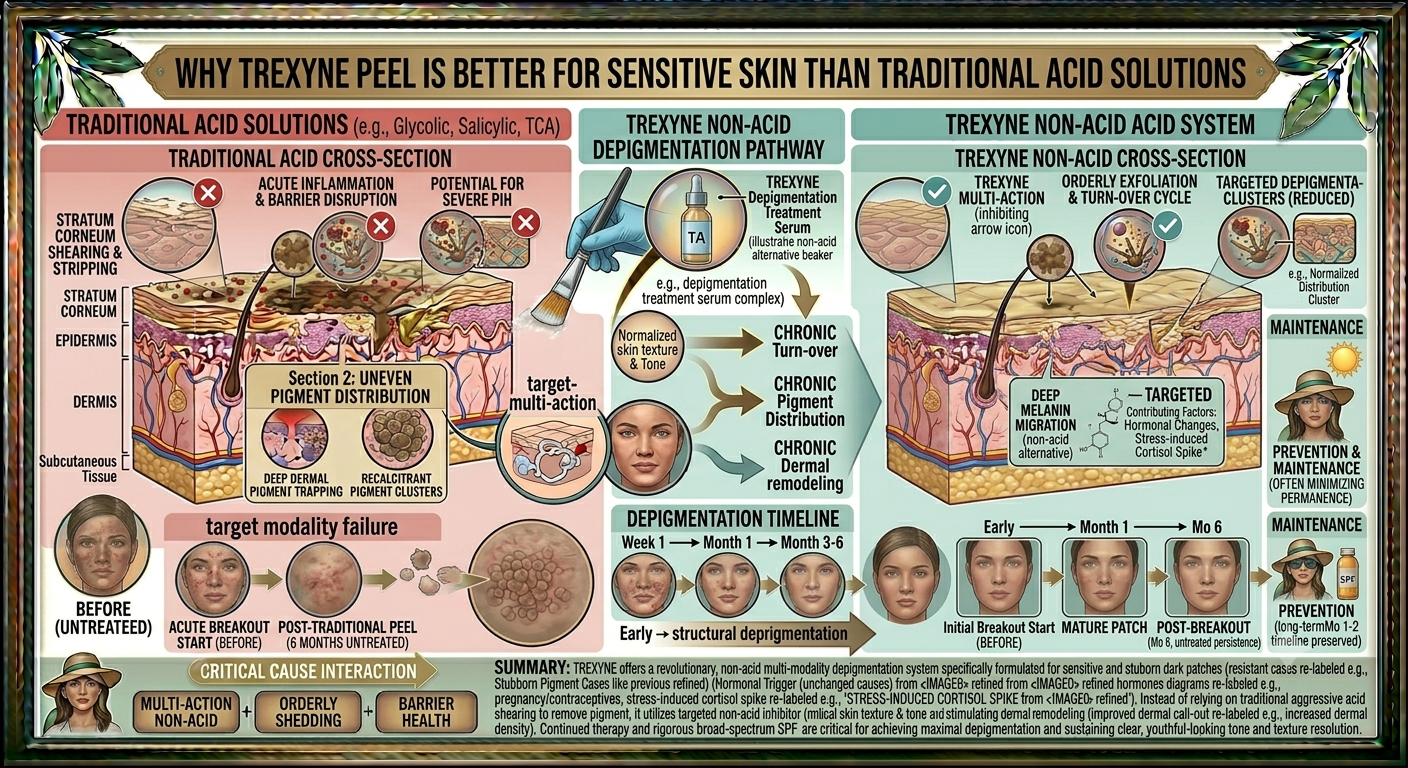
Why Is Trexyne Peel Better for Sensitive Skin Than Traditional Acid Solutions?
Sensitive skin and resurfacing treatments have a complicated relationship. The skin needs regular cell turnover support to maintain clarity and an even tone, but many of the most widely used resurfacing options rely on chemical exfoliants that reactive skin simply does not tolerate well. Redness, prolonged recovery, and post-inflammatory pigmentation are common outcomes when aggressive treatments are applied to sensitised skin. The Trexyne Peel takes a fundamentally different approach. By resurfacing through a mechanical mechanism rather than a chemical one, it offers practitioners a route to meaningful skin renewal without triggering the inflammatory responses that make acid-based options so difficult to manage on reactive skin. For the right client, that distinction changes the entire treatment equation.
The Core Problem With Acid-Based Resurfacing on Sensitive Skin
Acid-based resurfacing treatments work by dissolving the bonds between dead skin cells, prompting the outer layers to shed and stimulating renewal beneath. This is effective for many skin types, but it introduces an unavoidable chemical reaction that generates a degree of inflammation as part of the process. For skin with strong barrier function and good resilience, this inflammation is temporary and manageable. For sensitive skin, the story is different.
Reactive skin already operates with a lower threshold for irritation. Its barrier function is often compromised to some degree, which means it struggles to contain the inflammatory response triggered by chemical exfoliation. The result can be redness that outlasts the expected recovery window, sensitivity that intensifies rather than settles, and in susceptible skin types, post-inflammatory hyperpigmentation that leaves the client worse off than before treatment.
This is not a failure of individual products. It reflects a genuine mismatch between the mechanism of chemical resurfacing and the physiological characteristics of sensitised skin.
What Makes Skin Sensitive in the First Place
Understanding sensitivity in clinical terms helps explain why the mechanism of resurfacing matters so much. Sensitive skin is generally characterised by a weakened or disrupted skin barrier, a heightened immune response to environmental and chemical triggers, and a tendency for blood vessels close to the skin surface to dilate easily in response to stimulus.
The causes are varied. Some clients have a genetic predisposition to skin reactivity. Others have sensitised their skin over time through over-exfoliation, prolonged use of potent active ingredients, or a history of skin conditions such as rosacea or eczema. Sun damage, stress, and environmental pollution can all contribute to a state of chronic low-level inflammation that lowers the skin’s tolerance threshold further.
What this means in practice is that the same treatment applied to two clients can produce very different outcomes depending on the state of their barrier and their baseline inflammatory load. A treatment that sails through on one client may produce a prolonged inflammatory response on another.
Why the Inflammatory Response Matters
Inflammation is not just an inconvenience that makes skin look red for a few days. In sensitive and darker skin types, it is the direct trigger for the melanin overproduction that causes post-inflammatory hyperpigmentation. A treatment that lowers the inflammatory burden during resurfacing is therefore not just more comfortable for the client. It can also meaningfully reduce the risk of a complication that is far harder to manage than the original concern the client came in with.
The Mechanical Difference
The Trexyne Peel does not rely on any form of chemical exfoliation. Its active mechanism centres on marine-algae spicules, naturally occurring microscopic structures that create controlled micro-channels in the skin’s surface through a purely physical interaction. No acids are involved at any stage. There is no dissolving of cellular bonds, no chemical reaction taking place within the skin, and no associated chemical inflammatory response for the skin to manage.
This is a meaningful distinction, not a marginal one. The skin still undergoes resurfacing. Cell turnover is still stimulated. But the trigger for that renewal is mechanical rather than chemical, which removes one of the primary sources of irritation that makes traditional acid solutions so problematic for sensitive skin.
Vitamin E and the Recovery Phase
Resurfacing, even when done gently, places a temporary demand on the skin. The outer layers are being disrupted and the skin needs to repair and renew the affected tissue. On sensitive skin, this recovery phase is where many of the problems with acid-based treatments become visible. Barrier disruption during recovery can lead to transepidermal water loss, increased reactivity, and the kind of prolonged redness that undermines the client’s confidence in the treatment.
The Trexyne Peel includes stabilised tocopherol, a form of Vitamin E, which supports the skin’s recovery phase from the first application. By actively supporting repair rather than simply leaving the skin to manage recovery unaided, this recovery-supportive ingredient profile works with the skin’s natural processes rather than placing additional demands on them. For sensitive skin clients, this is a clinically relevant feature of the formulation, not a cosmetic addition.
A Tiered Protocol Built Around Predictability
One of the most useful aspects of the Trexyne Peel for sensitive skin is the tiered protocol that allows practitioners to match intensity to the individual client’s skin type and condition. This is not a one-size-fits-all treatment. The practitioner selects the appropriate level of intervention based on a thorough assessment, and that level can be adjusted across a treatment course as the skin’s response is monitored.
For sensitive skin clients, this means starting conservatively, observing how the skin responds, and progressing only when the skin has demonstrated its tolerance. It is an approach that would simply not be possible with a fixed-strength chemical solution, where the depth of the reaction is determined by the chemistry of the product rather than the judgement of the practitioner.
Why Predictable Downtime Changes the Client Conversation
Clients with sensitive skin are often reluctant to commit to resurfacing because they have had previous experiences of unpredictable reactions. They have seen what an unexpected inflammatory response looks like, and they are understandably cautious about repeating the experience. A treatment protocol with predictable downtime, matched to their specific skin type, changes that conversation significantly.
When a practitioner can explain in concrete terms what the client is likely to experience, how long recovery will take, and what the aftercare involves, clients are more likely to commit to a full treatment course. Consistency across a course of treatments is ultimately what produces visible, lasting results. Predictability is not just a comfort factor. It is a clinical outcome driver.
The Consultation Advantage for Sensitive Skin
Clients who present with sensitive skin often have a detailed history of reactions to previous treatments and products. This history is valuable clinical information, and the Trexyne Peel protocol gives practitioners the flexibility to act on it properly. Where a chemical resurfacing treatment offers relatively limited room to adjust the approach based on individual history, a tiered mechanical treatment can be shaped around what the practitioner knows about that client’s skin from the start.
This matters particularly for clients who have developed sensitisation through previous over-treatment. These clients need a practitioner who can offer something genuinely different, backed by a clear explanation of why the mechanism is better suited to their skin.
Practitioners looking to incorporate a professional botanical peel into their sensitive skin protocol can view the full product range via the Trexyne shop, or reach out to the team directly through the Trexyne contact page.
Realistic Outcomes for Sensitive Skin Clients
It is important to set honest expectations when treating sensitive skin. Visible improvement in skin texture, tone, and overall radiance is achievable, but it tends to build gradually over a course of treatments rather than appearing dramatically after a single session. This is true of any professional resurfacing approach, and presenting it clearly as a process rather than an event helps manage client expectations from the outset.
The advantage of working with a treatment that the skin tolerates consistently is that it makes a full treatment course genuinely achievable. Clients who react badly to a first session rarely return for the second. Clients who recover comfortably, notice gradual improvement, and experience predictable downtime become the kind of long-term treatment clients that sustain a practice.
Positioning the Trexyne Peel Within a Sensitive Skin Treatment Plan
The Trexyne Peel works best when it forms part of a considered treatment plan that also includes appropriate home-care guidance. For sensitive skin clients, this typically means recommending a simplified routine between sessions, prioritising barrier support and consistent SPF use, and avoiding any home-use actives that could compromise the skin’s tolerance ahead of the next appointment.
The practitioner’s role in guiding home care between sessions is just as important as the in-clinic treatment itself. Clients who understand what supports their results, and what undermines them, are better equipped to make good choices between appointments.
Practitioners who want to learn more about the brand’s approach to botanical resurfacing can explore further information on the Trexyne website.
What Practitioners Are Looking For in Sensitive Skin Solutions
Practitioners working regularly with sensitive skin clients often describe the same challenge: finding a resurfacing treatment that reliably delivers visible results without introducing new problems. Chemical resurfacing options, even well-formulated ones, carry an inherent risk of over-triggering sensitive skin. Managing that risk requires significant clinical skill and careful client selection.
A mechanical resurfacing option removes the variable of chemical inflammatory response from the equation. It does not remove the need for clinical skill or careful assessment, but it does give the practitioner a more controllable tool to work with. For clinics that treat a meaningful proportion of reactive or sensitised skin, having a professional botanical peel in the treatment menu addresses a genuine gap.
The Trexyne Peel is sold strictly to verified practitioners and clinics, which means it remains a professional-grade option used under the clinical oversight it was designed for.
Conclusion
The case for using the Trexyne Peel with sensitive skin clients comes down to mechanism. Acid-based resurfacing generates a chemical inflammatory response that reactive skin cannot always manage without consequences, including prolonged redness, barrier disruption, and post-inflammatory pigmentation. The Trexyne Peel resurfaces through marine-algae spicules with no acids involved at any stage, significantly reducing the inflammatory burden on the skin during treatment. Stabilised Vitamin E supports the recovery phase from the first application, and the tiered protocol allows practitioners to calibrate intensity to the individual client rather than applying a fixed intervention regardless of skin condition. Together, these qualities make the Trexyne Peel a more considered, predictable option for practitioners who want to support sensitive skin clients on a genuine path to a clearer, more even-looking complexion.
FAQs
Q: Why is the Trexyne Peel better suited to sensitive skin than acid-based peels?
The Trexyne Peel resurfaces through a mechanical mechanism using marine-algae spicules, with no acids involved at any stage. This removes the chemical inflammatory response that acid-based resurfacing generates, which is a significant advantage for sensitive skin that is prone to prolonged redness or post-inflammatory reactions.
Q: Can sensitive skin have a professional resurfacing treatment safely?
Yes, provided the treatment mechanism and intensity are appropriate for the skin’s current condition and history. A tiered, mechanical resurfacing approach such as the Trexyne Peel can be better matched to sensitive skin than a fixed-strength chemical option, because the practitioner can adjust the intensity to suit the individual client.
Q: Will the Trexyne Peel cause redness on sensitive skin?
Some short-term redness after resurfacing is a normal part of the renewal process and is not specific to sensitive skin. The Trexyne Peel is designed with a tiered protocol and predictable downtime, which allows practitioners to set accurate expectations for each client based on their skin type and the intensity selected.
Q: Does the Trexyne Peel contain any ingredients that could irritate reactive skin?
The Trexyne Peel contains marine-algae spicules and stabilised Vitamin E. It does not use acid-based exfoliants. Practitioners assess suitability for each client individually, which is one of the reasons the treatment is available exclusively to verified professionals rather than for home use.
Q: How many Trexyne Peel sessions do sensitive skin clients typically need to see results?
Visible improvement in skin texture and tone tends to build gradually across a course of treatments rather than appearing immediately after one session. Consistent treatment, supported by appropriate home care and daily SPF, is associated with the most reliable outcomes for sensitive skin clients.
Q: Is the Trexyne Peel suitable for clients with a history of post-inflammatory hyperpigmentation?
For skin that is prone to post-inflammatory hyperpigmentation, reducing the inflammatory burden of resurfacing is a genuine clinical priority. The Trexyne Peel’s mechanical mechanism avoids the chemical reaction associated with acid-based peels, which may reduce the risk of triggering further pigmentation in susceptible clients. Practitioners assess individual suitability based on skin history and condition.
Q: Where can practitioners find out more about stocking the Trexyne Peel for sensitive skin clients?
Practitioners can view the full product range and purchase options via the Trexyne shop, or get in touch with the team directly through the Trexyne contact page for further information on incorporating the treatment into a sensitive skin protocol.