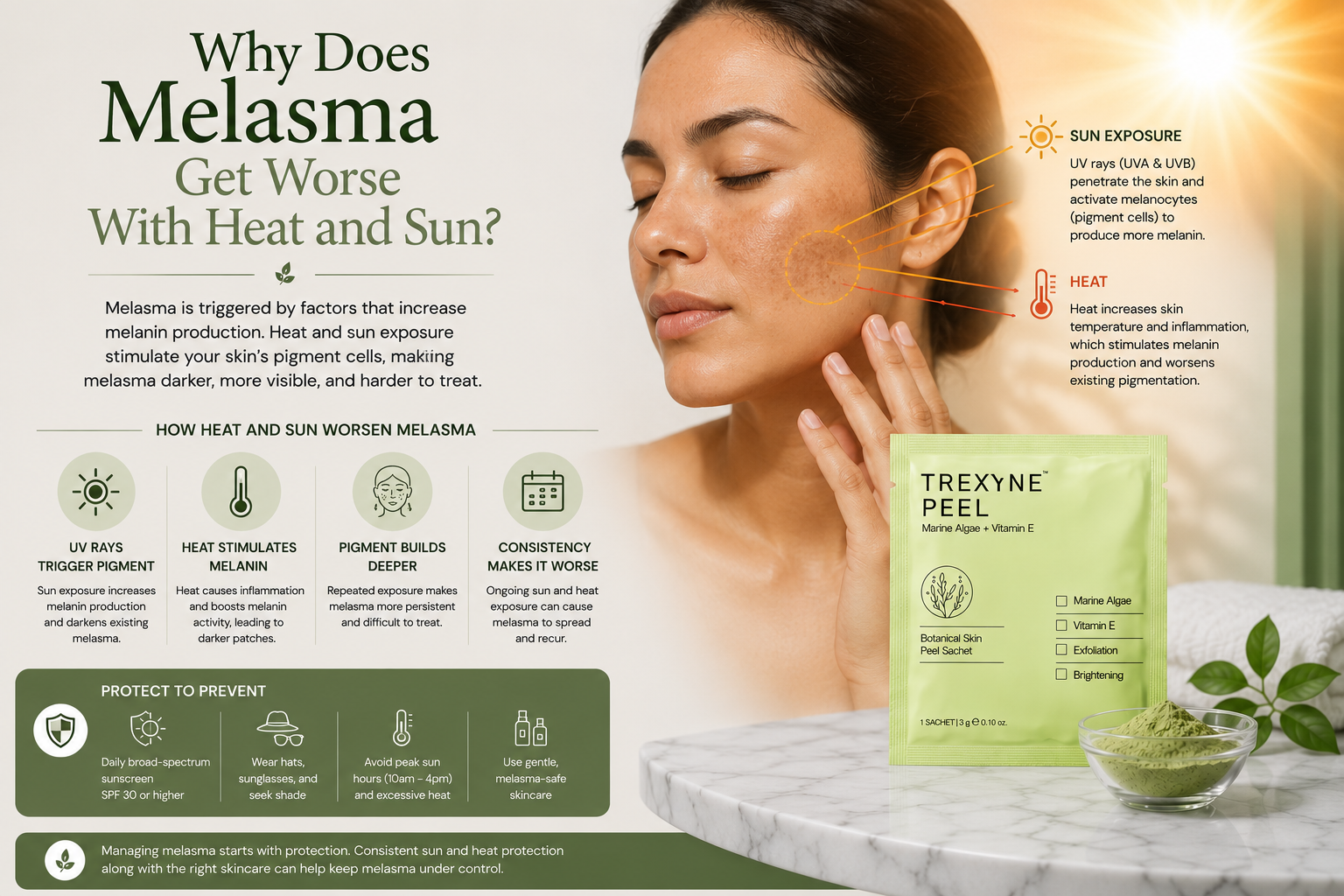
Why Does Melasma Get Worse With Heat and Sun?
Melasma worsens with heat and sun because both triggers directly stimulate the melanocytes responsible for the condition to produce more pigment. UV radiation is the most well-established driver of melasma activity, amplifying the hormonal sensitivity that underlies the condition and producing visible darkening that many clients notice within hours of sun exposure. Heat has a more recently recognised but similarly significant effect, acting through a separate biological pathway that also ends in increased melanin production. Understanding why both of these triggers behave this way is essential clinical context for anyone managing melasma professionally, and it explains why sun protection alone, while critical, may not fully contain the condition for clients with significant heat exposure. For practitioners building a melasma management protocol, treatment options such as the Trexyne Peel need to be considered alongside rigorous trigger management rather than as a standalone intervention.
The UV Trigger: How Sun Exposure Worsens Melasma
UV radiation is the primary environmental driver of melasma activity, and the mechanism by which it worsens the condition is relatively well understood. Melasma-prone skin has melanocytes that have been sensitised by hormonal factors, particularly elevated oestrogen and progesterone, to respond more aggressively to UV stimulus than melanocytes in unaffected skin. When UV radiation reaches the skin, it activates a signalling pathway that prompts melanocytes to produce melanin as a protective response.
In skin without melasma, this response is proportionate to the UV exposure received and produces the tanning response. In melasma-prone skin, the same UV stimulus produces a disproportionately large melanin response in the affected areas, generating the darker, more concentrated pigmentation that characterises the condition. Even brief, incidental UV exposure, the kind accumulated through short journeys outdoors, driving, or sitting near windows, can be sufficient to trigger visible darkening in clients whose melasma is active.
This is why UV exposure during a professional treatment course is so damaging to progress. Each session of resurfacing is working to progressively displace pigmented cells. Unprotected UV exposure between sessions is actively creating new pigmentation in the same areas. Without rigorous daily sun protection, these two processes can effectively cancel each other out, producing apparent stagnation in results that is caused not by treatment failure but by ongoing UV stimulation.
Why UVA Is Particularly Relevant for Melasma
It is worth being specific about which part of the UV spectrum is most relevant to melasma, because many clients equate sun protection with avoiding sunburn, which is primarily a UVB-driven phenomenon. Melasma is more significantly influenced by UVA radiation than UVB.
UVA penetrates more deeply into the skin than UVB and is present throughout daylight hours at relatively consistent levels regardless of season, cloud cover, or time of day. It penetrates glass, which means clients can accumulate significant UVA exposure while indoors near windows or while driving, without ever setting foot outside in direct sunlight.
This is why a broad-spectrum SPF that protects against both UVA and UVB is non-negotiable for melasma clients. UVB-only or primarily UVB-focused protection leaves the most relevant photostimulus for melasma largely unaddressed. Clients who are confused about why their melasma is worsening despite what they believe to be adequate sun protection often turn out to be using products with limited UVA coverage.
The Heat Trigger: A Separate Pathway That Also Worsens Melasma
Heat acts on melasma through a mechanism that is distinct from UV radiation, which means sun protection alone does not fully protect against all environmental worsening of the condition. Research has shown that heat directly stimulates melanocyte activity through temperature-sensitive receptors in the skin, increasing melanin production independently of any UV stimulus.
In practice, this means that clients can experience visible worsening of their melasma from sources of heat that involve no UV exposure at all. Saunas, steam rooms, very hot showers, cooking over a hot hob, and prolonged proximity to direct heat sources such as open fires or radiators can all trigger increased pigmentation activity in melasma-prone skin.
This also has implications for post-treatment management. The recovery period after a resurfacing session is a time of elevated skin temperature and, for some clients, residual warmth that persists for several hours after treatment. Managing heat exposure in this immediate post-treatment window is part of good aftercare for any resurfacing client, but it carries particular clinical weight for melasma clients where residual heat can provoke additional melanocyte activity in already-treated skin.
Visible Darkening After Sun Exposure: Why It Happens So Quickly
Clients with melasma often report that their skin visibly darkens within hours of sun exposure, sometimes within an hour of a brief outdoor outing. This rapid response can be alarming and discouraging, particularly during a treatment course when clients are hoping to see steady improvement rather than dramatic setbacks.
This rapid darkening reflects the fact that melanin production in sensitised melanocytes can be stimulated extremely quickly, and that some of this newly produced melanin is deposited close enough to the skin’s surface to become visible within hours rather than days. This is distinct from the slower development of new age spots, where accumulated UV damage over weeks and months gradually produces the characteristic defined spots. In melasma, the existing network of sensitised, hormonally primed melanocytes responds immediately to fresh UV stimulus, producing visible changes on a much shorter timescale.
Understanding this helps clients grasp why consistent daily SPF, applied every single morning without exception, is not excessive caution. A single day without adequate protection can produce visible darkening that takes multiple treatment sessions to address.
Why Seasonal Variation Is Characteristic of Melasma
Most clients with melasma notice that the condition fluctuates with the seasons, typically darkening visibly through spring and summer as UV exposure increases and improving somewhat through autumn and winter as exposure decreases. This seasonal pattern is one of the diagnostic features that helps clinicians identify melasma and distinguish it from other forms of pigmentation that do not fluctuate in the same way.
The seasonal pattern reflects the continuous interplay between the active hormonal trigger and the UV amplifier. During winter months, reduced UV exposure means the hormonal stimulus has less environmental input to work with, so melanocyte activity decreases and the pigmentation partially fades. During summer, increased UV exposure amplifies the hormonal sensitivity and visible pigmentation worsens, sometimes dramatically over just a few weeks.
For practitioners, this seasonal pattern has real implications for treatment planning. Beginning a professional resurfacing course in autumn or winter, when UV exposure is lower and the condition is at its least active, gives the treatment the best possible chance of making visible progress before the next summer’s UV stimulus begins to challenge it.
Managing the Heat and UV Triggers During a Treatment Course
Managing both UV and heat exposure during a professional treatment course is not just advice. For melasma, it is a clinical requirement for the course to have a realistic chance of producing the results the client is hoping for. Practitioners should communicate this specifically and practically rather than leaving it to general lifestyle guidance.
Specific UV management recommendations for melasma clients include applying a broad-spectrum SPF every morning as the final step before colour cosmetics, choosing a formulation with meaningful UVA protection rather than one focused primarily on UVB, reapplying during any outdoor exposure of more than two hours, wearing a wide-brimmed hat when outdoors during peak UV hours, and being particularly vigilant about glass exposure during car journeys.
Heat management recommendations include avoiding saunas, steam rooms, and very hot showers during the treatment course, being mindful of prolonged proximity to cooking heat or other strong heat sources, and following post-session guidance to avoid intense exercise that significantly raises core body temperature in the 48 hours after a resurfacing session.
The Trexyne Peel is designed around predictable, manageable downtime, and the mechanical resurfacing mechanism avoids the chemical inflammatory response that would add further heat and inflammatory activity to the post-treatment recovery. Stabilised Vitamin E in the formulation supports recovery and helps reduce the residual inflammatory load during the inter-session window. But these clinical advantages can only be fully realised when environmental trigger management is being handled consistently alongside the professional treatment.
Why SPF Alone Is Not Always Enough for Melasma
A common source of frustration for melasma clients is applying daily SPF consistently and still finding that their pigmentation persists or continues to worsen. This experience reflects the multi-trigger nature of the condition. UV radiation is the most powerful environmental driver of melasma activity, but it is not the only one. Hormonal factors, heat, and visible light have all been implicated in stimulating melasma activity.
Visible light, the non-UV portion of the light spectrum that includes blue light from screens and ambient daylight, has been recognised in recent literature as a potential trigger for melasma activity, particularly in clients with darker skin tones. While the evidence base continues to develop, it offers a possible explanation for why some clients find their melasma persistent despite rigorous SPF use.
For practitioners, this means melasma management needs to be discussed as a multi-layered approach rather than a simple sun protection plus resurfacing equation. Addressing the hormonal trigger where possible, managing heat exposure, maintaining rigorous and appropriate SPF use, and conducting regular professional resurfacing sessions are the combined tools available for managing a condition that responds to multiple inputs simultaneously.
Practitioners looking to incorporate the Trexyne Peel into their melasma management protocols can explore the full range through the Trexyne shop, or contact the team directly through the Trexyne contact page.
The Right Time of Year to Start a Melasma Treatment Course
Given what is known about the relationship between UV exposure and melasma activity, the optimal time to begin a professional resurfacing course for melasma is during the lower UV months, typically autumn through early spring in the UK. This timing maximises the window during which resurfacing can make progress without the competing UV stimulus that summer exposure introduces.
Starting a course in autumn also gives clients several months to establish the SPF habits and heat management practices that will need to continue through the following summer to sustain results. Clients who begin a course well before summer and arrive at the high-UV season with established protection habits and visible improvement already in place are in a much better position to maintain those results than those who start a course during or just before the summer months.
More information on the Trexyne approach to professional botanical resurfacing is available on the Trexyne website.
Conclusion
Melasma worsens with heat and sun because both triggers directly stimulate melanocytes that are already sensitised by hormonal factors to overproduce pigment. UV radiation, particularly UVA, activates the primary photostimulus pathway that drives melasma activity, while heat acts through a separate temperature-sensitive mechanism that can worsen the condition independently of UV exposure. Both triggers need to be actively managed throughout any professional treatment course for results to be achievable and sustainable. The Trexyne Peel offers a mechanical resurfacing approach that avoids adding chemical inflammatory stimulus to already-sensitised melasma-prone skin, with stabilised Vitamin E supporting recovery during the inter-session window. Used consistently alongside rigorous daily sun protection, heat avoidance, and appropriate trigger management, it may support visible improvement in melasma and contribute to a more even-looking complexion over the course of a well-managed professional treatment plan.
FAQs
Q: Why does melasma get worse in the sun?
UV radiation, particularly UVA, directly stimulates melanocytes in melasma-prone skin to produce excess melanin. These melanocytes have been sensitised by hormonal factors to respond more aggressively to UV than unaffected skin, meaning even brief sun exposure can trigger visible darkening. This is why daily broad-spectrum SPF with meaningful UVA coverage is non-negotiable for anyone managing melasma.
Q: Can heat make melasma worse even without sun exposure?
Yes. Heat stimulates melanocyte activity through temperature-sensitive receptors in the skin, independently of UV radiation. Saunas, steam rooms, hot showers, cooking over a hob, and prolonged proximity to heat sources can all worsen melasma even in the absence of UV exposure. Managing heat as well as UV is part of a complete melasma management approach.
Q: Why does my melasma get darker so quickly after sun exposure?
Melasma-prone skin has a network of sensitised, hormonally primed melanocytes that can produce and deposit melanin very rapidly in response to UV stimulus. Visible darkening within hours of sun exposure reflects this immediate melanocyte response rather than the slower cumulative process that produces age spots.
Q: What type of SPF is best for melasma?
A broad-spectrum formulation with meaningful UVA and UVB protection is essential. UVA, which penetrates glass and is present throughout daylight hours regardless of season, is the most relevant photostimulus for melasma activity. SPF products focused primarily on UVB protection leave the most significant melasma trigger largely unaddressed.
Q: Is there a best time of year to start melasma treatment in the UK?
Autumn through early spring is generally the most favourable time to begin a professional resurfacing course for melasma in the UK. Lower UV exposure during these months gives the treatment the best chance of making visible progress without the competing UV stimulus of summer. Clients who establish strong SPF habits during a winter course are also better prepared to protect their results through the following summer.
Q: Can the Trexyne Peel help with sun-triggered melasma?
The Trexyne Peel can form part of a professional management protocol for epidermal melasma, using a mechanical resurfacing mechanism that avoids the chemical inflammatory trigger most likely to worsen the condition. Progress is gradual and depends heavily on rigorous daily SPF use and heat avoidance throughout the course to prevent ongoing environmental restimulation of the treated areas.
Q: Why does melasma improve in winter and worsen in summer?
The seasonal pattern of melasma reflects the role of UV exposure as the primary environmental amplifier of the hormonal stimulus that drives the condition. During winter months, reduced UV exposure gives the hormonal melanocyte sensitivity less to work with, so pigmentation partially fades. Summer UV exposure amplifies the hormonal trigger and visible pigmentation worsens, sometimes within weeks of increased UV exposure.