Why Are the Dark Spots on My Face Getting Darker Even With Sunscreen
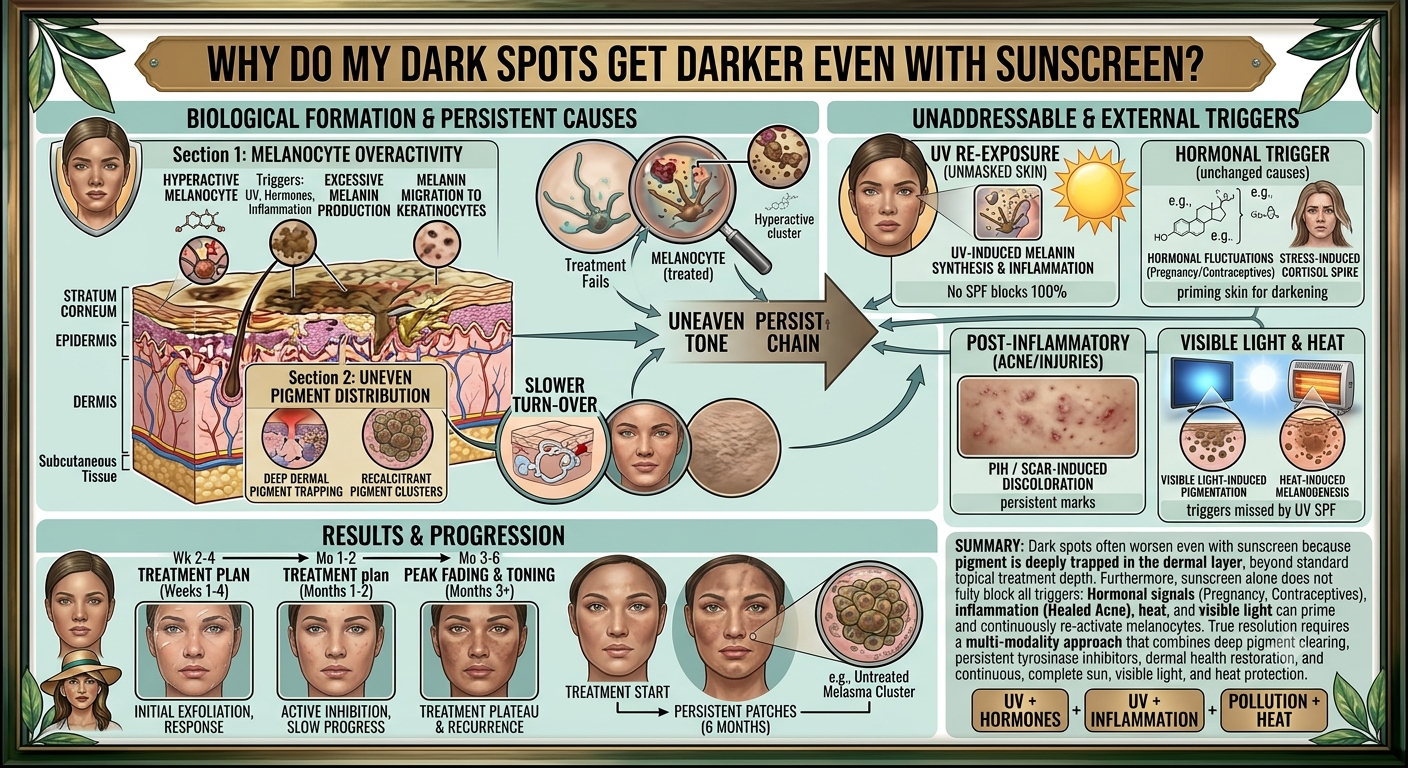
If dark spots are deepening despite consistent sunscreen use, sunscreen is rarely the whole story. UV exposure is one trigger among several, and SPF alone does not address inflammation, hormonal activity, heat exposure, or inconsistent application technique, all of which can keep pigmentation progressing. The most common reasons spots continue to darken are insufficient SPF amount or reapplication, an active inflammatory cause such as acne, a hormonal driver like melasma, or a treatment routine that is irritating the skin without the client realising it. For practitioners helping clients break this cycle, the Trexyne Peel — Professional Algae Resurfacing Treatment offers a botanical, mechanical resurfacing option that may support skin renewal as part of a properly structured pigmentation programme.
Sunscreen Alone Was Never Designed to Treat Existing Pigmentation
This is the first point worth clarifying with clients, because it resets expectations significantly. Sunscreen’s role is preventative. It reduces UV-driven stimulation of melanocytes, which helps prevent new pigmentation from forming and slows the rate at which existing spots deepen. It does not actively clear pigment that has already accumulated in the skin.
Clients often assume that wearing sunscreen should be enough to fade their dark spots over time. In reality, sunscreen is one part of a management plan, not a treatment in itself. Without an active resurfacing component, existing pigmentation can remain static or continue to slowly darken if other triggers are still in play, even with diligent sunscreen use.
Common Reasons Sunscreen Is Not Preventing Further Darkening
When a client reports that their dark spots are getting worse despite using sunscreen, there are usually one or more specific gaps worth investigating during consultation.
Insufficient Application Amount
Most people apply far less sunscreen than the amount used in SPF testing, which means the actual protection achieved in daily life is often significantly lower than the labelled SPF suggests. A thin layer applied once in the morning provides meaningfully less protection than a proper, generous application.
Inconsistent Reapplication
SPF degrades with UV exposure, sweat, and time. A single morning application is not sufficient protection for a full day, particularly for anyone spending extended time outdoors. Without reapplication every two hours in significant sun exposure, protection drops well before the day is over.
Incidental UV Exposure
Clients often underestimate UV exposure that happens outside of obvious situations like beach holidays. Walking to the car, sitting near a window, commuting, or spending time outdoors on an overcast day all involve UV exposure. UVA rays, which penetrate glass and contribute significantly to pigmentation, are present even on cloudy days.
Sunscreen Type and Formulation
Not all sunscreen formulations offer equal protection against UVA, which is the wavelength most associated with pigmentation. Broad-spectrum protection that explicitly covers UVA is important for clients managing hyperpigmentation specifically, rather than relying on SPF rating alone, which traditionally reflects UVB protection.
Hormonal Pigmentation Does Not Respond to Sunscreen Alone
For clients whose dark spots are continuing to deepen despite genuinely good sunscreen habits, a hormonal driver is worth considering, particularly if the pattern matches melasma.
Recognising Melasma in This Context
Melasma typically presents as symmetrical, diffuse patches across the cheeks, forehead, upper lip, and nose bridge. It is driven primarily by elevated oestrogen levels, which means it can progress independently of UV exposure, although UV remains a significant aggravating factor.
Clients using hormonal contraception, those who are pregnant, or those experiencing other hormonal shifts may see their pigmentation deepen even with excellent sun protection because the underlying hormonal stimulus continues to drive melanocyte activity. Sunscreen reduces one trigger but cannot address a hormonally driven process on its own.
This is an important conversation to have honestly with clients. It is not that their sunscreen routine has failed. It is that melasma has more than one driver, and sun protection addresses only one of them.
Inflammation Is a Trigger Sunscreen Cannot Prevent
Post-inflammatory hyperpigmentation develops in response to skin trauma, not UV exposure directly. If a client has ongoing acne, reactive skin, or is using a skincare routine that is irritating their skin, new pigmentation can form and existing patches can deepen regardless of how well they are protecting themselves from the sun.
Acne as an Ongoing Trigger
For clients with active or recurrent acne, every new breakout creates the conditions for additional post-inflammatory pigmentation. Sunscreen plays no role in preventing this because the trigger is inflammatory, not photo-induced. Unless the acne itself is being managed, new pigmentation will continue to form alongside existing spots, creating the impression that the dark spots are spreading or deepening overall.
Over-Exfoliation and Product Irritation
It is increasingly common for clients to be using several active skincare products simultaneously without professional guidance. Strong physical scrubs, frequent use of high-strength actives, and layering ingredients without understanding their interactions can create a chronic low-level inflammatory state in the skin. This kind of inflammation can stimulate melanocyte activity and worsen pigmentation, even while the client believes they are taking proactive steps to address it.
A skincare review during consultation often reveals this pattern. Clients are sometimes surprised to learn that their well-intentioned routine may be contributing to the problem they are trying to solve.
Heat Exposure and Pigmentation
Heat is a less commonly discussed trigger but a relevant one, particularly for melasma-prone skin. Saunas, steam rooms, hot yoga, prolonged hot showers, and even intense exercise that significantly raises facial skin temperature have been associated with worsening pigmentation in susceptible individuals.
Sunscreen does nothing to address heat-triggered pigmentation, which is why clients who are diligent with SPF but regularly exposed to high heat may still see progression. This is worth raising as part of a broader lifestyle conversation rather than assuming sun protection alone covers every angle.
Why Active Treatment Is Needed Alongside Sunscreen
Sunscreen prevents new UV-driven pigmentation and slows the progression of existing spots from that specific trigger. It does not actively clear pigment that has already formed, and it cannot address inflammatory or hormonal triggers on its own. This is why clients who rely on sunscreen alone, even when used correctly, often see their pigmentation plateau rather than improve, or continue to worsen if other triggers remain unaddressed.
Active resurfacing treatment addresses the pigment that is already present by accelerating cell turnover and supporting the shedding of pigmented surface cells. This is where professional treatment becomes essential rather than optional for clients who want genuine improvement rather than simply preventing further deterioration.
How the Trexyne Peel Supports Pigmentation That Has Resisted Sunscreen Alone
The Trexyne Peel addresses existing pigmentation through a botanical, mechanical resurfacing mechanism. Its active component, marine algae spicules, creates controlled micro-channels across the skin surface when applied by a trained practitioner. This physical action stimulates the skin’s natural renewal response, encouraging the shedding of pigmented surface cells and supporting a progressively more even-looking complexion over a structured course.
Because the mechanism is mechanical rather than chemical, the Trexyne Peel does not introduce the kind of additional inflammatory stimulus that chemical exfoliants can carry. This matters particularly for clients whose pigmentation has been worsened by inflammation, whether from acne, reactive skin, or an aggressive home skincare routine, since adding further inflammatory stress through treatment could compound the problem rather than resolve it.
Stabilised Vitamin E and Recovery
The formulation also includes stabilised tocopherol, a form of Vitamin E that may support the skin’s recovery phase from the first application. For clients whose skin has been under ongoing inflammatory or hormonal stress, supporting recovery between sessions is a meaningful part of how the treatment contributes to overall improvement.
Tiered Protocol for Reactive or Compromised Skin
The Trexyne Peel’s tiered protocol allows practitioners to adjust intensity according to each client’s skin condition. For clients presenting with skin that has been compromised by over-exfoliation or ongoing inflammation, starting conservatively allows the skin to stabilise before intensity is increased. This measured approach is particularly relevant for clients who have already experienced their pigmentation worsening through other means.
Building a Combined Approach: Treatment, Sunscreen, and Trigger Management
Genuine improvement in pigmentation that has continued to darken despite sunscreen use requires addressing all relevant triggers together, not relying on any single intervention.
Correcting the Sunscreen Routine
This starts with reviewing application amount, frequency, and formulation. Clients need a generous daily application of broad-spectrum SPF 30 minimum, rising to SPF 50 in summer or high exposure conditions, with reapplication every two hours during meaningful sun exposure.
Addressing Inflammatory Triggers
Where acne or reactive skin is present, this needs to be managed alongside any pigmentation treatment. A simplified, practitioner-guided skincare routine often replaces an overcomplicated one that may be contributing to ongoing irritation.
Professional Resurfacing
The Trexyne Peel can be introduced as the active treatment component, working on the pigment that is already present while the other elements of the plan reduce the rate of new pigmentation forming. Course options are available via the Trexyne shop, including single vials and packs of 10 or 20 for clients requiring a longer structured programme.
Ongoing Review
Pigmentation management benefits from regular review rather than a set-and-forget approach. Reassessing the client’s routine, treatment response, and any new triggers at each appointment allows the plan to adapt as needed.
For practitioners managing complex pigmentation cases and wanting to discuss treatment planning, the Trexyne team can be reached through the contact page.
What to Tell Clients Who Feel Frustrated
Clients who have been diligent with sunscreen and still see their pigmentation worsening often feel disheartened, sometimes to the point of giving up on sun protection altogether out of frustration. This is an important moment for clear, supportive communication.
The honest explanation is that sunscreen is doing its job by preventing additional UV-driven damage, even if it is not solving the whole problem. The remaining piece of the puzzle is identifying and addressing the other triggers at play, whether that is correcting application technique, managing an inflammatory source, considering hormonal factors, or introducing active resurfacing treatment to clear what has already accumulated.
Reframing the conversation this way helps clients understand that their efforts have not been wasted. It also reinforces the importance of continuing sun protection as part of a fuller plan rather than abandoning it.
More information about how the Trexyne Peel fits into a comprehensive pigmentation strategy is available at Trexyne.com.
Conclusion
Dark spots that continue to darken despite sunscreen use are usually being driven by a trigger that SPF alone cannot address. Insufficient application or reapplication, hormonal activity, ongoing inflammation from acne or an aggressive skincare routine, and heat exposure can all contribute to pigmentation progressing even when sun protection is genuinely being prioritised. Sunscreen remains essential, but it is preventative rather than corrective, which means existing pigment usually needs an active treatment alongside it.
The Trexyne Peel offers a botanical, mechanically driven resurfacing option that may support the skin’s renewal process and help progressively improve the appearance of existing pigmentation without adding further inflammatory stress. Its stabilised Vitamin E may support recovery between sessions, and its tiered protocol allows treatment to be calibrated carefully for skin that has already been compromised by other triggers. Combined with a properly corrected sunscreen routine and management of any inflammatory or hormonal drivers, it may help clients achieve a visibly brighter, more even complexion over time.
Frequently Asked Questions
Q: Why do my dark spots keep getting darker even though I wear sunscreen every day?
Sunscreen reduces UV-driven pigmentation but does not address other triggers such as hormonal activity, inflammation from acne or irritated skin, or heat exposure. It is also common for sunscreen to be under-applied or not reapplied frequently enough during the day, which reduces its effectiveness. If pigmentation continues to worsen despite sunscreen use, it is worth reviewing application technique and considering whether another trigger is also at play.
Q: Can hormonal changes cause dark spots to worsen even with good sun protection?
Yes. Conditions like melasma are driven primarily by hormonal activity, particularly elevated oestrogen levels, which can stimulate melanocyte activity independently of UV exposure. While sun protection remains important and reduces aggravation from UV, it cannot fully prevent hormonally driven pigmentation from progressing. Clients with this pattern may benefit from a longer-term management approach that addresses both the visible pigmentation and the hormonal context.
Q: Is it possible that my skincare routine is making my dark spots worse?
Yes, this is more common than many people realise. Overuse of strong actives, frequent physical exfoliation, or layering multiple products without professional guidance can create chronic low-level inflammation in the skin. This inflammatory state can stimulate melanocyte activity and worsen pigmentation, even when the intention behind the routine was to improve it. A professional skincare review can help identify whether this is a contributing factor.
Q: How does the Trexyne Peel help with pigmentation that has not responded to sunscreen alone?
The Trexyne Peel works on pigment that has already formed in the skin by stimulating cell renewal through a mechanical mechanism using marine algae spicules. Sunscreen is preventative and does not clear existing pigmentation, so an active resurfacing treatment is often needed alongside good sun protection. Because the Trexyne Peel does not rely on chemical exfoliants, it avoids adding further inflammatory stress to skin that may already be compromised by other triggers.
Q: Should I stop using sunscreen if it does not seem to be helping my dark spots?
No. Sunscreen should be continued and, ideally, reviewed for correct application amount, formulation, and reapplication frequency. Stopping sun protection would likely accelerate further pigmentation rather than improve the existing spots. Sunscreen plays a preventative role within a wider management plan that should also include active treatment for existing pigment and, where relevant, management of inflammatory or hormonal triggers.
Q: Can heat from exercise or hot showers make facial pigmentation worse?
Heat exposure has been associated with worsening pigmentation in some individuals, particularly those with melasma. Saunas, steam rooms, hot yoga, and prolonged hot showers can all contribute. This is a separate trigger from UV exposure, which means sunscreen alone will not address it. Clients with persistent pigmentation may benefit from being mindful of significant heat exposure as part of a broader trigger management approach.
Q: Where can I find a practitioner offering the Trexyne Peel for stubborn dark spots?
The Trexyne Peel is sold exclusively to verified practitioners and clinics, so it is not available for home purchase or use. Practitioners interested in offering the treatment can view pricing and pack options through the Trexyne shop, with single vials and course packs of 10 or 20 treatments available. For further information, the Trexyne team can be contacted via the contact page.