Does Sun Damage Cause Permanent Skin Discolouration?
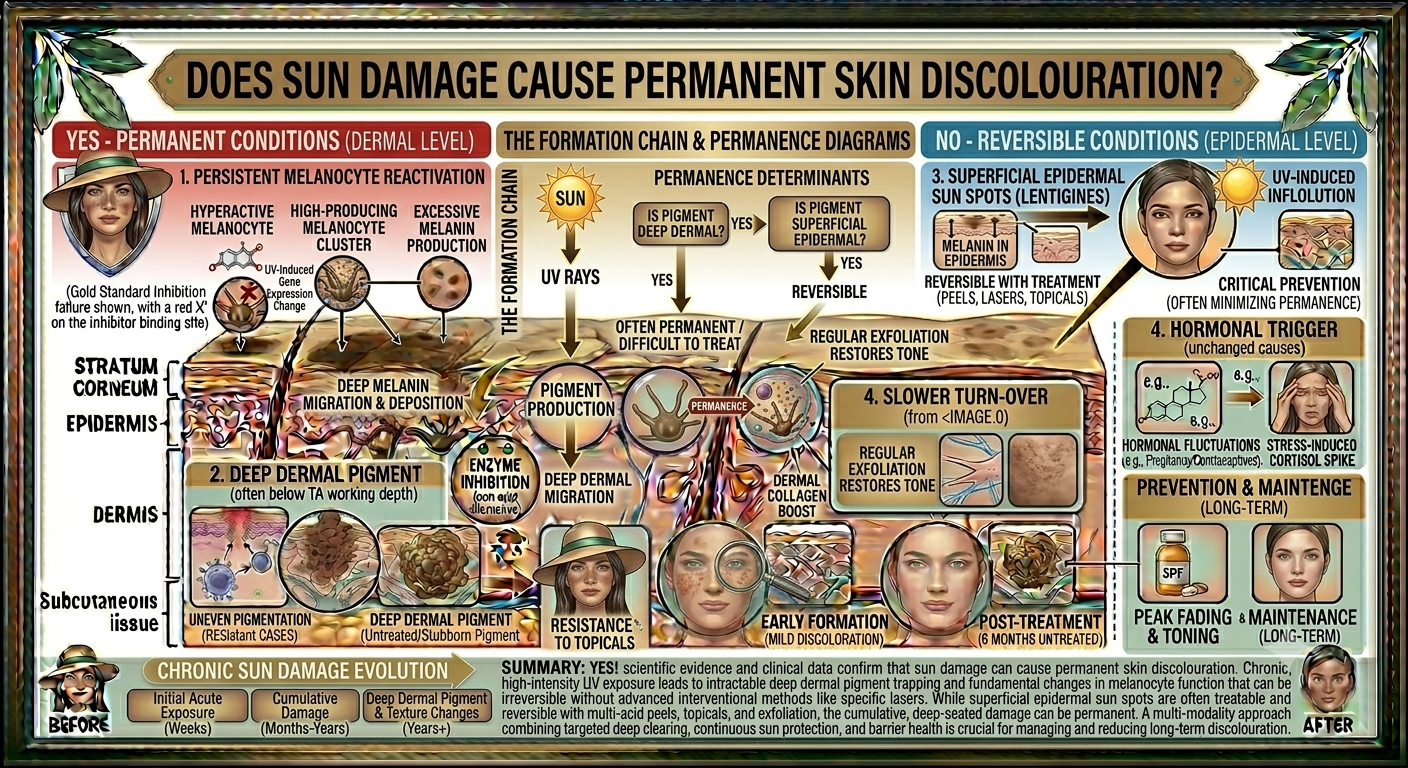
Sun damage can cause skin discolouration that becomes very difficult to reverse, though whether it is truly permanent depends on how much exposure has built up over time and how deep the pigment sits within the skin. A few unprotected days in strong sun rarely cause lasting marks on their own. Years of repeated exposure without adequate protection is a different matter, and this is where discolouration tends to become more stubborn and resistant to fading. Many clients come to clinic believing nothing can be done about long-standing sun marks, when in reality professional support, such as the Trexyne Peel, can help support a more even-looking complexion over a structured course of treatment. This article explains how sun damage leads to discolouration, why some marks are harder to shift than others, and what a realistic treatment plan looks like.
How UV Exposure Triggers Skin Discolouration
Ultraviolet light reaches the skin and stimulates melanocytes, the cells responsible for producing melanin, the pigment that gives skin its colour. This response is a natural protective mechanism, but it does not always occur evenly across the face or body. Areas that receive more direct or repeated sun exposure tend to produce more concentrated pigment over time, which is how patchy or blotchy discolouration begins to form.
Unlike a sudden sunburn, this kind of pigment build up is gradual. Many clients do not notice individual moments of damage. Instead, they notice the cumulative result years later, often appearing as patches that seem to have developed seemingly out of nowhere.
Types of Sun-Induced Discolouration
Solar Lentigines, Often Called Sun Spots
These are flat, brown marks that typically appear on areas with the most cumulative sun exposure, such as the face, hands, shoulders, and chest. They tend to become more defined and numerous with age, reflecting years of exposure rather than a single event.
Melasma Worsened by Sun Exposure
While melasma is primarily linked to hormonal activity, sun exposure is one of its strongest triggers and aggravating factors. Clients with melasma often notice their patches becoming significantly darker and more visible after time spent in the sun, even when other factors remain unchanged.
Diffuse Pigment Irregularity
Some sun-related discolouration does not appear as distinct spots at all, but as a general unevenness or blotchiness across the skin. This diffuse pattern can be harder for clients to pinpoint, as it often looks more like overall dullness than a specific mark.
Why Some Sun-Induced Marks Fade and Others Don’t
The depth at which pigment settles plays a major role in how readily it responds to time or treatment. Pigment sitting in the upper layers of the skin is more likely to fade as the skin naturally sheds and renews its surface cells. Pigment that has settled deeper, often the case after years of repeated exposure, tends to be far more resistant to fading on its own.
Skin’s natural renewal slows with age, which compounds the problem. Younger skin sheds and replaces surface cells more efficiently, giving sun-induced marks a better chance of fading naturally. Mature skin renews more slowly, which is part of why sun spots tend to become more entrenched and harder to shift the longer they have been present.
The Role of Cumulative Sun Exposure Over Time
It is worth being clear with clients that sun damage is rarely about a single event. Most visible discolouration reflects years, sometimes decades, of repeated low-level exposure rather than one memorable sunburn. This cumulative pattern means that by the time discolouration becomes visible, a significant amount of pigment activity has often already occurred beneath the surface.
This is also why discolouration can seem to appear suddenly in someone’s thirties or forties, even though the underlying cause began building up much earlier in life. Childhood and early adult sun exposure, often before consistent protection habits were in place, frequently lays the groundwork for marks that only become visible decades later. Understanding this timeline helps set realistic expectations for how long meaningful improvement is likely to take with treatment.
Can Sun Damage Be Reversed? Realistic Expectations
Sun-induced discolouration is not always permanent, but it is rarely something that disappears quickly or completely without some form of consistent intervention. Mild, surface-level marks may improve gradually with good sun protection and supportive skincare. More established marks, particularly those that have been present for years, generally need more direct, professional support to see a noticeable change.
It helps to frame this honestly with clients from the outset. Promising a complete reversal of years of cumulative sun exposure after a single treatment sets an unrealistic standard. A structured course of professional treatment, combined with consistent daily protection, tends to offer the most realistic route towards visible improvement.
Daily Sun Protection as the First Line of Defence
No discussion of sun-induced discolouration is complete without addressing prevention. Daily sun protection is one of the most important factors in preventing existing marks from deepening further and reducing the likelihood of new ones forming. This matters just as much during a course of professional treatment as it does beforehand, since freshly renewed skin can be more reactive to UV exposure in the days following a session.
Clients who are diligent with daily protection tend to see more lasting results from professional treatment, simply because they are not continuing to add new pigment activity on top of the improvement being made in clinic. This point is worth repeating clearly during consultations, as it is easy for clients to assume that a professional treatment alone will undo years of exposure regardless of what they do afterwards.
How Professional Resurfacing Supports Sun-Damaged Skin
Professional resurfacing treatments work by supporting the skin’s natural renewal process rather than attempting to bleach or strip pigment away directly. By encouraging the surface layers to shed and regenerate more efficiently, these treatments can help reduce the visible build up of sun-induced pigment over a course of sessions.
This renewal-focused approach tends to suit sun-damaged skin particularly well, since much of the discolouration sits within layers that respond to consistent, supported turnover rather than a single aggressive intervention. You can browse the full shop to see how resurfacing treatments compare for clients dealing with this type of pigmentation.
Introducing Trexyne Peel for Sun-Induced Discolouration
The Trexyne Peel is a precision botanical peel built around marine-algae spicules and stabilised Vitamin E. It works through a purely mechanical mechanism, creating controlled micro-channels in the skin’s surface without the use of chemical exfoliants. There are no acids involved and no chemical exfoliation taking place during treatment, which can suit clients who have found chemical-based options too harsh or unpredictable for sun-damaged skin in the past.
The marine-algae spicules support resurfacing and refinement of the skin’s surface, encouraging renewal from the very first application. The infused stabilised Vitamin E supports the skin’s recovery phase once treatment is complete, helping the skin move through its renewal process more comfortably.
What to Expect From a Trexyne Peel Course
A Tiered Protocol Suited to Sun-Damaged Skin
Trexyne Peel follows a tiered protocol, allowing the practitioner to match treatment intensity to each client’s skin type and the extent of their sun-induced discolouration. This means a client with mild sun spots and one with more extensive, longstanding discolouration can both be assessed and treated at an appropriate, predictable intensity.
Practitioner-Only, Course-Based Treatment
Trexyne Peel is sold strictly to verified practitioners and clinics, supplied as a 30ml practitioner vial offering approximately six to eight full-face treatments per vial. Because cumulative sun damage rarely responds to a single session, it is available as a single peel or as a course of 10 or 20 peels, allowing a realistic plan to be built around the client’s specific history of exposure.
If you would like to discuss adding a structured resurfacing option for sun-damaged skin to your clinic, get in touch through the contact us page. You can also learn more about the brand’s approach to professional skincare on the Trexyne homepage.
Conclusion
Sun damage can lead to discolouration that becomes increasingly difficult to reverse the longer it builds up, though it is not always strictly permanent. How readily a mark fades depends on the depth of the pigment, the age of the skin, and how much cumulative exposure has occurred over time. Daily sun protection remains the most important preventative measure, while professional support offers the most realistic route to visible improvement for more established marks. Trexyne Peel offers a botanical, mechanical approach to resurfacing, built around marine-algae spicules and stabilised Vitamin E, with a tiered protocol that allows treatment to be matched to each client’s skin, helping support a brighter, more even-looking complexion over time.
Frequently Asked Questions
Q: Is sun damage discolouration on the skin permanent?
It is not always permanent, but discolouration that has built up over years of cumulative sun exposure tends to be more resistant to fading and often needs professional support to see a noticeable improvement.
Q: Why do sun spots get darker the longer you have them?
Sun spots often reflect years of repeated low-level exposure rather than a single event, and continued sun exposure on top of existing pigment can deepen the discolouration further over time.
Q: Can sun-induced pigmentation be treated without chemical peels?
Yes. Mechanical resurfacing treatments using marine-algae spicules can support skin renewal and may help improve the appearance of sun-induced pigmentation without the use of acids or chemical exfoliants.
Q: How many treatments are needed to improve sun damage discolouration?
Because cumulative sun damage rarely responds to a single session, most professional plans involve a course of treatments. Trexyne Peel is available as one peel or as a course of 10 or 20 peels.
Q: Does Trexyne Peel work for melasma that has been worsened by sun exposure?
A practitioner will assess the pattern and depth of melasma before recommending treatment. Trexyne Peel’s tiered protocol allows intensity to be matched to the client’s specific skin condition and sensitivity.
Q: Can I treat sun-damaged skin with Trexyne Peel at home?
No. Trexyne Peel is sold strictly to verified practitioners and clinics and is designed for use exclusively by trained aesthetic professionals.
Q: What can I do alongside professional treatment to stop sun damage getting worse?
Consistent daily sun protection is one of the most important steps a client can take to prevent existing discolouration from deepening and to support the results achieved through a professional treatment course.