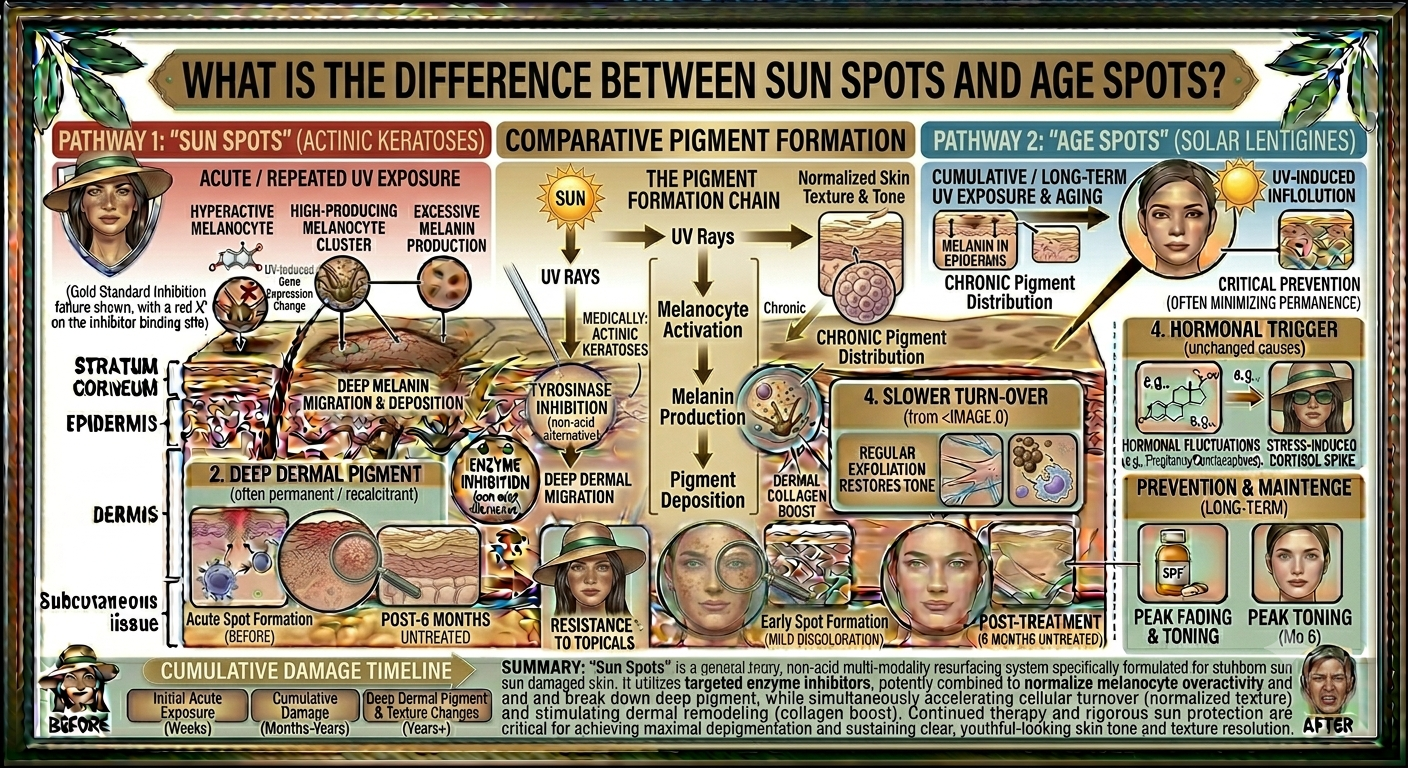
What Is the Difference Between Sun Spots and Age Spots
Sun spots and age spots are usually the same thing, medically known as solar lentigines, but the two terms are used slightly differently depending on context. Sun spots tend to emphasise the cause, namely cumulative UV exposure, while age spots emphasise when they typically appear, usually from midlife onwards as skin renewal slows down. In practice, most marks people describe using either term look and behave the same way under examination. Understanding this overlap helps set realistic expectations when discussing treatment options, including professional resurfacing approaches such as the Trexyne Peel. This article clarifies where the terms align, where they differ slightly in practice, and what a sensible treatment approach looks like for either type of mark.
Are Sun Spots and Age Spots the Same Thing?
In most clinical contexts, sun spots and age spots refer to the same underlying mark: a flat, brown patch caused by localised overproduction of melanin, known formally as a solar lentigo. They typically appear on areas that receive the most cumulative sun exposure over a lifetime, such as the face, hands, shoulders, and chest.
The difference between the two terms is largely about emphasis rather than biology. Sun spots highlights the trigger, which is UV exposure. Age spots highlights the timing, since these marks tend to become more visible as people get older. Many practitioners use the terms interchangeably, and clients often use whichever term they have heard most recently.
What Are Sun Spots?
Sun spots describe pigmentation that develops as a direct result of UV exposure over time. Ultraviolet light stimulates melanocytes, the cells responsible for producing melanin, and this response can become concentrated in specific areas rather than spreading evenly. Over years of repeated exposure, these concentrated areas develop into the flat, brown marks commonly referred to as sun spots.
This term is often used regardless of the person’s age, since younger adults who have spent significant time in strong sun without adequate protection can also develop these marks, sometimes earlier than expected.
What Are Age Spots?
Age spots refers to the same type of mark but frames it in terms of when it tends to become noticeable. As skin ages, its natural renewal process slows down, meaning surface cells, including pigmented ones, remain in place for longer than they would in younger skin. This slower turnover is part of why age spots often become more numerous and more defined later in life.
It is worth noting that age alone is not the root cause. Age spots still develop primarily because of cumulative UV exposure. Age is better understood as the factor that allows existing sun damage to become more visible, rather than a separate cause in its own right.
Key Similarities Between Sun Spots and Age Spots
Both terms describe marks that are flat, well-defined, and typically brown or tan in colour. They appear most commonly on sun-exposed areas of the body and tend to multiply or deepen with continued UV exposure. Both also respond to the same underlying biological process, which is localised melanin overproduction combined with pigment that has settled into the skin’s surface layers over time.
Because they share the same cause and appearance, sun spots and age spots are generally assessed and treated using the same clinical approach, regardless of which term a client uses to describe them.
Where the Terms Differ in Practice
Age of Onset
Sun spots can technically appear at any age if exposure has been significant enough, including in younger adults with a history of minimal sun protection. Age spots, by definition of the term, are more commonly associated with midlife and older clients, simply because slower renewal gives existing pigmentation more time to become visible.
Distribution and Density
Clients who develop marks earlier in life, often described as sun spots, may have a more localised pattern reflecting specific periods of high exposure, such as childhood or a particular sun-intensive period of their life. Age spots in older clients often appear more widespread, reflecting decades of cumulative exposure across many areas rather than one specific period.
Associated Skin Changes
Age spots are more likely to appear alongside other signs of slower skin renewal, such as rougher texture or reduced elasticity, since these changes tend to develop together over time. Sun spots in younger skin may appear in isolation, without these accompanying textural changes.
How to Tell Sun Spots and Age Spots Apart From Other Pigmentation
It helps to distinguish both terms from other types of facial pigmentation that are sometimes confused with them. Freckles tend to be smaller, more numerous, and often fade somewhat in winter months, unlike sun spots and age spots, which tend to remain fairly constant year-round. Melasma typically presents as larger, more symmetrical patches linked closely to hormonal activity, and it often responds differently to treatment compared with solar lentigines.
A proper assessment by a trained practitioner remains the most reliable way to confirm which type of pigmentation a client is dealing with, since visual similarities between these conditions can sometimes lead to confusion without a closer examination.
Why Both Types Respond to the Same Renewal-Focused Approach
Because sun spots and age spots share the same underlying cause and pigment depth pattern, they generally respond to the same style of treatment. Approaches that support the skin’s natural renewal process, encouraging older, pigmented surface cells to be replaced more efficiently, tend to work well for both terms without needing a separate treatment philosophy for each.
This is a useful point to communicate to clients, many of whom assume that age spots are somehow more permanent or harder to treat simply because of the word “age” in the name. In reality, the depth of the pigment and the client’s individual skin renewal rate matter far more than which term is used to describe the mark.
It can also be reassuring for older clients to hear that their age spots are not fundamentally different from the sun spots their younger relatives might be dealing with. The same renewal-supporting principles apply across both, even if the practical treatment plan may differ slightly based on how widespread the pigmentation has become.
How Professional Resurfacing Treatments Support Sun Spots and Age Spots
Professional resurfacing treatments work by supporting the skin’s renewal cycle directly, rather than relying solely on prevention or topical lightening over time. By encouraging the surface layers to shed and regenerate more efficiently, these treatments can help reduce the visible appearance of both sun spots and age spots across a course of sessions.
This approach tends to suit clients dealing with either term, since the treatment is addressing the shared underlying mechanism rather than treating them as separate conditions. You can browse the full shop to see how resurfacing treatments compare for clients dealing with this type of pigmentation.
Introducing Trexyne Peel for Sun Spots and Age Spots
The Trexyne Peel is a precision botanical peel built around marine-algae spicules and stabilised Vitamin E. It works through a purely mechanical mechanism, creating controlled micro-channels in the skin’s surface without the use of chemical exfoliants. There are no acids involved and no chemical exfoliation taking place during treatment, making it a predictable option regardless of whether a client’s marks are described as sun spots or age spots.
The marine-algae spicules support resurfacing and refinement of the skin’s surface, encouraging renewal from the very first application. The infused stabilised Vitamin E supports the skin’s recovery phase once treatment is complete.
What to Expect From a Trexyne Peel Course
A Tiered Protocol for Either Term
Trexyne Peel follows a tiered protocol, allowing the practitioner to match treatment intensity to the client’s skin type and the extent of their pigmentation, regardless of whether it is described as a sun spot or an age spot. A client with isolated, early sun spots and a client with widespread age spots can both be assessed and treated at an appropriate level.
Practitioner-Only, Course-Based Treatment
Trexyne Peel is sold strictly to verified practitioners and clinics, supplied as a 30ml practitioner vial offering approximately six to eight full-face treatments per vial. Because this type of pigmentation typically builds up over time, it is available as a single peel or as a course of 10 or 20 peels, allowing a realistic plan to be structured around the client’s specific pattern of marks.
If you would like to discuss adding Trexyne Peel to your clinic’s approach to treating sun spots and age spots, get in touch through the contact us page. You can also learn more about the brand’s approach to professional skincare on the Trexyne homepage.
Conclusion
Sun spots and age spots are largely the same underlying mark, with the difference coming down to emphasis on cause versus timing rather than any meaningful biological distinction. Both develop from cumulative UV exposure and become more visible as the skin’s natural renewal process slows, whether that happens earlier or later in life. Because they share the same cause, both respond well to the same renewal-focused treatment approach. Trexyne Peel offers a botanical, mechanical approach to resurfacing, built around marine-algae spicules and stabilised Vitamin E, with a tiered protocol that allows treatment to be matched to each client’s skin, helping support a brighter, more even-looking complexion regardless of which term describes their pigmentation.
Frequently Asked Questions
Q: Are sun spots and age spots actually different conditions?
No, in most cases they describe the same underlying mark, known as a solar lentigo. Sun spots emphasise the cause, which is UV exposure, while age spots emphasise the timing, since they often become more visible later in life.
Q: Can younger people get age spots, or are they only for older skin?
Age spots are more commonly associated with midlife and older clients, but the same type of mark, often called a sun spot in younger people, can appear earlier if UV exposure has been significant.
Q: Do sun spots and age spots require different treatments?
No. Because they share the same underlying cause and pigment depth pattern, both generally respond to the same renewal-focused treatment approach rather than needing separate treatment plans.
Q: Can Trexyne Peel treat both sun spots and age spots?
Trexyne Peel’s mechanical resurfacing mechanism and tiered protocol can be matched to a client’s specific pattern of pigmentation, regardless of whether their marks are described as sun spots or age spots.
Q: How can I tell if a mark is a sun spot, age spot, or something else like melasma? A proper assessment by a trained practitioner is the most reliable way to confirm the type of pigmentation, since freckles, melasma, and solar lentigines can sometimes look similar without a closer examination.
Q: How many Trexyne Peel sessions are needed to treat sun spots or age spots?
Because this type of pigmentation typically builds up over time, most practitioners recommend a course of treatments. Trexyne Peel is available as one peel or as a course of 10 or 20 peels.
Q: Is Trexyne Peel available for treating sun spots or age spots at home?
No. Trexyne Peel is sold strictly to verified practitioners and clinics and is designed for use exclusively by trained aesthetic professionals.