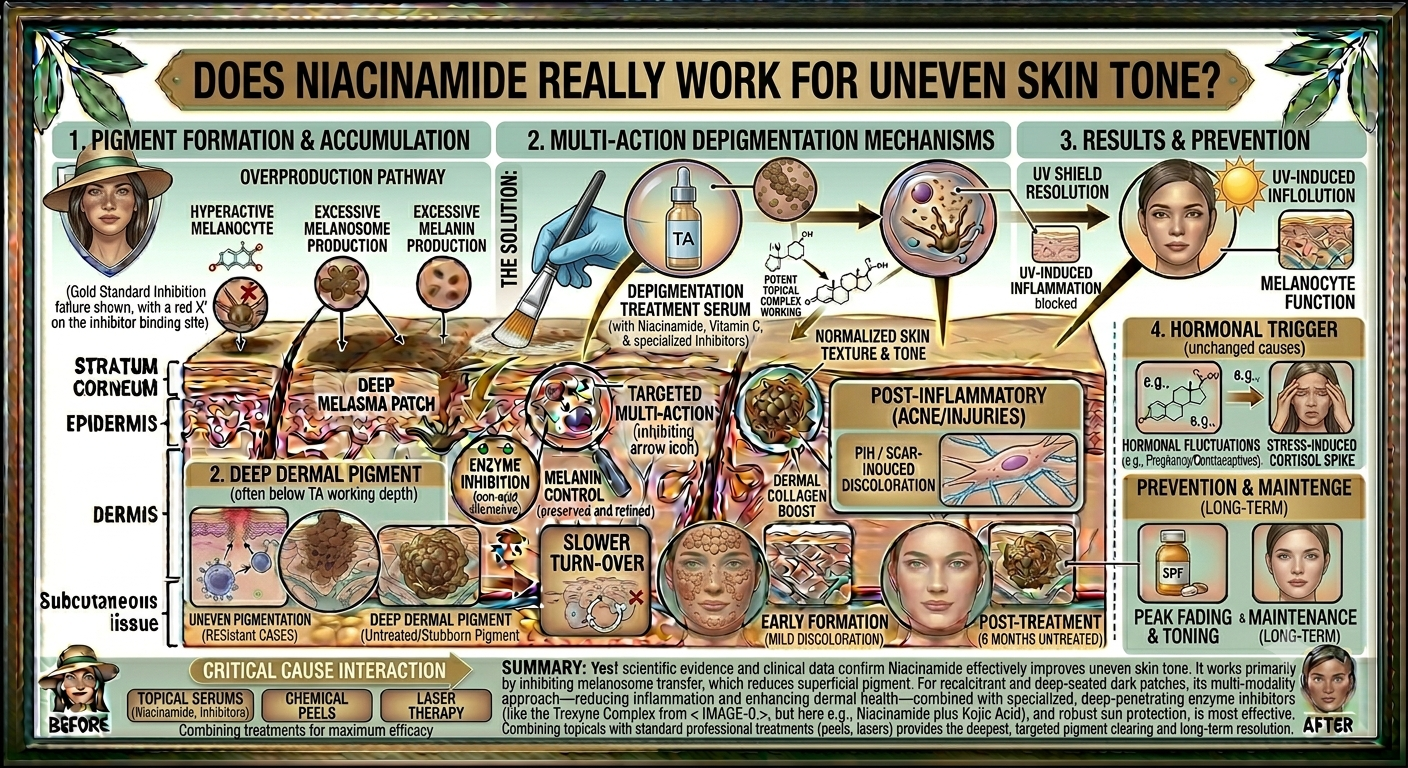
Does Niacinamide Really Work for Uneven Skin Tone?
Niacinamide can support a more even-looking skin tone for many people, but it works gradually and tends to deliver its best results as part of a wider routine rather than as a standalone fix. It is a form of Vitamin B3 that is widely used in topical skincare products and is generally well tolerated across most skin types. Clinical interest in niacinamide has grown because it is associated with improvements in skin barrier function and a more even complexion over consistent use. For clients with more persistent or stubborn pigmentation, many practitioners pair a niacinamide routine at home with professional in-clinic treatments such as the Trexyne Peel to support faster, more visible progress. This article looks honestly at what niacinamide can and cannot do, and where professional resurfacing fits into a realistic plan.
What Is Niacinamide and Why Is It Used for Skin Tone?
Niacinamide is a form of Vitamin B3 commonly included in serums, moisturisers, and targeted treatments aimed at improving skin tone and texture. It has become a popular ingredient in skincare formulations because it tends to be well tolerated, even by sensitive skin types, and is generally easy to combine with other active ingredients.
Its popularity for tone concerns comes from its association with supporting the skin’s barrier function and its role in research looking at pigmentation and oil regulation. Many practitioners recommend it as part of a daily routine for clients dealing with dullness, mild pigmentation, or general unevenness in skin tone.
How Niacinamide Is Thought to Support a More Even Complexion
Niacinamide is believed to work in a few different ways when it comes to skin tone. It is associated with supporting the skin’s natural barrier, which can help skin retain moisture and appear more even and less reactive over time. Some research also suggests it may help reduce the transfer of pigment within the upper layers of the skin, which is part of why it is often recommended for clients dealing with patchy or uneven tone.
It is worth noting that niacinamide works gradually. It is not designed to deliver an immediate, dramatic change, and most improvements reported in research and clinical use build up over several weeks of consistent application rather than appearing after a handful of uses.
What the Evidence Says About Niacinamide for Uneven Tone
There is a reasonable body of research looking at niacinamide’s role in supporting skin tone, and much of it points to modest, gradual improvement with consistent use. Studies have generally focused on outcomes like reduced blotchiness, improved skin barrier markers, and softer-looking pigmentation over a period of weeks.
It is important to be realistic about what this means in practice. Niacinamide is associated with supportive, incremental benefits rather than a fast or guaranteed transformation. For clients with mild dullness or early signs of unevenness, this gradual approach can be genuinely useful. For clients with more established or deeper pigmentation, niacinamide alone may not be enough to create a noticeable shift.
It also helps to remember that research findings often come from controlled studies using specific concentrations and formulations. Results seen in a clinical trial do not always translate directly to every product on the market, since formulation, concentration, and how consistently a client actually applies the product all play a part in real-world outcomes.
The Limits of Niacinamide Alone
Depth of Pigmentation Matters
One of the main limitations of niacinamide, and topical ingredients generally, is that they primarily act on the surface layers of the skin. Pigment that sits deeper within the skin, such as long-standing sun damage or hormonally driven patches, tends to be more resistant to topical ingredients alone, regardless of how consistently they are used.
Consistency Is Required
Niacinamide also relies heavily on consistent, long-term use to show any meaningful effect. Clients who use it sporadically, or who stop and start their routine frequently, are far less likely to notice an improvement compared with those who apply it as part of a steady daily routine over several months.
Why Topical Ingredients Often Need Professional Support
Because niacinamide and similar ingredients work primarily on the surface and require time to show results, they are often best viewed as one part of a broader approach to uneven tone rather than a complete solution. Clients dealing with more visible or longstanding pigmentation frequently benefit from combining a consistent home routine with professional treatment that supports renewal more directly.
This is where in-clinic resurfacing options become useful. Rather than relying solely on topical ingredients to gradually influence the skin’s surface, professional treatments can support the renewal process more directly, helping pigmented or dull surface cells be replaced more efficiently.
How Professional Resurfacing Complements a Niacinamide Routine
A well-structured approach to uneven tone often combines a consistent home routine, including ingredients like niacinamide, with periodic professional treatment to support deeper renewal. This combined approach allows the topical routine to maintain and support results between clinic visits, while the professional treatment addresses renewal more directly.
Practitioners exploring this kind of combined approach can review the full shop to understand how professional resurfacing options fit alongside a client’s existing skincare routine.
Introducing Trexyne Peel as a Professional Resurfacing Option
The Trexyne Peel is a precision botanical peel built around marine-algae spicules and stabilised Vitamin E. It works through a purely mechanical mechanism, creating controlled micro-channels in the skin’s surface without the use of chemical exfoliants. There are no acids involved at any stage, and no chemical exfoliation taking place during treatment.
For clients already using niacinamide as part of their home routine, Trexyne Peel offers a way to support renewal more directly in a clinical setting. The marine-algae spicules support resurfacing and refinement of the skin’s surface, while the infused stabilised Vitamin E supports the skin’s recovery phase from the first application.
What to Expect From a Trexyne Peel Course
A Tiered, Predictable Protocol
Trexyne Peel follows a tiered protocol, which allows the practitioner to match treatment intensity to each client’s skin type and expectations. This means a client already managing sensitive or reactive skin with a gentle home routine can still be assessed for a suitable, predictable level of professional treatment.
Practitioner-Only Application
Trexyne Peel is sold strictly to verified practitioners and clinics, supplied as a 30ml practitioner vial offering approximately six to eight full-face treatments per vial. It is designed for use exclusively by trained aesthetic professionals, so it is never intended to replace a home routine entirely but rather to work alongside it under proper supervision.
A Course-Based Approach
Because uneven tone usually responds best to consistent, repeated support, Trexyne Peel is available as a single peel or as a course of 10 or 20 peels. This mirrors the same principle behind a niacinamide routine: steady, repeated action tends to outperform a single, isolated attempt.
Building a Combined At-Home and In-Clinic Routine
For many clients, the most realistic path to a more even-looking complexion involves both elements working together. A consistent niacinamide-based routine at home can help support the skin’s barrier and maintain progress between clinic visits, while a course of professional treatment such as Trexyne Peel supports renewal more directly during in-clinic sessions.
Practitioners are well placed to advise on how to sequence these two elements, including how soon clients can resume certain home products after a professional session, to avoid over-treating sensitive skin during its recovery phase.
This kind of sequencing also helps manage client expectations. A client who understands that their home routine and their in-clinic treatment are working towards the same goal, on different timelines, tends to stay more patient and consistent with both than someone expecting a single product or session to do all the work alone.
Choosing the Right Approach for Your Skin
Deciding how much to rely on home ingredients like niacinamide versus professional treatment depends on the depth and history of the pigmentation, the client’s skin sensitivity, and how quickly they want to see visible change. A proper consultation helps clarify this before committing to a long-term plan.
If you are a practitioner interested in adding a professional resurfacing option alongside home-care advice, get in touch through the contact us page. You can also learn more about the brand’s approach to professional skincare on the Trexyne homepage.
Conclusion
Niacinamide can genuinely support a more even-looking skin tone, particularly for mild dullness or early unevenness, but it works gradually and depends heavily on consistent use. For more established or deeper pigmentation, topical ingredients alone may not be enough to create a visible change. Combining a steady home routine with professional treatment tends to offer the most realistic path forward. Trexyne Peel offers a botanical, mechanical approach to resurfacing, built around marine-algae spicules and stabilised Vitamin E, with a tiered protocol that allows treatment to be matched to each client’s skin, supporting a brighter, more even-looking complexion alongside an existing home routine.
Frequently Asked Questions
Q: Does niacinamide actually improve uneven skin tone over time?
Niacinamide is associated with gradual improvements in skin barrier function and a more even complexion when used consistently, although results tend to be modest rather than dramatic.
Q: How long does niacinamide take to show results for skin tone?
Most improvements associated with niacinamide build up over several weeks of consistent daily use, rather than appearing quickly after a few applications.
Q: Can niacinamide alone fix deep or longstanding pigmentation?
Topical ingredients like niacinamide primarily act on the skin’s surface, so deeper or longstanding pigmentation often requires additional professional support to see a more noticeable change.
Q: Can I combine niacinamide with professional treatments like Trexyne Peel?
Yes, many practitioners support combining a consistent home routine, including niacinamide, with professional resurfacing treatments like Trexyne Peel, though timing around each session should be guided by your practitioner.
Q: What makes Trexyne Peel different from a topical treatment like niacinamide?
Trexyne Peel is a professional, mechanical resurfacing treatment using marine-algae spicules and stabilised Vitamin E, applied by a trained practitioner, whereas niacinamide is a topical ingredient used as part of a daily home routine.
Q: Is Trexyne Peel suitable for clients already using niacinamide at home?
Trexyne Peel follows a tiered protocol, allowing a practitioner to assess and match treatment intensity to a client’s existing skin routine and sensitivity level.
Q: Can Trexyne Peel be purchased for home use alongside a niacinamide routine?
No. Trexyne Peel is sold strictly to verified practitioners and clinics and is designed for use exclusively by trained aesthetic professionals.