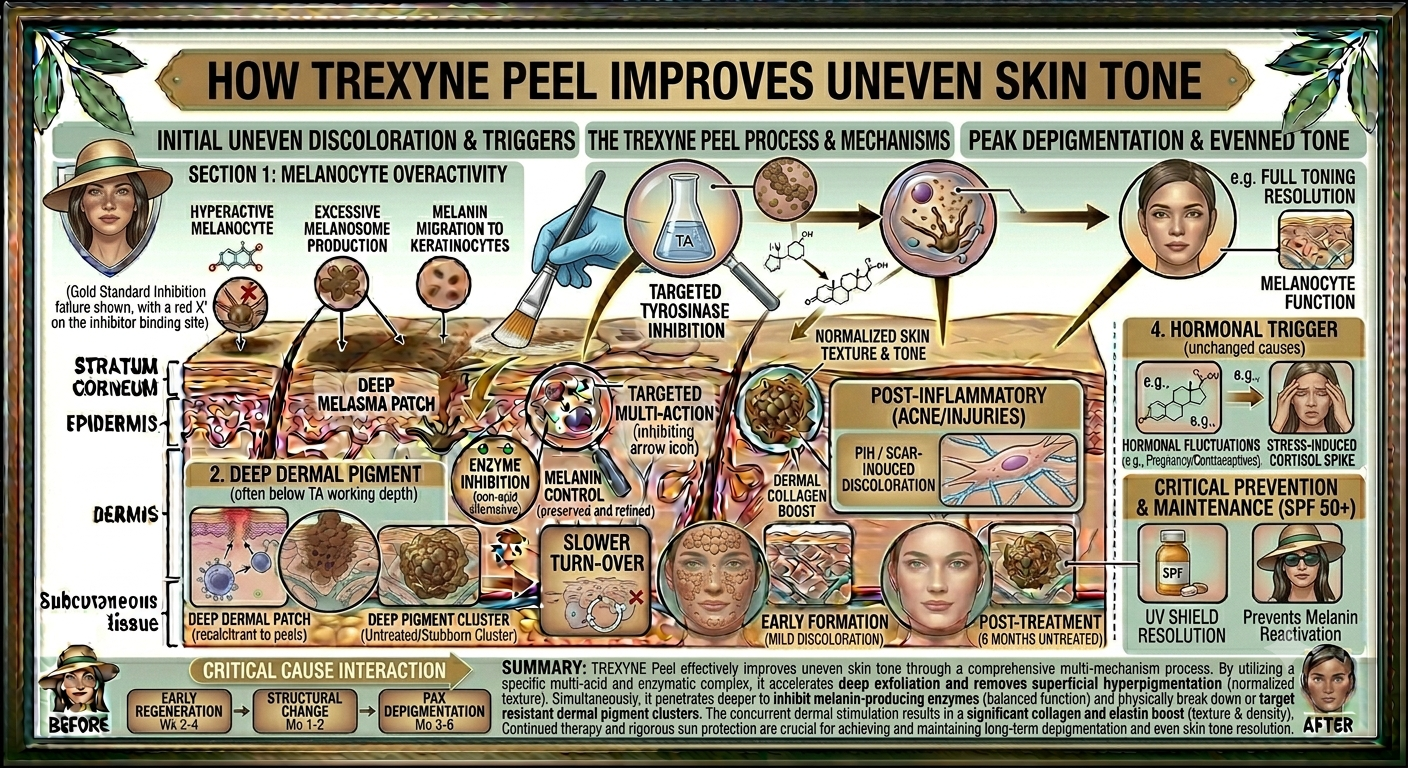
How Trexyne Peel Improves Uneven Skin Tone
Trexyne Peel improves uneven skin tone by supporting the skin’s natural renewal process through a mechanical resurfacing action, rather than relying on chemical exfoliation. Marine-algae spicules create controlled micro-channels across the skin’s surface, which helps encourage healthier turnover and a more even-looking complexion over a course of treatments. Stabilised Vitamin E works alongside this process to support the skin’s recovery once treatment is complete. For practitioners looking for a botanical, mechanical alternative to traditional resurfacing options, the Trexyne Peel offers a structured, predictable way to approach tone correction in clinic. This article looks at exactly how the treatment works, what happens during a course, and why this mechanism suits clients dealing with patchy or inconsistent skin tone.
How Does Trexyne Peel Work to Improve Uneven Skin Tone?
Uneven skin tone often comes down to two overlapping issues: irregular pigment distribution and slower surface cell turnover. Trexyne Peel addresses both by working through a purely mechanical mechanism. Rather than using acids to penetrate the skin chemically, the treatment relies on marine-algae spicules to create controlled micro-channels across the surface.
This mechanical action encourages the skin to begin its renewal process more efficiently. As older, pigmented surface cells are gradually replaced with fresher ones, the overall appearance of tone can become more even across a course of sessions. Because there is no chemical exfoliation involved, the process tends to be more predictable for both practitioner and client.
The Botanical Mechanism Behind Trexyne Peel
Marine-Algae Spicules
The core of the treatment lies in marine-algae spicules, which create the controlled micro-channels responsible for the resurfacing effect. This botanical mechanism works without chemical exfoliants, which means the treatment does not rely on acids or chemical penetration to achieve its effect on the skin’s surface.
A Precision-Built Formula
Trexyne Peel is described as a precision botanical peel, built specifically around these marine spicules alongside stabilised Vitamin E. This combination is designed to resurface, refine, and support skin renewal in a single, structured treatment, rather than relying on a generic blend of ingredients.
Why a Mechanical Approach Supports Skin Tone Without Chemical Exfoliation
Many practitioners look for resurfacing options that do not involve chemical exfoliation, either because of client sensitivity or a preference for a more predictable treatment experience. Trexyne Peel is not a chemical peel. It contains no acids and does not work through chemical penetration of the skin.
Instead, the mechanical micro-channelling created by the marine-algae spicules offers a different route to the same goal: supporting renewal so that pigmented and dull surface cells are replaced more efficiently. For clients who have found chemical peels too unpredictable or harsh in the past, this mechanical approach can offer an alternative that still targets uneven tone.
The Role of Stabilised Vitamin E in Supporting Recovery
Once the mechanical resurfacing action has taken place, the skin needs support to recover well. This is where the stabilised Vitamin E infused into Trexyne Peel plays its part. Tocopherol, the stabilised form of Vitamin E used in the formula, supports the skin’s recovery phase from the very first application.
This means the treatment is not just about creating micro-channels and leaving the skin to manage on its own. The infused Vitamin E works alongside the mechanical mechanism to help the skin move through its recovery phase more comfortably after each session.
The Tiered Protocol: Matching Intensity to Skin Type
One of the features that sets Trexyne Peel apart is its tiered protocol. This allows the practitioner to match treatment intensity to each client’s skin type and expectations, rather than applying a single fixed approach to every face that comes into the clinic.
Why Tiering Matters for Tone Correction
Uneven skin tone can range from mild dullness to more stubborn pigmentation, and clients vary significantly in how their skin responds to resurfacing. A tiered protocol means a practitioner can start more conservatively for sensitive or reactive skin, then adjust intensity in later sessions based on how the skin has responded. This reduces the guesswork that can come with less flexible resurfacing options.
Predictable Downtime
Because intensity is matched to the individual rather than applied uniformly, downtime tends to be more predictable. Practitioners can set realistic expectations with clients about how their skin is likely to look and feel in the days following treatment, which supports better planning around social or work commitments.
This predictability also helps with building trust over a longer course of treatment. Clients who know roughly what to expect after each session are more likely to stick with the full course rather than dropping out after one visit because the downtime felt unexpected or harder to manage than anticipated.
What Happens During a Trexyne Peel Treatment
A Trexyne Peel session is carried out exclusively by a trained aesthetic professional, in line with how the product is designed to be used. The practitioner assesses the client’s skin type and tone concerns, selects the appropriate tier of intensity, and applies the treatment using the marine-algae spicule mechanism to begin the resurfacing process.
Because the formula is supplied as a 30ml practitioner vial, offering approximately six to eight full-face treatments per vial, clinics can plan ahead for how many client sessions a single vial will support. This makes scheduling a course of treatments more straightforward from a practice management perspective as well as a clinical one.
How Many Sessions Are Needed to See Improvement in Tone
Because uneven skin tone usually develops over time, through a combination of pigmentation and slower cell turnover, a single session rarely tells the full story. Trexyne Peel is available as a single peel or as a course of 10 or 20 peels, which reflects the reality that consistent, repeated treatment tends to produce more noticeable results than an isolated session.
A course-based approach also allows the practitioner to adjust the tier of intensity as the skin responds over time. Early sessions might focus on building tolerance, while later sessions in the course can be adjusted based on how evenly the skin tone has begun to respond.
Who Trexyne Peel Is Designed For
Trexyne Peel is designed for use exclusively by trained aesthetic professionals. It is sold strictly to verified practitioners and clinics, which means it is not available for home use under any circumstances. This professional-only model ensures that every treatment is preceded by a proper skin assessment, and that intensity is matched appropriately to the individual rather than guessed at without training.
Clients dealing with uneven tone from sun exposure, hormonal changes, post-inflammatory marks, or general dullness linked to ageing may all be considered candidates, depending on the practitioner’s assessment of their specific skin pattern. You can browse the full shop to see how Trexyne Peel sits alongside other professional treatment options.
Supporting Results Between Sessions
While the treatment itself does the core work of supporting renewal, what happens between sessions also matters. Clients are generally advised to protect their skin from excessive sun exposure and avoid harsh, abrasive products while their skin moves through its recovery phase. This helps preserve the benefits of each session and supports the skin’s ability to respond well to the next stage of the tiered protocol.
Practitioners often find that clients who follow simple aftercare guidance between sessions see a more consistent improvement in tone across the full course, compared with those who return to harsh routines too soon after treatment.
Clear communication at the end of each appointment helps here. A short conversation about what to expect over the following days, and what to avoid before the next session, tends to make a noticeable difference to how smoothly a client progresses through their course.
Why Practitioners Are Adding Trexyne Peel to Their Tone-Correction Treatments
For clinics looking to offer a botanical, mechanical alternative to chemical resurfacing, Trexyne Peel offers a clear point of difference. The combination of marine-algae spicules, stabilised Vitamin E, and a tiered protocol gives practitioners a structured way to approach uneven tone without introducing acids or chemical exfoliation into the treatment room.
If you would like to find out more about adding Trexyne Peel to your clinic’s treatment menu, get in touch through the contact us page. You can also learn more about the brand’s approach to professional skincare on the Trexyne homepage.
Conclusion
Uneven skin tone is rarely solved by a single product or a one-off session, since it usually develops from a mix of pigmentation, slower cell turnover, and surface texture changes. Trexyne Peel approaches this through a precision botanical mechanism, using marine-algae spicules to create controlled micro-channels and stabilised Vitamin E to support the skin’s recovery phase. With a tiered protocol that matches intensity to skin type, and a course-based structure built around repeated treatment, Trexyne Peel offers practitioners a predictable, mechanical way to support a brighter, more even-looking complexion in clients dealing with uneven tone.
Frequently Asked Questions
Q: How does Trexyne Peel improve uneven skin tone without using acids?
Trexyne Peel works through a purely mechanical mechanism. Marine-algae spicules create controlled micro-channels in the skin’s surface, supporting renewal without any chemical exfoliants or acids involved.
Q: How many Trexyne Peel sessions are needed to see an improvement in skin tone?
Trexyne Peel is offered as a single peel or as a course of 10 or 20 peels. Because uneven tone usually develops over time, a course of repeated sessions tends to support more noticeable results than a single treatment.
Q: Is Trexyne Peel suitable for sensitive skin with uneven tone?
Trexyne Peel follows a tiered protocol, which allows a trained practitioner to match treatment intensity to the client’s skin type, including more sensitive or reactive skin.
Q: What does stabilised Vitamin E do in the Trexyne Peel formula?
The stabilised Vitamin E, in its tocopherol form, supports the skin’s recovery phase from the first application, working alongside the mechanical resurfacing action of the marine-algae spicules.
Q: Can I buy Trexyne Peel to treat uneven skin tone at home?
No. Trexyne Peel is sold strictly to verified practitioners and clinics and is designed for use exclusively by trained aesthetic professionals.
Q: How long does downtime last after a Trexyne Peel treatment for uneven tone?
Downtime varies depending on the tier of intensity selected for the client’s skin type. The tiered protocol is designed to make downtime more predictable, allowing practitioners to set realistic expectations before treatment.
Q: What makes Trexyne Peel different from a traditional chemical peel for tone correction?
Trexyne Peel is not a chemical peel. It works through a mechanical mechanism using marine-algae spicules rather than acids or chemical penetration, offering a botanical alternative for practitioners and clients who prefer to avoid chemical exfoliation.