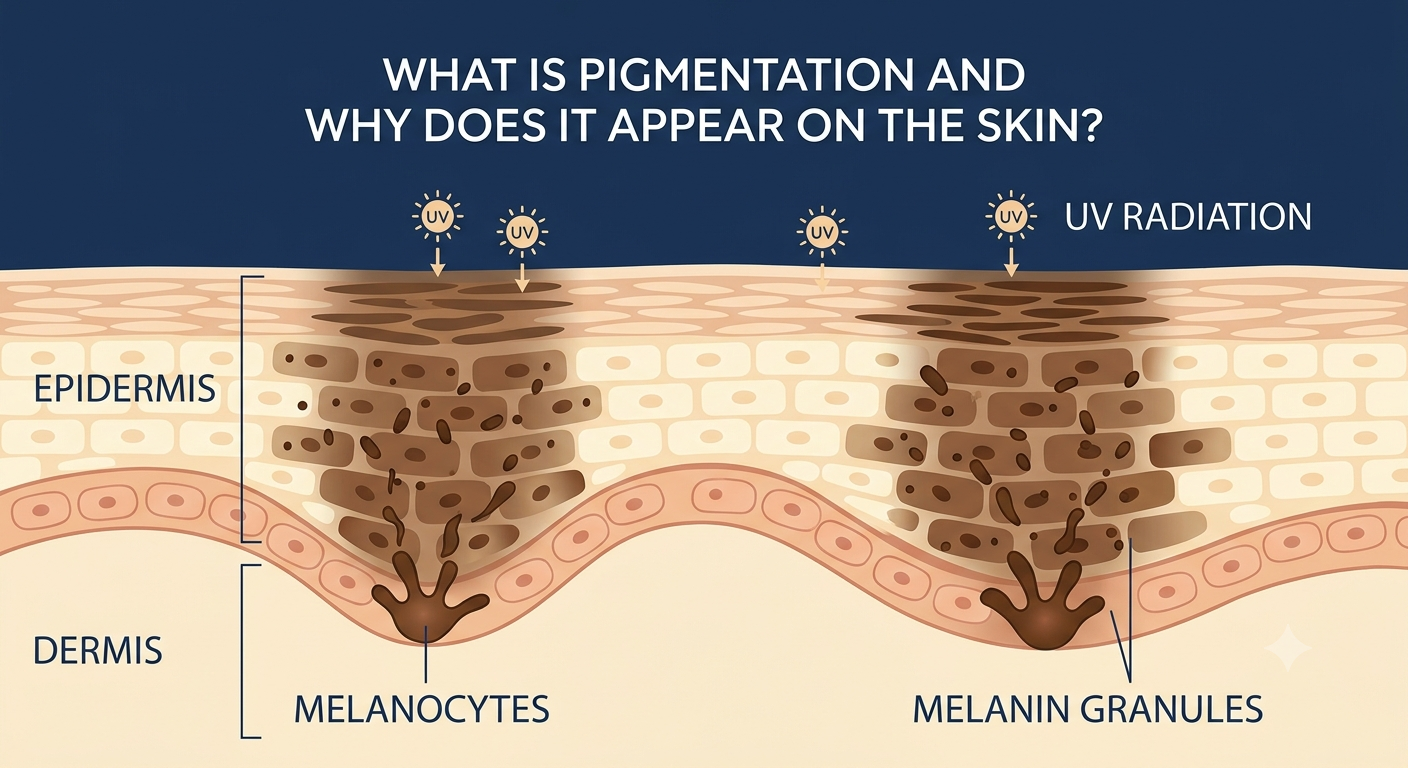
What Is Pigmentation and Why Does It Appear on the Skin?
Pigmentation is the term used to describe the color of your skin, and it is controlled by a naturally occurring pigment called melanin. For most people, melanin is distributed evenly across the skin, creating a consistent tone. But certain triggers cause the skin to overproduce melanin in specific areas, and that is when visible problems develop. Dark spots, patches of discoloration, and uneven tone are all signs that the skin’s pigment-producing system has been disrupted. Understanding what pigmentation is and why it appears gives you a clearer path toward managing it. For those seeking a professional solution, the Trexyne Peel is a clinically applied chemical peel that targets pigmentation directly, helping to restore a more even and balanced complexion.
What Is Pigmentation?
At its most basic level, pigmentation refers to the natural coloring of the skin. Every person’s skin tone is the result of melanin, a pigment produced deep within the epidermis, the outermost layer of the skin. The amount of melanin your skin produces and how it is distributed determines your baseline complexion.
Melanin is made by specialized cells called melanocytes, which are found at the base of the epidermis. These cells are present in roughly equal numbers across all skin tones. What differs between individuals is how active those cells are and how much melanin they produce. Genetics largely sets this baseline, but external and internal factors can push melanocyte activity up or down significantly.
When melanin production becomes uneven, certain areas of the skin accumulate more pigment than others. The result is what most people recognize as a pigmentation problem: a dark spot, a blotchy patch, or a generally inconsistent skin tone that does not respond easily to standard skincare.
How Does Melanin Work?
Melanin is not a single substance. It exists in two primary forms, and both contribute to the appearance of your skin in different ways.
Eumelanin
Eumelanin produces brown and black tones and is the dominant form of melanin in people with medium to dark skin. It is highly effective at absorbing ultraviolet radiation, which is why darker skin types tend to have stronger natural sun protection. When exposed to UV light, eumelanin production increases as a protective response.
Pheomelanin
Pheomelanin produces pink, yellow, and red tones and is found in higher concentrations in people with lighter skin and red or blond hair. It absorbs UV rays less efficiently, which explains why fair-skinned individuals are more likely to burn and may be more prone to sun-induced skin damage over time.
Both forms of melanin are synthesized through a chemical pathway that involves an enzyme called tyrosinase. This enzyme acts as the key trigger for melanin production, which is why many effective pigmentation treatments, both professional and topical, work by targeting or inhibiting tyrosinase activity.
Why Does Pigmentation Appear on the Skin?
Pigmentation appears when something causes the melanocytes to produce more melanin than the skin needs in a given area. Several different triggers can set this process in motion, and often more than one is at play at the same time.
Ultraviolet Radiation
UV light from the sun is the most universal trigger for excess melanin production. When UV rays penetrate the skin, they activate tyrosinase and signal melanocytes to ramp up output. In the short term, this is simply what produces a tan. Over time, with repeated and cumulative exposure, it leads to the formation of persistent sunspots and a general unevenness in skin tone, particularly on areas that receive the most sun.
Skin Inflammation
The skin has a direct link between its inflammatory response and its pigment-producing cells. When the skin becomes inflamed, whether from a pimple, a minor injury, a rash, or even a harsh skincare product, melanocytes in the affected area receive a signal to produce more melanin. Once the inflammation resolves, the excess pigment remains, leaving behind a dark mark. This is called post-inflammatory hyperpigmentation, and it is one of the most common reasons people develop dark spots on their skin.
Hormonal Fluctuations
Certain hormones, particularly estrogen and progesterone, can directly stimulate melanocyte activity. This is why hormonal events such as pregnancy, the use of oral contraceptives, or hormonal therapy often lead to a condition called melasma, characterized by large, diffuse patches of pigmentation, usually on the face.
Aging
As the skin ages, its ability to regulate melanin production declines. Melanocytes may become irregularly distributed, and decades of cumulative UV exposure cause them to cluster together in certain areas. The result is the age spots and general unevenness of tone that become more noticeable after the age of 40.
Where Does Pigmentation Most Commonly Appear?
Pigmentation can develop anywhere on the body, but it tends to concentrate in areas with the highest levels of UV exposure and hormonal sensitivity.
- The face, particularly the cheeks, forehead, upper lip, and nose
- The hands and tops of the fingers
- The chest and decolletage
- The shoulders and upper back
- Areas that have experienced repeated acne breakouts or skin irritation
Facial pigmentation is the most commonly treated concern because it is the most visible and has the greatest impact on how a person perceives their own complexion. The skin on the face is also frequently exposed to sunlight and hormonal influences, making it especially susceptible.
What Are the Different Types of Skin Pigmentation?
Pigmentation is not one uniform condition. Different types develop through different mechanisms and require tailored approaches to treatment.
Hyperpigmentation
Hyperpigmentation is the umbrella term for any condition where areas of the skin become darker than the surrounding tone due to excess melanin. Sunspots, melasma, and post-inflammatory marks all fall under this category. It is the most common form of pigmentation concern and the one most people refer to when they say they have a pigmentation problem.
Melasma
Melasma appears as large, flat, symmetrical patches of brown or gray-brown discoloration, most often on the face. It is strongly linked to hormonal activity and UV exposure and tends to be more stubborn than other forms of hyperpigmentation because both triggers are often ongoing.
Post-Inflammatory Hyperpigmentation
This type develops after the skin experiences trauma or inflammation. Acne scars are the most common example, but it can also follow insect bites, eczema, or minor injuries. The marks are flat and may be brown, red, or purple depending on skin tone and the depth of the pigment.
Solar Lentigines
These are the small, well-defined flat spots that develop on sun-exposed areas over years of UV damage. They are distinct from freckles in that freckles are genetically driven and often fade in winter, while solar lentigines persist and darken with continued sun exposure.
Why Does Pigmentation Stay on the Skin for So Long?
One of the most frustrating aspects of pigmentation is how long it can persist. Several factors work against the skin’s natural ability to clear it.
Depth of the pigment: Melanin deposits in the upper layers of the skin are easier to address than pigment that has settled deeper in the epidermis or into the dermis below. Surface treatments may not penetrate deeply enough to reach all of the discoloration.
Slow cell turnover: Your skin naturally sheds and replaces its surface cells over a cycle of four to six weeks. In aging skin, this cycle slows considerably, meaning pigmented cells stay on the surface longer before being replaced.
Ongoing triggers: If the trigger that caused the pigmentation, whether sun exposure, hormonal activity, or recurring breakouts, continues to be present, the skin keeps producing more melanin faster than it can clear the existing discoloration.
Individual skin response: Darker skin tones are more prone to producing excess melanin in response to stimulation, which means pigmentation can develop more easily and take longer to fade without targeted intervention.
When Does Pigmentation Need Professional Treatment?
Mild pigmentation may respond to a well-designed daily skincare routine that includes SPF, vitamin C, and other brightening actives. However, there are clear signs that a professional approach will be more effective.
- The pigmentation has been present for more than three to six months without visible improvement
- Multiple areas are affected or the discoloration covers a large surface
- Over-the-counter brightening products have produced little to no change
- The pigmentation is linked to hormonal changes that make topical treatment alone insufficient
- You want visible results in a shorter timeframe than topical products can deliver
A professional pigmentation treatment provides the level of intervention that topical products simply cannot match. Treatments like the Trexyne Peel remove pigmented surface cells and stimulate the skin to regenerate more quickly, addressing the discoloration at a structural level rather than just suppressing melanin on the surface.
Can Pigmentation Be Prevented?
While not every type of pigmentation can be fully prevented, the most common triggers are manageable with consistent habits.
Daily Sun Protection
Broad-spectrum sunscreen with an SPF of 30 or higher, applied every morning regardless of the weather or season, is the single most effective preventive measure. UV radiation is present even on overcast days and through glass, so daily application is essential rather than occasional.
Managing Inflammation
Keeping inflammatory skin conditions such as acne under control reduces the risk of post-inflammatory pigmentation. Avoiding harsh scrubbing, picking at spots, and using overly aggressive products also lowers the likelihood of trauma-triggered melanin production.
Hormonal Awareness
If you know your skin is sensitive to hormonal changes, working with a healthcare provider to manage those changes, combined with rigorous sun protection, gives you the best chance of keeping hormonally driven pigmentation at bay.
How Trexyne Peel Addresses Pigmentation at the Source
The Trexyne Peel is a professionally administered chemical peel that approaches pigmentation by removing the outer skin layers where discoloration is stored and stimulating the production of fresh, more evenly toned cells. Unlike topical products that work gradually on the skin’s surface, this treatment reaches deeper into the epidermis and works on multiple types of pigmentation, including sunspots, post-inflammatory marks, and areas of uneven tone caused by aging.
When applied by a trained practitioner, the peel exfoliates the pigmented surface layer in a controlled way, clearing it to reveal the cleaner skin beneath. With each successive session, the cumulative effect becomes more visible, and with consistent sun protection in between, the results are sustainable rather than temporary.
Conclusion
Pigmentation appears on the skin when melanin is produced unevenly due to UV exposure, inflammation, hormonal shifts, aging, or a combination of these factors. It forms because the skin’s protective and healing mechanisms, while necessary, can leave lasting marks that are slow to clear on their own.
Understanding the biology behind why pigmentation appears is the first step toward addressing it effectively. For those who are ready to go beyond topical management, advanced skin peel solutions like Trexyne Peel offer a professionally guided treatment path that works with the skin’s natural renewal process to deliver a clearer, more even, and more confident complexion.
Frequently Asked Questions
1. What is pigmentation on the skin and why does it develop?
Pigmentation refers to the coloring of the skin, which is produced by a pigment called melanin. It develops visibly as a problem when melanocytes, the cells responsible for melanin production, become overactive in certain areas. This is most commonly triggered by sun exposure, inflammation from acne or injury, hormonal changes, and the natural aging process. When excess melanin builds up in localized areas, it creates the dark spots and uneven tone that people refer to as a pigmentation concern.
2. Is skin pigmentation the same as a birthmark?
Not exactly. Birthmarks are a specific type of pigmentation present from birth or appearing shortly after, and they result from an abnormal concentration of melanocytes or blood vessels in a particular area. Hyperpigmentation, the type most people seek treatment for, develops later in life in response to triggers such as sun damage, acne, or hormonal activity. Both involve melanin, but they have different origins and different treatment considerations.
3. Can pigmentation on the skin disappear on its own?
Mild, recent pigmentation such as fresh post-acne marks can fade gradually on its own as the skin sheds and renews its surface cells. However, older or deeper pigmentation, particularly sun-induced spots and melasma, rarely clears without active treatment. The process is also very slow without intervention, taking months or years, and can easily be reversed by continued sun exposure or hormonal triggers.
4. Why does my skin tone look uneven even without any specific dark spots?
General unevenness in skin tone without defined spots often results from cumulative UV exposure that has caused melanin to distribute inconsistently across the skin. It can also be related to mild, low-grade inflammation from environmental stressors, dehydration, or a compromised skin barrier. Professional treatments that promote even cell turnover, such as Trexyne Peel, can help address this type of diffuse discoloration along with more defined dark spots.
5. Does pigmentation affect all skin tones equally?
All skin tones can develop pigmentation, but the experience differs. Darker skin tones have more active melanocytes and are more prone to post-inflammatory hyperpigmentation, meaning any trigger such as a pimple, scratch, or rash is more likely to leave a lasting dark mark. Lighter skin tones are more susceptible to sun-induced pigmentation such as freckles and sunspots due to lower melanin protection against UV radiation. Treatment should always be tailored to the individual’s skin tone.
6. What is the connection between pigmentation and sun damage?
Sun damage is one of the primary drivers of pigmentation. When UV rays reach the skin, they activate the melanin production pathway as a protective response. Years of this repeated activation cause melanin to accumulate in uneven clusters, resulting in sunspots, age spots, and a generally mottled complexion. This is why daily SPF is considered the most fundamental part of any pigmentation prevention or management strategy.
7. How does Trexyne Peel help with skin pigmentation?
Trexyne Peel is a professionally applied chemical peel that works by removing the outer layers of the skin where excess melanin is concentrated. This controlled exfoliation reveals fresher, more evenly pigmented skin beneath while stimulating the production of new cells. Over a series of treatments, dark spots and areas of uneven tone become progressively lighter. The treatment is administered by a qualified practitioner and is customized to each patient’s skin type and pigmentation concern.