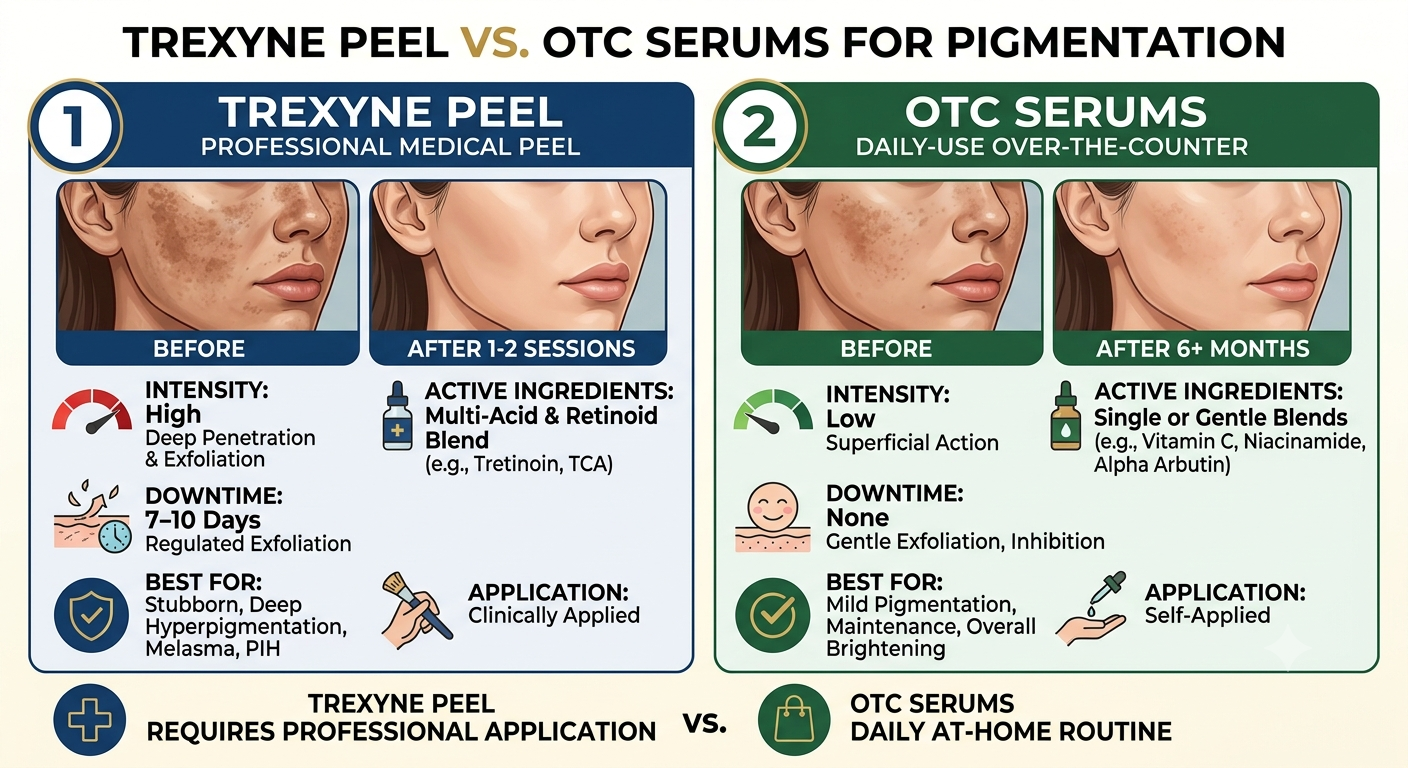
Trexyne Peel vs. OTC Serums for Pigmentation
Standing in a pharmacy or scrolling through skincare retailers, the number of brightening serums, dark spot correctors, and pigmentation treatments available can feel overwhelming. Many promise to fade discoloration, even out skin tone, and deliver visibly clearer skin. Some of them contain genuinely active ingredients and produce modest improvement over time. But if you have been using these products consistently and still find your pigmentation largely unchanged, there is a reason for that. The Trexyne Peel is a professionally applied chemical peel that works through an entirely different mechanism than any over-the-counter serum, and that difference is what determines the results. This article breaks down exactly how the two approaches compare so you can make an informed decision about which is right for your skin.
How Over-the-Counter Brightening Serums Work
Most over-the-counter serums for pigmentation work by targeting one of two things: the enzyme that triggers melanin production, or the transfer of melanin from melanocytes to surrounding skin cells. The most commonly used and well-researched ingredients operate through these pathways.
Vitamin C
Vitamin C is an antioxidant that inhibits tyrosinase, the enzyme that catalyzes melanin synthesis. At effective concentrations, typically 10 to 20 percent, it can slow the production of new melanin and provide some brightening effect on recent surface pigmentation. It also protects the skin from free radical damage caused by UV exposure, which helps prevent future discoloration. Its limitations are that it oxidizes quickly, requires very consistent use, and works slowly for anything beyond mild or recent pigmentation.
Niacinamide
Niacinamide, also known as vitamin B3, works by interfering with the transfer of melanin from melanocytes to the keratinocytes that carry it to the skin surface. At five percent concentration or above, it can reduce the visible appearance of dark spots over several months of consistent use. It is one of the more reliably tolerated brightening ingredients and works well as part of a daily routine, but it cannot reach the established deposits of melanin that sit deeper in the epidermis.
Alpha Arbutin and Kojic Acid
Both of these ingredients inhibit tyrosinase and reduce melanin production. They are found in many professional-grade brightening products and can produce a modest lightening effect on surface pigmentation when used daily over an extended period. Neither works quickly enough to address moderate to significant established pigmentation in a clinically meaningful timeframe for most patients.
Azelaic Acid
Azelaic acid combines tyrosinase inhibition with anti-inflammatory properties, making it particularly useful for post-inflammatory hyperpigmentation. It is also one of the few brightening ingredients considered safe for use during pregnancy. At prescription strength it can produce meaningful improvement, but over-the-counter concentrations are more limited in their effect.
The Central Limitation of OTC Serums
The ingredients above all have genuine activity and a legitimate role in a skincare routine. The problem is not that they do not work. The problem is that they work only on the surface and at concentrations that are deliberately limited for safety in unsupervised use.
Melanin accumulates across multiple layers of the epidermis. Established pigmentation, particularly sunspots that have been developing for years, post-acne marks that have been present for many months, and melasma driven by ongoing hormonal activity, involves melanin deposits at depths that a topically applied serum, regardless of formulation quality, cannot reliably reach.
This is why patients who are consistent and diligent with their brightening routine for six months or more often see only marginal improvement in established pigmentation. They are addressing the surface while the deeper problem remains untouched.
How Trexyne Peel Works Differently
The Trexyne Peel does not try to slow melanin production from the outside. It removes the layers of skin where melanin is already stored. This is a fundamentally different approach and one that operates at a structural level rather than a surface-chemistry level.
When the professionally formulated peel solution is applied to the skin, it dissolves the structural bonds between cells in the outermost epidermis, triggering their controlled shedding. The melanin-rich cells that create the visible dark spots and uneven tone are removed in this process, and the fresher skin beneath is revealed. At the same time, the exfoliation signals the skin to accelerate its production of new cells, shortening the renewal cycle and bringing unpigmented skin to the surface faster.
Over a series of sessions, this cumulative clearing of pigmented layers and replacement with fresh ones produces a measurable and progressive reduction in discoloration. The result is not a gradual, subtle shift over many months. It is a visible improvement that builds with each session in the series.
A Direct Comparison: What Each Can and Cannot Do
Speed of Results
OTC serums require consistent daily use for months before producing visible change, and even then the improvement is typically modest for established pigmentation. Trexyne Peel produces initial visible improvement within one to two weeks of the first session and builds progressively across the series. For patients with significant discoloration, the difference in speed is substantial.
Depth of Action
OTC serums work on the skin’s outermost surface, slowing melanin production at the point of synthesis or transfer. Trexyne Peel physically removes the layers where melanin is stored, including deposits that sit deeper in the epidermis and are inaccessible to topical products. For moderate to significant pigmentation, depth of action is the decisive factor.
Customization
OTC serums are formulated for general use across a broad population. They cannot be adjusted based on your specific skin type, pigmentation depth, or individual response. Trexyne Peel is applied by a trained practitioner who calibrates the treatment to your specific skin, adjusting depth, timing, and approach based on the assessment. This precision is what allows it to produce consistent results across diverse skin types and conditions.
Suitability for Complex Pigmentation
Mild, recent, surface-level pigmentation, such as fresh post-acne marks or very mild UV discoloration, may respond adequately to a good OTC routine over time. Moderate to significant pigmentation, including established sunspots, longer-standing post-inflammatory marks, and melasma, requires a more powerful intervention. This is the category where Trexyne Peel delivers results that serums simply cannot match.
Risk Profile
OTC serums, when used as directed, carry minimal risk of adverse reactions beyond occasional sensitivity. Trexyne Peel is a professional treatment that requires appropriate patient selection, skilled application, and proper aftercare to achieve safe outcomes. In the right hands and with the right patient, the risk is well managed. The higher intervention level comes with a higher responsibility on the part of both practitioner and patient.
Where OTC Serums Genuinely Belong in a Pigmentation Plan
Dismissing OTC serums entirely would be inaccurate. They have a real role, particularly in two contexts.
As prevention: Daily vitamin C in the morning, combined with SPF, helps slow new melanin production from UV exposure and provides antioxidant protection. For people who have addressed their pigmentation with professional treatment, this kind of maintenance routine helps prevent new discoloration from forming at the same rate it would without any topical support.
As a supporting element during a peel series: Using niacinamide or azelaic acid between sessions can complement the clearing work of each peel by slowing melanin production in the treated areas. The combination of professional exfoliation and targeted topicals addresses both the existing pigmentation and the ongoing stimulus for new melanin production simultaneously.
The mistake is using serums as the primary or sole treatment for established pigmentation that has not responded to them. This is where switching to or incorporating a professional approach changes the trajectory of results.
Who Should Consider Moving Beyond OTC Serums?
The following situations are clear signals that an OTC routine is unlikely to deliver the results you are looking for and that professional treatment is worth exploring.
- You have been using brightening products consistently for three months or more without visible change
- Your pigmentation has been present for over six months, particularly if it predates your current skincare routine
- The discoloration covers a larger area or multiple distinct spots rather than a single recent mark
- Your pigmentation is linked to hormonal activity such as pregnancy or contraceptive use
- Your skin tone is uneven across the face rather than just in specific spots
- You want visible improvement in weeks rather than months or years
A professional pigmentation treatment consultation allows a practitioner to assess your specific situation and recommend the most appropriate plan, whether that is a peel series alone or a combined approach that also incorporates targeted topicals.
The Best of Both: Combining Trexyne Peel With a Smart Home Routine
The most effective approach to pigmentation for most patients is not a choice between professional treatment and a good home routine. It is both, used strategically.
A Trexyne Peel series addresses existing discoloration at a depth and speed that topical products cannot match. A daily routine with SPF, vitamin C, and a supporting brightening ingredient prevents new pigmentation from forming between sessions and supports the maintenance of results after the series is complete.
This combined approach treats the existing problem and manages the conditions that would cause it to return. The professional treatment provides the structural improvement and the home routine provides the ongoing protection and support.
Conclusion
Over-the-counter brightening serums have a legitimate role in skincare, but they are not equipped to address moderate to significant established pigmentation on their own. Their surface-level action and concentration limitations mean they work best for prevention and mild maintenance rather than as primary treatment for visible dark spots and uneven skin tone.
The advanced skin peel solutions offered through Trexyne Peel operate at a deeper level, physically removing pigmented skin layers and stimulating fresh cell renewal in a way that no topical product can replicate. For patients who have invested time and money in serums without the results they were hoping for, a structured Trexyne Peel series represents the next step toward a genuinely clearer, more even, and more confident complexion.
Frequently Asked Questions
1. Can OTC brightening serums really fade pigmentation?
Yes, for mild or very recent pigmentation, OTC serums containing ingredients like vitamin C, niacinamide, and alpha arbutin can produce gradual improvement over several months of consistent use. They work by slowing melanin production at the surface level. For established, moderate to significant pigmentation, their limited penetration depth means they rarely deliver the visible results patients are hoping for, which is when a professional treatment like Trexyne Peel becomes the more appropriate option.
2. How is Trexyne Peel more effective than a dark spot serum?
Trexyne Peel physically removes the layers of skin where melanin is stored rather than simply trying to slow its production from the outside. This allows it to address pigmentation that sits deeper in the epidermis, beyond the reach of topical serums. The result is faster and more significant improvement for established dark spots and uneven tone. Serums work on the skin’s surface; Trexyne Peel works at a structural level.
3. Should I stop using my brightening serum if I start Trexyne Peel?
Not necessarily. Your practitioner will advise on which products to continue or pause during the treatment series. In general, certain actives such as high-concentration acids or retinoids may be paused around session days to avoid over-sensitizing the skin. Supporting ingredients like niacinamide can often be continued between sessions, where they complement the clearing effect of each peel. Your practitioner will tailor this guidance to your specific routine.
4. How long do results from Trexyne Peel last compared to serums?
Results from a completed Trexyne Peel series last significantly longer than the benefit from serum use, provided sun protection is maintained. Serum-based improvement typically requires uninterrupted daily use to sustain; stopping the product often allows pigmentation to return to baseline over time. The structural improvement from a peel series is more durable, particularly when supported by periodic maintenance sessions and consistent daily SPF.
5. Is Trexyne Peel worth the cost compared to buying serums?
For patients with established pigmentation that has not responded to serums, the cost of a Trexyne Peel series often represents a more efficient investment than continuing to purchase products that are not producing meaningful results. The improvement achieved in a professional series in a few months often exceeds what years of serum use can deliver for moderate to significant discoloration. The practitioner consultation also provides a more precise understanding of what is driving the pigmentation and how best to address it.
6. Can I use vitamin C serum after a Trexyne Peel?
Yes, once the skin has fully recovered from the peeling phase, typically after seven to fourteen days, vitamin C can be reintroduced as part of the morning routine. It works well as a supporting ingredient during a peel series by slowing new melanin production between sessions. Your practitioner will advise on the exact timing for reintroducing actives based on how your skin is recovering.
7. What kind of pigmentation responds best to Trexyne Peel compared to serums?
Trexyne Peel is most clearly superior to OTC serums for moderate to significant established pigmentation, including sunspots that have been developing for years, post-inflammatory marks that have persisted for months, age-related uneven tone, and the surface component of melasma. For very mild or very recent pigmentation where serums are making visible progress, a combined approach, serums for daily maintenance and Trexyne Peel for a results boost, often produces the best overall outcome.