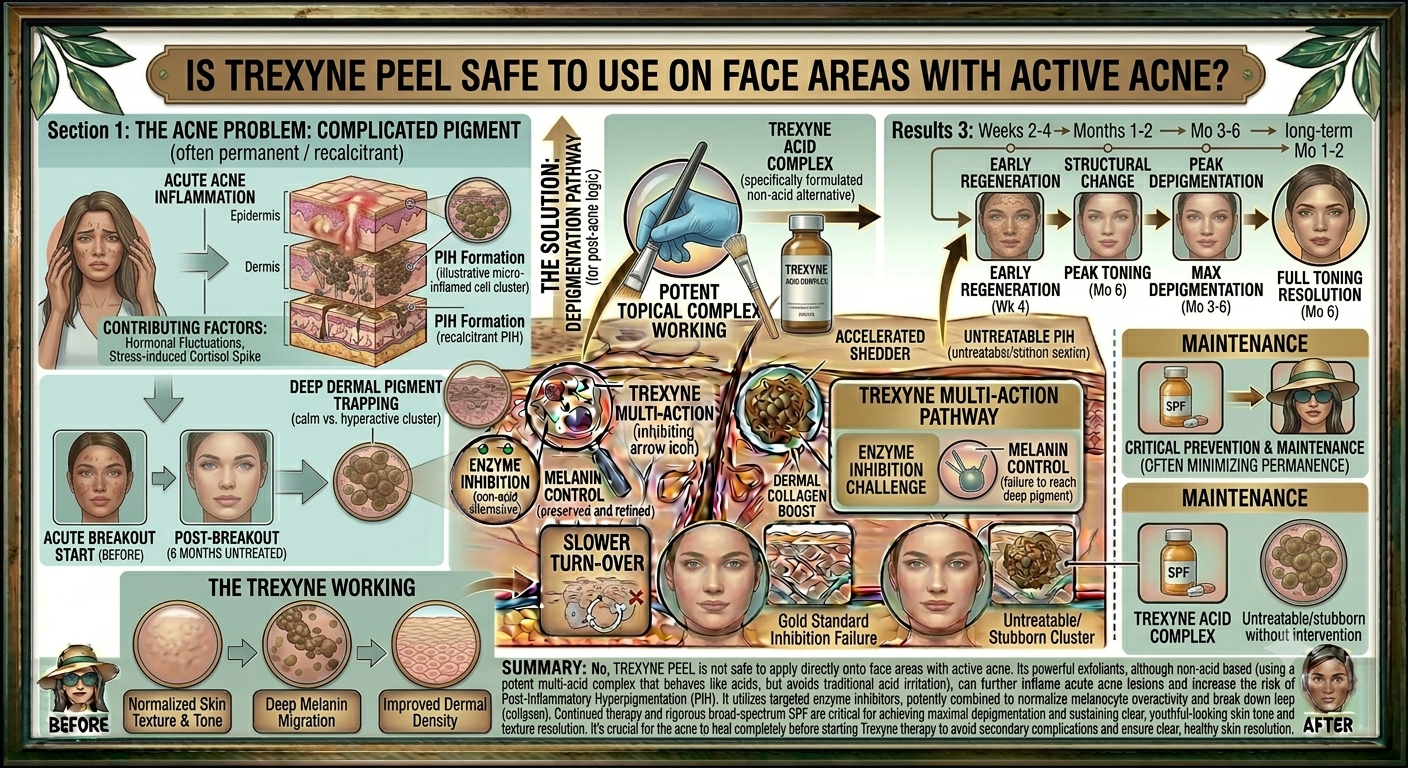
Is Trexyne Peel Safe to Use on Face Areas With Active Acne?
It is one of the most common questions practitioners ask before introducing any resurfacing treatment into their clinic menu: can this be used on skin with active acne? With the Trexyne Peel Professional Algae Resurfacing Treatment, the answer is not a simple yes or no. It depends on the presentation, the protocol, and how well you know your client’s skin. This post walks through what practitioners need to consider before treating acne-prone or actively breaking-out skin with the Trexyne Peel — covering the mechanism, client assessment, protocol considerations, and when it may be better to wait.
Understanding Active Acne Before Any Resurfacing Treatment
Before discussing Trexyne Peel specifically, it helps to define what “active acne” actually means in a clinical context.
The Difference Between Acne-Prone Skin and Active Breakouts
Acne-prone skin is a skin type. It tends toward congestion, enlarged pores, and irregular sebum production, but it may not have active lesions present at every consultation.
Active acne is a different matter. It refers to inflamed lesions — papules, pustules, nodules, or cysts — that are currently in an inflammatory phase. The skin barrier in these areas is already compromised. Sebaceous follicles are distended. There may be localised infection or secondary inflammation.
These two presentations require different clinical thinking, even when treating with a mechanical resurfacing product.
Why the Acne Question Matters for Resurfacing
Any resurfacing treatment, mechanical or otherwise, works by disrupting the skin surface to some degree. That disruption is the point — it stimulates renewal, refines texture, and improves the overall condition of the skin over time. But when inflammatory acne lesions are present, the skin’s surface integrity is already under strain. Adding further mechanical activity to those specific areas needs careful consideration.
How the Trexyne Peel Works: The Mechanical Mechanism
To evaluate safety on acne-prone skin, you first need to understand precisely how the Trexyne Peel functions. This is not a chemical peel. There are no acids involved and no chemical penetration.
Marine Algae Spicules: What They Do
The Trexyne Peel is built around marine algae spicules. These are microscopic, needle-like structures derived from marine algae. When applied to the skin and worked in using a professional technique, they create controlled micro-channels across the skin surface. This is a purely physical, mechanical process.
The spicules do not chemically dissolve the stratum corneum. They physically interact with it — creating precise, superficial channels that support the skin’s own renewal processes. The result is resurfacing without the unpredictability that can come with chemical exfoliation.
Stabilised Vitamin E: Supporting Recovery
Alongside the spicules, the Trexyne Peel contains stabilised Vitamin E (tocopherol). This ingredient supports the skin’s recovery phase from the first application. Vitamin E is well established for its role in skin recovery, and incorporating it into the formulation means the treatment is not simply wounding and leaving — it actively supports what comes next.
Why This Mechanism Matters for Acne Skin
The mechanical nature of the Trexyne Peel is actually a relevant consideration when treating acne-prone clients. Unlike formulations that rely on chemical penetration, the spicule mechanism is more localised in its action. A skilled practitioner can adapt application technique and pressure to the skin’s condition at the time of treatment. That adaptability is a meaningful clinical advantage.
Assessing the Client: What to Look For at Consultation
Practitioner assessment is the deciding factor in every case. The Trexyne Peel is designed exclusively for use by trained aesthetic professionals, and that professional judgement is exactly what is needed here.
Grading the Acne Presentation
Not all acne is the same at presentation. Consider the following:
Comedonal acne refers to blackheads and whiteheads without significant inflammation. The skin surface may be congested, but the inflammatory response is minimal. This presentation may still be suitable for a carefully applied, lower-intensity Trexyne protocol.
Mild to moderate inflammatory acne involves some papules and pustules. There is active inflammation, but lesions may be scattered rather than widespread. Treatment decisions here depend on the density of breakouts, their distribution across the face, and the client’s overall skin condition.
Severe inflammatory or cystic acne involves deep, painful nodules and cysts. The skin is significantly compromised. This is generally not an appropriate time to introduce resurfacing treatment of any kind.
The Client’s History With Resurfacing
A client who has never had any professional resurfacing treatment requires a different approach to one who has tolerated previous treatments well. Start conservatively. Use the Trexyne tiered protocol to match the intensity to the individual, not to the average client.
Skin Barrier Integrity
Active acne lesions are already areas of barrier disruption. If a client presents with extensive active breakouts across large areas of the face, the barrier is compromised over a significant surface. That is an important signal to consider carefully before proceeding.
The Trexyne Tiered Protocol: Matching Intensity to Skin Condition
One of the strengths of the Trexyne Peel is its tiered protocol. This means practitioners can adjust the intensity of treatment based on skin type and client expectation, rather than applying a one-size-fits-all approach.
Starting at Lower Intensity
When treating a client with active breakouts, the tiered protocol allows you to begin at a lower intensity. This means lighter application technique, reduced working time, and fewer passes over sensitive or inflamed areas. You are still delivering the resurfacing benefits of the marine spicule mechanism, but in a way that is calibrated to the skin’s current state.
Avoiding Active Lesions
A common and sensible clinical approach is to work around active inflammatory lesions rather than directly over them. The Trexyne Peel can be applied to areas of the face that are not currently inflamed while those specific breakout zones are avoided or treated with a much lighter hand. This spot-selective technique is something a practitioner with proper training will be comfortable adapting.
Building Tolerance Over a Course of Treatments
The Trexyne Peel is available in courses of 1, 10, or 20 peels, reflecting the value of cumulative treatment. For acne-prone clients, beginning conservatively and building intensity over successive sessions often produces better outcomes than pushing too hard at the first appointment. Visit Trexyne’s shop to view the full range of purchasing options for your clinic.
When to Proceed and When to Wait
This is the most important clinical decision a practitioner will make.
Situations Where Treatment May Be Appropriate
Trexyne Peel treatment may be appropriate when:
- The client presents with acne-prone skin but minimal active inflammatory lesions at the time of appointment
- Lesions present are primarily comedonal with limited active inflammation
- The client has a good consultation history and no known sensitivity issues
- A lower-intensity protocol is planned with careful avoidance of active lesions
- The practitioner is confident in assessing and managing the client’s expectations
Situations Where Waiting Is the Better Choice
In some cases, it is better to postpone treatment:
- Widespread active pustular or cystic breakouts across the face
- Skin that appears significantly compromised or infected
- A client who is mid-flare and has not been assessed at baseline
- Clients taking certain systemic medications for acne (always take a thorough medical history)
Your clinical judgement protects both the client and your professional reputation. When in doubt, wait.
Post-Treatment Considerations for Acne-Prone Skin
After treatment, acne-prone skin may respond differently to skin that is not prone to congestion.
Expected Downtime
The Trexyne Peel is designed for predictable downtime. The tiered protocol means that when you treat conservatively, the post-treatment response is manageable and consistent. Clients should expect some redness and mild sensitivity following treatment. For acne-prone skin, this generally settles in a similar timeframe to other skin types when a lower-intensity protocol has been used.
Aftercare Guidance
Advise clients to keep the skin clean and to avoid touching the face unnecessarily in the days following treatment. Heavy occlusive products should be avoided. Clients should also avoid further mechanical disruption to the skin, including other professional treatments, until the skin has settled.
What Clients May Notice
Over a course of treatments, acne-prone clients may notice improvements in skin texture, pore appearance, and overall skin clarity. These are the kinds of outcomes that motivate clients to commit to a full treatment course, which is why starting conservatively and building is a sound strategy.
Communicating With Acne-Prone Clients
How you discuss resurfacing treatment with an acne-prone client matters as much as how you deliver it.
Setting Realistic Expectations
Be clear that the Trexyne Peel is a professional resurfacing treatment focused on skin renewal, texture refinement, and resurfacing. It is not a standalone acne treatment in the clinical sense. Clients with active acne should have those lesions managed through appropriate channels, with the Trexyne Peel positioned as a complementary treatment for overall skin quality.
Transparency About the Protocol
Explain to clients why you are beginning at a lower intensity. Clients respond well to knowing that their treatment has been adapted to their skin’s current condition. It builds trust and increases the likelihood that they will commit to a full course.
Addressing Concerns About Breakout Risk
Some clients worry that resurfacing will trigger more breakouts. Acknowledge this concern directly. The Trexyne Peel works through a mechanical mechanism, not chemical penetration, and when used with the appropriate protocol and aftercare guidance, the risk of triggering new breakouts is managed through practitioner skill and timing.
Why Professional-Only Access Matters Here
The Trexyne Peel is sold strictly to verified practitioners and clinics. This is not a marketing position — it is a safety standard. Treatment decisions on acne-prone or active-acne skin require training, experience, and clinical assessment that cannot be replicated in a home setting.
The mechanical mechanism of the marine spicules is precise and effective in trained hands. In untrained hands, the same mechanism could be applied incorrectly, at the wrong intensity, on unsuitable skin, without the benefit of proper assessment. Professional access is what makes this treatment predictable and appropriate.
If you are a practitioner looking to introduce the Trexyne Peel to your clinic, or if you would like to discuss whether your clients are suitable candidates, visit the Trexyne website for more information about the product range, or get in touch with the Trexyne team directly.
Conclusion
Active acne on the face does not automatically rule out resurfacing treatment, but it does demand a thoughtful clinical approach. The Trexyne Peel’s mechanical mechanism, built on marine algae spicules and stabilised Vitamin E, gives practitioners a resurfacing option that can be adapted through the tiered protocol to match the skin’s current condition. By assessing the nature and extent of any breakouts, working around active inflammatory lesions, and starting at a lower intensity where appropriate, practitioners can use the Trexyne Peel safely and effectively on many acne-prone clients.
Over a course of treatments, clients with acne-prone skin may notice meaningful improvements in skin texture, tone, and overall clarity. The key is sound assessment, appropriate protocol selection, and clear communication — all things that trained aesthetic professionals are well placed to deliver.
Frequently Asked Questions
Q: Can the Trexyne Peel be used on skin with active acne pustules?
This depends on the extent and severity of the breakout. Where pustular lesions are widespread and the skin is significantly inflamed, it is generally more appropriate to wait until the breakout has settled before proceeding. Where lesions are scattered and the overall skin condition is suitable, a lower-intensity protocol with careful avoidance of active lesions may be appropriate. Practitioner assessment is essential in every case.
Q: Is the Trexyne Peel a chemical peel suitable for acne-prone skin?
The Trexyne Peel is not a chemical peel. It works through a purely mechanical mechanism using marine algae spicules, which create controlled micro-channels in the skin without the use of chemical exfoliants. This distinction is relevant for acne-prone skin because there is no acid activity involved, which changes the risk profile compared to traditional chemical peeling treatments.
Q: How many Trexyne Peel sessions are recommended for acne-prone clients?
There is no universal number, as this depends on the individual client’s skin condition and how they respond to treatment. Many practitioners find that a course of treatments produces the best results. The Trexyne Peel is available in single, 10-peel, and 20-peel options, allowing clinics to offer structured courses that match a client’s treatment plan.
Q: Will the Trexyne Peel make acne worse?
When applied correctly by a trained practitioner using an appropriate protocol, the Trexyne Peel is not expected to trigger new breakouts. Starting with a lower-intensity protocol and avoiding active lesions are key elements of safe treatment on acne-prone skin. Proper aftercare guidance also plays an important role in managing post-treatment skin response.
Q: Can I use the Trexyne Peel on a client who is currently on prescription acne medication?
A full medical history must be taken at consultation. Some systemic medications used for acne can affect skin sensitivity, healing response, and tolerance to resurfacing treatments. Always review what your client is currently taking and apply your clinical judgement accordingly before proceeding with treatment.
Q: Where can aesthetic professionals purchase the Trexyne Peel for their clinic?
The Trexyne Peel is sold exclusively to verified practitioners and clinics. You can find full purchasing information through the Trexyne shop, or contact the Trexyne team if you have specific questions about clinic orders or professional verification.
Q: Is the Trexyne Peel suitable for clients with both acne scarring and active breakouts?
These are two separate skin concerns that often co-exist. Active breakouts require careful management as described above. Acne scarring, where lesions are no longer active, is generally a more straightforward indication for resurfacing treatment. When both are present, a phased approach may be appropriate — addressing active breakouts first and then focusing on resurfacing and renewal once the skin is in a more stable condition.