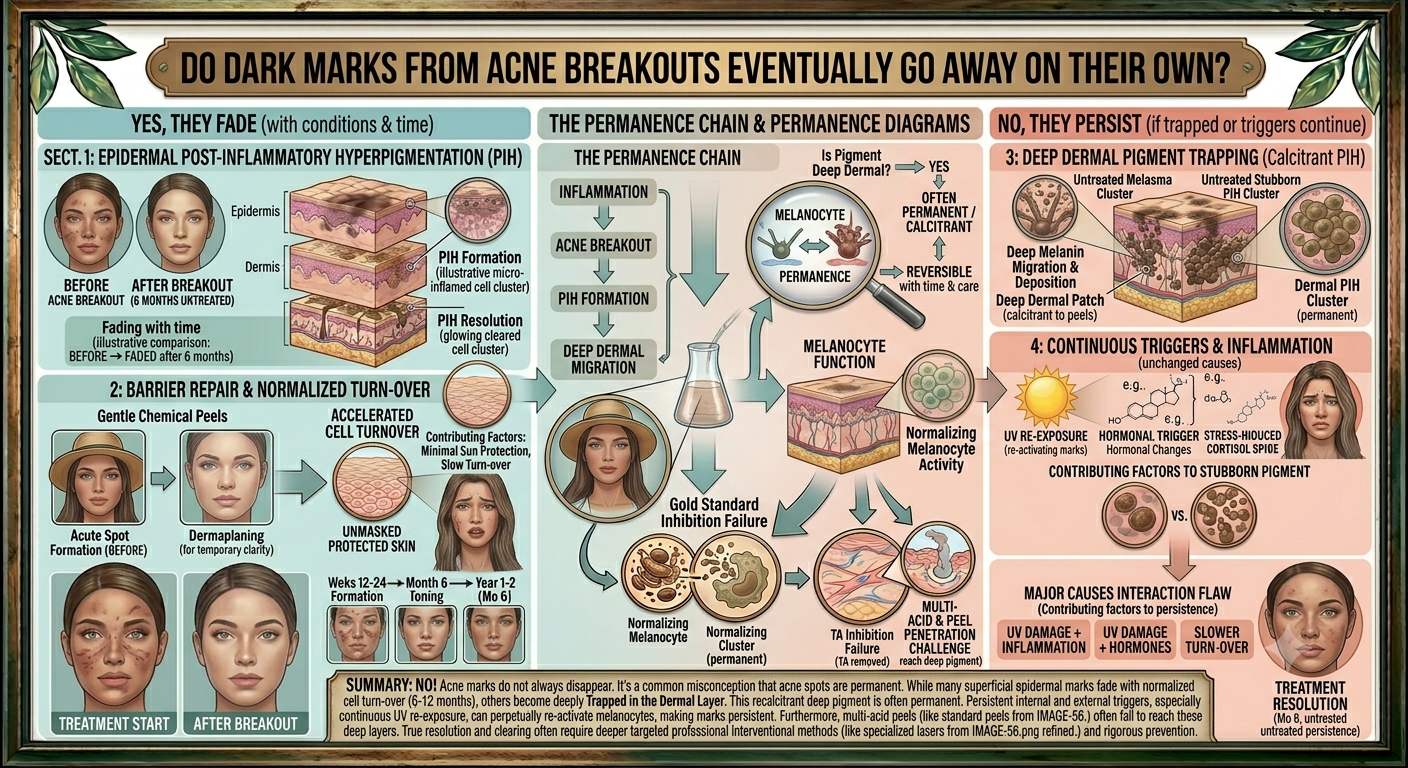
Do Dark Marks From Acne Breakouts Eventually Go Away On Their Own?
Dark marks left behind after a breakout are one of the most common concerns clients raise in clinic. The honest answer is that some marks do fade on their own over time, but many linger far longer than people expect, sometimes for months or even years. This happens because post-acne pigmentation sits in the skin at a depth that the body’s natural renewal process struggles to clear quickly. For practitioners and clients who want to speed up that process safely, the Trexyne Peel offers a professional route that supports resurfacing without relying on chemical exfoliants. Understanding why these marks form, and what genuinely helps them fade, is the first step toward managing expectations and results.
What Causes Dark Marks After Acne?
Dark marks that appear after a spot has healed are usually a form of post-inflammatory hyperpigmentation, often shortened to PIH. When skin experiences inflammation, whether from a cyst, a popped pimple, or even an aggressive extraction, the melanocytes in that area can become overstimulated. This leads to excess pigment being deposited in the upper layers of the skin, leaving a flat, discoloured mark once the original blemish has healed.
It is worth noting that PIH is different from acne scarring. Scarring involves a change in skin texture, such as indentation or raised tissue, caused by damage to collagen structures. Dark marks, by contrast, are purely a pigmentation issue and do not involve textural change. This distinction matters because the two require different approaches.
Why Some Marks Fade Faster Than Others
Skin tone, the depth of the original inflammation, and how much the area was picked at or irritated during healing all influence how long a mark sticks around. Deeper inflammation tends to push pigment further into the skin, which naturally takes longer to clear through normal cell turnover.
How Long Do Acne Dark Marks Usually Take To Fade?
For many people, mild PIH can fade within three to six months as the skin naturally renews itself. However, more stubborn marks, particularly those affecting deeper skin tones or areas that were repeatedly irritated, can take twelve months or longer to fade fully without intervention. Some marks may never disappear entirely on their own, especially if the cell turnover process has slowed due to age, sun exposure, or ongoing inflammation in the area.
This is why so many clients become frustrated waiting for marks to clear and start looking for professional support that can encourage the renewal process along more efficiently.
Why Does Skin Take So Long To Clear Pigmentation Naturally?
The skin’s natural renewal cycle, where old surface cells shed and are replaced by fresh ones, slows down with age and can be disrupted by factors like sun exposure, hormonal changes, and chronic skin stress. When this cycle is sluggish, pigmented cells sit on the surface for longer instead of being cleared away as part of normal turnover.
This is one of the reasons professional resurfacing treatments are often recommended for persistent dark marks. By gently encouraging the renewal process, these treatments can help shift pigmented cells along more efficiently than waiting for the skin to do it entirely unassisted.
Can At-Home Skincare Alone Clear Dark Marks?
Many clients try to manage dark marks with home skincare routines built around brightening serums or daily SPF. These steps are genuinely helpful for protecting skin and supporting overall tone, and good sun protection in particular helps prevent marks from darkening further. However, home skincare alone is often limited in how much it can accelerate the clearance of more established pigmentation.
This is where in-clinic, professional-grade treatments come into their own. A trained practitioner can assess the depth and type of pigmentation and choose a resurfacing approach that matches the skin’s needs, something that is simply not possible with over-the-counter products.
Why Mechanical Resurfacing Is Worth Understanding
When people think of resurfacing treatments for pigmentation, chemical peels often come to mind first. However, not every effective resurfacing option relies on chemical exfoliation. The Trexyne Peel works through a different route entirely.
How Trexyne Peel’s Mechanism Differs
Trexyne Peel is built around marine-algae spicules and stabilised Vitamin E. The spicules create controlled micro-channels in the skin through a purely mechanical mechanism, with no acids and no chemical exfoliants involved at any stage. This botanical mechanism allows practitioners to support resurfacing and skin renewal without the chemical penetration associated with traditional peeling agents.
For clients who are wary of chemical peels, or for practitioners who want a predictable, tiered approach to treatment intensity, this mechanical method offers an alternative way to support the skin’s natural renewal process.
What Makes Trexyne Peel Suitable For Post-Acne Marks?
Post-acne dark marks sit within the skin’s surface layers, and supporting renewal in that area is central to helping them fade. Trexyne Peel is designed to do exactly that. Its marine-algae spicules create controlled micro-channels that support the skin’s resurfacing process, while the stabilised Vitamin E infused into the formula supports the skin’s recovery phase from the very first application.
This combination means the treatment is not just about creating micro-channels, but about supporting the skin through its recovery afterwards too, which is particularly relevant for clients dealing with lingering post-acne discolouration.
The Value Of A Tiered Protocol
One of the most useful aspects of Trexyne Peel for treating dark marks is its tiered protocol. This allows a practitioner to match treatment intensity to the client’s skin type and expectations around downtime. For clients with more sensitive skin or those new to professional resurfacing, this predictability can make a real difference to comfort and confidence in the process.
What Should Practitioners Consider Before Recommending Resurfacing For Dark Marks?
Before recommending any resurfacing treatment, a thorough skin consultation is essential. Practitioners need to assess skin type, the depth and age of the pigmentation, and whether the client has any history of sensitivity or post-inflammatory response to previous treatments. This is part of why Trexyne Peel is sold strictly to verified practitioners and clinics rather than directly to the public, ensuring the treatment is always delivered with proper assessment and aftercare guidance.
Clinics interested in stocking Trexyne Peel as part of their pigmentation treatment offering can browse the full range on the Trexyne shop page or get in touch directly via the contact page for more detail on protocols and training.
How Many Sessions Are Typically Needed?
The number of sessions needed to support visible improvement in post-acne dark marks varies from client to client. Factors such as how long the pigmentation has been present, its depth, and the client’s overall skin renewal rate all play a role. A single 30ml practitioner vial of Trexyne Peel provides approximately six to eight full-face treatments, which allows for a course of sessions to be planned out as part of a structured treatment programme.
Practitioners often find that a course of treatments, spaced appropriately apart, supports more noticeable results than a single session, particularly for marks that have been present for several months or longer.
Supporting Realistic Expectations With Clients
It is important for practitioners to set realistic expectations with clients from the outset. While Trexyne Peel’s mechanical resurfacing and Vitamin E support may help encourage a brighter, more even-looking complexion over time, results vary depending on individual skin and the nature of the pigmentation being treated. No professional should promise guaranteed or immediate clearance of dark marks, as skin renewal is a gradual biological process.
Clear, honest communication about timelines and likely outcomes helps build trust and ensures clients understand what a course of treatment can realistically offer.
Where To Learn More About Trexyne Peel
Practitioners who want to explore whether Trexyne Peel fits within their pigmentation treatment offering can find full product details on the Trexyne Peel product page, or visit the Trexyne homepage to learn more about the brand and its approach to professional botanical resurfacing.
Conclusion
Dark marks left behind after acne breakouts can fade on their own, but the process is often slow and unpredictable, particularly for deeper or longer-standing pigmentation. Understanding the difference between post-inflammatory pigmentation and true scarring helps set the right expectations, as does recognising that home skincare alone often has limits when it comes to speeding up clearance. For clients seeking professional support, mechanical resurfacing offers an alternative to traditional chemical peels. Trexyne Peel, with its marine-algae spicule mechanism and stabilised Vitamin E, is designed to support the skin’s natural renewal process through a tiered, predictable protocol. Used as part of a properly assessed treatment plan, it may help support a brighter, more even-looking complexion over time.
FAQs
Q: Do all acne dark marks eventually fade without treatment?
Many mild marks do fade over several months as the skin naturally renews itself, but more stubborn or deeper pigmentation can persist for a year or longer, and some marks may not clear fully without professional support.
Q: What is the difference between acne scarring and acne dark marks?
Dark marks are a pigmentation issue caused by post-inflammatory melanin deposits, while scarring involves changes to skin texture from collagen damage. They require different treatment approaches.
Q: Is Trexyne Peel a chemical peel for treating dark marks?
No. Trexyne Peel works through a purely mechanical mechanism using marine-algae spicules to create controlled micro-channels. It contains no acids and does not rely on chemical exfoliation.
Q: How many Trexyne Peel sessions are usually needed for post-acne pigmentation?
This varies by individual, but a course of treatments is often recommended rather than a single session, particularly for marks that have been present for several months. A 30ml vial provides approximately six to eight full-face treatments.
Q: Can Trexyne Peel be used at home for dark marks?
No. Trexyne Peel is designed exclusively for use by trained aesthetic professionals in a clinic setting and is sold strictly to verified practitioners.
Q: Why does Trexyne Peel include Vitamin E?
The formula includes stabilised tocopherol to support the skin’s recovery phase from the first application, working alongside the mechanical resurfacing action of the marine-algae spicules.
Q: How can a clinic start offering Trexyne Peel to clients?
Clinics can review the available options on the Trexyne shop page or reach out through the contact page to discuss protocols and verification as a professional practitioner.