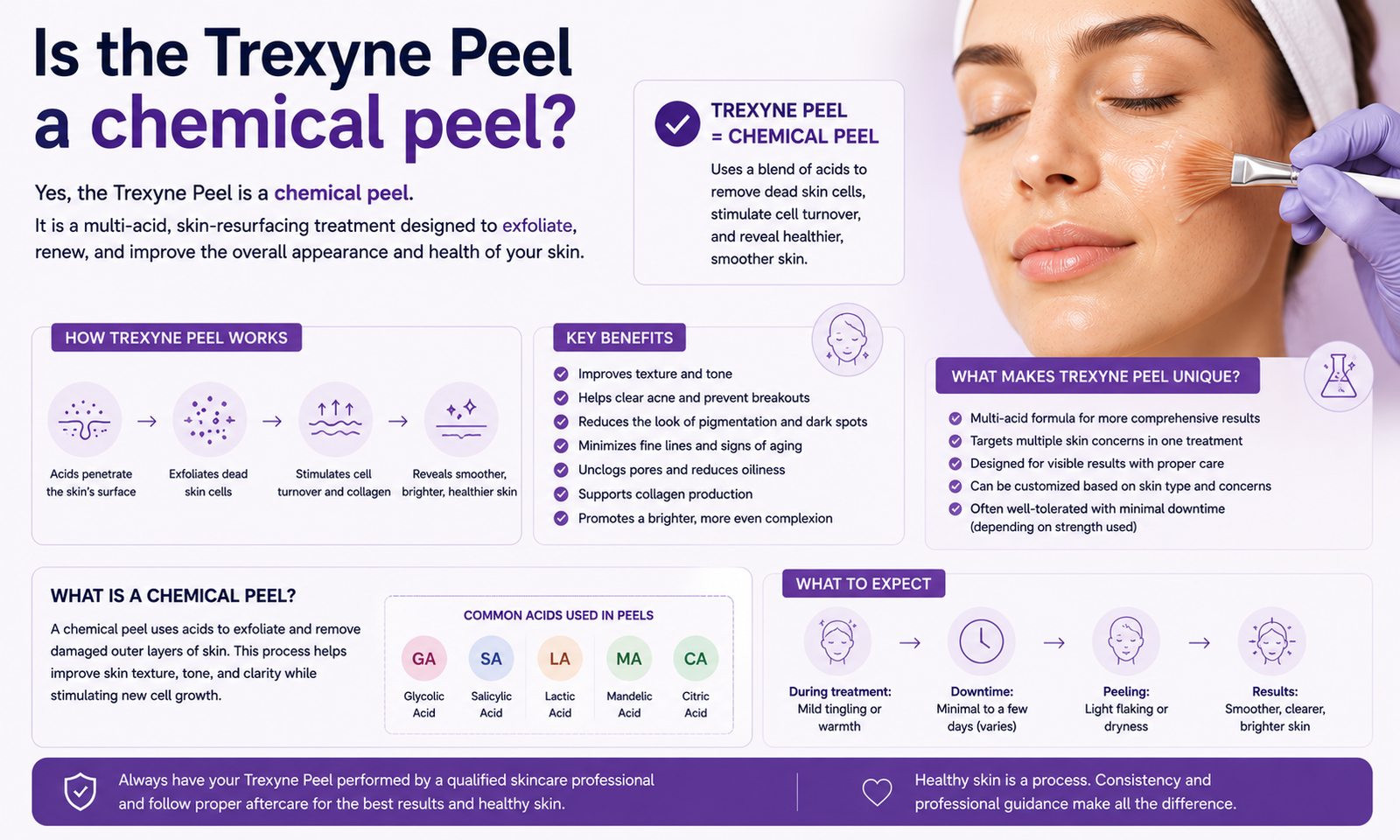
Is the Trexyne Peel a Chemical Peel?
No. The Trexyne Peel is not a chemical peel. This is one of the most important things to understand about the product before using it clinically or recommending it to clients. It works through an entirely different mechanism. Where chemical peels use acids or other chemical exfoliants to dissolve bonds between skin cells and trigger a chemical reaction within the skin, the Trexyne Peel resurfaces through a purely physical process using marine-algae spicules. No acids are involved at any stage. No chemical reaction takes place in the skin during treatment. The result is a resurfacing effect achieved through mechanical action rather than chemical penetration, which has real clinical implications for how the skin responds, how it recovers, and which clients are well suited to it. Understanding that distinction in full is the starting point for using the Trexyne Peel effectively.
What a Chemical Peel Actually Does
To understand why the Trexyne Peel is not a chemical peel, it helps to be clear about what chemical peeling actually involves. Chemical peels work by applying an active chemical agent, typically an acid of some kind, to the skin surface. This agent disrupts the bonds holding dead or damaged skin cells together, causing the outer layers to shed and stimulating renewal in the layers beneath.
The chemistry of this process is the mechanism. The acid reacts with skin tissue. That reaction generates a controlled inflammatory response, which is part of how the renewal process is triggered. The depth of the peel, the degree of cell turnover stimulated, and the recovery period required are all determined by the chemical reaction, which is influenced by the concentration of the agent, the application time, and the condition of the skin.
This inflammatory response is a feature of how chemical resurfacing works, not a side effect of it. For many skin types it is manageable and temporary. For others, particularly those with reactive, sensitised, or pigmentation-prone skin, it is the reason chemical peeling carries a higher risk of prolonged redness, barrier disruption, or post-inflammatory hyperpigmentation.
What the Trexyne Peel Does Instead
The Trexyne Peel achieves resurfacing through a fundamentally different route. The active component is marine-algae spicules, which are naturally occurring microscopic structures derived from marine algae. When applied to the skin correctly by a trained practitioner, these spicules create controlled micro-channels in the surface layers of the skin through direct physical action. The mechanism is entirely mechanical. The spicules interact with the skin structurally rather than chemically.
This mechanical action stimulates the skin’s renewal process in a similar way to chemical resurfacing in terms of the end goal, supporting cell turnover, refining texture, and encouraging fresher, more even skin to the surface. But the route to that outcome is entirely different. There is no chemical reaction. There is no acid penetrating the skin. There is no chemically induced inflammation as the driver of the renewal process.
The clinical implications of this difference are significant, and they shape which clients are best suited to the Trexyne Peel versus those who might be candidates for a chemical resurfacing approach.
Why the Mechanism Distinction Matters Clinically
The phrase “no acids, no surprises” in the Trexyne Peel’s product description is not simply a marketing line. It reflects a real clinical characteristic of the treatment that matters in practice.
Chemical resurfacing involves managing a reaction that, once initiated, follows its own course. The practitioner applies the product, the chemical reaction begins, and the degree of that reaction is influenced by multiple variables including the client’s skin condition on the day, any barrier disruption that may have existed before treatment, and how the skin’s individual biochemistry responds to the specific agent used. Skilled practitioners manage this well, but the unpredictability is inherent to the mechanism.
Mechanical resurfacing removes the chemical reaction from the equation. The degree of resurfacing is determined by how the treatment is applied, the number of passes, the pressure used, and the intensity level selected within the tiered protocol. These are variables the practitioner directly controls rather than variables that emerge from the chemistry once treatment is underway. This is what the product means by predictable: the outcome is more directly linked to the practitioner’s decisions throughout the session.
What Marine-Algae Spicules Are
It is worth understanding what marine-algae spicules actually are, because they are the core of what makes the Trexyne Peel’s mechanism possible. Spicules are tiny, needle-like structural elements found naturally in certain marine organisms, including some species of algae. They are solid, physical structures with a natural geometry that enables them to create micro-channels in the skin’s surface when applied with appropriate technique.
Their action is comparable in concept to how other forms of physical resurfacing work, but specific to their natural structure and scale. The micro-channels they create are controlled and deliberate, not random or aggressive. The depth and density of these micro-channels is influenced by the practitioner’s technique and the protocol intensity selected, which is why the tiered protocol and trained application are inseparable from the treatment’s clinical value.
The fact that the mechanism is botanical and naturally derived is also worth noting for practitioners who work with clients seeking treatments that align with a preference for non-synthetic active agents.
Why No Chemical Exfoliants Means No Chemical Inflammatory Trigger
The absence of chemical exfoliants from the Trexyne Peel’s mechanism is not simply a formulation choice. It has a direct functional consequence. Chemical exfoliants trigger an inflammatory pathway in the skin as part of how they work. This pathway is the mechanism by which melanocytes in sensitive or pigmentation-prone skin can overreact, producing excess melanin and leading to the post-inflammatory hyperpigmentation that is one of the most common adverse outcomes of chemical resurfacing.
Without a chemical exfoliant, that specific inflammatory trigger is not present. The skin undergoes resurfacing and the renewal process is stimulated, but through a mechanical route that does not engage the same inflammatory cascade. This is why the Trexyne Peel’s mechanism is particularly relevant for skin types that are prone to PIH or that have a history of prolonged inflammatory responses following chemical treatments.
The Role of Stabilised Vitamin E
The Trexyne Peel includes stabilised tocopherol, a form of Vitamin E, which supports the skin’s recovery phase from the first application. This is a deliberate formulation decision that complements the mechanical resurfacing mechanism. Even without a chemical reaction in the skin, any resurfacing creates a degree of controlled disruption that requires recovery. Supporting that recovery from within the treatment formulation itself means the skin is not left to manage the repair process unaided.
Stabilised tocopherol is chosen specifically because of its stability compared to other forms of Vitamin E, which can be prone to oxidation and become less effective over time. The stabilised form maintains its potency through the product’s shelf life and through application to the skin, delivering recovery support consistently across every use.
For practitioners, this means the recovery-supportive component of the formulation is reliable rather than variable, which contributes to the consistency of outcomes across a treatment course.
Who Benefits Most From a Non-Chemical Resurfacing Approach
The clinical value of the Trexyne Peel’s non-chemical mechanism is most clearly relevant for several client groups that practitioners regularly encounter.
Clients with sensitive or reactive skin who have previously experienced prolonged redness or barrier disruption following chemical resurfacing treatments are often the clearest candidates. The absence of a chemical inflammatory trigger reduces the risk of the same response occurring, and the tiered protocol allows intensity to be started conservatively and built gradually.
Clients with medium to darker skin tones in the Fitzpatrick III to VI range, who carry a higher risk of post-inflammatory hyperpigmentation following inflammatory triggers, benefit from a resurfacing approach that does not rely on generating a chemical inflammatory response in the skin.
Clients who have experienced post-inflammatory hyperpigmentation after previous treatments and need a resurfacing approach that supports renewal without restimulating the melanocyte pathway that caused the original pigmentation.
Clients who want effective resurfacing results but cannot accommodate extended or unpredictable downtime in their schedule, for whom the predictable recovery profile of a mechanical, tiered treatment is a practical advantage.
The Tiered Protocol and What It Enables
The Trexyne Peel is built around a tiered protocol that allows practitioners to match treatment intensity to the individual client’s skin type, current condition, and treatment history. This is possible precisely because the mechanism is mechanical rather than chemical. The intensity of the resurfacing is determined by how the treatment is applied, which means the practitioner can genuinely calibrate it from session to session rather than committing to a fixed chemical depth.
For practitioners who work with a diverse client base, this flexibility is a significant clinical advantage. A single product can serve multiple different skin types and concerns at different intensity levels, rather than requiring different products or formulations for different depths of intervention.
Practitioners interested in stocking the Trexyne Peel can explore the full range through the Trexyne shop, or contact the team directly via the Trexyne contact page.
How This Affects Client Conversations
The fact that the Trexyne Peel is not a chemical peel matters in client consultations, because the term “peel” carries strong associations for many clients. Clients who have had difficult experiences with traditional peels, or who have been advised to avoid chemical peels due to their skin type or concern history, may assume the Trexyne Peel carries the same risks and contraindications.
Explaining clearly that the mechanism is mechanical rather than chemical, that no acids are involved, and what this means specifically for their skin type and history is an important part of the consultation process. Clients who understand the difference are better placed to give informed consent, set realistic expectations, and engage with the treatment course with confidence rather than anxiety.
This conversation is also an opportunity to reframe what “peel” means in the context of this treatment. The word describes the outcome, not the method. The skin renews and refines through a process that has nothing to do with acid application or chemical exfoliation.
More information on the Trexyne Peel’s approach to professional botanical resurfacing is available on the Trexyne website.
Conclusion
The Trexyne Peel is not a chemical peel. It works through marine-algae spicules that resurface the skin through a purely mechanical mechanism, with no acids and no chemical exfoliants involved at any stage. This removes the chemical inflammatory trigger that underlies the most common adverse outcomes associated with acid-based resurfacing, including prolonged redness, barrier disruption, and post-inflammatory hyperpigmentation in susceptible skin types. Stabilised Vitamin E supports recovery from the first application, and the tiered protocol allows practitioners to calibrate intensity directly rather than managing the variables of a chemical reaction. For practitioners and clients who have been searching for a resurfacing option that delivers meaningful skin renewal without the risk profile of chemical peeling, the Trexyne Peel offers a clinically distinct alternative that may support a brighter, more even-looking complexion for a broad range of skin types and concerns.
FAQs
Q: Is the Trexyne Peel a chemical peel?
No. The Trexyne Peel is not a chemical peel. It resurfaces the skin through a mechanical mechanism using marine-algae spicules. No acids or chemical exfoliants are involved at any stage of the treatment.
Q: How is the Trexyne Peel different from a chemical peel?
Chemical peels use acids to dissolve skin cell bonds and trigger a chemical reaction in the skin. The Trexyne Peel uses marine-algae spicules to create controlled micro-channels through a purely physical mechanism. This removes the chemical inflammatory trigger that is central to chemical peeling and changes the risk profile of the treatment, particularly for sensitive, reactive, and pigmentation-prone skin types.
Q: Can clients who cannot have chemical peels have the Trexyne Peel?
The Trexyne Peel’s mechanical mechanism removes the specific risks associated with chemical exfoliants, which makes it a more suitable option for some clients who have been advised against or who have reacted badly to chemical resurfacing. A thorough consultation with a trained practitioner will assess individual suitability and determine whether the treatment is appropriate.
Q: Does the Trexyne Peel still cause redness even though it is not a chemical peel?
Any resurfacing treatment creates a degree of controlled disruption in the skin that may produce some temporary redness during the recovery period. Because the Trexyne Peel does not generate a chemical inflammatory response, the redness associated with recovery is generally more predictable and manageable compared to chemical resurfacing, particularly in reactive or sensitive skin. The tiered protocol allows intensity to be matched to the skin’s tolerance.
Q: Is the Trexyne Peel safe for darker skin tones?
Fitzpatrick skin types III to VI carry a higher risk of post-inflammatory hyperpigmentation following treatments that generate a chemical inflammatory response. Because the Trexyne Peel resurfaces mechanically without chemical exfoliants, it removes this specific trigger, which may make it a more appropriate resurfacing option for clients in these Fitzpatrick groups. Practitioners assess individual suitability at consultation.
Q: What does the Trexyne Peel contain if it has no acids?
The Trexyne Peel contains marine-algae spicules, which are the active resurfacing component, and stabilised tocopherol, a form of Vitamin E that supports the skin’s recovery phase. These are the two key components described in the official product brief. The treatment is free from acids and chemical exfoliants.
Q: Where can practitioners find out more about the Trexyne Peel?
Practitioners can explore the full product range and stocking options via the Trexyne shop, or contact the team directly through the Trexyne contact page for further information about incorporating the treatment into their clinical protocols.