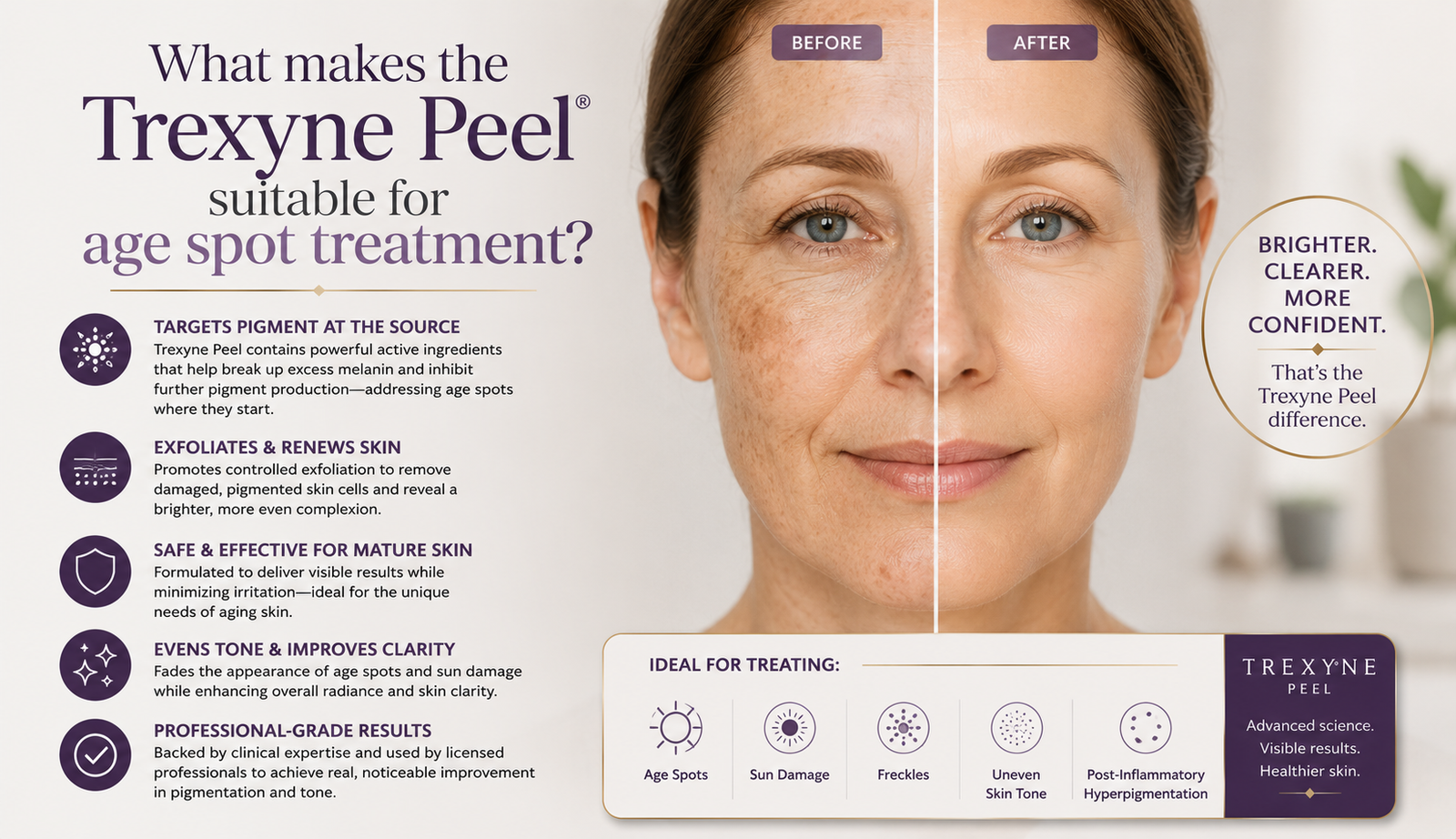
What makes the Trexyne Peel suitable for age spot treatment?
Age spots are one of the most frequently discussed skin concerns in professional aesthetic clinics. They develop over time, are resistant to many topical treatments, and can significantly affect a client’s confidence. The good news is that targeted resurfacing, delivered with the right tool, can make a real difference. The Trexyne Peel is built around a mechanical resurfacing mechanism that may support a more even skin tone over a course of treatments, without the unpredictability that sometimes accompanies more aggressive interventions. This post explores what age spots are, why they form, and why the Trexyne Peel is increasingly the treatment of choice for practitioners looking for a dependable, botanically derived resurfacing option.
Understanding age spots: what they are and why they form
Age spots, sometimes called solar lentigines or liver spots, are flat, darkened areas of skin that appear most commonly on sun-exposed areas. The face, backs of the hands, forearms, and decolletage are the most frequently affected zones. They vary in colour from light tan through to dark brown and tend to have a defined border.
The role of melanin
Skin colour is determined by melanin, the pigment produced by melanocytes in the basal layer of the epidermis. When skin is exposed to UV light, melanocytes produce more melanin as a protective response. Over years of cumulative exposure, this process can become uneven. Certain areas produce an excess of melanin that clusters rather than distributing evenly, resulting in the discolouration we recognise as an age spot.
Who is most affected
Age spots are more prevalent in people over 40, though they can appear earlier with high sun exposure or in those with a history of sunbed use. Fairer skin tones are statistically more susceptible, though age spots can develop across all Fitzpatrick types. Hormonal influences, particularly from pregnancy or oral contraception, can also accelerate pigment clustering in a similar pattern.
Why surface-level treatments often fall short
Many clients arrive at the clinic having already tried a range of skincare products aimed at brightening or fading spots. Some of these may offer modest improvement over many months. However, products applied to the surface of intact skin face a fundamental challenge: the pigment they are targeting sits deeper in the epidermis, and the outer layer of dead skin cells forms a barrier that limits how much active ingredient actually reaches the right depth.
This is where professional resurfacing treatments deliver results that topical skincare simply cannot match. By working at the level of the stratum corneum and encouraging the shedding of pigment-containing cells, a well-designed resurfacing treatment can help accelerate the natural cell turnover process. Done consistently over a course, this can visibly reduce the appearance of established age spots and help prevent new ones from consolidating at the surface.
The Trexyne Peel: a mechanical approach to resurfacing
The Trexyne Peel takes a distinct approach to resurfacing. Rather than relying on chemical exfoliation, it works through a purely mechanical mechanism. This distinction matters enormously when treating pigmentation concerns, particularly in clinic environments where clients have varied skin types and unpredictable sensitivities.
How marine spicules create controlled micro-channels
The active resurfacing component in the Trexyne Peel is marine algae spicules. These are microscopic, needle-like structures derived from marine organisms. When applied to the skin, they create controlled micro-channels in the stratum corneum, physically disrupting the outermost layer without any chemical penetration. This triggers a targeted renewal response at the skin’s surface, encouraging the turnover of pigment-bearing cells.
The result is a genuine resurfacing effect, delivered entirely through mechanical action. There are no acids involved, no chemical exfoliants, and no risk of the pH-related unpredictability that can complicate other resurfacing approaches. For practitioners managing age spot concerns in clients with reactive or sensitive skin, this is a significant practical advantage.
Vitamin E to support the skin through renewal
Alongside the marine spicules, the Trexyne Peel incorporates stabilised tocopherol, a form of Vitamin E. This ingredient supports the skin’s recovery phase from the first application. Vitamin E is well recognised for its role in skin conditioning and can help the skin maintain comfort during the renewal process. Its inclusion reflects a considered formulation approach, pairing the resurfacing action with nutritive support so the skin is not simply disrupted but also tended to throughout treatment.
Why a mechanical mechanism is especially relevant for pigmentation
Treating age spots requires a reliable, repeatable method of encouraging cell turnover in the superficial epidermis. The challenge with many resurfacing approaches is variability. Results can differ depending on skin sensitivity, preparation, environmental factors, and the practitioner’s experience with the product. Any resurfacing treatment that introduces additional variables around depth or reactivity makes consistent pigmentation outcomes harder to achieve.
The mechanical action of marine spicules removes some of that variability. The resurfacing effect is a direct consequence of physical contact with the skin. There is no chemical cascade to manage and no complex neutralisation step. This lends itself well to a tiered protocol approach, where the practitioner can match treatment intensity to the individual client’s skin type and the nature of their pigmentation concern.
For clients with age spots that have developed gradually over years of sun exposure, a course of treatments spaced appropriately can steadily reduce the depth of visible pigmentation as newer, more evenly pigmented cells emerge at the surface. The Trexyne Peel supports this kind of structured, progressive approach with predictable results across a course.
The tiered protocol: matching intensity to the client
One of the practical strengths of the Trexyne Peel is its tiered protocol. Not all age spots are the same in depth or density, and not all clients tolerate the same treatment intensity. A lighter presentation of superficial spotting in a client with fair, sensitive skin requires a different approach than denser, more established pigmentation in a client with greater skin resilience.
The tiered protocol in the Trexyne Peel system allows the practitioner to adjust accordingly. This is not a one-size-fits-all treatment. It is a tool that rewards thoughtful assessment and clinical judgement. Practitioners can begin at a lower intensity and progress through the protocol as the client’s skin adapts, or maintain a consistent intensity for clients where the primary goal is sustained maintenance rather than aggressive correction.
This adaptability is one of the reasons practitioners find the Trexyne Peel fits naturally into an age spot treatment programme rather than functioning as a standalone, occasional intervention. You can explore full protocol details and treatment options via the Trexyne shop.
What practitioners can realistically expect across a course of treatments
Expectations matter in aesthetics. Managing what clients hope for and what a treatment can reliably deliver is central to a successful clinical relationship. When it comes to age spots, the Trexyne Peel is not presented as a single-session correction. Its strength lies in progressive improvement over a course.
Treatment spacing and course structure
Most practitioners structure age spot treatments in courses of several sessions, typically spaced two to four weeks apart. The Trexyne Peel vial contains approximately six to eight full-face treatments, which aligns well with a structured course without requiring frequent reordering. This makes planning straightforward, and the vial format keeps waste minimal.
What clients may notice
Over a course of treatments, clients with age spots may notice a gradual lightening of the affected areas. The pigmented cells in the outermost layer shed more efficiently, and the fresh cells emerging beneath are not yet carrying the accumulated pigment. Skin texture may also improve alongside tone, as the micro-channelling action supports a broader renewal response in the epidermis.
Downtime is predictable and, for most clients, manageable within their daily routines. The Trexyne Peel is designed to offer a tiered downtime response, meaning clients can be informed accurately in advance of what to expect and plan accordingly.
How Trexyne Peel compares to more aggressive resurfacing approaches
Practitioners working in age spot treatment have a range of options available to them, spanning different technologies and mechanisms. The positioning of the Trexyne Peel within this landscape is important to understand.
More aggressive resurfacing approaches can deliver faster results but often carry a higher burden in terms of downtime, preparation, and post-treatment management. For clients who cannot accommodate extended downtime, or for those whose skin type makes them less suitable candidates for more intense procedures, the Trexyne Peel offers a genuinely useful alternative.
It is also worth noting that the Trexyne Peel can sit alongside other treatments in a comprehensive skin programme. Because it works mechanically rather than through chemical means, there is no concern about layering chemical mechanisms. This makes it a flexible addition to a clinic’s offering rather than a treatment that competes with or disrupts the rest of a client’s plan.
If you would like to discuss how the Trexyne Peel might fit within your existing treatment portfolio, the team is available via the contact page.
Professional-only: why this matters for age spot treatment outcomes
The Trexyne Peel is sold exclusively to verified practitioners and clinics. This is not a limitation; it is a deliberate design choice that supports better outcomes. Age spot treatment requires accurate skin assessment before any resurfacing intervention. Factors such as Fitzpatrick type, the nature and depth of the pigmentation, any recent sun exposure, and the client’s full history of previous treatments all inform how a course should be structured.
A trained professional can make those assessments, manage the protocol appropriately, and recognise when progress is on track or when adjustments are needed. The Trexyne Peel is built to be used in this environment, which is why its results hold up consistently across a range of client presentations when it is applied with professional oversight.
All product information, including pricing, vial size, and professional eligibility, is available on the Trexyne website.
Supporting age spot treatment with the right aftercare advice
Resurfacing produces its best results when the skin is supported well between sessions. For age spot treatment, aftercare guidance is particularly important because UV exposure is the primary driver of melanin overproduction. Any resurfacing treatment, including the Trexyne Peel, should be accompanied by clear and consistent sun protection advice.
Clients should be counselled to apply a high-SPF broad-spectrum sunscreen every morning, regardless of whether they plan to spend time outdoors. Reapplication throughout the day is advisable if exposure is prolonged. Hats, protective clothing, and seeking shade during peak UV hours are practical additions that make a genuine difference to long-term outcomes.
Post-treatment, the skin may be more sensitive to UV for a short period as the outer layers are actively renewing. This makes clear aftercare communication an important part of the practitioner’s role in any resurfacing programme aimed at age spot reduction.
Building age spot treatment into your clinic’s resurfacing offering
Age spots are a high-demand concern that clients seek professional help for at all stages of life. Offering a structured, professional resurfacing treatment specifically suited to age spot reduction gives practitioners a strong clinical offering that is both results-driven and manageable within a busy clinic environment.
The Trexyne Peel’s combination of marine spicule-driven mechanical resurfacing, stabilised Vitamin E support, and a tiered protocol makes it a practical foundation for a dedicated age spot programme. Its predictable downtime profile and professional-only positioning mean it sits naturally within a credible clinical setting rather than competing with the retail category.
Practitioners interested in adding the Trexyne Peel to their clinic can find full product details, pricing, and purchasing information on the product page.
Conclusion
Age spots develop through years of cumulative UV exposure that disrupts normal melanin distribution in the epidermis. The pigment clusters beneath the skin’s surface, making superficial topical treatments a limited option for meaningful correction. Effective treatment requires a resurfacing approach that works at the level of the stratum corneum, encouraging the shedding of pigment-bearing cells and supporting the emergence of more evenly toned skin beneath.
The Trexyne Peel addresses this need through its mechanical mechanism, using marine algae spicules to create controlled micro-channels that trigger the renewal process without chemical exfoliation. Paired with stabilised Vitamin E, it supports the skin from the first treatment. Its tiered protocol allows practitioners to tailor intensity appropriately for each client, and its predictable downtime profile makes it a realistic option for clients who cannot accommodate lengthy recovery periods.
Used consistently over a structured course, the Trexyne Peel may support a brighter, more even-looking complexion, making it a well-suited addition to any practitioner’s approach to age spot treatment.
Frequently asked questions
Is the Trexyne Peel suitable for treating age spots on darker skin tones?
The Trexyne Peel works through a mechanical mechanism rather than a chemical one, which removes some of the concern around post-inflammatory hyperpigmentation that can complicate resurfacing in deeper Fitzpatrick types. That said, any resurfacing treatment should be approached with care across all skin tones, and a thorough consultation and patch assessment should precede a full course. A trained practitioner is best placed to assess suitability on an individual basis.
How many Trexyne Peel sessions are typically needed to see an improvement in age spots?
Results vary depending on the depth and density of the age spots, the client’s skin type, and the protocol intensity used. Many practitioners structure a course of four to six sessions, spaced two to four weeks apart. Some clients may notice gradual lightening during this period; others may require a longer programme. The Trexyne Peel is designed to support progressive improvement rather than deliver a single-session correction.
Can the Trexyne Peel be used on age spots on the hands or body, or is it only for the face?
The Trexyne Peel vial provides approximately six to eight full-face treatments, and the treatment is designed to be delivered by a trained professional in a clinic setting. Use beyond the face should be discussed with your Trexyne account contact or assessed on a case-by-case basis during training. Off-face use may require protocol adjustments depending on the area being treated.
Does the Trexyne Peel contain any brightening agents to target melanin directly?
The Trexyne Peel is formulated around marine algae spicules for mechanical resurfacing and stabilised Vitamin E to support skin recovery. It does not contain brightening agents as named ingredients in its core formulation. Its effect on age spots is driven by accelerating cell turnover at the surface, which may help pigmented cells shed more efficiently and allow newer, more evenly toned cells to emerge.
What sun protection advice should be given to clients undergoing Trexyne Peel treatment for age spots?
Sun protection is essential throughout any resurfacing programme aimed at age spot reduction. Clients should apply a high-SPF broad-spectrum sunscreen every morning and reapply as needed throughout the day. UV exposure is the primary driver of the melanin overproduction that causes age spots, and inadequate sun protection during a resurfacing course can counteract progress. Clear written aftercare guidance is a recommended part of every client’s treatment plan.
Is the Trexyne Peel for age spots available to purchase for home use?
No. The Trexyne Peel is a professional-only product, sold exclusively to verified practitioners and clinics. It is not available for home use. This ensures that the treatment is delivered with the clinical assessment and professional oversight that safe and effective resurfacing requires.
Where can I find out more about using the Trexyne Peel in my clinic?
Full product details, protocol information, and purchasing options are available on the Trexyne Peel product page. You can also browse the full range via the Trexyne shop, or reach the team directly through the contact page.