How Much Does a Professional Trexyne Peel Course Cost for Age Spots?
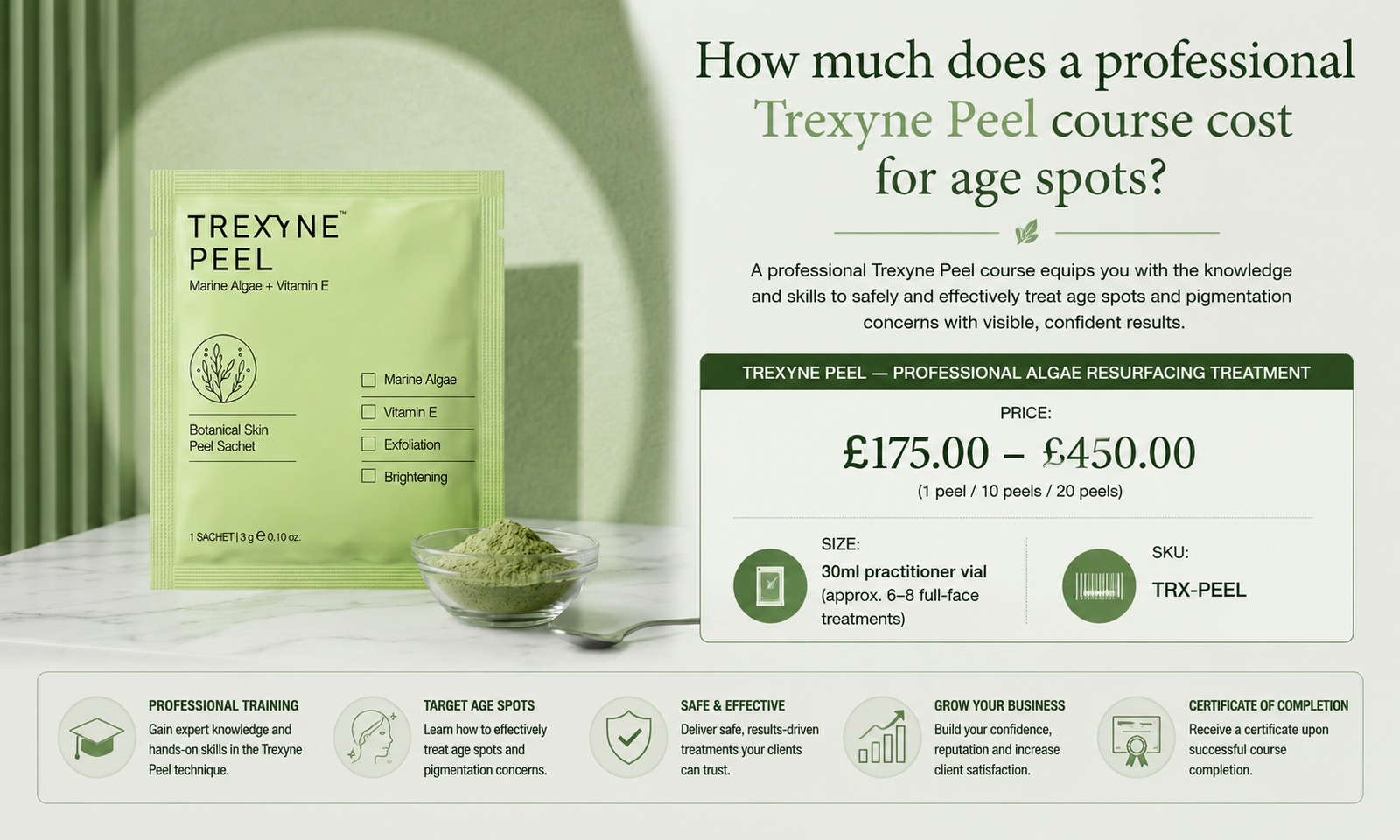
The Trexyne Peel is priced at £175.00 for a single session, with course options ranging up to £450.00 for a course of 20 peels. The specific cost of a treatment course for age spots depends on how many sessions are recommended based on the depth and extent of your pigmentation, and this is confirmed at consultation with a trained practitioner rather than determined in advance. Age spots that have accumulated over years typically require a sustained course of sessions rather than a single treatment to achieve meaningful visible improvement, which is why understanding what a course investment involves matters as much as the headline price. The Trexyne Peel is available exclusively through verified practitioners and clinics, and the investment reflects both the professional-grade treatment and the clinical expertise surrounding each session.
What the Trexyne Peel Pricing Structure Covers
The Trexyne Peel is available at three price points: a single peel, a course of 10 peels, and a course of 20 peels, spanning a price range of £175.00 to £450.00. These prices reflect the practitioner-vial format in which the product is supplied. Each 30ml vial provides approximately 6 to 8 full-face treatments, which means the product itself is formulated for sustained professional use across multiple client appointments rather than single-use applications.
The pricing structure is designed to make a full treatment course financially accessible for clients who commit to the recommended number of sessions. A course of peels at the higher end of the range represents a meaningful reduction in cost per session compared to booking individual treatments, which makes sense for age spot clients who are undertaking a planned course over several months rather than a one-off treatment.
The cost of treatment also reflects something beyond the product. It includes the practitioner’s assessment time at each appointment, the clinical judgement applied during the session, and the aftercare guidance provided. These elements are inseparable from the treatment outcome and are part of what a client pays for when they book with a verified professional.
Why Age Spots Require a Course Rather Than a Single Session
One of the most common misconceptions about professional resurfacing for age spots is that a single session will produce dramatic, lasting results. For superficial, recently formed pigmentation, a single session can produce a visible initial improvement. For age spots that have been present for years, the reality is different and worth explaining clearly before any treatment is booked.
Solar lentigines, the clinical term for age spots and liver spots, develop from cumulative UV exposure over a lifetime. The melanin is not concentrated in a thin, accessible surface layer. It is distributed across multiple depths of the epidermis, having built up over many years of repeated UV stimulus. A single resurfacing session, however well executed, stimulates cell turnover in the surface layers but does not reach all of the accumulated pigment in one pass.
Visible, sustained improvement comes from consistent resurfacing across a course of sessions, where each session builds on the progress of the previous one. Over time, the combined effect of progressive cell turnover gradually displaces the pigmented cells with fresh, unpigmented ones, producing the kind of improvement that endures rather than fading back to baseline after a few weeks.
This is why the recommended approach for age spots is a planned course rather than a single treatment, and why the course pricing structure is relevant for clients serious about addressing this concern.
What Influences How Many Sessions an Age Spot Course Requires
The number of sessions needed varies between clients, and a practitioner assessment is the only reliable way to form a realistic recommendation. Several factors influence this:
The depth and density of the pigmentation matters significantly. Age spots that have been building for decades and that sit across multiple layers of the epidermis will generally require more sessions to shift than more recent, lighter pigmentation. Spots that are darker and more defined typically have a higher concentration of melanin to work through progressively.
The size and distribution of the affected areas also plays a role. Localised spots that are isolated to specific areas of the face or hands may respond more quickly than widespread pigmentation across the full face, décolleté, and hands combined.
The individual’s skin response to treatment is another variable. Some clients see relatively quick improvement from the early sessions. Others find that progress builds more noticeably in the middle to later sessions of a course. Neither pattern is unusual, and both reflect the natural variation in how different skin types respond to mechanical resurfacing.
The consistency of daily SPF use between sessions is one of the most direct influences on how efficiently a course progresses. UV exposure between sessions can restimulate melanocytes in treated areas, slowing or partially reversing the improvement that the treatment is supporting. Clients who maintain daily sun protection throughout their course consistently see better progress than those who do not.
What Makes a Professional Course Better Value Than Home Alternatives
Clients weighing the cost of a professional Trexyne Peel course against the ongoing spend on over-the-counter products for age spots are comparing two very different levels of intervention. This is worth addressing honestly because many clients will have spent considerable amounts on topical products before seeking professional treatment, often with limited results.
Over-the-counter products that target pigmentation work at the skin’s surface. They can support mild, gradual fading of very superficial or recently formed pigmentation over time, but they do not have the mechanism to address the multi-layered pigment accumulation of established solar lentigines. Clients who have been using these products for months or years without meaningful improvement are experiencing this limitation directly.
Professional mechanical resurfacing reaches deeper into the epidermis than topical products can, stimulating genuine cell turnover rather than surface-level adjustment. The cumulative effect of a planned course, supported by clinical assessment at each session and specific aftercare guidance, produces a quality of result that home products are not able to replicate regardless of cost or duration of use.
When viewed over the same time period, the investment in a professional course often compares favourably to the cumulative spend on topical products that have not delivered meaningful improvement, particularly when the results of professional treatment are maintained with ongoing SPF use and appropriate follow-up sessions.
What Each Session Includes Beyond the Treatment Itself
Understanding what a professional session includes helps contextualise the cost. When a client books a Trexyne Peel session for age spots, they are not simply paying for a product application. Each session includes a skin assessment before treatment begins, during which the practitioner reviews the client’s current skin condition, checks for any changes to previous presentations, and determines the appropriate intensity level within the tiered protocol for that specific appointment.
During the session, the practitioner applies clinical judgement in real time, adjusting technique based on how the skin responds across different treatment areas. This is particularly relevant for age spots because photodamaged skin often presents variably, with some zones more compromised than others. Managing that variability within a single session requires active clinical engagement rather than routine product application.
After the session, the practitioner provides specific written aftercare guidance tailored to what was observed during treatment. This includes clear direction on SPF use, routine simplification, heat avoidance, and what to expect during the recovery period. Personalised aftercare of this kind is one of the most influential factors in how well and how quickly a client recovers from each session.
The Tiered Protocol and Its Effect on Cost-Effectiveness
The Trexyne Peel is built around a tiered protocol that allows the practitioner to match intensity to the skin’s condition at each appointment. For age spot clients, this means the course can progress in a way that reflects how the skin is actually responding rather than following a fixed schedule regardless of individual variation.
Starting conservatively and building intensity as the skin demonstrates its tolerance can mean earlier sessions feel less dramatic than later ones, but the cumulative approach protects the skin from the kind of over-treatment that produces setbacks and extends the overall timeline of the course. A well-paced course that progresses appropriately is more cost-effective in the long run than a more aggressive approach that triggers adverse reactions requiring recovery time before treatment can resume.
The tiered protocol is also what allows a single product to serve clients at very different stages of their pigmentation journey, from early, mild age spots through to more established and deeply pigmented lesions.
Finding a Practitioner Who Offers the Trexyne Peel
The Trexyne Peel is available exclusively through verified practitioners and clinics, which means booking with a professional who has been authorised to stock and administer the treatment. Practitioners can explore stocking the Trexyne Peel through the professional supply channel by visiting the Trexyne shop. Clients or practitioners with questions about access to the treatment can reach the Trexyne team directly through the Trexyne contact page.
When choosing a practitioner for age spot treatment, it is worth looking for someone with specific experience in treating pigmentation concerns and a clear consultation process that includes a thorough skin assessment before any treatment is recommended. The consultation is where realistic expectations and an appropriate treatment plan are established, and it is worth taking the time to get this right before committing to a course.
What to Ask at Your Initial Consultation
Going into a consultation prepared with relevant questions helps ensure you leave with a clear picture of what the recommended course involves and what value you can expect from it. Useful questions include how many sessions are realistic for your specific pigmentation, what the expected timeline for visible improvement looks like, what the recovery period after each session involves, and what home care is required between appointments.
It is also worth asking about the role of daily SPF in protecting the results of treatment, since sun protection is not simply a general health recommendation in this context. It is a clinical requirement for the treatment to produce the results it is capable of delivering. A practitioner who addresses SPF as a central part of the protocol, rather than an afterthought, is demonstrating the kind of thorough clinical approach that tends to produce the best outcomes.
More information on the Trexyne approach to professional botanical resurfacing is available on the Trexyne website.
How to Maintain Results After a Treatment Course
The investment in a Trexyne Peel course for age spots produces the best long-term return when results are maintained after the main course is complete. This involves two things: consistent daily SPF use to prevent new UV-stimulated pigmentation forming in treated areas, and follow-up sessions at extended intervals to support ongoing skin renewal.
Many practitioners recommend a maintenance session every few months after an initial course, with the frequency tailored to the individual client’s skin behaviour and lifestyle. Clients who spend significant time outdoors, or who have skin that tends to repigment quickly, may benefit from more frequent maintenance than those whose skin holds its results over longer intervals.
The combination of a successful treatment course, ongoing SPF protection, and appropriate maintenance sessions is what produces the kind of consistently even, clearer-looking skin that clients who invest in professional treatment are aiming for.
Conclusion
A professional Trexyne Peel course for age spots is priced at £175.00 to £450.00 depending on the number of sessions selected, with the specific recommendation for an individual client determined at consultation based on the depth and extent of their pigmentation. Age spots require a planned course of sessions rather than a single treatment because the accumulated melanin sits across multiple epidermal layers and responds to progressive resurfacing over time rather than a single pass. The Trexyne Peel resurfaces through marine-algae spicules with no acids involved, includes stabilised Vitamin E to support recovery, and uses a tiered protocol that allows intensity to be matched to the skin’s condition at each session. Maintained with consistent daily SPF and appropriate follow-up, it may support meaningful, visible improvement in the appearance of age spots and contribute to a brighter, more even-looking complexion over the course of a well-managed professional treatment plan.
FAQs
Q: How much does a Trexyne Peel course cost for treating age spots?
The Trexyne Peel ranges from £175.00 for a single peel to £450.00 for a course of 20 peels. The specific cost of a course for age spots depends on the number of sessions recommended based on your pigmentation at consultation. A course of sessions is generally recommended for established solar lentigines rather than a single treatment.
Q: How many Trexyne Peel sessions do I need for age spots?
The number of sessions needed depends on how long the age spots have been present, how deep the pigmentation sits, and how your skin responds to treatment. A practitioner assessment at consultation will provide a realistic recommendation. Established age spots typically require a sustained course rather than one or two sessions to achieve meaningful visible improvement.
Q: Is a professional Trexyne Peel course worth the cost compared to home products for age spots?
Home-use products work at the skin’s surface and have limited capacity to address the multi-layered pigment accumulation of established solar lentigines. A professional resurfacing course stimulates deeper, more consistent cell turnover than topical products can achieve. For clients who have spent money on home products without meaningful results, a professional course often represents better value over the same timeframe.
Q: What does the cost of a Trexyne Peel session include?
Each session includes a clinical skin assessment before treatment, trained application with real-time adjustment of technique during the session, and specific written aftercare guidance tailored to what was observed. The cost reflects both the treatment itself and the professional expertise surrounding it.
Q: How can I find a practitioner who offers the Trexyne Peel for age spots?
The Trexyne Peel is available exclusively through verified practitioners and clinics. Clients can contact the Trexyne team through the contact page on the website to find out about practitioners offering the treatment. Practitioners interested in stocking the product can explore options via the Trexyne shop.
Q: Does daily SPF really affect how well a Trexyne Peel course works for age spots?
Yes, significantly. UV exposure between sessions can restimulate the melanocytes in treated areas, slowing progress or partially reversing the improvement the treatment is supporting. Consistent daily broad-spectrum SPF is a clinical requirement for the course to produce the results it is capable of delivering, not simply a general skincare recommendation.
Q: Can I book a single Trexyne Peel session for age spots rather than a full course?
A single session is available and may produce an initial visible improvement in lighter or more superficial pigmentation. For established age spots with deeper, denser melanin accumulation, a single session is unlikely to deliver the sustained improvement a planned course can achieve. A practitioner at consultation will advise which option is appropriate based on an assessment of your specific pigmentation.