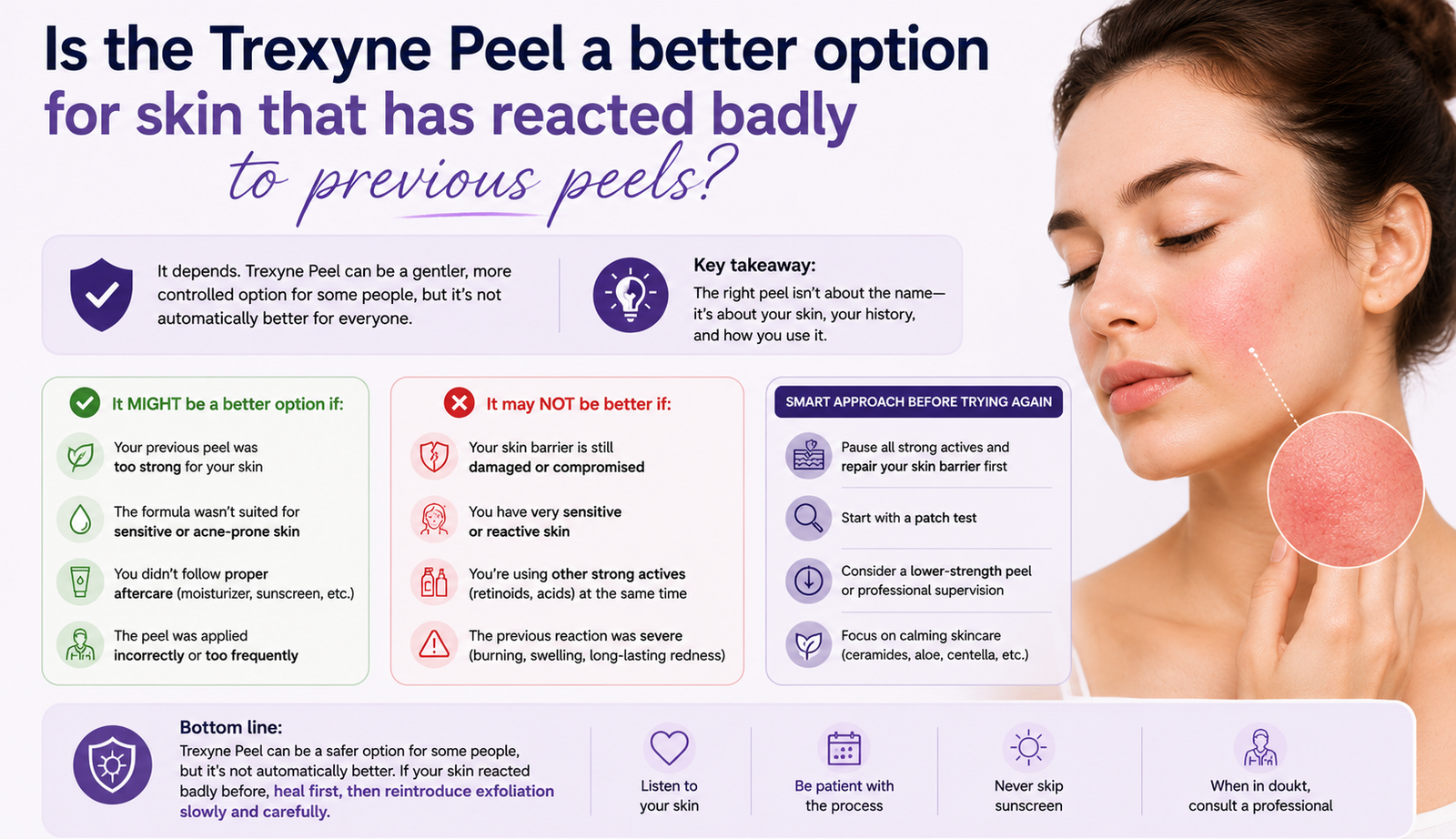
Is the Trexyne Peel a Better Option for Skin That Has Reacted Badly to Previous Peels?
For many clients, a bad reaction to a previous peel is the reason they are searching for an alternative in the first place. The experience of prolonged redness, unexpected darkening, or a recovery period that went well beyond what they were told to expect leaves a lasting impression. It also raises a legitimate clinical question: was the reaction a one-off, or does it say something meaningful about how that particular skin responds to resurfacing? In most cases, it is the latter. Skin that reacts badly to chemical resurfacing is often giving a clear signal that the mechanism, the intensity, or both were not well matched to its biology. The Trexyne Peel approaches resurfacing through an entirely different mechanism, and for the right client, that difference changes the clinical picture considerably.
Why Some Skin Reacts Badly to Resurfacing
Not all skin tolerates resurfacing equally, and understanding why helps clarify whether a different approach is likely to produce a better outcome. Skin that reacts strongly to standard resurfacing treatments tends to fall into one or more of several categories.
Sensitive or reactive skin has a lower threshold for irritation than resilient skin types. Its barrier function is typically compromised to some degree, which means it cannot contain inflammatory responses as effectively. Sensitised skin can also develop over time in clients who have been over-treated, whether through aggressive in-clinic sessions, high-concentration home-use actives, or both.
Fitzpatrick skin types III to VI carry a higher risk of post-inflammatory hyperpigmentation. When resurfacing triggers an inflammatory response in these skin types, the melanocyte reaction can be disproportionately strong, producing dark patches that are more distressing than the original concern the treatment was meant to address.
Clients with a compromised barrier at the time of treatment, whether from stress, recent skin illness, over-exfoliation, or prescription medication use, may find that even a moderate-intensity resurfacing session generates a reaction that would not have occurred in a more robust skin state.
In all these cases, the problem is not resurfacing as a concept. It is the specific mechanism and the load it places on that individual’s skin.
What a Bad Reaction Actually Tells You
A difficult post-peel experience is clinically informative rather than simply unfortunate. It tells the practitioner something specific about the skin’s current capacity to manage a given level of inflammatory stimulus. That information is worth acting on rather than dismissing.
Clients who have experienced post-peel hyperpigmentation have demonstrated that their melanocytes respond strongly to inflammation. Any future resurfacing approach needs to minimise the inflammatory trigger while still achieving meaningful cell turnover. Clients who experienced prolonged redness and barrier disruption have demonstrated that their skin’s repair capacity was exceeded by the treatment. The next resurfacing approach needs to be better matched to that recovery capacity, not simply repeated at a lower dose of the same chemical mechanism.
This is where the mechanism of the next treatment becomes the central clinical question, not just the intensity.
The Problem With Reducing Concentration Rather Than Changing Mechanism
A common clinical instinct after a client has reacted badly to a resurfacing treatment is to try the same approach again at a lower concentration or with a shorter application time. This can work in some cases, but it does not address the fundamental issue when the problem is mechanism-related rather than simply dose-related.
If a client’s skin is prone to post-inflammatory hyperpigmentation, reducing the concentration of an acid-based treatment still leaves a chemical reaction and associated inflammation taking place in the skin. The melanocytes may still respond with excess pigment production, just to a slightly lesser degree. If a client’s barrier is compromised and reactive, a lower concentration of the same chemical exfoliant may still generate more inflammatory burden than the skin can manage without consequences.
Changing the mechanism rather than just the intensity is a more considered response for clients whose reactions suggest a genuine mismatch between their skin biology and chemical resurfacing.
How the Trexyne Peel’s Mechanism Differs
The Trexyne Peel resurfaces entirely through physical means. Marine-algae spicules create controlled micro-channels in the skin’s surface through direct mechanical action. There is no chemical reaction taking place in the skin at any stage. There are no exfoliating acids involved. The resurfacing effect is achieved through the structure and action of the spicules themselves rather than through any chemical interaction with the skin’s tissues.
For skin that has reacted badly to chemical resurfacing, this distinction removes the specific trigger that caused the previous reaction. The skin still undergoes resurfacing. Cell turnover is still stimulated. But the inflammatory pathway that chemical exfoliants activate, and that PIH-prone or reactive skin responds to so strongly, is not engaged in the same way.
This does not mean the Trexyne Peel is without any recovery period. Any resurfacing treatment creates a degree of controlled disruption in the skin that requires recovery time. What changes is the nature and intensity of that disruption, and the risk profile for clients whose skin has demonstrated a specific sensitivity to chemical inflammatory triggers.
The Significance of Vitamin E in the Formulation
For skin that has previously been through a difficult post-peel recovery, the recovery phase of the next treatment carries particular weight. A client who has experienced barrier disruption, prolonged redness, or post-inflammatory pigmentation will be acutely aware of how their skin behaves in the days following resurfacing. Any sign of a similar trajectory will erode their confidence in the treatment and the practitioner.
The Trexyne Peel includes stabilised tocopherol, a form of Vitamin E, which supports the skin’s recovery phase from the first application. By actively supporting the skin’s own repair processes rather than leaving a disrupted barrier to manage recovery unaided, this recovery-supportive component of the formulation works with the skin rather than placing additional demands on it. For a client with a history of difficult recoveries, this is a clinically meaningful aspect of the treatment rather than a secondary consideration.
Recovery Support as a Clinical Differentiator
Practitioners working with clients who have been through bad peel reactions often find that these clients are almost more anxious about the recovery period than the treatment itself. They have a clear reference point for what a difficult recovery feels like, and they are watching their skin extremely closely in the days after treatment.
A formulation that provides recovery support from the outset, combined with clear and specific written aftercare, gives both the practitioner and the client a stronger foundation for managing that recovery window. Smaller, well-managed steps forward tend to be more persuasive to this client group than ambitious treatment plans, however well-intentioned.
The Tiered Protocol as a Tool for Rebuilding Confidence
One of the more practical aspects of the Trexyne Peel for clients returning to resurfacing after a difficult experience is the tiered protocol that allows the practitioner to match intensity to the skin’s current condition. Rather than starting at a standard treatment intensity and hoping for the best, the practitioner can begin conservatively, observe how the skin responds, and progress gradually as confidence on both sides of the treatment table builds.
This kind of graduated approach has clinical value beyond simply being cautious. It generates real data about how an individual’s skin responds to this specific mechanism at this specific intensity, which informs every subsequent session. A client who recovers well from a conservative first session is significantly more likely to commit to the full treatment course needed for visible, lasting results.
Approaching post-reaction clients with a tiered protocol also positions the practitioner as genuinely responsive to what the client’s skin is communicating, rather than following a fixed template regardless of individual history.
The Consultation That Must Come Before Any Next Step
Before any resurfacing treatment is booked for a client who has had a previous bad reaction, a thorough consultation is essential. This is not a formality. It is the session in which the practitioner gathers the clinical information needed to determine whether a different approach is likely to produce a different outcome, and what that approach should look like in practice.
Key areas to cover include the nature of the previous reaction: what it looked like, when it appeared, how long it lasted, and how it resolved. Current skin condition, including barrier integrity, baseline reactivity, and any recent product or prescription changes. The client’s skin history beyond the one bad reaction, including their full Fitzpatrick type and any previous history of PIH or prolonged post-procedure sensitivity. And the client’s expectations and anxiety level, which will shape how the treatment plan is framed and paced.
Clients who have had a bad experience with resurfacing need to understand exactly why this treatment approach is different, not just be reassured that it will be fine. A clear explanation of how mechanical resurfacing differs from chemical resurfacing, and what that means specifically for their skin type and history, is what converts a cautious client into a committed one.
Practitioners looking to incorporate a professional botanical peel into their protocols for clients with complex treatment histories can explore the full range via the Trexyne shop or get in touch directly through the Trexyne contact page.
Building Long-Term Trust With a Difficult Client Group
Clients who arrive with a history of bad peel reactions are often among the most valuable long-term clients a clinic can have, precisely because they have been failed elsewhere and are genuinely motivated to find something that works. When a practitioner takes the time to understand their history, explain the difference in approach with genuine clinical reasoning, and then delivers a resurfacing course that progresses without drama, the loyalty that follows tends to be significant.
This is not a group to be cautious of or to redirect away from resurfacing entirely. It is a group that needs the right treatment mechanism, the right pacing, and a practitioner willing to work with the specific characteristics of their skin rather than against them.
Further information on Trexyne’s approach to professional botanical resurfacing is available on the Trexyne website.
Conclusion
Skin that has reacted badly to previous peels is not telling the practitioner that resurfacing is impossible. It is providing specific clinical information about what the skin cannot tolerate and what needs to change. For clients whose reactions suggest a genuine mismatch with chemical resurfacing, whether through post-inflammatory hyperpigmentation, prolonged barrier disruption, or unexpected redness, changing the mechanism rather than simply reducing the dose is the more considered response. The Trexyne Peel resurfaces through marine-algae spicules with no chemical exfoliants involved, removes the specific chemical inflammatory trigger associated with the most common post-peel reactions, and includes stabilised Vitamin E to support recovery from the first application. With a tiered protocol that allows intensity to be matched carefully to the skin’s demonstrated tolerance, it offers a more predictable and clinically appropriate path forward for clients who deserve a better resurfacing experience than they have had before.
FAQs
Q: Is the Trexyne Peel suitable for skin that has reacted badly to previous chemical peels?
For skin that has experienced post-inflammatory hyperpigmentation, prolonged redness, or barrier disruption following chemical resurfacing, the Trexyne Peel’s mechanical mechanism may offer a meaningfully different risk profile. Because no acids are involved, it does not generate the chemical inflammatory response that tends to trigger these reactions in susceptible skin. A thorough consultation before any new treatment course is always essential.
Q: Why does some skin react badly to chemical peels?
Skin that reacts badly to chemical peels typically has either a compromised barrier that cannot manage the inflammatory response generated by the treatment, a heightened melanocyte sensitivity that produces post-inflammatory pigmentation in response to inflammation, or a reactive baseline that has been sensitised over time through over-treatment or aggressive actives. These factors make chemical resurfacing a higher-risk approach than a mechanical alternative for these skin types.
Q: Will reducing the concentration of a chemical peel prevent a reaction in sensitive skin?
Reducing concentration may reduce the severity of a reaction in some cases, but it does not change the fundamental mechanism. If the skin’s issue is with the chemical inflammatory response generated by acid-based exfoliation, a lower-concentration version of the same treatment may still produce a reaction, albeit a milder one. Changing the mechanism is a more substantive response for clients whose reactions suggest a genuine mismatch with chemical resurfacing.
Q: How does the Trexyne Peel support skin that has a history of post-inflammatory hyperpigmentation?
The Trexyne Peel resurfaces through a mechanical mechanism that does not generate a chemical reaction in the skin, removing one of the primary triggers for post-inflammatory hyperpigmentation in susceptible skin. Stabilised Vitamin E supports the recovery phase from the first application, and the tiered protocol allows the practitioner to begin at a conservative intensity appropriate to the skin’s history.
Q: How soon after a bad peel reaction can I have the Trexyne Peel?
Any further resurfacing should be deferred until the skin has fully returned to a stable, settled baseline following a previous reaction. The skin needs to demonstrate consistent calm over a period of time before a new resurfacing approach is introduced. A follow-up consultation to assess the skin’s current condition is essential before any next steps are planned.
Q: What makes the Trexyne Peel’s recovery profile different from acid-based peels?
Because the Trexyne Peel’s resurfacing mechanism is mechanical rather than chemical, the skin is not managing a chemical reaction alongside its repair process during recovery. Stabilised Vitamin E in the formulation actively supports recovery from the first application. Together, these factors can contribute to a more manageable recovery period for skin that has previously struggled following chemical resurfacing.
Q: Where can practitioners learn more about the Trexyne Peel for clients with complex treatment histories?
Practitioners can browse the full product range and purchasing options via the Trexyne shop, or contact the team directly through the Trexyne contact page for guidance on incorporating the Trexyne Peel into protocols for clients with sensitive, reactive, or previously over-treated skin.