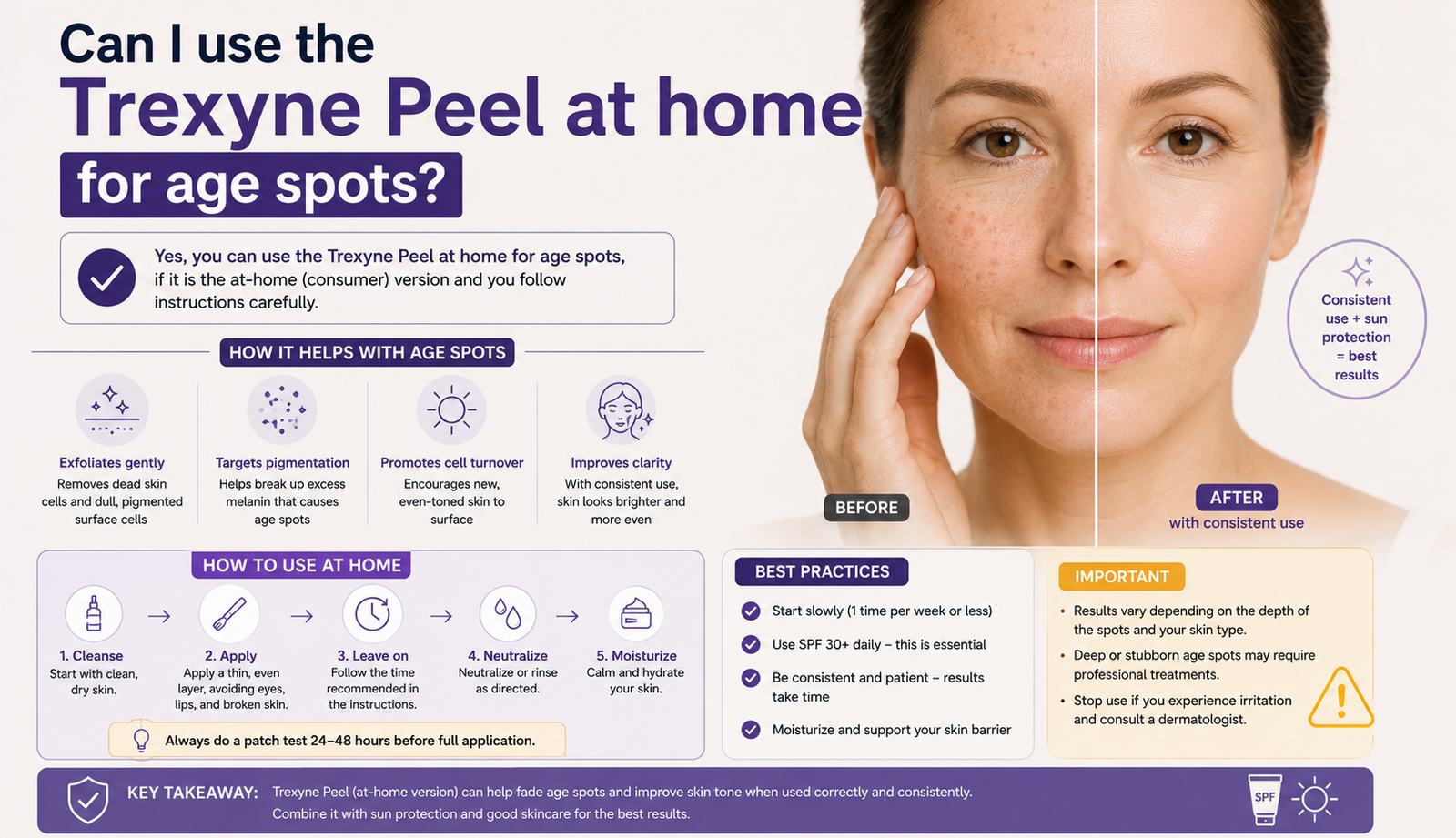
Can I Use the Trexyne Peel at Home for Age Spots?
No. The Trexyne Peel is sold exclusively to verified practitioners and clinics and is not available for home use under any circumstances. This is not a commercial restriction added as an afterthought. It is a deliberate design principle built into how the product is formulated, protocolled, and supplied. Professional resurfacing treatments work precisely because they are applied by trained practitioners who can assess the skin, select the appropriate intensity, monitor the response, and provide clinical oversight throughout the recovery period. These are not steps that can be replicated at home, regardless of how much a client knows about skincare. For anyone searching for a way to address age spots with the Trexyne Peel, the correct route is booking a consultation with a verified aesthetic practitioner who stocks and administers the treatment professionally.
Why the Trexyne Peel Is Professional-Only
The professional-only supply policy behind the Trexyne Peel is grounded in how the treatment works and what responsible use of it requires. The treatment uses marine-algae spicules to create controlled micro-channels in the skin’s surface through a mechanical mechanism. The word “controlled” is load-bearing here. The degree of resurfacing achieved, the depth of the micro-channels, and the overall intensity of the session are all determined by how the treatment is applied, and that requires clinical training and hands-on experience to execute correctly.
In untrained hands, applying a professional resurfacing treatment without the knowledge to assess skin suitability, manage the session in real time, or support recovery appropriately creates a genuine risk of harm. Post-inflammatory hyperpigmentation, prolonged barrier disruption, and uneven results are all more likely when professional oversight is absent. For age spots specifically, where the aim is to achieve progressive, even skin renewal over a carefully managed course of sessions, the clinical judgement involved at each appointment is not optional.
This is why the Trexyne Peel is not sold through general retail channels, is not available for consumer purchase, and is not designed to be self-administered.
What Age Spots Actually Require From Treatment
Part of the reason professional oversight matters so much for age spot treatment is the nature of the concern itself. Solar lentigines, the clinical name for age spots and liver spots, develop from years of cumulative UV exposure that has repeatedly stimulated melanocytes to produce localised deposits of melanin. The pigmentation often sits across multiple layers of the epidermis rather than close to the surface alone, which means meaningful improvement requires consistent, progressive cell turnover across a sustained course of sessions rather than a single application.
This kind of progressive, multi-session protocol requires ongoing clinical assessment at each appointment. The practitioner needs to evaluate how the skin has responded since the previous session, whether the intensity should be maintained or adjusted, whether the recovery was straightforward or showed any signs of concern, and whether the skin’s overall condition has changed in ways that affect the next treatment. None of this is achievable with a one-off home application.
Age spots on clients in their forties, fifties, and beyond are also often accompanied by other changes in the skin, including reduced barrier integrity, thinner epidermis, and variable texture across different facial zones. Matching treatment intensity to these factors across a full-face session is a clinical skill, not a product instruction.
What Practitioners Bring That Home Use Cannot Replicate
The difference between professional and home-use resurfacing is not simply a matter of product strength. It is a matter of what surrounds the product application: the assessment before, the judgement during, and the clinical follow-up after.
Before a session, a trained practitioner assesses the skin’s current condition, checks for contraindications, reviews the client’s recent history, and selects an appropriate intensity within the tiered protocol. For a client with age spots, this assessment will also consider whether any of the pigmented areas need closer examination before resurfacing proceeds, which is a basic clinical safeguarding step.
During a session, the practitioner monitors the skin’s response in real time and can adjust the technique accordingly. They can identify areas of the skin that are responding differently from others and manage them appropriately within the same session.
After a session, the practitioner provides specific, tailored aftercare guidance based on what they observed during treatment and what they know about the individual client’s skin. They are also available to support the client through the recovery period if questions or concerns arise.
The Role of the Tiered Protocol in Professional Settings
The Trexyne Peel’s tiered protocol is one of the features that makes it particularly well suited to professional administration. It allows the practitioner to match intensity to the individual client’s skin type, current condition, and treatment history at each session. This kind of real-time calibration is only meaningful when the person making the calibration has the training and clinical experience to read the skin accurately and act on what they see.
The tiered protocol is not a self-explanatory instruction manual. It is a framework that trained practitioners apply with clinical judgement. That is precisely why the product is designed for professional use only.
The Risk of Unregulated Home Resurfacing for Age Spot Concerns
Clients searching for home alternatives to professional resurfacing treatments for age spots are often motivated by cost, convenience, or frustration at slow results from over-the-counter products. These are understandable motivations. They are also motivations that carry real clinical risk when they lead to self-administration of professional-grade treatments.
Resurfacing a treatment area incorrectly can produce uneven results at best and significant skin damage at worst. For age spot concerns in particular, where post-inflammatory hyperpigmentation is a genuine risk in susceptible skin types, triggering an inflammatory response through incorrect home resurfacing can create new dark patches alongside or instead of fading existing ones. The outcome can be more distressing than the original concern.
The professional setting also provides clinical accountability. When a practitioner administers a treatment, they take responsibility for the appropriateness of that treatment and its aftercare. This accountability is part of what makes professional treatment genuinely safer than home alternatives, not just procedurally but in terms of the quality of the decision-making throughout the process.
How to Find a Practitioner Who Offers the Trexyne Peel
For clients interested in addressing age spots with the Trexyne Peel, the practical next step is finding a verified practitioner who stocks and administers the treatment. The Trexyne Peel is available to verified practitioners and clinics through the professional supply channel, which means the right starting point is contacting the brand directly.
Practitioners and clinics looking to stock the Trexyne Peel can explore the full range and purchase options via the Trexyne shop. Clients with questions about where to access the treatment, or practitioners wanting to discuss incorporating the Trexyne Peel into their treatment menu, can reach the team directly through the Trexyne contact page.
What to Expect From a Professional Age Spot Treatment Course
Understanding what a professional treatment course actually involves helps clients set realistic expectations before they book. For age spots, a course typically involves multiple sessions spaced at appropriate intervals to allow the skin to complete its renewal cycle between appointments. Visible improvement in the appearance of solar lentigines builds gradually across the course rather than appearing dramatically after a single session.
The practitioner will assess the skin at each appointment before deciding how to proceed. There may be sessions where the intensity is maintained from the previous appointment and sessions where it is adjusted based on the skin’s condition. This session-by-session calibration is normal and reflects good clinical practice rather than inconsistency.
Between sessions, the client’s role is to follow aftercare guidance consistently. Daily broad-spectrum SPF use is the single most important home habit for age spot clients, since UV exposure between sessions can restimulate the melanocytes in treated areas and slow visible progress. A simple, barrier-supportive home-care routine that avoids unnecessary irritation supports recovery between appointments.
What a Professional Consultation Looks Like
For clients who have not previously attended a skin consultation for resurfacing, knowing what to expect can lower the barrier to booking. A professional consultation for age spot concerns will typically involve a thorough skin assessment, a review of the client’s skin history and any previous treatments, a discussion of what the client wants to achieve and how realistic those aims are within the timescale they have in mind, and an explanation of the treatment approach and what the recovery period involves.
Practitioners may also assess whether any of the pigmented lesions present need closer examination before resurfacing is considered. This is standard good practice for any consultation involving pigmented spots and is not cause for concern in the vast majority of cases.
Further information on the Trexyne approach to professional botanical resurfacing is available on the Trexyne website.
Why Professional Treatment Produces Better Long-Term Results
Beyond the immediate safety considerations, professional resurfacing produces better long-term results for age spots than home alternatives for a straightforward reason: the quality of the assessment, the precision of the application, and the continuity of clinical oversight across a full course of treatment cannot be replicated at home. Each of these factors contributes to the outcome, and the combined effect of getting them all right is visible over the course of a well-managed treatment programme.
Clients who commit to a professional course, follow aftercare guidance consistently, and maintain daily SPF between and after sessions are those who see the most meaningful and lasting improvement in solar pigmentation. The professional relationship also allows for adjustment if the skin responds differently from expected, which protects the investment of time and money the client has made in the treatment.
Conclusion
The Trexyne Peel is not available for home use, and age spot treatment is precisely the kind of concern that illustrates why professional administration matters. Solar lentigines require consistent, progressive resurfacing across a managed course of sessions, with clinical assessment at each appointment to guide intensity, monitor the skin’s response, and adjust the protocol accordingly. The Trexyne Peel resurfaces through marine-algae spicules without chemical exfoliants, includes stabilised Vitamin E to support recovery, and uses a tiered protocol that trained practitioners apply with clinical judgement at every session. Used correctly within a professional setting, alongside consistent daily SPF and appropriate home care between sessions, it may support a gradual and visible improvement in the appearance of age spots and contribute to a brighter, more even-looking complexion for clients who access it through the right channel.
FAQs
Q: Can I buy the Trexyne Peel to use at home for age spots?
No. The Trexyne Peel is sold exclusively to verified practitioners and clinics and is not available for home use or consumer purchase. To access the treatment for age spots, you need to book with a trained aesthetic practitioner who stocks and administers the Trexyne Peel professionally.
Q: Why is the Trexyne Peel only available to professionals?
The Trexyne Peel requires clinical assessment, trained application, and professional aftercare guidance to be used safely and effectively. The tiered protocol that allows intensity to be matched to individual skin type and condition can only be applied correctly by a trained practitioner with the clinical judgement to read the skin accurately at each session.
Q: How many sessions of the Trexyne Peel are needed for age spots?
Age spots, or solar lentigines, typically require a sustained course of professional sessions to achieve visible improvement. The number of sessions depends on the depth and density of the pigmentation, the individual’s skin response, and how consistently aftercare including daily SPF is maintained between appointments. A practitioner assessment will help set realistic expectations before the course begins.
Q: How do I find a practitioner who offers the Trexyne Peel for age spots?
Practitioners and clinics stocking the Trexyne Peel access it through the professional supply channel. Clients looking to find a practitioner who offers the treatment, or practitioners interested in stocking it, can contact the Trexyne team directly through the contact page on the Trexyne website.
Q: What makes the Trexyne Peel suitable for age spot treatment?
The Trexyne Peel resurfaces through a mechanical mechanism using marine-algae spicules, which supports progressive cell turnover without chemical exfoliants. This can contribute to the gradual displacement of pigmented cells over a course of professional sessions. Stabilised Vitamin E supports the recovery phase, and the tiered protocol allows intensity to be matched to the individual skin’s condition and history.
Q: Can home-use skincare products treat age spots as effectively as the Trexyne Peel?
Over-the-counter products that support skin renewal can play a useful role in a broader skincare routine but are not able to replicate the depth of resurfacing or the clinical oversight provided by a professional treatment course. For established solar lentigines that have accumulated over years, a professional resurfacing approach is generally needed to achieve meaningful visible improvement.
Q: Is daily SPF really necessary during a Trexyne Peel course for age spots?
Yes. UV exposure between sessions can restimulate melanocytes in treated areas and slow or counteract the visible progress of resurfacing. Consistent broad-spectrum SPF applied every morning is one of the most important steps a client can take to protect the results of their professional treatment course and prevent new pigmentation from developing alongside the existing spots being addressed.