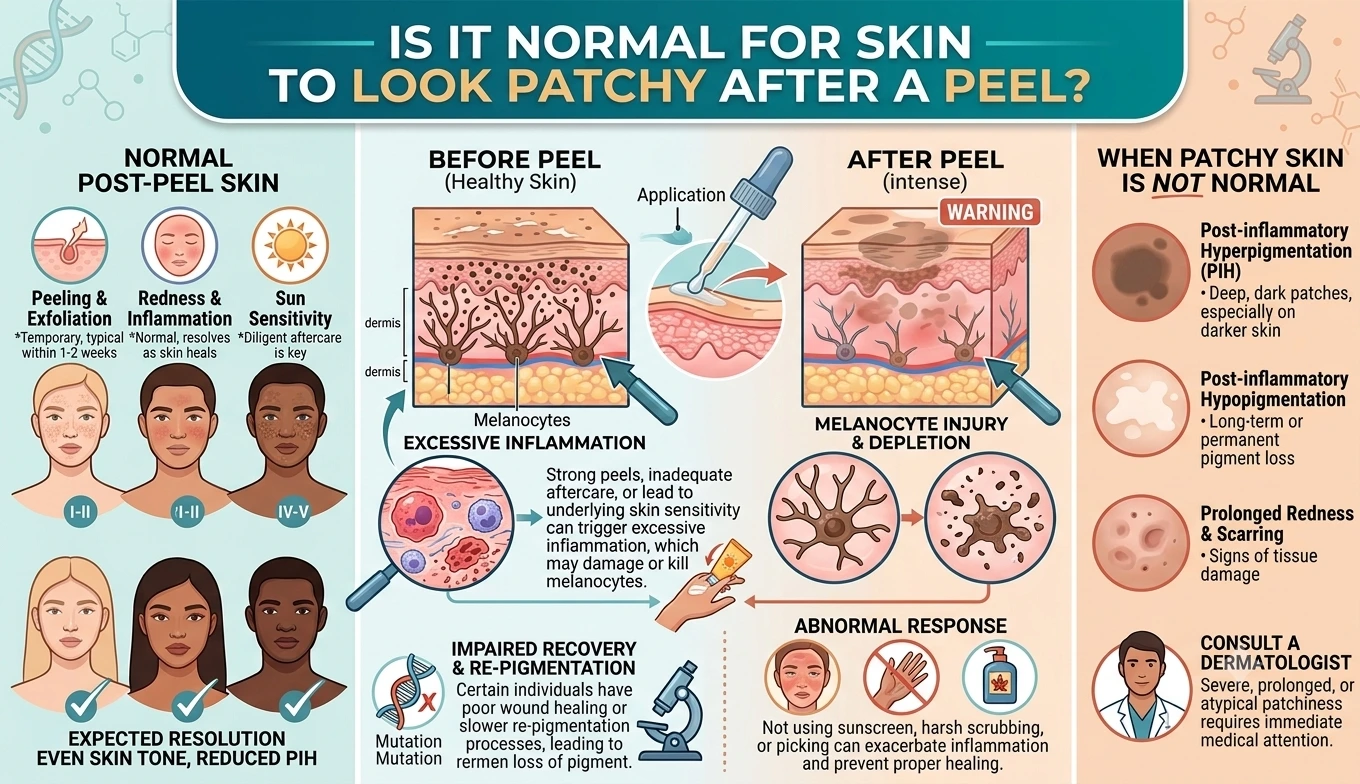
Is It Normal for Skin to Look Patchy After a Peel?
Patchy skin after a professional peel treatment is one of the most common concerns clients raise during recovery. The short answer is yes, some degree of uneven skin appearance after resurfacing is normal and expected. It is part of how the skin renews itself following treatment. The skin does not shed or recover uniformly across the entire face, which means certain areas may appear lighter, darker, drier, or more uneven during the recovery phase. Understanding why this happens, how long it typically lasts, and what genuinely warrants attention helps practitioners manage client expectations effectively. The Trexyne Peel is designed with predictability in mind, and this extends to how the post-treatment skin response is managed.
What Patchiness After a Peel Actually Looks Like
Patchiness is a broad term that clients use to describe several different presentations. Practitioners benefit from understanding exactly what the client is seeing before making any clinical judgement about whether the response is within normal range.
The Most Common Post-Peel Skin Appearances
After a resurfacing treatment, clients may notice:
- Areas of redness sitting alongside areas of normal skin tone
- Dry or flaking patches as the surface begins to shed and renew
- Slightly lighter areas where the surface has renewed faster
- Uneven skin tone that shifts day by day as recovery progresses
- A mottled or blotchy appearance in the first 48 to 72 hours
All of these can look alarming to a client who has not been prepared for them. In most cases, they are simply the skin cycling through its natural renewal process at different rates across different areas of the face.
The forehead, cheeks, nose, and chin each have different skin thicknesses, sebaceous gland densities, and renewal rates. This variation means that recovery across the face is rarely perfectly uniform, and visible patchiness during this period is a normal part of the process rather than an indication that something has gone wrong.
Why the Skin Renews Unevenly After Resurfacing
To understand post-treatment patchiness, it helps to understand what happens at a cellular level during the recovery phase.
The Skin Renewal Process
When the surface of the skin is resurfaced, the outermost layer is refined and disrupted in a controlled way. The skin immediately begins its repair process, moving new cells toward the surface to replace those that have been treated. This is not a process that happens simultaneously across every millimetre of skin. Different zones of the face are at different stages of their natural cell cycle at any given time.
The result is that some areas may look refreshed and smooth within a few days, while others are still in an active shedding or renewal phase. This staggered progression is entirely normal. It reflects the biological reality of how skin behaves, not a flaw in the treatment outcome.
Areas That Tend to Show More Visible Unevenness
Certain facial zones are more prone to visible patchiness during recovery:
- The area around the mouth and nose tends to have thinner skin and a higher density of fine lines, which can make uneven recovery more visible
- The forehead is often oilier, which can affect how the surface sheds and renews
- The cheek area typically has more consistent skin thickness and often recovers more evenly
- The jawline and chin can sometimes lag slightly behind other areas
Clients with dry or dehydrated skin going into treatment may experience more visible patchiness because their barrier function is already compromised before resurfacing begins.
How the Trexyne Peel’s Approach Supports a More Predictable Recovery
The mechanism behind a resurfacing treatment has a direct influence on how the recovery phase progresses. Not all resurfacing approaches produce the same pattern of post-treatment response.
The Botanical Mechanical Mechanism
The Trexyne Peel uses marine algae spicules to create controlled micro-channels in the skin’s surface. This is a purely mechanical and botanical process. The spicules work physically on the outermost skin layer without any chemical agents involved. The resurfacing action is applied by the practitioner, and the depth and intensity are controlled throughout.
This controlled application means that the degree of surface disruption is consistent with the intention of the treatment. The skin’s recovery response is therefore more predictable than it might be with treatments where variables are harder to manage in real time.
Stabilised Vitamin E as a Recovery Anchor
One of the Trexyne Peel’s key features is its inclusion of stabilised tocopherol, the active form of Vitamin E. This ingredient supports the skin’s recovery phase from the very first application. In the context of post-treatment patchiness, recovery support matters because skin that can rebuild its surface efficiently is less likely to show prolonged or pronounced uneven appearance during healing.
The combination of a controlled resurfacing mechanism and active recovery support is what makes the Trexyne approach a considered choice for clients who are concerned about downtime and post-treatment skin appearance.
When Patchiness Is Within Normal Range
Practitioners need to be able to distinguish between a normal post-treatment recovery and a presentation that warrants closer attention. This distinction is partly about timing and partly about the nature of the patchiness itself.
What to Expect in the First 72 Hours
In the first 24 to 48 hours after a resurfacing treatment, some degree of redness, surface unevenness, and visual patchiness is expected. The skin is in the earliest stage of its renewal response, and it will not look its best during this window. Clients should be briefed on this before they leave the clinic so they are not alarmed by what they see at home.
Between 48 and 72 hours, the skin typically begins to stabilise. The more acute redness starts to reduce, and the surface begins to feel less reactive. Some visible flaking or uneven tone may still be present, but the trajectory should be clearly toward improvement.
By days four to seven in most cases, the skin should be visibly progressing toward a more settled, even appearance. The pace of this progression varies between clients, but the direction should be consistent and positive.
When Patchiness Needs a Closer Look
While most patchiness after a peel is normal, there are presentations that warrant a follow-up consultation and a more careful assessment.
Signs That Fall Outside Normal Recovery
Practitioners should arrange a follow-up if the client presents with:
- Patchiness that is worsening rather than improving after 72 hours
- Areas that look significantly darker or more pigmented than the surrounding skin, persisting beyond the first week
- Any areas that appear white or distinctly lighter in a way that is sharply delineated from the rest of the skin
- Skin that feels increasingly uncomfortable, tight, or reactive rather than gradually calming
These presentations can indicate post-inflammatory pigmentation changes, barrier disruption that is not resolving, or in rarer cases, a response that requires modified aftercare or a delay in continuing the treatment course.
The tiered Trexyne protocol is specifically designed to give practitioners the flexibility to adjust intensity at each session based on the skin’s response. If a client has recovered from an initial session with a more pronounced response than anticipated, the next session can be approached more conservatively. Practitioners with questions about specific client presentations can contact the Trexyne team directly for support.
The Role of Aftercare in Managing Post-Peel Patchiness
What clients do in the days following a treatment has a significant effect on how their skin looks and how quickly the patchiness resolves. Aftercare guidance should be specific, practical, and easy to follow.
The Essentials of Post-Peel Aftercare
Keep the routine minimal. This is the single most important message for clients to take home. During the recovery phase, the skin does not need complex layering or active ingredients. It needs support and protection.
A gentle, fragrance-free moisturiser applied twice daily helps maintain the skin’s moisture levels while the barrier is rebuilding. Dehydrated skin during recovery looks more patchy and uneven because it lacks the surface plumpness that smooths out the appearance of uneven tone.
Daily SPF is non-negotiable. UV exposure on recovering skin can trigger pigmentation changes and extend the period of visible unevenness. A broad-spectrum SPF applied every morning, regardless of whether the client plans to spend time outdoors, is an essential step throughout the recovery period.
What Clients Should Avoid During Recovery
Clients should avoid:
- Any exfoliating tools or products, which add further surface disruption to already-recovering skin
- Heat-generating activities such as saunas, steam rooms, and intense exercise for at least 48 hours
- Makeup products that may occlude or irritate the skin during the active renewal phase
- Skincare actives such as retinoids that accelerate cell turnover and may interfere with the recovery cycle
The Connection Between Dehydration and Visible Patchiness
Dehydrated skin and post-treatment patchiness are closely linked. This connection is often underestimated in aftercare conversations.
Why Dehydration Makes Patchiness More Visible
When the skin’s surface is dehydrated, light reflects off it unevenly. This makes variations in tone, texture, and surface renewal far more visible to the eye. Clients may describe their skin as looking dull, patchy, or uneven when a significant part of what they are seeing is simply surface dehydration rather than a pigmentation issue.
After resurfacing, the skin’s barrier is temporarily reduced. This means transepidermal water loss increases, the skin loses moisture more quickly than usual, and dehydration can develop rapidly without adequate moisturiser application.
Encouraging clients to apply moisturiser consistently during the recovery phase, even if their skin does not feel dry, is a practical step that can meaningfully reduce the visual patchiness they experience. Drinking adequate water supports this from within, though topical hydration remains the more immediately impactful factor for surface appearance.
How a Full Trexyne Peel Course Addresses Uneven Skin Over Time
A single resurfacing session can produce visible improvement, but a structured course of treatments is where consistent and sustained skin refinement is achieved.
Building Skin Quality Across a Course
Over a planned course of Trexyne Peel sessions, the skin’s renewal cycle is consistently supported and encouraged. Early sessions establish the resurfacing response. Later sessions build on the improvement already achieved, progressively refining the surface and supporting a more even overall skin quality.
Clients who complete a full course often find that not only has their primary concern improved, but the general quality and evenness of their skin tone has also changed. This is because repeated, well-managed resurfacing supports consistent cell renewal across the whole treatment area over time.
The Trexyne professional shop offers the peel in 10-session and 20-session formats, making it practical for clinics to plan and deliver structured treatment courses. For practitioners building skin health programmes for clients with unevenness as a primary concern, these formats provide a clear and manageable course structure.
Setting Client Expectations Before Treatment Begins
The most effective way to manage client concern about post-treatment patchiness is to address it before it happens. Clients who are well-prepared are far less likely to feel alarmed by a normal recovery and far more likely to complete their full treatment course.
What to Cover in the Pre-Treatment Consultation
A pre-treatment consultation should include a clear explanation of what the skin may look like in the days following each session. Practitioners should explain:
- Why patchiness and uneven appearance occur during recovery
- What the expected timeline for improvement looks like
- What the client should do at home to support their skin
- What would warrant getting in touch with the clinic for a follow-up
Providing this information in written form as part of an aftercare sheet ensures clients have something to refer back to when they are at home and their skin looks different from how they expected.
For practitioners who want to learn more about how the Trexyne Peel integrates into a full clinic programme, the Trexyne website provides further information on the product and its professional positioning.
Conclusion
Patchy skin after a peel is a normal and expected part of the resurfacing recovery process. It reflects the skin’s natural, staggered renewal cycle and is almost always temporary. Redness, uneven tone, flaking, and surface variation during recovery are signs that the skin is doing exactly what it should. With the right aftercare, adequate hydration, daily SPF, and a minimal product routine, the skin typically moves through this phase and emerges with a noticeably improved surface.
The Trexyne Peel is built around a botanical mechanical mechanism and a tiered protocol that supports predictable, manageable post-treatment recovery. Combined with stabilised Vitamin E to support the skin from the first application, it offers practitioners a resurfacing option where outcomes are controlled and post-treatment skin responses can be anticipated and managed with confidence. Over a structured course, it may support a progressively smoother, more even-looking, and more refined complexion.
Frequently Asked Questions
Q: Is it normal for skin to look patchy after a professional peel treatment?
Yes, patchy skin during the recovery period after a resurfacing treatment is a normal part of the process. The skin renews itself at different rates across different facial zones, which creates visible variation in tone and surface texture during healing. This typically improves within a few days as the skin progresses through its renewal cycle. Clients who are briefed on this before treatment tend to manage the recovery phase much more comfortably.
Q: How long does patchy skin last after a peel treatment?
For most clients, the most visible patchiness reduces noticeably within the first 72 hours after treatment. By days four to seven, the skin is usually progressing clearly toward a more settled and even appearance. The exact timeline varies depending on the intensity of the session, the individual skin’s recovery pace, and the quality of aftercare followed at home. If patchiness is worsening rather than improving after 72 hours, a follow-up consultation with the practitioner is advisable.
Q: Why does skin look uneven after a resurfacing peel?
Skin looks uneven after resurfacing because different areas of the face are at different stages of their natural cell renewal cycle at any given time. After a resurfacing treatment, the skin begins repairing itself across all treated areas, but it does not do so at a perfectly uniform rate. Some zones recover faster, while others take longer, creating the patchy or mottled appearance that clients often notice in the days following treatment. This is a biological characteristic of skin recovery, not an indication of an adverse outcome.
Q: Can dehydration make skin look more patchy after a peel?
Yes. Dehydrated skin reflects light unevenly, which makes variations in tone and surface texture far more visible. After resurfacing, the skin’s barrier is temporarily reduced and moisture loss increases. Clients who do not apply adequate moisturiser during the recovery phase may experience more pronounced visible patchiness as a result of dehydration rather than any underlying pigmentation issue. Consistent moisturiser use and daily SPF are the most effective practical steps for reducing visible patchiness during recovery.
Q: Does the Trexyne Peel cause patchiness after treatment?
Some degree of surface unevenness during recovery is a normal response to any resurfacing treatment, including the Trexyne Peel. However, the Trexyne Peel’s tiered protocol and botanical mechanical mechanism are designed to support a predictable and manageable post-treatment response. Stabilised Vitamin E in the formulation also supports the skin’s recovery phase from the first application, which helps the skin rebuild its surface more efficiently and reduces the duration of visible unevenness.
Q: When should I be concerned about patchy skin after a peel?
Most post-treatment patchiness resolves within the expected recovery window and does not require intervention. However, clients should contact their practitioner if patchiness is getting worse rather than better after 72 hours, if distinctly darker or lighter areas are developing and persisting beyond the first week, or if the skin feels increasingly uncomfortable or reactive rather than gradually calming. These presentations can indicate that the skin needs modified aftercare or that the next treatment session should be approached more conservatively.
Q: How can I minimise patchy skin after a professional peel treatment?
The most effective steps for minimising patchiness during recovery are applying a gentle, fragrance-free moisturiser consistently, using a broad-spectrum SPF every day, avoiding heat, exfoliation, and active skincare ingredients during the recovery phase, and keeping the routine as simple as possible. Clients who follow these steps closely tend to move through the patchy recovery phase more quickly and comfortably than those who continue their usual full skincare routine immediately after treatment.