How Long Does Post-Inflammatory Hyperpigmentation Take to Fade?
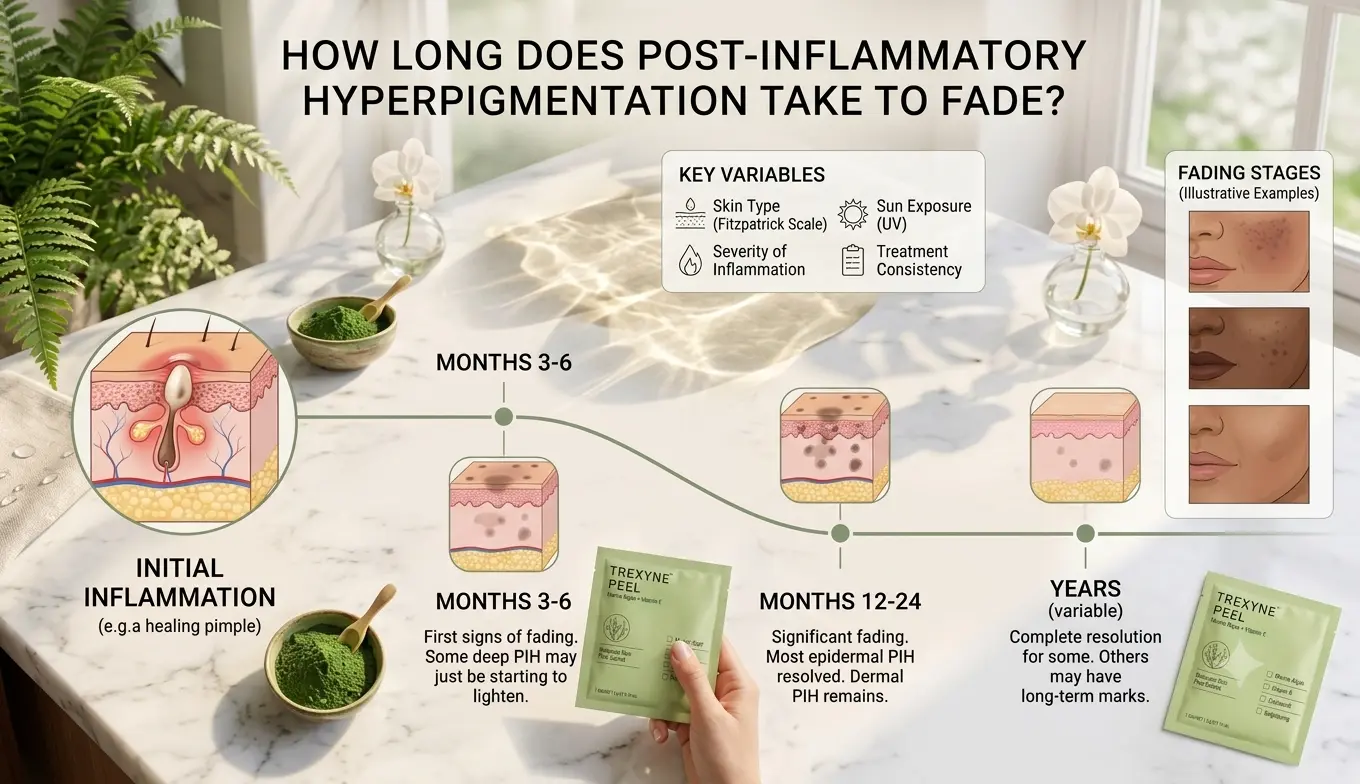
Post-inflammatory hyperpigmentation can take anywhere from a few weeks to several years to fade, depending on a range of factors that vary significantly between individuals and between individual marks. Without professional intervention or consistent sun protection, most PIH will eventually lighten on its own as the skin’s natural cell turnover cycle gradually brings the pigmented cells to the surface and replaces them with unpigmented ones. But that natural process is slow, and for many clients, particularly those with medium to darker skin tones where PIH tends to be more pronounced and more persistent, waiting without professional support is neither practical nor necessary. Professional resurfacing with a treatment such as the Trexyne Peel can significantly accelerate the fading process by stimulating cell turnover more effectively than the skin would achieve on its own. Understanding the factors that influence the timeline is the starting point for setting realistic expectations and designing an effective treatment plan.
Why There Is No Single Answer to How Long PIH Lasts
The range of timelines associated with PIH fading is genuinely broad, and this is not vagueness for its own sake. It reflects real and meaningful variation in the clinical factors that determine how quickly any individual’s PIH responds. Practitioners who give clients a single definitive timeline without contextualising it to the individual are setting expectations that may not be met.
The most important variables are the depth and density of the melanin deposition, the individual’s skin tone and melanocyte reactivity, whether the inflammatory trigger that caused the PIH is still active, how consistently daily SPF is being used, and whether professional resurfacing is being used to accelerate the process or the skin is being left to manage it at its own pace.
Each of these factors can shift the timeline significantly, and when several unfavourable factors are present simultaneously, PIH that might otherwise fade within a few months can persist for a year or more without active intervention.
The Depth of Melanin Deposition
The depth at which the excess melanin has been deposited in the skin is the single most significant factor in how long PIH takes to fade. Melanin deposited close to the skin’s surface, in the uppermost layers of the epidermis, is reached relatively quickly by the cell turnover process and begins to migrate towards the surface and shed within weeks.
Melanin that has been deposited deeper within the epidermal layers, closer to the dermal-epidermal junction, takes longer for the renewal cycle to reach. Each complete cell turnover cycle brings the deeper pigmented cells one step closer to the surface, but the journey takes longer when the starting point is further down. Deeper PIH may require multiple months of consistent resurfacing and SPF use before visible improvement becomes apparent.
In some cases, melanin deposits at the dermal-epidermal junction produce marks that have a distinctive grey or greyish-brown tone rather than the warm brown of purely epidermal PIH. These marks are particularly resistant to fading and may require specialist assessment before any resurfacing course is planned.
How Skin Tone Influences the Fading Timeline
Skin tone is one of the most clinically significant predictors of how long PIH will take to fade, and the relationship runs in a consistent direction: darker skin tones tend to produce more pronounced PIH that takes longer to resolve than the same inflammatory trigger would produce in lighter skin.
This is because melanocytes in skin with higher melanin content have greater baseline activity and a stronger response to inflammatory signals. When inflammation triggers melanocyte overproduction, the resulting pigment deposit is typically more concentrated, sits at greater depth within the epidermis, and persists longer because there is more excess melanin for the renewal cycle to work through.
In Fitzpatrick types I and II, PIH often presents initially as a pinkish or reddish mark with a significant vascular component. This early-stage coloration reflects active inflammation rather than established melanin deposition and typically fades within weeks as the inflammation fully resolves, transitioning to a light brown tone if any melanin deposit remains. The melanin component in these skin types is usually relatively superficial and fades within a few months with appropriate management.
In Fitzpatrick types III to VI, PIH presents as a true melanin deposit from an earlier stage, tends to be deeper in the epidermis, and can persist for six months to several years without professional intervention. The marks are often clearly visible and contrast significantly with the surrounding skin, which makes them more distressing to clients and more likely to drive them to seek professional treatment.
The Effect of an Ongoing Inflammatory Trigger
PIH that has been produced by a single, resolved inflammatory event is in the best position for natural fading. The trigger is gone, no new melanin is being produced, and the skin simply needs to complete the renewal cycle that progressively replaces the pigmented cells.
PIH produced by an ongoing or recurring inflammatory trigger, such as active acne that is continuing to produce new breakouts, a skin condition that has not been controlled, or continued exposure to a contact irritant, is in a much more difficult position. New pigment is being produced as fast or faster than the renewal cycle is clearing the old deposits. In this situation, PIH does not fade in a meaningful way regardless of how much resurfacing is applied, because the underlying trigger is continually resetting the process.
For clients in this position, the clinical priority is managing the underlying inflammatory cause before resurfacing is prioritised. Controlling active acne through appropriate medical or aesthetic management, identifying and removing contact irritants, and stabilising any inflammatory skin conditions creates the conditions under which PIH fading through professional resurfacing becomes achievable.
How UV Exposure Affects the Fading Timeline
UV exposure is one of the most impactful factors in how long PIH persists, and it is one of the few factors that is almost entirely within the client’s control. Every day of unprotected UV exposure in areas affected by PIH provides a stimulus for the local melanocytes to produce more melanin. In already-susceptible skin where melanocytes are primed to respond to UV stimulus, this ongoing stimulus actively deepens and extends the duration of existing PIH.
Without consistent daily SPF use, PIH fading timelines extend significantly. Clients who manage their PIH without sun protection will find that marks darken during summer months and lighten slightly in winter, but never reach the degree of fading they could achieve with consistent photoprotection supporting the process.
Daily broad-spectrum SPF of at least factor 30, applied every morning and reapplied during extended outdoor exposure, is the single most impactful thing a client can do to support PIH fading regardless of whether they are receiving professional treatment. For clients receiving a resurfacing course, it protects each session’s contribution to the cumulative result from being undermined by UV-driven melanocyte restimulation between appointments.
How Professional Resurfacing Accelerates Fading
Natural PIH fading occurs through the skin’s cell turnover cycle, which operates at approximately 28 days in younger adults and extends to 45 days or more with age. At this natural rate, significant visible fading of deep or established PIH can take a very long time.
Professional resurfacing accelerates this process by stimulating cell turnover beyond its natural rate. Each resurfacing session prompts the skin to prioritise renewal, bringing pigmented cells to the surface more quickly than they would travel there on their own. Over a course of professional sessions, the cumulative effect of this accelerated turnover produces visible fading significantly faster than natural cell renewal would achieve.
The Trexyne Peel accelerates PIH fading through a mechanical resurfacing mechanism using marine-algae spicules, without chemical exfoliants. For PIH-prone skin, this matters because a resurfacing approach that generates a chemical inflammatory response risks producing new pigmentation in susceptible melanocytes during the treatment itself. The Trexyne Peel’s mechanical mechanism removes this specific risk, and the stabilised Vitamin E in the formulation supports efficient recovery between sessions, further protecting the skin from the residual inflammatory triggers that could slow fading during the inter-session window.
What Realistic Progress Looks Like Session by Session
Clients undergoing professional resurfacing for PIH benefit from understanding what improvement typically looks like across the sessions of a course rather than expecting dramatic change after a single appointment.
Early sessions, particularly the first two or three, typically produce an improvement in overall skin brightness and surface quality rather than dramatic visible fading of the PIH marks themselves. The skin is responding to the accelerated cell turnover by refreshing the surface layers, which improves general radiance and the quality of the skin surrounding the marks. Some clients notice modest lightening of their PIH from the first few sessions; others find the improvement becomes more apparent later in the course.
By the middle sessions, typically from the third or fourth session onwards, most clients begin to notice a more clearly visible reduction in the intensity of their PIH marks. The marks may appear lighter in colour, less well-defined at their edges, or reduced in the contrast they create with the surrounding skin.
The later sessions of the course consolidate the improvement achieved by earlier sessions and address the remaining deeper-deposited melanin that the initial sessions began working towards. Comparative photographs taken at the start and at the end of the course typically show the most clearly visible evidence of the cumulative progress.
Practitioners interested in incorporating the Trexyne Peel into their PIH treatment protocols can explore the full range via the Trexyne shop, or contact the team directly through the Trexyne contact page.
What to Do if PIH Is Not Fading as Expected
If PIH is not showing visible improvement after an appropriate course of professional resurfacing and consistent sun protection, several factors warrant investigation before continuing or escalating treatment.
First, assess whether the original inflammatory trigger has been fully resolved. If acne remains active, a skin condition has not been adequately controlled, or UV exposure has been significant without adequate SPF, progress will be limited regardless of the resurfacing approach used.
Second, consider the depth of the pigmentation. Marks that have a greyish rather than brown tone, or that have been present for many years without any change, may have a component at or near the dermal-epidermal junction that is less responsive to epidermal resurfacing. Dermatological assessment of pigmentation depth may be appropriate for these cases.
Third, review whether the treatment intensity and session spacing are appropriate for the degree of PIH present. Conservative starting intensities are appropriate for PIH-prone skin, but a course that remains at minimal intensity throughout may not be stimulating sufficient cell turnover to produce meaningful visible change in established or dense pigmentation.
More information on the Trexyne approach to professional botanical resurfacing is available on the Trexyne website.
Conclusion
Post-inflammatory hyperpigmentation takes varying lengths of time to fade depending on the depth of melanin deposition, the individual’s skin tone, whether the inflammatory trigger has been resolved, how consistently daily SPF is used, and whether professional resurfacing is supporting the process. In lighter skin types with recent, superficial PIH, fading can begin within weeks with appropriate management. In medium to darker skin tones with older or deeper marks, a sustained course of professional treatment combined with rigorous daily sun protection is typically needed to produce meaningful visible improvement within a clinically realistic timeframe. The Trexyne Peel accelerates PIH fading through a mechanical resurfacing mechanism that avoids the chemical inflammatory trigger most likely to worsen pigmentation in susceptible skin, supported by stabilised Vitamin E for recovery and a tiered protocol that allows conservative progression matched to the individual’s skin. With the right approach and consistent aftercare, meaningful visible improvement in PIH and a brighter, more even-looking complexion are achievable outcomes for most clients within a well-managed professional treatment course.
FAQs
Q: How long does post-inflammatory hyperpigmentation take to fade?
PIH can take anywhere from a few weeks to several years to fade depending on the depth of the melanin deposit, the individual’s skin tone, and how consistently sun protection is maintained. Professional resurfacing significantly accelerates the natural fading process. Lighter skin types with recent, superficial PIH may see meaningful improvement within a few months. Darker skin tones with older or deeper marks typically require a sustained professional treatment course.
Q: Will post-inflammatory hyperpigmentation fade on its own without treatment?
PIH does fade naturally over time as cell turnover progressively replaces pigmented cells with unpigmented ones. However, this natural process is slow, particularly in medium to darker skin tones, and can take many months to years for established marks. Professional resurfacing supported by daily SPF significantly accelerates the timeline and produces more visible results within a shorter period.
Q: Why is PIH slower to fade in darker skin tones?
Darker skin tones have higher melanocyte activity and a stronger melanin response to inflammatory signals, producing PIH deposits that are typically denser, deeper within the epidermis, and more persistent. The renewal cycle needs to work through more accumulated pigmented cells, which extends the fading timeline compared to the same inflammatory event in a lighter skin type.
Q: Does sun exposure affect how long PIH takes to fade?
Yes, significantly. UV exposure stimulates melanocyte activity in areas affected by PIH, deepening existing marks and extending the fading timeline. Without consistent daily broad-spectrum SPF use, PIH fading is substantially slower and may plateau or worsen seasonally with increased UV exposure. SPF is a clinical requirement for PIH management, not optional advice.
Q: How many Trexyne Peel sessions are needed to fade PIH? The number of sessions depends on the depth and age of the pigmentation and the individual’s skin response. Visible improvement typically builds progressively across a course, with more noticeable fading often becoming apparent from the third to fourth session onwards. A practitioner assessment will provide a realistic recommendation based on the specific presentation.
Q: Can the Trexyne Peel fade post-inflammatory hyperpigmentation from acne?
Yes. The Trexyne Peel supports PIH fading through a mechanical resurfacing mechanism that accelerates cell turnover without the chemical inflammatory trigger that can worsen PIH in acne-prone, susceptible skin. Stabilised Vitamin E supports recovery between sessions, and the tiered protocol allows conservative progression suited to skin with a documented tendency towards post-inflammatory pigmentation.
Q: Why is my PIH not fading even with treatment?
If PIH is not showing expected progress, the most common reasons are an ongoing inflammatory trigger such as active acne or unprotected UV exposure, pigmentation that sits too deeply within the epidermis to respond fully to surface resurfacing, or a treatment course that has not yet reached sufficient intensity or duration to produce visible change in established marks. A practitioner review can identify which factor is most likely and adjust the treatment plan accordingly.