Can the Trexyne Peel Treat Post-Inflammatory Hyperpigmentation?
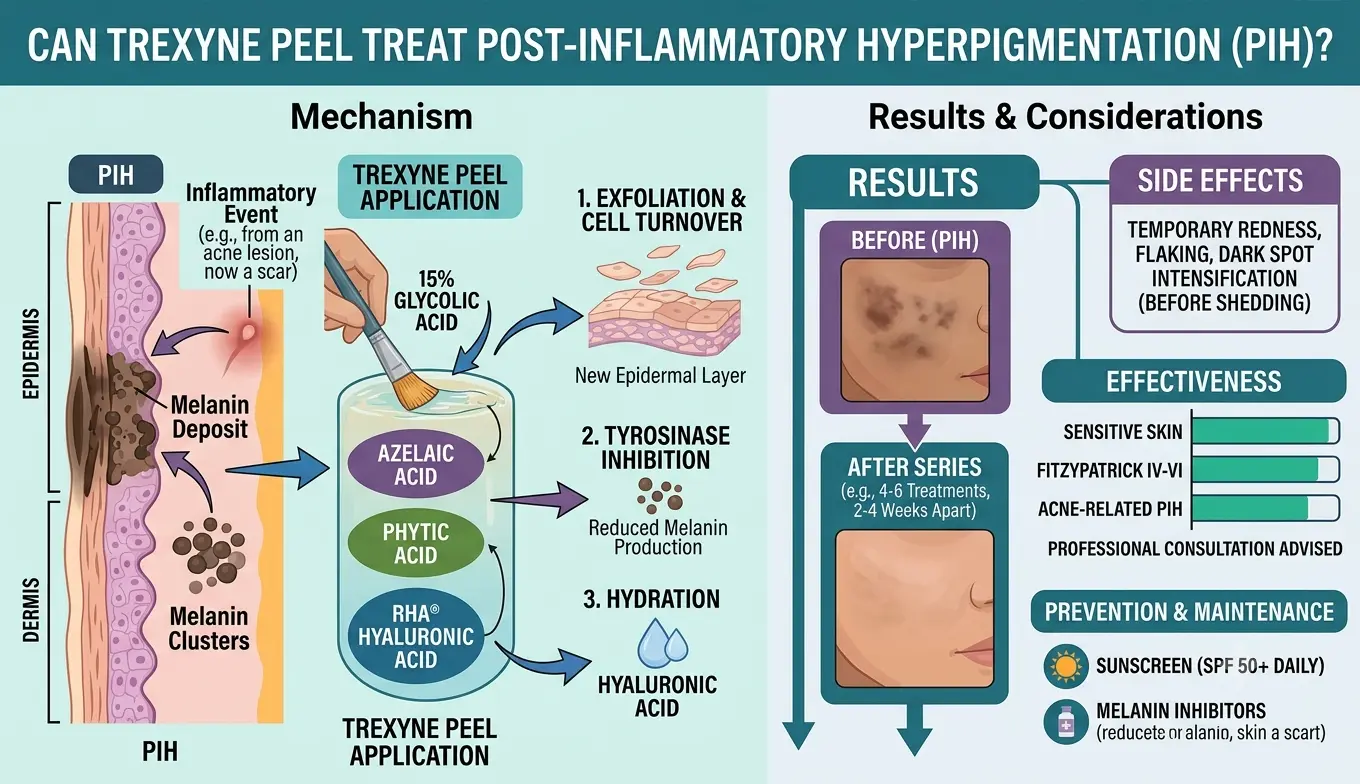
Yes, the Trexyne Peel can form part of a professional treatment plan for post-inflammatory hyperpigmentation. PIH is an epidermal pigmentation concern, meaning the excess melanin sits within the skin’s upper layers where accelerated cell turnover can progressively displace it with fresh, unpigmented cells over a course of sessions. The reason the Trexyne Peel is particularly well suited to PIH is not simply that it resurfaces. It is that the mechanism it uses to resurface avoids the specific inflammatory trigger that is most likely to produce new PIH in susceptible skin while treating the existing marks. For clients whose skin has already demonstrated a tendency to produce dark marks in response to inflammation, applying a resurfacing treatment that generates a chemical inflammatory response carries a real risk of creating new pigmentation alongside the old. The Trexyne Peel resurfaces through a purely mechanical mechanism, removing that chemical trigger from the equation. This is the clinical basis for its relevance in PIH management rather than simply a feature of the formulation.
Why Mechanism Matters So Much for PIH
Most forms of skin pigmentation can be addressed with a broad range of resurfacing approaches, and the mechanism of the treatment is a secondary consideration after selecting the appropriate depth and intensity for the concern. PIH is different. For this specific condition, the mechanism of resurfacing is a primary clinical decision because getting it wrong can worsen the exact concern being treated.
Post-inflammatory hyperpigmentation occurs because inflammation stimulates melanocytes to overproduce melanin. Melanocytes in PIH-prone skin have demonstrated that they respond to inflammatory signals with excess pigment production. A resurfacing treatment that generates inflammation as part of its mechanism therefore carries a risk of activating this same response in the very melanocytes the treatment is working to address.
This is not a theoretical risk. Post-peel PIH is a documented and common adverse outcome in susceptible skin types, particularly Fitzpatrick types III to VI, when chemical resurfacing is used without adequate attention to the inflammatory burden the treatment places on the skin. The resulting pigmentation can be as difficult to manage as the original concern and in some cases more extensive.
Choosing a resurfacing mechanism that does not engage this inflammatory pathway reduces this risk substantially. It does not eliminate all risk, because any skin disruption involves some degree of repair response. But removing the chemical inflammatory trigger removes the most significant driver of PIH provocation during resurfacing.
How the Trexyne Peel Works for PIH
The Trexyne Peel creates controlled micro-channels in the skin surface through the physical action of marine-algae spicules. This mechanical disruption stimulates the skin’s renewal response without a chemical reaction taking place in the skin. The inflammatory burden associated with this type of resurfacing is lower than that generated by chemical approaches, which changes the risk profile for PIH-prone skin meaningfully.
As the skin responds to the mechanical micro-channelling with accelerated cell turnover, the pigmented cells contributing to the PIH marks are progressively displaced and shed, to be replaced by fresher, unpigmented cells generated by the renewal cycle. This process does not happen immediately after a single session. It builds cumulatively across a course of treatments, with each session adding to the progress of the previous one.
The stabilised Vitamin E in the formulation supports the skin’s recovery from the first application. For PIH-prone skin, the recovery period is a window of particular vulnerability. Any residual inflammation during recovery can act as a secondary trigger for further melanin production in already-sensitised melanocytes. Recovery support from within the formulation works alongside appropriate aftercare to reduce this risk during the inter-session window.
Building a PIH Protocol Around the Trexyne Peel
A well-structured PIH treatment course using the Trexyne Peel requires attention to several clinical factors beyond the treatment sessions themselves. These elements work together to determine how effectively the course produces visible improvement.
The first consideration is whether the underlying inflammatory trigger has been resolved. PIH that is still being actively produced by recurring acne, a skin condition that has not been controlled, or repeated exposure to an irritant will not respond satisfactorily to resurfacing alone, because new pigment is being created at a rate comparable to or greater than the rate at which resurfacing is clearing it. Managing the cause of the PIH is a precondition for the resurfacing course to work effectively.
Session intensity should begin conservatively, particularly for new clients or those with a pronounced PIH history. The Trexyne Peel’s tiered protocol allows the practitioner to start at an appropriate level and advance as the skin demonstrates its tolerance. The first session is as much an assessment of how that individual’s skin responds to this mechanism at this intensity as it is a treatment session in its own right. A first session that recovers cleanly and without evidence of PIH provocation in the treated area tells the practitioner that the approach is appropriate for this skin and that progression is appropriate.
Session spacing of three to four weeks allows the skin to complete its renewal cycle between treatments. This spacing is important because each session builds on completed renewal from the previous one. Sessions spaced too closely do not allow this cycle to finish, which can reduce the cumulative benefit and increase the risk of barrier disruption that would heighten PIH vulnerability.
Daily SPF use throughout the course is a clinical requirement rather than optional aftercare. UV exposure between sessions actively stimulates melanocyte activity in the affected areas, producing new pigment as fast as or faster than resurfacing is clearing it. Without consistent photoprotection, the course is working against an ongoing UV trigger.
What Clients Should Expect Across the Course
Clients undergoing a Trexyne Peel course for PIH benefit from a clear understanding of how improvement typically develops so they can evaluate their progress accurately rather than drawing premature conclusions from individual sessions.
The early sessions, typically the first two to three, tend to produce visible improvements in overall skin brightness and surface quality more than dramatic visible fading of the PIH marks themselves. The renewal stimulated by resurfacing refreshes the skin broadly, and the initial improvement in radiance and surface texture is often the first change clients notice. Some lightening of the marks may also become apparent, but it is typically subtle at this early stage.
By the middle sessions, most clients begin to notice a more clearly visible reduction in the depth and intensity of their PIH marks. The marks appear lighter, less defined at their borders, and less contrasted with the surrounding skin. For clients with moderate PIH from recent acne or mild skin trauma, this stage often represents the most satisfying visible change.
The later sessions of the course consolidate improvement and address deeper-deposited melanin that the earlier sessions have been working towards. Clients with older, more established marks, or those with deeper pigmentation typical of Fitzpatrick types IV to VI, may need more sessions before this stage of visible improvement is clearly apparent. Comparing photographs from the start of the course with those taken at the midpoint and end provides the clearest evidence of cumulative progress.
The PIH Clients Who Benefit Most From This Approach
The Trexyne Peel’s combination of a non-inflammatory resurfacing mechanism, recovery-supportive formulation, and tiered protocol makes it particularly relevant for specific client profiles within the broader PIH-affected population.
Clients with Fitzpatrick types III to VI who need meaningful resurfacing for PIH but whose melanocyte reactivity makes chemical resurfacing a higher-risk approach are perhaps the clearest candidates. For these clients, removing the chemical inflammatory trigger from the resurfacing mechanism significantly changes the risk-benefit calculation.
Clients who have previously developed PIH after chemical resurfacing treatments, whether from a professional peel or from aggressive home-use actives, have directly demonstrated that their melanocytes respond to chemical inflammatory triggers with excess pigment production. For these clients, a mechanical alternative is not simply a preference. It is the clinically appropriate response to what their skin has shown.
Clients with post-acne PIH who are managing ongoing or recently resolved breakout activity need a resurfacing approach that can work on existing marks without aggravating the skin and triggering further breakout or PIH activity. The Trexyne Peel’s mechanical mechanism and the absence of chemical irritants in its formulation reduces this risk compared to acid-based options.
Practitioners looking to incorporate a professional resurfacing option for PIH into their treatment offering can explore the full range via the Trexyne shop, or contact the team directly through the Trexyne contact page.
Aftercare That Supports PIH Treatment
The aftercare period following each session is where a significant proportion of the total clinical outcome for PIH is determined. Practitioners who invest in thorough, specific aftercare guidance protect the contribution of each session to the overall course result.
The core aftercare requirements for PIH-focused resurfacing are the same as for resurfacing generally, but carry particular clinical weight for this concern. Daily broad-spectrum SPF applied every morning without exception protects the skin from UV-driven melanocyte stimulation between sessions. Avoiding active home-use products including retinoids and exfoliating acids in the days immediately following each session reduces the risk of secondary irritation that could trigger further PIH in the recovery window. Avoiding heat, vigorous exercise, and saunas in the 48 hours following treatment reduces the vascular stimulus that can extend the post-treatment inflammatory period.
Clients who receive written aftercare guidance, rather than verbal instructions alone, are significantly more likely to follow it accurately throughout the course. The recovery period immediately after treatment, when the skin is most vulnerable to secondary triggers, is precisely when clients most need the specific, practical guidance that a clearly written aftercare document provides.
When to Review Progress and Adjust the Protocol
At each session of a PIH course, the practitioner should review the skin’s response to the previous session before deciding how to proceed. The tiered protocol of the Trexyne Peel provides the structure for this review: if the previous session produced a clean recovery and visible progress, intensity can be maintained or advanced. If the previous recovery was more difficult than expected, or if there is any evidence of PIH provocation in the treated area, intensity should be held or reduced before being reconsidered.
Progress photographs taken at consistent intervals, ideally at the start of the course and then every few sessions, give both the practitioner and the client an objective measure of how the marks are responding. This is particularly important for PIH, where improvement is gradual and can be difficult to perceive through day-to-day observation of the same face in the same mirror. Photographic comparison across the course makes the cumulative progress visible in a way that supports client confidence and treatment compliance.
More information on the Trexyne approach to professional botanical resurfacing is available on the Trexyne website.
Conclusion
The Trexyne Peel can treat post-inflammatory hyperpigmentation by accelerating cell turnover through a mechanical resurfacing mechanism that avoids the chemical inflammatory trigger most likely to produce new PIH in susceptible skin. PIH sits within the epidermis where progressive cell renewal can displace pigmented cells over a sustained course, and the Trexyne Peel’s combination of a non-chemical resurfacing mechanism, stabilised Vitamin E recovery support, and a tiered protocol suited to conservative, gradual progression makes it a clinically appropriate option for this concern across a range of skin types. For Fitzpatrick types III to VI, for clients with a history of post-peel PIH from chemical treatments, and for post-acne skin where minimising inflammatory burden during resurfacing is a clinical priority, the Trexyne Peel offers a more considered mechanism than acid-based alternatives. Supported by consistent daily SPF, an appropriate treatment timeline, and thorough aftercare, it may help support meaningful visible fading of PIH and a brighter, more even-looking complexion over the course of a well-managed professional treatment plan.
FAQs
Q: Can the Trexyne Peel treat post-inflammatory hyperpigmentation?
Yes. The Trexyne Peel supports PIH treatment by stimulating cell turnover through a mechanical resurfacing mechanism that avoids the chemical inflammatory trigger most likely to produce new pigmentation in susceptible skin. PIH responds to accelerated cell turnover, and the Trexyne Peel’s approach is particularly relevant for skin types prone to PIH provocation from chemical resurfacing.
Q: Why is the Trexyne Peel better suited to PIH than chemical peels?
PIH-prone skin has demonstrated that it responds to inflammatory signals with excess melanin production. Chemical resurfacing generates inflammation as part of its mechanism, which can provoke new PIH even as it treats existing marks. The Trexyne Peel’s mechanical mechanism does not generate a chemical inflammatory response, removing the primary trigger for treatment-induced PIH in susceptible skin.
Q: How many sessions of the Trexyne Peel are needed for PIH?
The number of sessions depends on the depth and age of the pigmentation and the individual’s skin response. Visible improvement typically builds progressively, with more noticeable fading often apparent from the third or fourth session onwards. Older or deeper marks, particularly in Fitzpatrick types IV to VI, may require a more sustained course. A practitioner assessment provides a realistic recommendation.
Q: Can the Trexyne Peel be used for PIH in darker skin tones?
The Trexyne Peel’s mechanical mechanism is particularly relevant for darker skin tones, where the risk of chemical resurfacing provoking melanocyte-driven PIH is highest. Starting conservatively within the tiered protocol and building based on demonstrated tolerance is the appropriate approach for Fitzpatrick types III to VI. Suitability is assessed at consultation.
Q: What should I do between Trexyne Peel sessions to help my PIH fade faster?
Daily broad-spectrum SPF is the most impactful step. UV exposure between sessions stimulates melanocyte activity in affected areas and can slow or reverse visible progress. Avoiding active skincare products and heat sources in the days after each session reduces secondary inflammatory triggers during recovery. Keeping the home routine simple and consistent between appointments supports the renewal stimulated by each professional session.
Q: Is it safe to have the Trexyne Peel if I have active acne alongside PIH?
Resurfacing should not be applied to actively inflamed or broken-out skin. Active acne should be at a controlled or manageable level before a resurfacing course begins. The practitioner assesses the skin’s current condition at each appointment and adjusts or defers sessions where active inflammation is present. Managing active acne before and during the course is also important for preventing new PIH from forming during treatment.
Q: Where can practitioners find more information about using the Trexyne Peel for PIH?
Practitioners can explore the full product range and stocking options through the Trexyne shop, or contact the Trexyne team directly through the contact page for guidance on incorporating mechanical resurfacing into PIH management protocols across a range of skin types and presentations.