How Trexyne Peel Helps Fade Dark Patches Without Acids
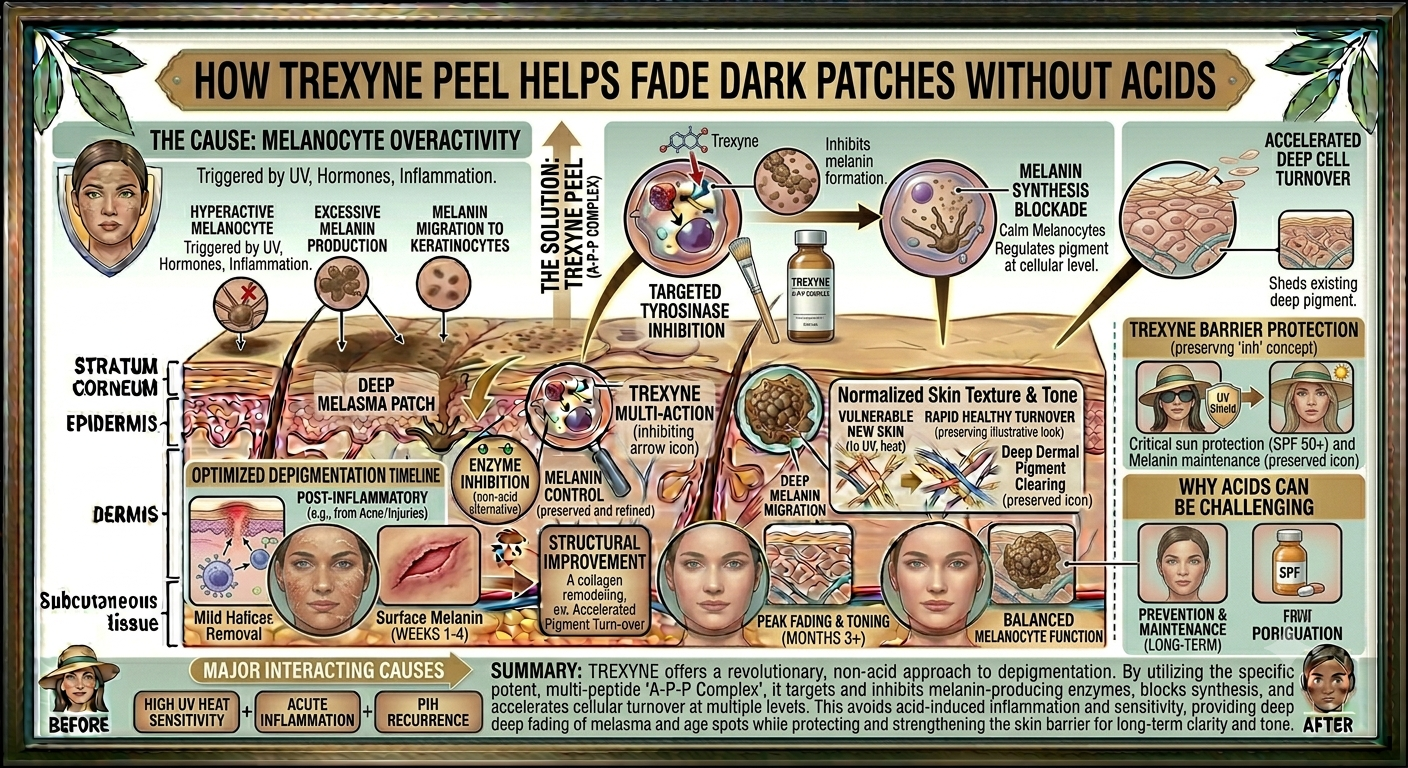
Most conversations about professional resurfacing for pigmentation start with acids. But acid-free options exist, and for a significant proportion of clients they are not just a preference — they are a clinical necessity. Clients with reactive skin, pigmentation-prone skin types, or a history of adverse reactions to chemical exfoliants often need a different approach entirely. The Trexyne Peel — Professional Algae Resurfacing Treatment is built entirely around a mechanical mechanism, using marine algae spicules to resurface the skin without chemical exfoliants of any kind. This post looks at how that mechanism works, why it matters for clients with dark patches, and how practitioners can use it within a structured pigmentation programme.
The Problem With Chemical Exfoliation for Certain Skin Types
Before explaining what the Trexyne Peel does, it is worth being clear about why acid-free resurfacing matters clinically. Chemical exfoliation is not inherently problematic. For many clients and many presentations, it works well. But it carries a specific risk profile that becomes significant in the context of hyperpigmentation.
Chemical exfoliants work by breaking down the bonds between skin cells through a chemical reaction at the skin surface. In doing so, they trigger an inflammatory cascade. For most skin types, that inflammation is mild, transient, and manageable. For clients with pigmentation-prone skin, particularly those with Fitzpatrick skin types IV through VI, or those already dealing with post-inflammatory hyperpigmentation, that same inflammatory response can stimulate melanocyte activity and worsen the very pigmentation being treated.
This is the central clinical tension. The treatment you use to address dark patches can, in the wrong client, deepen them. The mechanism matters.
What Makes the Trexyne Peel Different
The Trexyne Peel does not use acids, chemical exfoliants, or any compound that relies on chemical penetration to resurface the skin. Its mechanism is entirely mechanical, driven by one key active: marine algae spicules.
These are microscopic, needle-like structures derived from algae. When a trained practitioner applies the Trexyne Peel, the spicules create controlled micro-channels across the skin surface through physical contact. This physical disruption stimulates the skin’s natural renewal response — cell turnover accelerates, pigmented surface cells begin to shed, and the skin starts producing fresher cells from below.
The process looks similar to chemical resurfacing in terms of outcome, but the pathway to that outcome is fundamentally different. There are no chemical signals, no acid-driven breakdown of cellular bonds, and no associated inflammatory chemistry. The skin responds to a mechanical stimulus rather than a chemical one.
Why the Mechanical Mechanism Matters for Dark Patches
For clients with dark patches, the distinction between mechanical and chemical resurfacing has practical consequences.
Lower Risk of Rebound Pigmentation
One of the risks with chemical resurfacing for hyperpigmentation is the potential for rebound. If the treatment triggers more inflammation than the skin can manage without activating its melanin response, new pigmentation can form in the weeks following treatment. In some cases, clients end up with pigmentation that is worse than it was before.
Because the Trexyne Peel’s micro-channels are created mechanically rather than through a chemical reaction, the inflammatory signal to the skin is different. The stimulus is physical and controlled. This may reduce the risk of triggering the melanocyte response that drives rebound pigmentation in susceptible skin.
More Predictable Response Across Skin Types
Chemical exfoliation can behave unpredictably across different skin tones because the inflammatory response it triggers varies by individual. Mechanical resurfacing, when delivered through a tiered protocol by a trained practitioner, tends to produce a more predictable skin response. The intensity can be calibrated precisely and adjusted in real time based on what the skin is doing.
For practitioners managing hyperpigmentation across a diverse client base, this predictability has real clinical value.
The Role of Marine Algae Spicules in Skin Renewal
Marine spicules are not a new discovery in dermatology, but their application in professional resurfacing represents a considered use of a naturally occurring physical exfoliant with a specific structural advantage.
Their microscopic size and needle-like geometry allow them to create very fine, very controlled disruption at the skin surface. This is not the blunt trauma of a physical scrub. It is a precise, repeatable mechanical stimulus that the skin interprets as a signal to renew.
When cell turnover accelerates in response to that signal, the cycle that causes dark patches to persist is disrupted. Pigmented cells that have accumulated at the surface shed more efficiently. Newer cells rising from below carry less concentrated melanin. Over a course of treatments, this progressive improvement can lead to a visibly more even skin tone.
The depth and distribution of the micro-channels can be influenced by how the Trexyne Peel is applied, which is why it is designed for use exclusively by trained aesthetic professionals. The spicules are effective precisely because they are used with knowledge and clinical judgement behind them.
Stabilised Vitamin E: Supporting Recovery Alongside Resurfacing
The Trexyne Peel formulation includes stabilised tocopherol alongside the marine spicules. Tocopherol is a form of Vitamin E with antioxidant properties that is well established in professional skincare.
In the context of a resurfacing treatment, its role is to support the skin’s recovery phase. When the spicules create micro-channels and the renewal process begins, the skin needs to respond constructively. The stabilised Vitamin E in the Trexyne Peel may support that recovery from the first application, helping to maintain skin integrity through the treatment course.
This pairing of active resurfacing and recovery support is a deliberate design feature. You are not simply disrupting the skin surface and leaving it to manage. You are providing a stimulus for renewal and the support to respond to it well. For clients with dark patches, where the skin’s integrity and recovery capacity directly influence how well it responds to treatment, this matters.
The Tiered Protocol: Matching Intensity to the Client
One of the practical advantages of the Trexyne Peel for pigmentation work is its tiered protocol. Practitioners can adjust treatment intensity to match the individual client’s skin type, history, and tolerance.
Starting Conservatively
For clients with reactive skin, a history of treatment-induced PIH, or darker Fitzpatrick skin types, starting at a lower intensity reduces the risk of over-stimulating the skin. A conservative first session also allows the practitioner to observe how the skin responds before escalating. What the skin does in the 24 to 48 hours after the first treatment tells you a great deal about how to approach subsequent sessions.
Building Progressively
As the skin demonstrates resilience and consistent renewal, intensity can be built incrementally across the treatment course. This progressive approach tends to produce better cumulative results than trying to push intensity too quickly. The goal is to keep the skin in a state of active, productive renewal throughout the course rather than creating a sharp peak of disruption followed by a recovery phase that sets the programme back.
Adjusting for Maintenance
Once the active phase of treatment has produced visible improvement, the tiered protocol also supports the transition to maintenance sessions. Lower intensity maintenance appointments keep the renewal cycle going without the level of disruption appropriate for the clearing phase. This is clinically efficient and easier for clients to fit into a regular schedule.
Who Benefits Most From an Acid-Free Resurfacing Approach
The Trexyne Peel’s acid-free mechanism makes it particularly relevant for specific client profiles.
Clients with post-inflammatory hyperpigmentation where ongoing acne or skin reactivity means that additional inflammatory stimulus from chemical exfoliants carries real risk. Clients with Fitzpatrick skin types IV through VI where chemical resurfacing requires extra caution and the potential for treatment-induced pigmentation is higher. Clients who have previously experienced adverse reactions to chemical peels or exfoliants and are understandably wary of repeating the experience. Clients with sensitive or reactive skin where predictability and gentleness are as important as efficacy.
It is also a relevant option for clients who simply prefer a botanical, non-chemical approach. That preference is increasingly common and the results achievable through mechanical resurfacing support it as a clinically credible choice rather than a compromise.
Building a Programme With the Trexyne Peel for Dark Patches
A single treatment can produce noticeable results, but a structured course is where the Trexyne Peel’s benefits for dark patch management become most apparent. Cumulative renewal builds across sessions. The skin’s response typically improves as the programme progresses and the practitioner can calibrate intensity with greater precision based on observed response.
Practitioners can view the full range of pack options and pricing via the Trexyne shop. The Trexyne Peel is available as a single 30ml vial priced at £175.00, with course packs of 10 and 20 peels for practitioners running longer pigmentation programmes. Each vial provides approximately 6 to 8 full-face treatments, which makes per-session costs manageable within a clinical setting.
Treatment intervals, home care guidance, and SPF protocol should all be established at the outset. Clients with dark patches need to understand that SPF compliance is not optional during a resurfacing programme. UV exposure can reverse gains quickly, particularly in skin that is actively renewing at the surface. The treatment and the sun protection work together. One without the other is unlikely to produce results that hold.
What to Expect During and After Treatment
Setting clear expectations is part of the practitioner’s role, and it directly influences client confidence and compliance through the programme.
During the treatment, clients may notice a mild tingling or sensation associated with the mechanical action of the spicules. This is expected and resolves quickly. The level of visible response after treatment, such as mild redness or surface texture change, will vary depending on the treatment intensity used and the individual’s skin profile.
The Trexyne Peel is designed for predictable downtime. The tiered protocol means practitioners can match intensity to what the client can accommodate in terms of recovery time and visible skin change between appointments. There should be no extended downtime, and clients should be able to return to their normal routine within an appropriate period depending on the intensity selected.
Over the course of the programme, clients may notice a gradual improvement in the evenness of their skin tone as surface pigmentation sheds and fresher cells emerge. The pace of visible change varies, but consistent treatment at appropriate intervals tends to produce steady, cumulative improvement.
Practitioners with specific clinical questions about the Trexyne Peel or its application for facial hyperpigmentation are welcome to get in touch via the Trexyne contact page.
Why Professional Delivery Is Essential
The Trexyne Peel is sold exclusively to verified practitioners and clinics. This is central to how the treatment works as intended. The marine spicules are effective because they are applied with clinical knowledge, appropriate technique, and the ability to assess how the skin is responding in real time.
The difference between a well-delivered mechanical resurfacing treatment and one applied without that knowledge is not just about results. It is about safety. Client assessment, contraindication screening, appropriate intensity selection, and post-treatment guidance all require trained professional judgement. These are not steps that can be replicated with a consumer product.
For practitioners who want to understand more about the treatment and whether it suits their clinic’s offering, full product information is available at Trexyne.com.
Conclusion
Dark patches on the face can be addressed through resurfacing without relying on acids or chemical exfoliants. The Trexyne Peel demonstrates that clearly. Its marine algae spicules create controlled micro-channels through a purely mechanical mechanism, stimulating skin renewal and supporting the progressive shedding of pigmented surface cells. The stabilised Vitamin E in the formulation may support skin recovery throughout the treatment course. The tiered protocol gives practitioners precise control over intensity, making the treatment adaptable across a wide range of skin types and pigmentation presentations.
For clients where chemical resurfacing carries a risk of rebound pigmentation, or where skin reactivity and tone make a more conservative approach clinically appropriate, the Trexyne Peel offers a credible, well-structured alternative. Used consistently as part of a programme that includes SPF compliance and appropriate home care, it may help clients achieve a progressively brighter, more even-looking complexion without the unpredictability that some chemical approaches can bring to pigmentation-prone skin.
Frequently Asked Questions
Q: How does the Trexyne Peel fade dark patches without using acids?
The Trexyne Peel uses marine algae spicules to create controlled micro-channels in the skin through a purely mechanical action. This physical stimulus accelerates cell turnover and encourages the shedding of pigmented surface cells without relying on chemical exfoliants. The result is progressive improvement in skin tone over a course of treatments, driven by the skin’s own renewal response rather than chemical disruption.
Q: Is an acid-free peel as effective as a chemical peel for dark patches?
Effectiveness depends on the type and depth of the pigmentation, the client’s skin profile, and how the treatment course is structured. For clients with surface-level dark patches, particularly those caused by post-inflammatory hyperpigmentation or cumulative UV exposure, a mechanical resurfacing treatment like the Trexyne Peel can support meaningful visible improvement over a course of sessions. For clients where chemical resurfacing carries a risk of rebound pigmentation, an acid-free approach may actually produce better sustained results.
Q: Can the Trexyne Peel be used on sensitive skin with dark patches?
Yes, the Trexyne Peel’s tiered protocol allows practitioners to start at a lower treatment intensity for sensitive skin and build gradually as the skin’s response is observed. The mechanical mechanism avoids the chemical inflammatory signals that can be problematic for reactive skin. A thorough consultation, patch test, and conservative initial protocol are always recommended for clients with a history of skin sensitivity.
Q: How many Trexyne Peel sessions are needed to see improvement in dark patches?
The number of sessions required varies depending on the type of pigmentation, how long it has been present, the client’s skin type, and their SPF compliance between appointments. Most practitioners recommend a structured course rather than a single session for meaningful improvement in dark patches. Surface-level pigmentation may begin to show visible change after a handful of treatments, while more established patches typically benefit from a longer programme.
Q: Is the Trexyne Peel suitable for darker skin tones with hyperpigmentation?
The Trexyne Peel is a considered option for clients with medium to deeper Fitzpatrick skin types because its mechanical mechanism avoids the chemical inflammatory signals that can increase the risk of treatment-induced pigmentation in these skin tones. The tiered protocol allows intensity to be kept conservative and built gradually. That said, individual assessment, patch testing, and a careful starting protocol are essential for any client with hyperpigmentation-prone skin regardless of treatment type.
Q: Does the Trexyne Peel require significant downtime after treatment?
The Trexyne Peel is designed for predictable downtime, and its tiered protocol means intensity can be matched to what the client can accommodate. There is no extended downtime associated with the treatment when used at appropriate intensity levels. Clients may notice mild redness or surface texture change after a session, but the degree of visible response depends on the intensity selected and the individual skin profile.
Q: Where can practitioners purchase the Trexyne Peel for pigmentation treatment?
The Trexyne Peel is available exclusively to verified practitioners and clinics. It can be purchased through the Trexyne shop, with a single 30ml vial priced at £175.00 and course packs of 10 and 20 peels available for longer treatment programmes. Each vial provides approximately 6 to 8 full-face treatments. For clinical or purchasing enquiries, the team can be reached via the contact page.