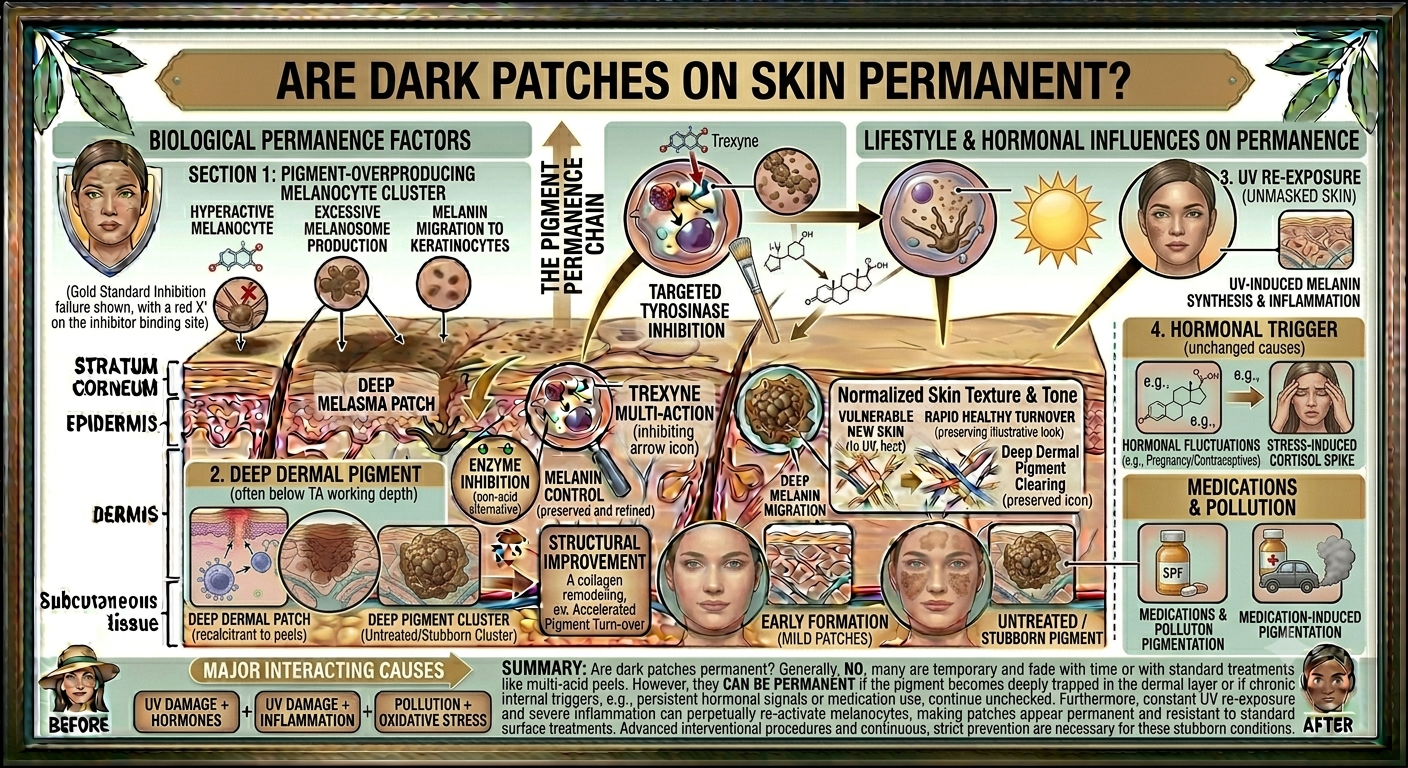
Are Dark Patches on Skin Permanent?
Dark patches on the skin are not always permanent, but whether they fade depends on what caused them and how deep the pigment sits within the skin. Some patches lighten naturally over months. Others, particularly those linked to sun exposure or hormonal changes, can persist for years without the right support. Many clients ask their practitioner this question because they want a realistic answer before investing in treatment. The good news is that targeted, professional approaches can support a more even-looking complexion over time. One option many UK clinics now offer is the Trexyne Peel, a botanical resurfacing treatment designed to support skin renewal without the use of chemical exfoliants. This article looks at why dark patches form, which types are more likely to fade, and how professional resurfacing fits into a sensible long-term plan.
What Causes Dark Patches on the Skin?
Dark patches develop when melanin, the pigment responsible for skin colour, is produced unevenly across the skin’s surface. This can happen for several reasons. Sun exposure is one of the most common triggers, as ultraviolet light stimulates melanocytes to produce more pigment as a protective response. Hormonal fluctuations, particularly during pregnancy or while taking certain contraceptives, can also trigger patchy pigmentation. Inflammation from acne, eczema, or skin injury often leaves behind a temporary mark known as post-inflammatory hyperpigmentation. Genetics play a role too, as some skin types are naturally more prone to pigment irregularities than others.
Understanding the underlying cause matters because it shapes how a practitioner approaches treatment. A patch caused by a healed spot behaves very differently from one caused by years of sun exposure.
Are Dark Patches Permanent or Temporary?
This is rarely a simple yes or no answer. Pigment can sit at different depths within the skin. Patches that sit closer to the surface, in the epidermis, tend to respond more readily to resurfacing and renewal-focused treatments. Patches that sit deeper, in the dermis, are generally more stubborn and can take longer to fade, even with consistent care.
Some marks fade on their own within weeks or months, especially mild post-inflammatory marks in younger skin. Others, such as long-standing melasma or sun-induced patches in mature skin, may never disappear completely without professional support. This is why so many people search for answers rather than waiting and hoping the patch will fade by itself.
Common Types of Dark Patches Explained
Not all dark patches are the same, and recognising the difference helps set realistic expectations.
Melasma
Melasma typically appears as symmetrical patches on the cheeks, forehead, or upper lip. It is closely linked to hormonal changes and sun exposure, and it tends to be one of the more persistent forms of pigmentation. It often becomes more noticeable in warmer months and can fade slightly in winter, only to return with sun exposure.
Post-Inflammatory Hyperpigmentation
This type follows skin trauma such as acne, cuts, or burns. It usually presents as a flat, brownish mark where the skin previously healed. It is often more responsive to treatment than melasma, particularly when addressed early.
Sun-Induced Pigmentation
Often called sun spots or age spots, these patches develop from cumulative UV exposure over years. They are common on the face, hands, and chest, and they tend to deepen in colour with continued sun exposure.
Why Some Dark Patches Fade and Others Don’t
The skin naturally renews itself by shedding surface cells and replacing them with new ones. In younger, healthier skin, this turnover happens more efficiently, which is why some marks fade without intervention. As skin ages or experiences repeated UV exposure, this renewal process slows down. Pigment can become trapped in the upper layers for longer, making patches look more stubborn and settled.
Patches that have been present for a long time, or those triggered by ongoing factors like hormonal activity, are less likely to resolve without consistent professional input. This is where structured, repeated treatment protocols tend to outperform sporadic home care.
It is also worth noting that pigment can deepen further with continued exposure to triggers, even while a patch is technically fading underneath. A client may feel discouraged seeing little visible change week to week, when in fact the renewal process is working steadily beneath the surface. Setting expectations around timeframes, rather than promising a fixed result, tends to keep clients engaged with their treatment plan for long enough to see genuine improvement.
The Role of Skin Renewal in Reducing the Appearance of Dark Patches
Supporting the skin’s natural renewal cycle is one of the most reliable ways to address uneven pigmentation over time. When the outer layers of skin are encouraged to shed and regenerate at a steadier pace, pigmented cells are gradually replaced with fresher, more evenly toned skin. This is not an overnight process, but consistent renewal support, delivered through a professional setting, can make a visible difference across a course of treatments.
This is also why many practitioners recommend a tiered approach rather than a single intense session. Gradual, controlled renewal tends to be more sustainable and better tolerated than aggressive intervention.
How Professional Resurfacing Treatments Support an Even Skin Tone
Professional resurfacing treatments work by encouraging the skin to renew itself more effectively. Rather than masking pigmentation, they support the skin’s own process of shedding older, pigmented surface cells. This approach can be particularly useful for clients who want visible improvement without extended downtime or unpredictable results.
Resurfacing does not have to mean harsh chemical exfoliation. Botanical and mechanical approaches offer an alternative route for practitioners who want to support renewal while keeping the treatment experience predictable for their clients. You can explore the full range of professional treatments available through the Trexyne shop to compare options suited to different skin concerns.
Introducing Trexyne Peel: A Botanical Approach to Resurfacing
The Trexyne Peel is a precision botanical peel built around marine-algae spicules and stabilised Vitamin E. It works through a purely mechanical mechanism, creating controlled micro-channels in the skin’s surface without the use of chemical exfoliants. This means there are no acids involved and no chemical exfoliation taking place during treatment.
The marine-algae spicules are designed to resurface and refine the skin’s texture while supporting the renewal process from the very first application. The infused Vitamin E, in its stabilised tocopherol form, supports the skin’s recovery phase once the treatment has been carried out. Together, this combination offers practitioners a way to support a more even-looking complexion without relying on chemical penetration.
What to Expect From a Trexyne Peel Treatment
A Tiered, Predictable Protocol
Trexyne Peel follows a tiered protocol, which allows the practitioner to match treatment intensity to the client’s skin type and expectations. This predictable downtime structure means practitioners can plan a course of treatments with greater confidence, and clients know roughly what to expect afterwards.
Practitioner-Only Application
Trexyne Peel is sold strictly to verified practitioners and clinics. It is supplied as a 30ml practitioner vial, offering approximately six to eight full-face treatments per vial. This professional-only model ensures the treatment is always carried out by someone trained to assess skin type, pigmentation pattern, and suitability before application.
A Course-Based Approach
Because dark patches respond best to consistent renewal support rather than a single session, Trexyne Peel is typically offered as part of a course. Pricing reflects this, with options available for a single peel or a course of 10 or 20 peels, allowing practitioners to build a realistic treatment plan around each client’s pigmentation history.
Daily Habits That Support Results Between Treatments
Professional treatment works best alongside sensible daily habits. Consistent daily sun protection is one of the most important factors in preventing existing patches from deepening and reducing the likelihood of new ones forming. Clients should also be encouraged to avoid picking at healing skin, as this can trigger further post-inflammatory marks. Gentle, non-abrasive skincare between sessions allows the skin to recover properly without undoing the renewal work achieved during treatment. Practitioners often find that clients who follow this advice see more consistent results across a course of sessions.
It also helps to keep clients informed about why patience matters. Skin renewal is a gradual biological process, and rushing it with harsh products or excessive exfoliation at home can irritate the skin and slow down recovery between professional sessions. A simple, consistent routine almost always outperforms an aggressive one when the goal is long-term improvement in tone and texture.
Choosing a Practitioner for Pigmentation Concerns
Because pigmentation can be caused by several different factors, a proper assessment matters. A qualified practitioner will look at the type, depth, and likely cause of the dark patches before recommending a treatment plan. This helps set realistic expectations and avoids unnecessary disappointment.
If you are a practitioner looking to add a botanical resurfacing option to your clinic, or a client wanting to find a qualified provider near you, the Trexyne team can point you in the right direction. Visit the contact us page to get in touch, or learn more about the brand’s approach to professional skincare on the Trexyne homepage.
Conclusion
Dark patches on the skin are not always permanent, but they rarely resolve on their own once they have been present for some time. Sun exposure, hormonal activity, inflammation, and genetics all play a part in how stubborn a patch becomes, and the depth of the pigment within the skin largely determines how readily it responds to treatment. Supporting the skin’s natural renewal cycle through consistent, professional care tends to offer the most realistic path towards a more even-looking complexion. Trexyne Peel offers practitioners a botanical, mechanical approach to resurfacing, built around marine-algae spicules and stabilised Vitamin E, with a tiered protocol that allows treatment to be matched to each client’s skin and expectations.
Frequently Asked Questions
Q: Can dark patches on the face fade without treatment? Some dark patches, particularly mild post-inflammatory marks, can fade naturally over weeks or months as the skin renews itself. Others, such as melasma or long-standing sun damage, are less likely to fade without consistent professional support.
Q: How long does it take for hyperpigmentation to go away? This varies depending on the cause and depth of the pigment. Surface-level marks may improve within a few months, while deeper or hormonally driven pigmentation can take considerably longer and may benefit from a structured course of professional treatments.
Q: Is Trexyne Peel suitable for treating dark patches caused by sun damage? Trexyne Peel supports the skin’s renewal process through a mechanical, botanical mechanism, which may help support a more even-looking complexion over a course of treatments. A practitioner will assess the specific type and depth of pigmentation before recommending a treatment plan.
Q: Does Trexyne Peel use chemical exfoliation to treat pigmentation? No. Trexyne Peel is not a chemical peel. It works through marine-algae spicules that create controlled micro-channels mechanically, without the use of acids or chemical exfoliants.
Q: Can I buy Trexyne Peel for home use? No. Trexyne Peel is sold strictly to verified practitioners and clinics and is intended for professional application only.
Q: How many treatments are usually needed to see an improvement in dark patches? Because pigmentation responds best to consistent renewal support, most practitioners recommend a course of treatments rather than a single session. Trexyne Peel is available as a single peel or as a course of 10 or 20 peels to suit a longer-term plan.
Q: Where can I find a practitioner who offers Trexyne Peel? You can get in touch with the Trexyne team directly through the contact page to find out more about practitioners offering this treatment, or browse the shop to learn more about the full treatment range.