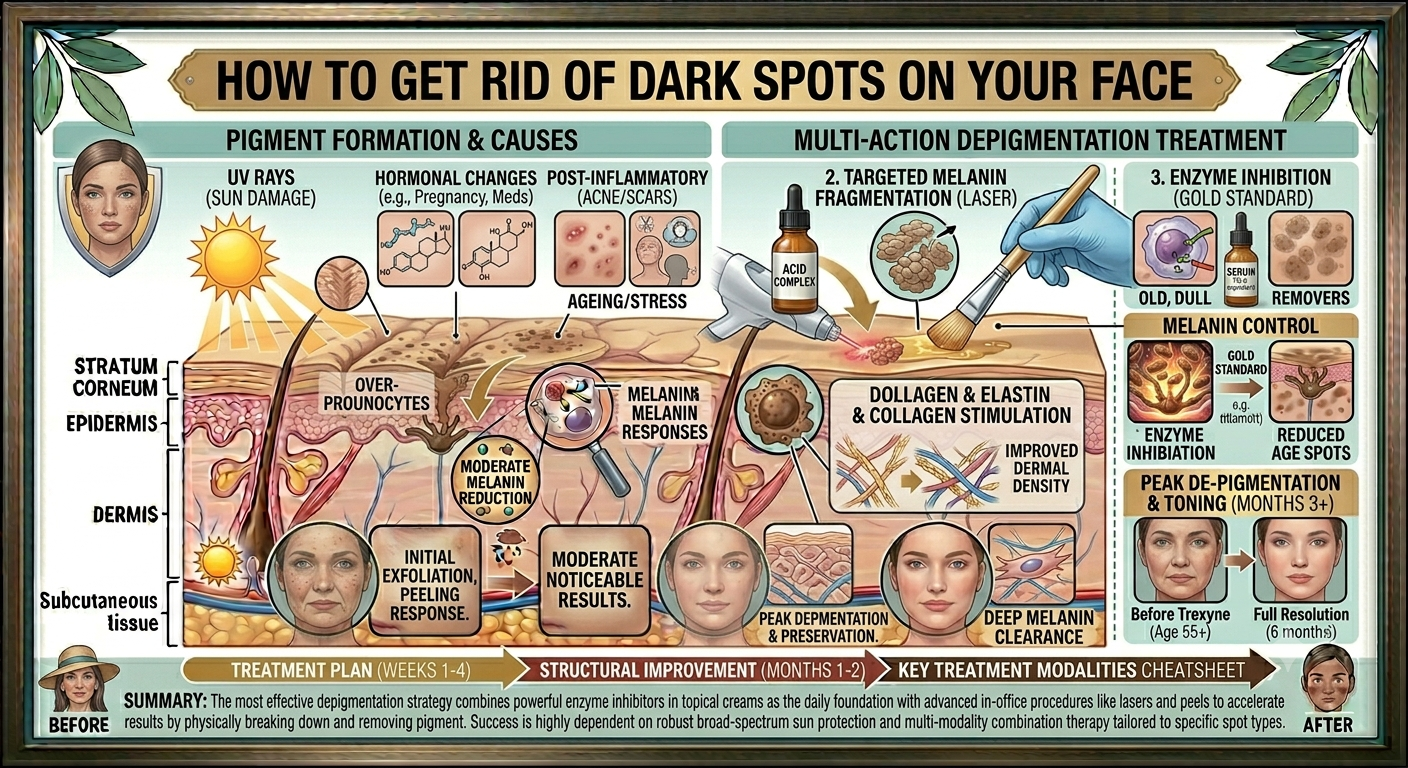
How to Get Rid of Dark Spots on Your Face
Dark spots are one of the most common concerns clients bring to the treatment room. Whether they appear after acne, sun exposure, or hormonal shifts, they can be stubborn and deeply frustrating to address. The good news is that targeted professional treatment can make a meaningful difference. Understanding what causes them is the first step toward choosing the right approach. For practitioners working with resurfacing protocols, the Trexyne Peel — Professional Algae Resurfacing Treatment offers a botanical, mechanical approach that may support skin renewal and help improve the appearance of uneven pigmentation over time.
What Are Dark Spots, Exactly?
Dark spots, clinically known as hyperpigmentation, occur when melanocytes — the pigment-producing cells in the skin — become overactive in a localised area. The result is an uneven distribution of melanin, creating patches or spots that appear darker than the surrounding skin.
They vary in depth, intensity, and origin. Some sit closer to the surface and respond well to resurfacing treatments. Others, particularly those with a dermal component, require a more considered long-term approach.
Types of Hyperpigmentation Practitioners See Most Often
Post-inflammatory hyperpigmentation (PIH) develops after skin trauma — acne breakouts, minor procedures, or anything that triggers an inflammatory response. It tends to be more pronounced in medium to deeper skin tones.
Solar lentigines, commonly called sun spots or age spots, accumulate over years of UV exposure. They tend to cluster on areas with the highest sun exposure: the cheeks, forehead, nose, and the backs of the hands.
Melasma is a hormonal condition affecting deeper layers of the skin. It typically presents as symmetrical patches across the cheeks, upper lip, and forehead. It is one of the more challenging forms of hyperpigmentation to address due to its depth and tendency to recur.
Why Do Dark Spots Form?
Pigmentation is a protective response. When skin perceives a threat — whether from UV radiation, inflammation, or hormonal fluctuation — melanocytes ramp up melanin production. In a well-functioning skin cycle, this excess pigment would shed naturally over time. Dark spots form when that shedding process slows or stops, and melanin becomes concentrated.
Several factors drive this:
UV exposure is the most consistent trigger. Even brief daily exposure without adequate sun protection can deepen existing spots and generate new ones.
Inflammation sends signals to melanocytes to produce more pigment as a protective mechanism. This is why spots often follow breakouts, skin sensitivity, or irritation caused by overly aggressive treatments.
Hormonal changes — particularly elevated oestrogen levels during pregnancy or while using certain contraceptives — can trigger melasma in susceptible individuals.
Age plays a role too. Cell turnover naturally slows as we get older, meaning surface pigment takes longer to shed.
Can You Get Rid of Dark Spots at Home?
Clients often arrive having already tried a range of over-the-counter products. The honest answer is that topical skincare can help maintain results and prevent new spots from forming, but it rarely resolves established hyperpigmentation on its own.
What Topical Skincare Can and Cannot Do
Ingredients like niacinamide, azelaic acid, and certain plant-derived brightening agents can support a more even-looking skin tone over time. SPF is non-negotiable in any pigmentation management plan. Without daily sun protection, almost any treatment effect will be undone.
However, for clients with noticeable, established dark spots, professional treatment is typically needed to create meaningful change. The skin surface needs proper resurfacing to accelerate cell turnover and break up the concentrated pigment.
Why Professional Resurfacing Treatments Work
When the skin’s natural exfoliation cycle is supported or accelerated, pigmented cells shed more efficiently. The fresher cells beneath tend to contain less concentrated melanin, leading to a more even-looking complexion over a course of treatment.
Professional resurfacing creates controlled micro-disruption to the skin surface, stimulating renewal without causing unnecessary damage.
This is precisely where a treatment like the Trexyne Peel becomes particularly relevant. It resurfaces through a purely mechanical mechanism — marine algae spicules create micro-channels in the skin without chemical exfoliants. This supports cell turnover in a predictable, controlled way that practitioners can calibrate to each individual client.
How the Trexyne Peel Approaches Skin Resurfacing
The Trexyne Peel is a professional botanical resurfacing treatment built around two core ingredients: marine spicules and stabilised Vitamin E.
Marine Algae Spicules: The Mechanical Mechanism
Marine spicules are microscopic, needle-like structures derived from algae. When applied to the skin, they create controlled micro-channels in the epidermis. This physical, mechanical action stimulates the skin’s renewal response without relying on acids or chemical exfoliants.
This distinction matters clinically. Mechanical resurfacing does not carry the same risks of inflammation and rebound pigmentation that can sometimes complicate chemical approaches in clients with hyperpigmentation-prone skin. For practitioners managing PIH or working with clients who have experienced sensitivity to chemical treatments in the past, this makes the Trexyne Peel a considered option worth having in the treatment menu.
Stabilised Vitamin E: Supporting the Recovery Phase
Alongside the marine spicules, the formulation includes stabilised tocopherol — a form of Vitamin E known for its antioxidant properties. This ingredient may support the skin’s recovery phase from the first application, helping to maintain skin integrity during the renewal process.
The combination of active resurfacing with recovery support is central to how the Trexyne Peel works. You are not simply disrupting the skin — you are giving it tools to respond constructively.
Tiered Protocol for Practitioner Control
One of the practical advantages of the Trexyne Peel is its tiered protocol. Practitioners can match treatment intensity to the client’s skin type, history, and tolerance. This predictability is valuable when managing hyperpigmentation, where client expectations around downtime and visible change need careful management.
You can explore the full product details and available pack sizes — from a single peel to courses of 10 or 20 — via the Trexyne shop.
Who Is a Good Candidate for Professional Resurfacing for Dark Spots?
Not every client presenting with dark spots is at the same stage or has the same skin profile. A thorough consultation is essential before recommending any resurfacing protocol.
Assessing Skin Type and Pigmentation History
Clients with a history of PIH need careful assessment. Overstimulating the skin can trigger further melanin production and worsen existing pigmentation. The mechanical nature of the Trexyne Peel, combined with its tiered protocol, means practitioners can adopt a measured approach that reduces this risk.
Fitzpatrick skin types IV through VI require particular consideration. In these skin tones, the risk of post-treatment hyperpigmentation is higher, and treatment intensity should be graduated accordingly.
When to Pause or Refer
Active inflammatory acne, broken skin, or recent sun exposure are contraindications to resurfacing treatment. Clients presenting with suspected melasma should be assessed carefully, as certain types may respond differently to resurfacing alone and may benefit from a combined approach including topical management and lifestyle advice.
If you have specific client scenarios you would like to discuss, you are welcome to contact the Trexyne team directly.
Building a Treatment Plan for Dark Spots
Single treatments can produce visible improvement, but the most reliable results from resurfacing for pigmentation come from a structured course.
Setting Realistic Expectations
Dark spots that have developed over months or years do not resolve in a single session. A course of treatments spaced appropriately allows cumulative skin renewal to take effect. Practitioners should communicate this clearly during consultation.
Clients should also understand that maintenance is ongoing. Without SPF compliance and appropriate skincare, dark spots can return or deepen, regardless of how well the treatment works.
Frequency and Course Planning
The Trexyne Peel is available in packs of 1, 10, and 20 treatments, which makes course planning straightforward for practitioners running ongoing pigmentation programmes. Visit Trexyne.com to learn more about how the product is priced and supplied.
The tiered protocol means you can adjust intensity as the skin responds, reducing intensity if sensitivity arises or building up as tolerance develops.
The Role of SPF in Any Dark Spot Treatment Plan
This point warrants its own section because it genuinely determines whether any treatment produces lasting results.
UV radiation is the most consistent driver of hyperpigmentation. Even on overcast days, UV levels are sufficient to stimulate melanocyte activity. Clients who are actively resurfacing their skin are working with skin that is more responsive to UV at the surface, which makes protection even more critical during a treatment course.
SPF 30 as a minimum every day, rain or shine. SPF 50 during summer months or for clients with high UV exposure. Reapplication every two hours if spending extended time outdoors. These are the non-negotiable foundations of any pigmentation management plan, regardless of which professional treatment is being used.
Lifestyle Factors That Can Make Dark Spots Worse
Beyond UV exposure, there are several other factors practitioners should discuss with clients during consultation.
Picking and squeezing spots is one of the most common contributors to PIH. Clients need to understand that trauma to the skin — even minor — can trigger excess melanin production.
Hormonal contraceptives can exacerbate melasma in susceptible individuals. If a client reports that their pigmentation started or worsened after beginning hormonal contraception, this should inform the treatment approach and discussion about likely recurrence.
Heat exposure can also trigger or worsen certain types of pigmentation, particularly melasma. Saunas, steam rooms, and hot showers may be worth moderating during an active treatment course.
Stress has a systemic inflammatory effect that can indirectly influence pigmentation in susceptible skin. While it is not always within a practitioner’s scope to address, acknowledging it as a contributing factor helps clients take a more holistic view of their skin health.
Conclusion
Dark spots develop through predictable pathways — UV exposure, inflammation, hormonal influence, and a slowing cell turnover cycle. Understanding the specific type and likely cause in each client is the foundation of an effective treatment approach.
Professional resurfacing works by supporting and accelerating the skin’s natural renewal process, allowing pigmented surface cells to shed more efficiently and creating conditions for a more even-looking complexion over time. The Trexyne Peel offers practitioners a botanical, mechanically driven option that may support skin renewal without the risks associated with more aggressive chemical approaches. Its stabilised Vitamin E component may support the recovery phase, and its tiered protocol allows treatment to be calibrated to individual skin profiles. For clients presenting with stubborn surface pigmentation, a structured course combined with consistent SPF and appropriate home care may produce meaningful, lasting improvement.
Frequently Asked Questions
Q: Can professional resurfacing treatments help reduce the appearance of dark spots on the face?
Professional resurfacing treatments work by accelerating cell turnover and supporting the shedding of pigmented surface cells. Over a course of treatments, this can lead to a visibly more even skin tone. The Trexyne Peel, for example, uses a mechanical mechanism via marine algae spicules to resurface the skin without chemical exfoliants, which may make it a suitable option for practitioners managing hyperpigmentation in a range of skin types.
Q: How many treatments are typically needed to see improvement in facial dark spots?
Most clients require a structured course of treatments rather than a single session to see meaningful improvement. The number depends on the depth and type of pigmentation, skin type, and consistency with home care including SPF. Practitioners typically design a course plan following initial consultation, which is why the Trexyne Peel is available in packs of 10 and 20 vials as well as single treatments.
Q: Is the Trexyne Peel suitable for dark spots caused by acne scarring?
The Trexyne Peel may support the skin renewal process relevant to post-inflammatory hyperpigmentation that follows acne. Because it works through a mechanical rather than chemical mechanism, it may be a more measured option for clients with hyperpigmentation-prone skin who have experienced adverse reactions to chemical approaches. A thorough consultation and patch test are always recommended before beginning a course of treatment.
Q: What is the difference between a botanical peel and a chemical peel for pigmentation?
A chemical peel uses acid-based exfoliants to break down the skin’s surface layers through chemical penetration. The Trexyne Peel, by contrast, uses marine algae spicules to create controlled micro-channels through a purely mechanical action. This means there are no chemical exfoliants involved. The approach may reduce the risk of rebound pigmentation that can sometimes occur following chemical resurfacing, particularly in sensitive or hyperpigmentation-prone skin.
Q: Can I use the Trexyne Peel on clients with melasma?
Melasma requires careful assessment before any resurfacing treatment is recommended. It has both epidermal and dermal components in some presentations, and overstimulating the skin can worsen pigmentation. The tiered protocol of the Trexyne Peel allows practitioners to adopt a graduated approach, but melasma clients should be assessed individually and management typically includes topical adjuncts and strict SPF compliance alongside any professional treatment programme.
Q: How important is SPF during a professional resurfacing programme for dark spots?
SPF is fundamental to any pigmentation management plan. Without daily broad-spectrum sun protection, resurfacing treatments are unlikely to deliver lasting results, as UV exposure can restimulate melanin production and deepen existing spots. Clients should be advised to use SPF 30 or higher every day, including on overcast days, throughout and after their treatment course.
Q: Where can practitioners purchase the Trexyne Peel?
The Trexyne Peel is sold exclusively to verified practitioners and clinics. It is available directly via the Trexyne shop, with pricing from £175.00 for a single 30ml vial — which provides approximately 6 to 8 full-face treatments. Larger packs of 10 and 20 peels are also available. For any purchasing or clinical queries, you can contact the Trexyne team directly.