How to Choose a Peel for Combination Skin?
Combination skin brings a specific challenge for both clients and practitioners: an oily T-zone paired with drier cheeks, uneven texture, and skin that can react differently across the face to the same treatment. Choosing the right peel means finding a solution that balances refinement in oilier areas without stripping or irritating drier ones. The Trexyne Peel offers a mechanical, botanical approach that practitioners can tailor by zone, making it a practical option for skin that behaves in two different ways at once.
This guide walks through what combination skin actually needs from a peel, what to avoid, and how a tiered, non-chemical protocol can support more even, refined-looking results across a full course of treatment.
What Combination Skin Actually Means
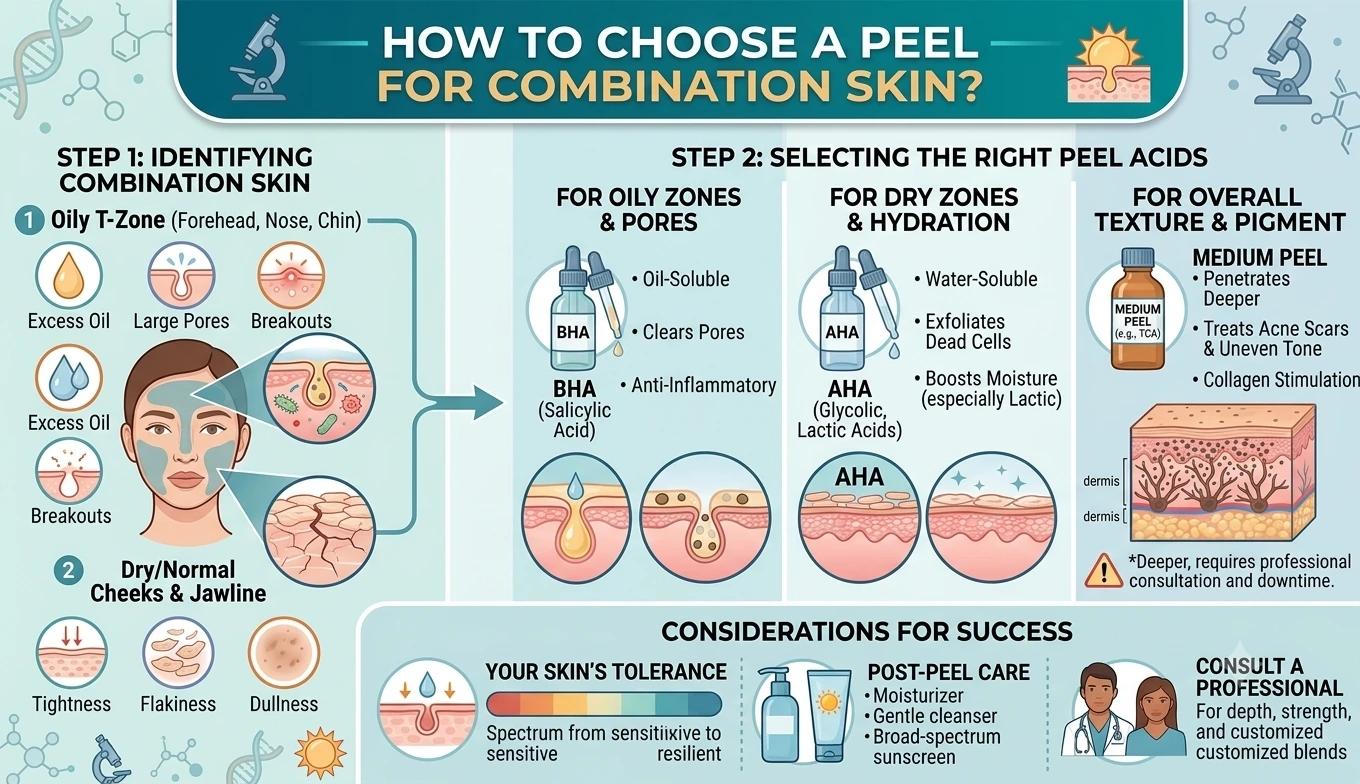
Combination skin isn’t a single skin type. It’s a pattern where the T-zone (forehead, nose, chin) produces more sebum, while the cheeks and jawline tend towards normal or dry. This uneven oil distribution often leads to visible pores and congestion in some areas, and flakiness or sensitivity in others.
It’s also worth noting that combination skin can shift with the seasons, with hormonal changes, or simply with age. A client who was oilier through the T-zone in their twenties may find their skin behaves quite differently a decade later. This means peel selection isn’t a one-time decision. It’s something practitioners often revisit as a client’s skin pattern evolves.
Why This Matters for Peel Selection
A peel that’s too aggressive can overwhelm the drier zones, leaving redness or tightness. A peel that’s too gentle may not do enough for the congested areas. Practitioners need a treatment that can be adjusted rather than applied uniformly.
This is one of the main reasons generic, fixed-strength peels often underperform on combination skin. The formulation is set before it ever touches the client’s face, which leaves little room to respond to what the practitioner actually sees and feels during application.
Why Generic Peel Advice Falls Short
Much of the advice circulating about peels assumes uniform skin. In reality, combination skin needs a more considered approach, one that accounts for texture, oil production, and sensitivity varying across a single face. Treatments designed for one skin type rarely translate well when applied without adjustment.
This is where a tiered intensity approach becomes valuable. Rather than a fixed strength product, professionals benefit from being able to match treatment intensity to what each zone of the face actually needs. A protocol that allows this kind of adjustment tends to produce a more balanced, natural-looking result than one applied the same way from forehead to chin.
The Risk of Treating Combination Skin as “Average” Skin
It can be tempting to treat combination skin as a middle ground, somewhere between oily and dry, and select a peel intensity that sits in the average range. In practice, this often satisfies neither zone. The T-zone may remain under-treated while the cheeks end up more irritated than necessary. A zone-by-zone approach avoids this compromise altogether.
The Case Against Chemical-Style Exfoliation for Uneven Skin
Many peels rely on chemical exfoliants that penetrate the skin to dissolve the bonds between cells. For combination skin, this can be unpredictable. Chemical exfoliation doesn’t always account for the fact that different areas of the face have different tolerance levels, which can result in patchy results or unexpected sensitivity.
A mechanical mechanism, by contrast, works on the skin’s surface through controlled physical action rather than chemical penetration. This allows a practitioner to visually assess and adjust as they work, rather than relying on a fixed chemical reaction across the whole face. Because the process depends on technique rather than a timed chemical reaction, there’s more opportunity to respond in real time to how each area of the skin is presenting on the day of treatment.
How Trexyne Peel Approaches Combination Skin
The Trexyne Peel is built around marine-algae spicules, which create controlled micro-channels through a purely mechanical process. There are no acids and no chemical exfoliants involved. This mechanism gives practitioners more visual and tactile control during application, which is particularly useful when treating skin that isn’t uniform from one area to the next.
Marine-Algae Spicules and Controlled Resurfacing
The spicules work by creating micro-channels on the skin’s surface. Because this action is mechanical rather than chemical, practitioners can moderate pressure and coverage depending on what each area of the face requires, rather than depending on set timing for a chemical reaction to take effect.
This tactile control is particularly relevant for combination skin. A practitioner can spend a little more time refining texture around the nose and chin, while using a lighter hand across the cheeks, all within the same session.
Stabilised Vitamin E for Recovery Support
Trexyne Peel is infused with stabilised tocopherol (Vitamin E), which can support the skin’s recovery phase from the first application. For combination skin, where drier areas may be more prone to visible irritation, this addition may help support comfort during the renewal process.
Supporting recovery matters just as much as the resurfacing step itself. A treatment that resurfaces well but leaves the skin feeling unsupported afterwards isn’t necessarily the right long-term choice, particularly for skin that already has some areas prone to dryness or reactivity.
Why a Tiered Protocol Suits Combination Skin Best
One of the more practical features of the Trexyne Peel is its tiered protocol, which lets practitioners match intensity to skin type and client expectation. For combination skin, this means a treatment can be calibrated rather than delivered identically across the whole face.
Adjusting Intensity by Facial Zone
A practitioner might choose a slightly higher intensity in the T-zone, where congestion and texture concerns are often more pronounced, while using a gentler approach on the cheeks. This flexibility is difficult to achieve with fixed-strength chemical peels, where the reaction is largely determined by formulation and timing rather than manual adjustment.
Predictable Downtime Across Different Skin Behaviours
Because the mechanism is mechanical, downtime tends to be more predictable. This matters for combination skin clients who may already be managing sensitivity in some areas. A treatment with consistent, predictable downtime helps set realistic expectations regardless of which zone is being treated.
Building Confidence Through Consistency
Predictability also helps build trust between practitioner and client. When a client knows roughly what to expect after treatment, regardless of which part of their face was treated more intensively, they’re more likely to stick with a structured course rather than abandoning treatment after a single unpredictable session.
What to Expect During a Trexyne Peel Session for Combination Skin
During application, a trained practitioner will typically assess the face by zone before beginning treatment. This assessment informs how the tiered protocol is applied across the T-zone, cheeks, and jawline.
Before Treatment
A short consultation usually precedes the session itself. This is where the practitioner identifies which areas show more congestion or texture irregularity, and which areas are drier or more reactive, so the intensity can be planned zone by zone before the treatment begins.
During Treatment
Clients may notice a light physical sensation as the spicules work across the skin’s surface. Because there’s no chemical exfoliation involved, there’s no burning or stinging sensation associated with acid-based treatments.
After Treatment
Following the session, the stabilised Vitamin E supports the skin’s recovery phase. Downtime is generally predictable and tends to align with the intensity level chosen for each area, rather than varying unpredictably as it might with a chemical alternative.
Building Combination Skin Into a Wider Treatment Plan
A single peel session rarely addresses every concern associated with combination skin on its own. Most practitioners build a treatment plan around a series of sessions, often spaced according to how the client’s skin responds and recovers between appointments.
Clinics offering the Trexyne Peel can review the full range of options, including single sessions and course packages, on the Trexyne shop page. Working through a structured course, rather than a one-off treatment, often supports more consistent results for skin that behaves differently across different zones.
Spacing Sessions for Combination Skin
Because combination skin can respond differently by zone, some practitioners choose to review progress zone by zone at each follow-up appointment, rather than assessing the face as a whole. This can help refine intensity choices over the course of a treatment plan, rather than repeating the same approach at every session regardless of how the skin has responded.
Setting Client Expectations for Combination Skin
Clear communication before treatment matters, particularly for combination skin clients who may have tried multiple products or treatments without much success. Explaining that the Trexyne Peel works mechanically, rather than through chemical exfoliation, can help clients understand why the approach might suit their skin differently to previous treatments they’ve tried.
Discussing Realistic Outcomes
Practitioners should be clear that results can vary between individuals and that the tiered protocol is designed to be matched to skin type and expectation, not to guarantee a specific outcome. Language around “may help” or “can support” a brighter, more even-looking complexion is more accurate than promising a fixed result.
Why Professional-Only Access Matters for Combination Skin
The Trexyne Peel is sold strictly to verified practitioners and clinics. This professional-only positioning matters for combination skin specifically, because the zone-by-zone assessment and intensity adjustment required for good results depend on trained clinical judgement. This isn’t a treatment designed or suitable for home use.
Clinics interested in stocking the Trexyne Peel or learning more about training and protocols can get in touch through the Trexyne contact page.
Choosing the Right Practitioner for Combination Skin Treatments
Not every clinic will approach combination skin the same way. When researching where to book a treatment, it’s worth asking whether the practitioner assesses skin by zone before treatment and whether they can explain how intensity will be adjusted across the face. A practitioner familiar with tiered protocols, such as those used with the Trexyne Peel, is more likely to deliver a treatment tailored to combination skin rather than a generic, one-size-fits-all session.
More information about the brand’s approach to professional botanical resurfacing is available on the Trexyne homepage.
Conclusion
Combination skin presents a genuine challenge for peel selection because it behaves differently across the face, oilier in the T-zone, drier along the cheeks, and often uneven in texture throughout. A treatment that can be adjusted by zone, rather than applied uniformly, tends to suit this skin pattern far better than a fixed-strength approach. The Trexyne Peel’s mechanical mechanism, built around marine-algae spicules and stabilised Vitamin E, gives practitioners the flexibility to match intensity to what each area of the face actually needs. With predictable downtime and a tiered protocol designed around client expectation, it may help support a brighter, more even-looking complexion over a structured course of professional treatments.
FAQs
Q: What is the best type of peel for combination skin?
A peel that allows intensity to be adjusted by facial zone tends to work best for combination skin. Because oil production and sensitivity vary across the face, a tiered, adjustable protocol like the one used with the Trexyne Peel can be matched to each area’s needs rather than treating the whole face the same way.
Q: Can a peel help even out combination skin texture?
A mechanical peel that creates controlled micro-channels, such as the Trexyne Peel, may help support a more even-looking texture over a course of sessions. Results vary between individuals, and a practitioner can advise on realistic expectations during a consultation.
Q: Is a chemical peel necessary for treating combination skin?
No. Combination skin can be approached through non-chemical, mechanical methods. The Trexyne Peel works through marine-algae spicules rather than acids, offering an alternative for practitioners who prefer to avoid chemical exfoliation on skin that reacts differently across zones.
Q: How many sessions are usually needed for combination skin concerns?
This depends on the individual and the specific concerns being addressed. Many practitioners build a course of sessions using the tiered protocol, adjusting intensity as the skin responds. Details on single sessions versus course packages are available on the Trexyne shop page.
Q: Does combination skin need different treatment on different parts of the face?
Often, yes. Because the T-zone and cheeks can behave quite differently, many practitioners adjust intensity or technique by area during a single session. This zone-by-zone approach is one of the reasons a tiered protocol suits combination skin well.
Q: Is Trexyne Peel suitable for sensitive combination skin?
The tiered protocol allows practitioners to select a lower intensity for more sensitive areas, which can make it a suitable option for combination skin with sensitive patches. A qualified practitioner will assess the skin during consultation to determine the right approach.
Q: Can I use Trexyne Peel at home for combination skin?
No. The Trexyne Peel is sold exclusively to verified practitioners and clinics and is designed for professional, in-clinic use only. Clients interested in treatment should book with a trained practitioner rather than attempt at-home application.