Can Oily Skin Benefit From a Professional Peel?
Yes, oily skin can benefit meaningfully from a professional peel, and in some respects it responds particularly well to resurfacing. The concerns most commonly associated with oily skin, including congestion, enlarged-appearing pores, uneven texture, and the persistent dullness that can accompany excess sebum, are all influenced by cell turnover and surface skin quality in ways that professional resurfacing directly addresses. The common assumption that oily skin is robust and can tolerate aggressive treatment is not always accurate, and selecting the right treatment approach matters as much for oily skin as it does for any other type. A mechanical resurfacing option such as the Trexyne Peel offers a considered route to meaningful skin improvement for oily skin clients without the risk of triggering the kind of inflammatory response that can, in some cases, worsen the congestion and post-inflammatory pigmentation that oily skin is prone to producing.
What Oily Skin Actually Is
Oily skin is characterised by excess sebum production from the sebaceous glands. Sebum is a natural oil that the skin produces to protect the barrier and maintain hydration, and at normal levels it is beneficial. When the sebaceous glands produce more sebum than the skin needs, the excess creates a visible shine, particularly across the forehead, nose, and chin, and contributes to congestion within the pores.
The causes of excess sebum production include genetics, hormonal activity, environmental factors, and in some cases, the skin’s response to being stripped of its natural oils by harsh products. Androgens, the hormonal group that includes testosterone, are the primary driver of sebaceous gland activity, which is why oily skin is most pronounced during adolescence and tends to moderate with age as androgen levels stabilise.
Oily skin is not a single, uniform presentation. Some clients have diffuse oiliness across the full face. Others have combination skin where oiliness is concentrated in the central zone while cheeks and temples are relatively balanced or dry. The treatment approach needs to reflect this variation rather than applying a single protocol across the whole face.
Why Oily Skin Develops Specific Skin Concerns
Several of the most common aesthetic concerns associated with oily skin have a direct connection to the excess sebum and the cell turnover disruptions that accompany it.
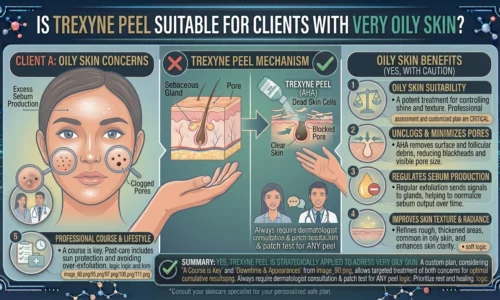
Congestion and blocked pores develop when excess sebum combines with dead skin cells within the follicle. When this mixture is not shed efficiently through normal cell turnover, it accumulates within the pore, widening it from within and either oxidising to form a blackhead or remaining as a whitehead or skin-coloured plug. The visible result is congested, uneven skin with pores that appear enlarged.
Post-inflammatory hyperpigmentation is particularly common in oily, acne-prone skin because each inflammatory acne lesion carries the potential to leave a dark mark as it resolves. Clients with oily skin who also experience breakouts frequently accumulate PIH marks that compound the visual complexity of their skin concern.
Surface texture irregularity in oily skin often presents as a bumpy, uneven surface that is not smooth to the touch despite having no active breakouts. This reflects a combination of subclinical congestion, sluggish surface cell shedding, and the visual effect of excess sebum disrupting the skin’s surface light reflection.
Dullness is paradoxically common in oily skin despite the visible shine. The shine reflects light from the surface, but the underlying skin texture and tone can be flat and uneven, particularly when excess sebum is trapping surface cells rather than allowing them to shed efficiently.
How Professional Resurfacing Addresses Oily Skin Concerns
Professional resurfacing directly addresses the cell turnover component of oily skin concerns. By stimulating the skin to renew its surface layers more efficiently, resurfacing supports the shedding of accumulated dead skin cells that contribute to congestion, helps clear the surface material that gives oily skin its uneven texture, and progressively improves the overall quality and tone of the skin surface.
For oily skin clients with accumulated PIH from breakouts, professional resurfacing is particularly relevant because it simultaneously addresses both the surface texture and the pigmentation component of the concern. Cell turnover stimulated by resurfacing displaces pigmented cells progressively alongside the general surface renewal, producing improvement in both concerns across the same treatment course.
Importantly, resurfacing also supports more efficient pore drainage by improving the quality of the skin surrounding the pores. As the surface texture refines and the accumulation of dead skin cells reduces, congestion within the pores is less likely to build to the level that produces visible blocked pores and breakouts. This is an indirect benefit of the resurfacing mechanism rather than a direct treatment of sebum production, but it can make a meaningful difference to the clinical picture over a sustained course.
Why the Mechanism of Resurfacing Matters for Oily Skin
Oily skin is not always the robust, resilient skin type it is sometimes assumed to be. Many oily skin types are also reactive, acne-prone, or PIH-prone, and applying aggressive chemical resurfacing to skin with these characteristics carries specific risks that need to be weighed carefully.
Chemical resurfacing generates inflammation as part of its mechanism. In oily, acne-prone skin, inflammation is already a recurring feature of the skin’s behaviour. Adding a significant chemical inflammatory load on top of this baseline can trigger further breakout activity, worsen PIH in susceptible skin, and in some cases stimulate increased sebum production as part of the skin’s stress response to chemical disruption.
A mechanical resurfacing approach that achieves cell turnover stimulation without generating a chemical inflammatory response reduces these risks substantially. The Trexyne Peel resurfaces through marine-algae spicules using a purely mechanical mechanism, with no chemical exfoliants involved. This removes the chemical inflammatory trigger from the resurfacing process, making it a more considered option for oily, congestion-prone, or PIH-susceptible skin.
The Tiered Protocol for Variable Oily Skin
Oily skin does not present consistently. Sebum production varies with hormonal cycles, diet, stress, season, and lifestyle, meaning an oily skin client can present at one session with very different skin than at the previous appointment. A treatment protocol that applies a fixed, predetermined intensity regardless of how the skin presents on any given day is not well suited to this variability.
The Trexyne Peel’s tiered protocol allows practitioners to match intensity to the skin’s actual condition at each session. If a client arrives with skin that is more reactive or congested than usual, the appropriate response is to hold intensity at the current level or reduce it, rather than proceeding at a fixed intensity regardless of presentation. This session-by-session responsiveness produces more reliable outcomes for oily skin across a treatment course than a rigid protocol would.
It also allows practitioners to advance intensity appropriately when the skin is responding well and demonstrating tolerance, which produces more meaningful cumulative improvement over the course than a consistently conservative approach would achieve.
Purging in Oily and Congested Skin
Oily, congested skin clients are more likely than any other skin type to experience a purging phase following the early sessions of a resurfacing course. Purging occurs when accelerated cell turnover brings forward existing subclinical congestion that was already developing beneath the skin surface, making it visible more quickly than it would have appeared naturally.
This is not the treatment causing new breakouts. It is the existing congestion surfacing in a compressed timeframe. Practitioners who explain this clearly at the initial consultation reduce the risk of clients discontinuing a course that is actually working, because they can interpret what they are observing accurately rather than concluding the treatment is not agreeing with their skin.
The purging phase in oily skin typically peaks within the first two to four weeks after the initial resurfacing sessions and then settles as the pre-existing congestion clears. Once it has resolved, the skin generally looks clearer and more refined than it did before the course began, which reflects the improvement in surface quality that the accelerated turnover has produced.
Home Care Between Sessions for Oily Skin
The home-care routine oily skin clients follow between professional sessions influences how well the skin responds to treatment and how effectively the improvements are maintained. Several principles guide appropriate home care for oily skin within a resurfacing course.
Avoiding over-stripping the skin with harsh cleansers or excessive exfoliation at home is one of the most important. Counter-intuitively, stripping the skin of its natural oils can stimulate increased sebum production as a compensatory response, worsening the oiliness the client is trying to manage. A gentle, balanced cleanser used consistently is more effective than alternating between harsh cleansers and periods of heavy product use.
Consistent daily SPF use is essential, both to protect against UV-driven pigmentation in skin that may be PIH-prone, and to prevent ongoing UV stimulus from driving the kind of photodamage that compounds oily skin concerns with uneven tone and texture over time.
Home-use actives including retinoids and exfoliating acids should be paused in the days immediately following each professional session to avoid over-treating skin that is already in an active renewal phase, and reintroduced carefully and gradually between sessions rather than maintained at full frequency throughout the course.
Practitioners interested in incorporating the Trexyne Peel into their oily skin treatment protocols can explore the full range through the Trexyne shop, or contact the team directly through the Trexyne contact page.
What a Realistic Treatment Course Looks Like for Oily Skin
For oily skin clients, a professional resurfacing course typically addresses congestion, surface texture, and any accumulated PIH as its primary clinical targets. Sessions spaced three to four weeks apart give the skin time to complete its renewal cycle between treatments and to stabilise from any temporary purging response before the next session.
Visible improvement in surface quality and a reduction in visible congestion often begin to appear within the first few sessions for oily skin types, as accelerated cell turnover progressively clears accumulated surface debris and subclinical congestion. Improvement in any associated PIH marks builds more gradually across the course, with the most noticeable changes typically apparent from the third or fourth session onwards.
Maintaining improvements after the course requires ongoing daily SPF use, an appropriate non-comedogenic home-care routine, and periodic maintenance sessions to sustain the renewal activity that keeps oily skin looking clear and refined rather than allowing congestion to re-accumulate gradually. More information on the Trexyne approach is available on the Trexyne website.
Conclusion
Oily skin can benefit significantly from professional resurfacing, and the concerns most associated with it, including congestion, enlarged-appearing pores, surface texture irregularity, and post-inflammatory pigmentation from breakouts, are all meaningfully addressed by accelerated cell turnover across a sustained professional course. The mechanism of resurfacing matters for oily skin because acne-prone and PIH-susceptible oily skin types are not necessarily robust enough to tolerate chemical inflammatory triggers without risk of worsening breakout activity or pigmentation. The Trexyne Peel resurfaces through marine-algae spicules without chemical exfoliants, includes stabilised Vitamin E to support recovery, and uses a tiered protocol that responds to the variability of oily skin across sessions. Used consistently alongside appropriate home care and daily SPF, it may support a clearer, more refined, and more even-looking complexion for oily skin clients seeking genuine professional resurfacing results.
FAQs
Q: Can oily skin have a professional peel?
Yes. Oily skin can benefit meaningfully from professional resurfacing, which addresses congestion, surface texture, and post-inflammatory pigmentation through accelerated cell turnover. The mechanism of the treatment matters for oily, acne-prone skin, since chemical inflammatory triggers can worsen breakout activity and PIH. A mechanical approach avoids this risk.
Q: Will a professional peel make oily skin worse?
A well-chosen resurfacing approach will not make oily skin worse. Some clients experience temporary purging in the early sessions as existing subclinical congestion surfaces through accelerated cell turnover. This settles within a few weeks and is followed by clearer, more refined skin. Chemical approaches that generate significant inflammation can increase breakout activity in reactive oily skin, which is one reason a mechanical alternative may be more appropriate.
Q: Can a professional peel reduce oiliness?
Professional resurfacing does not directly reduce sebum production, which is driven by hormonal and genetic factors. It can improve the surface quality of oily skin by addressing congestion, refining texture, and improving the skin’s ability to shed dead surface cells efficiently, all of which contribute to a clearer, less congested appearance that many oily skin clients associate with reduced oiliness.
Q: Is the Trexyne Peel suitable for oily, acne-prone skin?
The Trexyne Peel’s mechanical mechanism avoids the chemical inflammatory trigger that can worsen breakout activity and post-inflammatory pigmentation in acne-prone skin. The tiered protocol adapts to the variable condition of oily skin across sessions. Resurfacing should not proceed during active breakouts, and the practitioner assesses suitability at each appointment.
Q: Why does oily skin get congested and how does resurfacing help?
Congestion in oily skin occurs when excess sebum combines with dead skin cells within the follicle. If cell turnover is slow, this mixture accumulates rather than being shed efficiently. Professional resurfacing accelerates cell turnover, helping clear accumulated surface debris and reducing the rate at which congestion builds over time.
Q: How many professional peel sessions does oily skin need?
For oily skin concerns including congestion and surface texture, improvement can begin to appear within the first few sessions. Post-inflammatory pigmentation associated with acne builds more gradually and typically shows more visible fading from the third or fourth session onwards. The total number of sessions depends on the extent of the concerns and the individual’s skin response.
Q: Can oily skin purge after a professional peel?
Yes. Oily and congested skin is more likely than other types to experience a temporary purging phase after early resurfacing sessions. This reflects existing subclinical congestion surfacing through accelerated turnover rather than new breakouts being caused by the treatment. It typically peaks within two to four weeks of the first sessions and resolves as the pre-existing congestion clears.