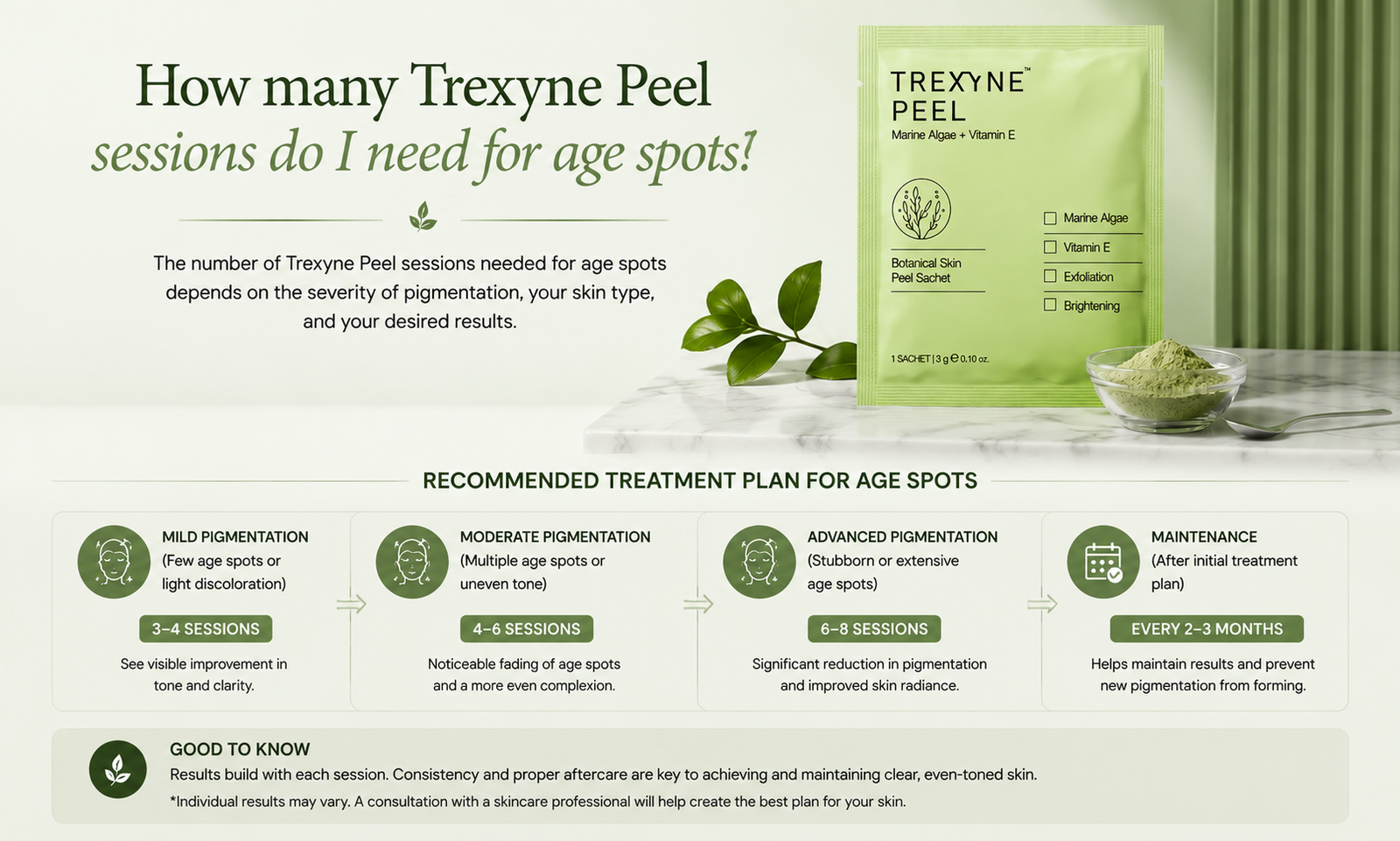
How Many Trexyne Peel Sessions Do I Need for Age Spots?
There is no single answer that applies to every client, but most people addressing established age spots with a professional resurfacing course will need a sustained series of sessions rather than one or two appointments. The number depends on how long the spots have been present, how deep the melanin sits within the skin, the individual’s skin response to treatment, and how consistently daily SPF is used between sessions. A practitioner assessment is the only reliable way to arrive at a realistic recommendation for a specific client. What can be said with confidence is that the Trexyne Peel is designed around a tiered protocol that allows treatment intensity to build progressively across a course, which is precisely the approach that suits the gradual, layered nature of age spot pigmentation. This post explains why, and what clients and practitioners can realistically expect at each stage of a course.
Why Age Spots Require More Than One or Two Sessions
Age spots, clinically known as solar lentigines, are not a surface-level skin change. They develop from years or decades of cumulative UV exposure that has repeatedly stimulated melanocytes to produce localised deposits of melanin. That melanin does not sit in a single thin layer close to the skin’s surface. It is distributed across multiple depths of the epidermis, having built up gradually over time in response to ongoing UV stimulus.
This is the fundamental reason why age spots require a sustained course of professional sessions rather than a single high-intensity treatment. Resurfacing stimulates cell turnover and encourages the skin to renew itself from within, progressively displacing pigmented cells with fresh, unpigmented ones over time. One session begins this process, but it cannot reach all of the accumulated pigment in a single pass. Each subsequent session builds on the progress of the previous one, working progressively through the layers of pigmentation as the skin continues to renew.
Clients who have tried a single professional resurfacing session for age spots and been disappointed with the results are often experiencing this limitation directly. The issue is not that the treatment did not work. It is that the pigmentation requires a course rather than a single appointment.
What Influences the Number of Sessions Needed
Several factors shape how many sessions a specific client will need, and a practitioner who takes the time to assess these at consultation provides a more useful recommendation than one who gives a standard answer without individual assessment.
The age and depth of the pigmentation is the most significant factor. Age spots that have been forming for decades and that appear dark and clearly defined have a higher concentration of melanin across deeper epidermal layers than lighter, more recently formed spots. Darker, more established spots generally require more sessions to produce visible improvement than paler or more recently developed ones.
The size and distribution of the affected areas also matters. A client with two or three isolated spots on one cheek is in a different clinical position from one with widespread age spots across the full face, décolleté, and backs of the hands. Localised concerns may respond more quickly than diffuse or extensive photodamage.
The individual’s skin response to resurfacing varies between clients. Some skins produce consistent, progressive improvement from early in a course. Others show slower initial progress that accelerates as the course continues. Neither pattern is abnormal, and neither should prompt a change in approach before the skin has had sufficient sessions to demonstrate its full response.
Daily SPF use between sessions is one of the most direct influences on how efficiently a course progresses. UV exposure restimulates melanocytes in treated areas, which can slow visible improvement or partially counteract the progress the resurfacing is achieving. Clients who protect their skin consistently between sessions see better results in fewer sessions than those whose sun protection is inconsistent.
A Realistic Session Estimate by Pigmentation Type
While individual variation makes any specific number an approximation rather than a guarantee, the following gives clients and practitioners a realistic framework for planning.
For mild, recently formed age spots that sit relatively close to the skin’s surface, visible improvement can begin to appear within three to five sessions of a well-executed course. These are spots that have not had decades to deepen and may have a lighter, more uniform colour. They respond more readily to progressive resurfacing because there is less accumulated pigment to work through.
For moderate age spots that have been present for several years, are more clearly defined, and appear in a medium-to-deep brown tone, a course of six to ten sessions is a more realistic starting expectation. Visible improvement typically builds progressively across this range, with more noticeable changes appearing in the middle to later sessions of the course.
For deep, long-established age spots that have a high concentration of melanin and have been present for many years, a longer course may be needed to achieve the level of improvement the client is looking for. These clients may also benefit from a maintenance protocol after the initial course to sustain results and prevent new pigmentation from forming.
These ranges are starting estimates rather than fixed prescriptions. The practitioner’s assessment at each session determines whether the course is progressing as expected and whether the approach needs to be adjusted.
How the Trexyne Peel’s Tiered Protocol Supports Age Spot Treatment
The Trexyne Peel is built around a tiered protocol that allows practitioners to match intensity to the individual client’s skin condition at each appointment. For age spot clients, this is clinically significant for several reasons.
Beginning at a conservative intensity with a new client allows the practitioner to observe how that skin responds to mechanical resurfacing before committing to a higher intensity. This is not overly cautious. It is how responsible progressive treatment works. A first session that recovers smoothly and begins to show early improvement tells the practitioner that this skin can tolerate the treatment at this intensity. That information supports confident progression in subsequent sessions.
Progressing intensity appropriately as the course advances means later sessions can work more effectively through the deeper layers of pigmentation that earlier, more conservative sessions could not reach as directly. This graduated approach is more effective for established age spots than applying maximum intensity from the first session, which risks a difficult recovery that disrupts the course timeline and potentially triggers post-inflammatory hyperpigmentation in susceptible skin types.
Why Consistent Session Spacing Matters
The spacing between sessions within a course also influences how many total sessions are needed. Allowing sufficient time between sessions for the skin to complete its renewal cycle, typically three to four weeks for most adults, allows each session to work on skin that has fully processed the previous treatment. Sessions spaced too closely together may not allow this cycle to complete, reducing the cumulative benefit of each appointment.
A practitioner who spaces sessions appropriately and assesses the skin at each appointment before deciding how to proceed produces better outcomes over the same number of sessions than one who follows a fixed schedule regardless of how the skin is responding.
What to Expect at Each Stage of the Course
Understanding what typically happens at different stages of a Trexyne Peel course for age spots helps clients know what they are looking for and helps practitioners set accurate expectations from the outset.
In the early sessions, the primary outcome is surface renewal. The outermost layers of the skin are disrupted and replaced with fresher cells, producing an initial improvement in overall skin brightness and clarity. Age spots may appear slightly lighter after these first sessions, but the change will typically be subtle rather than dramatic.
In the middle sessions of the course, as intensity progresses appropriately and the renewal process works through deeper layers of the epidermis, more visible improvement in the age spots themselves tends to appear. Spots may begin to look noticeably lighter, less defined at their edges, or reduced in size compared to their appearance at the start of the course. This is the stage at which many clients first feel that the treatment is producing the results they were hoping for.
In the later sessions, the focus shifts to consolidating the improvement already achieved and reaching any residual deeper pigmentation that earlier sessions have been working towards. The cumulative effect of the full course is typically most apparent when early and later photographs are compared directly.
The Role of Aftercare in Determining How Many Sessions Are Needed
Aftercare has a direct and measurable impact on how efficiently a treatment course progresses. Two clients beginning an identical course with similar age spot presentations can end up needing different numbers of sessions depending on how consistently they follow aftercare guidance between appointments.
Daily broad-spectrum SPF is the most critical step. UV exposure is the reason age spots formed in the first place, and ongoing UV stimulus between sessions can restimulate melanocytes in treated areas, slowing or reversing visible progress. Clients who apply SPF every morning and reapply when spending extended time outdoors protect each session’s contribution to the overall result. Those who do not may find that more sessions are needed to achieve the same endpoint.
A simple, barrier-supportive home routine that avoids unnecessary irritation between sessions also supports recovery and prepares the skin well for the next treatment. Avoiding active skincare products including retinoids and exfoliating treatments in the days immediately following each session reduces the risk of barrier disruption that could delay recovery and affect the spacing of subsequent sessions.
Practitioners interested in adding the Trexyne Peel to their treatment offering can explore the full product range via the Trexyne shop, or get in touch with the team directly through the Trexyne contact page.
Maintenance After the Initial Course
Once an initial course has produced meaningful visible improvement in age spots, the question shifts from how many sessions are needed to achieve results to how many are needed to maintain them. Age spots can recur or deepen with continued UV exposure even after a successful course, particularly in clients who spend significant time outdoors or who have skin that is highly responsive to UV stimulus.
A maintenance programme of periodic professional sessions, typically every two to four months depending on the individual, combined with consistent daily SPF use, is the most effective way to sustain the improvement achieved through the initial course. Clients who invest in a maintenance plan tend to retain their results significantly better than those who complete a course and assume no further treatment is needed.
More information on the Trexyne approach to professional botanical resurfacing is available on the Trexyne website.
Conclusion
The number of Trexyne Peel sessions needed for age spots depends on the depth and age of the pigmentation, the individual’s skin response, and the consistency of daily SPF use between appointments. Mild or recently formed spots may show visible improvement within three to five sessions, while established solar lentigines with deeper, denser melanin accumulation typically require a longer course to achieve the level of improvement clients are seeking. The Trexyne Peel is built around a tiered protocol that allows practitioners to start conservatively and build progressively across a course, which suits the gradual, layered nature of age spot pigmentation. Supported by consistent daily SPF and appropriate aftercare, a well-managed course may support meaningful, visible improvement in age spots and contribute to a brighter, more even-looking complexion over time.
FAQs
Q: How many Trexyne Peel sessions do I need for age spots?
The number of sessions depends on the depth and age of the pigmentation, with mild or recently formed spots often showing visible improvement within three to five sessions and more established age spots typically requiring a longer course. A practitioner assessment at consultation will provide a realistic recommendation based on your specific pigmentation and skin condition.
Q: Will one Trexyne Peel session remove age spots?
A single session begins the renewal process and may produce some initial improvement in skin brightness and clarity, but it is unlikely to produce lasting visible improvement in established age spots. Age spot pigmentation sits across multiple layers of the epidermis and responds to consistent, progressive resurfacing over a course of sessions rather than a single appointment.
Q: How often should I have Trexyne Peel sessions for age spots?
Sessions are typically spaced three to four weeks apart to allow the skin to complete its renewal cycle between appointments. This spacing allows each session to work on skin that has fully processed the previous treatment, producing the best cumulative result across the course. A practitioner will advise on the appropriate interval based on your skin’s response.
Q: Why do age spots take longer to treat than other pigmentation concerns?
Age spots have accumulated over years or decades of UV exposure, with melanin distributed across multiple depths of the epidermis rather than sitting close to the surface. This layered pigmentation responds to progressive resurfacing over time rather than a single high-intensity intervention. The longer the spots have been present and the deeper the pigmentation, the more sessions are needed to work through the accumulated melanin.
Q: Does daily SPF affect how many sessions I need for age spots?
Yes, directly. UV exposure between sessions can restimulate melanocytes in treated areas, slowing progress and potentially requiring more sessions to achieve the same endpoint. Clients who use daily broad-spectrum SPF consistently tend to see better results in fewer sessions than those who do not, making sun protection one of the most practical ways to support the efficiency of a treatment course.
Q: What happens after I finish a Trexyne Peel course for age spots?
Once the initial course is complete, a maintenance programme of periodic sessions every two to four months, combined with daily SPF, helps sustain the improvement achieved. Age spots can recur with continued UV exposure, so ongoing protection and occasional maintenance treatment is the most effective way to retain results over the long term.
Q: How do I know if my age spots need more sessions than average?
A practitioner assessment at consultation and at each subsequent session is the most reliable guide. Spots that are deeply pigmented, have been present for many years, or that show slower than expected progress during the course may need more sessions than lighter or more recently formed pigmentation. Your practitioner will monitor progress and advise on any adjustments to the course plan.