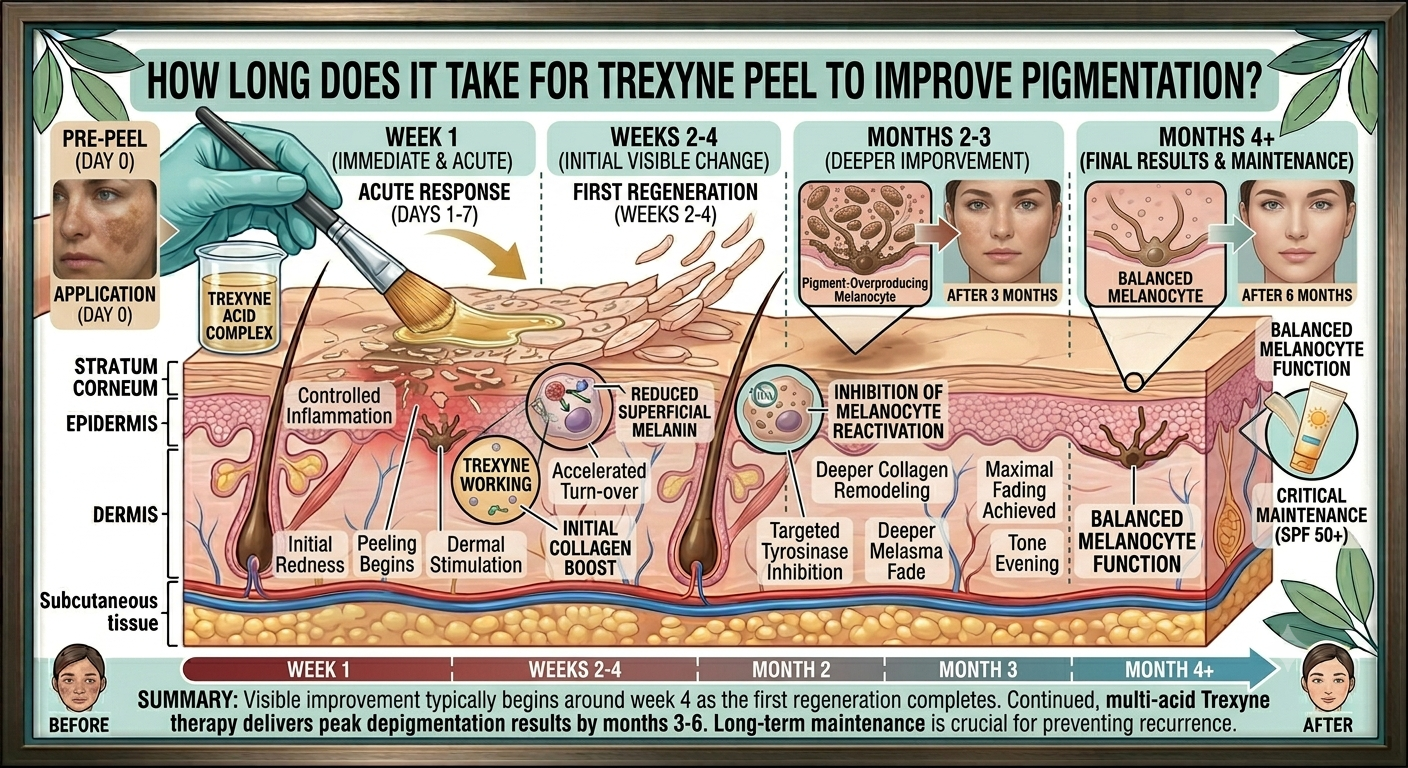
How Long Does It Take for Trexyne Peel to Improve Pigmentation?
When starting a professional skin treatment for discoloration, one of the most common and practical questions patients ask is about the timeline for results. Knowing what to expect helps you plan your schedule around recovery and manage expectations dynamically. The Trexyne Peel is a clinical-grade professional treatment that targets uneven skin tone, but because it relies on the skin’s natural healing and cellular renewal mechanisms, changes happen progressively rather than overnight. This article breaks down the exact timeline of a Trexyne Peel series, from the immediate post-peel days to when you can expect to see full, structural improvements in your pigmentation.
The Immediate Post-Peel Phase: Days 1 to 10
Before deep changes occur, your skin goes through a distinct recovery and shedding process. This period is essential because the visible peeling is the physical mechanism removing old, melanin-rich surface cells.
Days 1 to 2 (The Tightness Window): Immediately after the practitioner applies the peel, your skin will likely appear slightly flushed, pink, or feel notably tight. This is a normal protective response to the acidic compounds breaking down old cellular links.
Days 3 to 5 (The Peeling Window): Active flaking and shedding typically begin around the central facial areas (mouth and nose) before moving outward. The intensity depends on the peel depth selected during your clinical assessment.
Days 6 to 10 (The Reveal Window): As the old, damaged surface layer finishes shedding, the fresh skin underneath becomes fully exposed. At this stage, your skin will typically look smoother, cleaner, and brighter, providing the very first glimpse of an improved complexion.
When Do Initial Pigmentation Improvements Appear?
Most individuals begin to note the first clear improvements in superficial pigmentation around 7 to 14 days after their very first session, right as the skin finishes its initial shedding phase. Minor sunspots may look slightly lighter, and post-inflammatory hyperpigmentation (like recent acne marks) often shows a visible reduction in intensity.
However, it is vital to remember that a single session only shifts the top layers of the epidermis. For moderate, long-standing, or deeper discoloration, a isolated session will only clear a fraction of the built-up melanin. True, lasting reduction requires a structured professional pigmentation treatment protocol rather than a single appointment.
The Cumulative Timeline: Why Real Improvement Takes 2 to 4 Months
To achieve significant structural changes, a standard clinical protocol usually consists of a series of 4 to 6 sessions, spaced roughly 3 to 4 weeks apart. This spacing is designed to allow your skin matrix to heal completely and begin a new cell cycle before the next application.
Because of this structured spacing, the full timeline to achieve your final, peak results typically spans 2 to 4 months. Here is how your results build across a series:
After Session 2: The skin’s base cell turnover speeds up. Pigmented patches begin to fragment, meaning dark spots may look smaller or broken up as fresh cells push their way to the surface.
After Sessions 3 and 4: This is often the period of maximum visible change. Moderate sun damage, diffuse aging discoloration, and stubborn surface marks fade significantly. The overall tone of the complexion becomes much more uniform.
After Sessions 5 and 6: Deeply settled epidermal pigmentation reaches its maximum point of clearance. Alongside tone correction, dermal stimulation results in noticeable improvements in skin texture, firmness, and natural radiance.
Factors That Inquire How Fast Your Skin Responds
Not every individual clears pigmentation at the exact same speed. Several biological and practical variables determine your personal timeline:
1. The Depth and Age of the Pigmentation
Recent discoloration—such as dark spots left behind by a recent acne breakout—sits high up in the epidermis and responds rapidly, sometimes clearing significantly in just a couple of sessions. In contrast, deep sun spots that have accumulated over ten or twenty years sit deeper and take longer to break apart and rise up to be shed.
2. Your Natural Cellular Turnover Rate
Younger skin naturally moves cells from the basal layer to the surface in about 28 days. As we age, this cycle slows down to 45 or 60 days. While the peel manually compresses this timeline, individuals with a faster baseline metabolism will inherently reveal fresh, cleared skin slightly quicker.
3. The Specific Pigmentation Condition
Conditions like melasma require a highly cautious and gradual treatment approach. Because aggressive peeling can trigger defense mechanisms and worsen melasma, practitioners utilize milder, more progressive profiles of the Trexyne Peel over a longer period. This means the timeline for melasma is naturally longer and more conservative compared to simple sun damage.
How to Protect and Accelerate Your Results During the Timeline
While the clinical solution does the structural work, your daily actions heavily dictate whether those results are protected or actively undermined.
· Rigorous Sun Protection: Freshly peeled skin is highly vulnerable to UV rays. Unprotected sun exposure will immediately trigger melanocytes to produce new melanin, completely ruining the progress made by the peel. Apply a broad-spectrum SPF 30 or higher every single morning, regardless of weather.
· Do Not Pick or Peel: Forcing skin flakes to come off before they are ready can cause micro-tears, bleeding, or localized inflammation, leading directly to post-inflammatory hyperpigmentation.
· Maintain a Hydrated Skin Barrier: Use simple, nourishing creams during the active recovery window to assist the skin matrix in repairing itself evenly.
Conclusion
While you will notice an initial glow and surface freshness within 7 to 10 days of your first session, real, meaningful improvement of moderate pigmentation takes a cumulative commitment. A structured series of treatments spaces out the clearing process across 2 to 4 months to safely, progressively, and structurally dismantle built-up melanin down to the lower epidermis.
By combining the clinical precision of advanced skin peel solutions with professional supervision and strict daily sun protection, you can achieve a profoundly clearer, more vibrant, and beautifully even complexion that lasts.
Frequently Asked Questions
1. How long does it take to see results from Trexyne Peel for pigmentation?
You will typically see initial surface improvements—such as a brighter complexion and minor fading of superficial dark marks—within 7 to 14 days after your first treatment session, once the peeling phase concludes. However, significant structural clearing of moderate or deeper pigmentation requires a full series of sessions, usually taking between 2 to 4 months to realize completely.
2. Can I get faster results by doing sessions closer together?
No. Your skin requires a strict 3 to 4 weeks between sessions to completely rebuild its barrier and undergo a natural cell turnover cycle. Attempting to apply a professional peel too soon can cause excessive inflammation, tissue damage, and paradoxical hyperpigmentation, making your discoloration worse.
3. Why does my pigmentation look darker immediately after the peel?
It is completely normal for certain dark spots to look temporarily darker in the first 2 to 4 days post-treatment. This happens because the acidic compounds pull heavily pigmented, older cells up to the very surface of the skin as they prepare to flake away. Once the peeling phase occurs, these dark spots will shed, leaving behind a lighter layer.
4. How many sessions of Trexyne Peel will I need?
While mild surface discoloration might respond beautifully to 2 or 3 sessions, a standard professional protocol for established hyperpigmentation, severe sun damage, or melasma generally ranges from 4 to 6 structured sessions to achieve maximum results.
5. Will the pigmentation return after the treatment series is complete?
Pigmentation can return if the cellular triggers are reactivated. Since the skin retains a cellular memory of damage, even brief exposure to intense UV radiation or significant hormonal shifts can cause melanocytes to overproduce pigment again. Regular maintenance sessions and absolute dedication to daily SPF are required to sustain your results.
6. Is the recovery timeline different for sensitive skin types?
The overall timeline to see results remains similar, but the practitioner will likely use a gentler protocol or fewer passes for reactive skin. This means the initial flushing or peeling might be subtler, and the clearing process may proceed slightly more progressively across a longer, safer series framework.
7. What should I do if my skin isn’t peeling visibly by day four?
Do not worry if you do not experience heavy, sheet-like peeling. Micro-exfoliation (where skin sheds invisibly at a microscopic level) is incredibly common and still highly effective. The chemical active compounds have still penetrated the skin matrix and initiated accelerated cellular renewal, even if you don’t see large flakes.