How Does the Trexyne Peel Compare to Microdermabrasion?
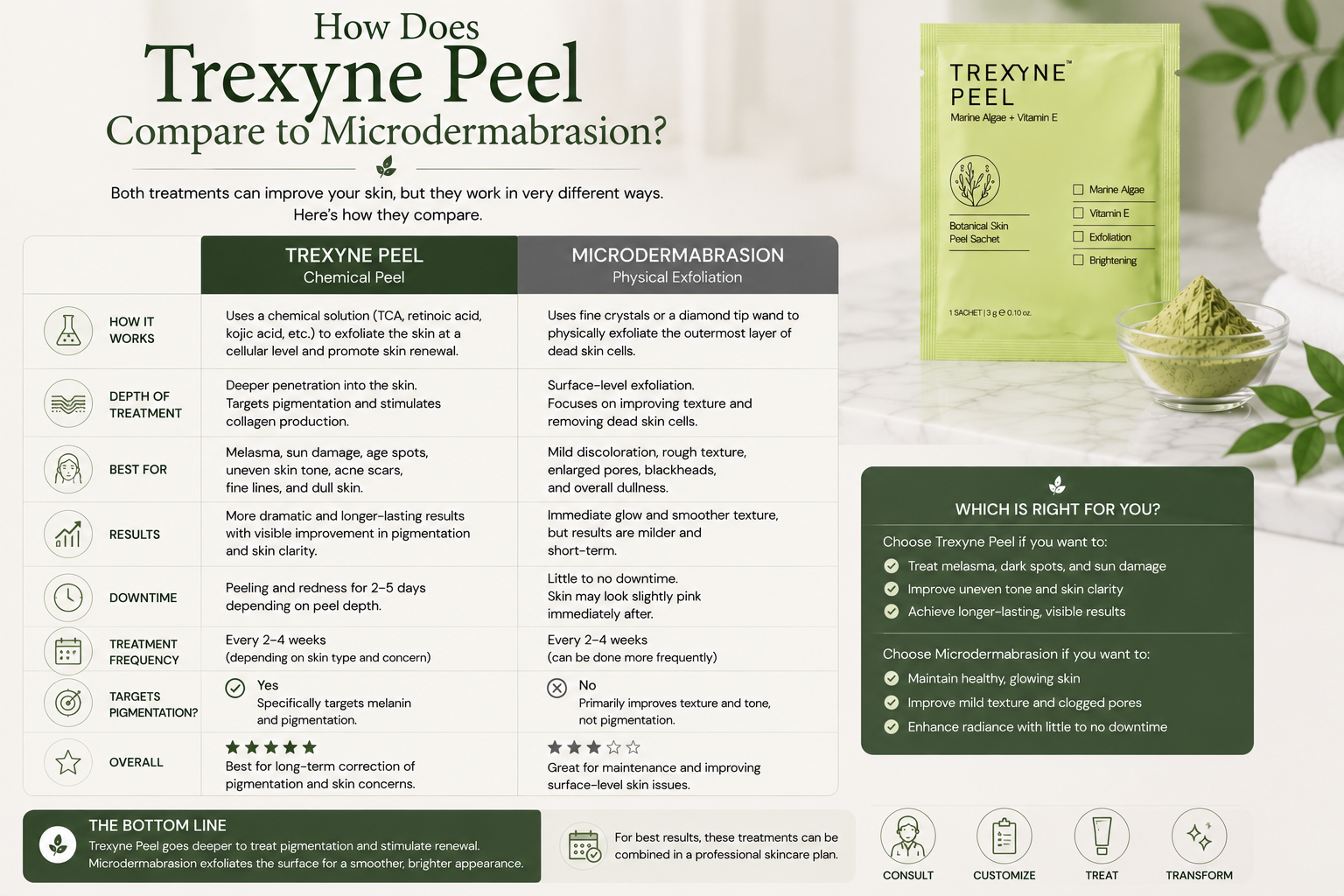
Both the Trexyne Peel and microdermabrasion are professional mechanical resurfacing treatments, and this shared category is worth establishing clearly before examining where they differ. Neither relies on chemical exfoliation to achieve its resurfacing effect, which places both in a distinct position from acid-based peel treatments. The differences between them lie in their specific mechanisms, the depth and type of resurfacing they achieve, the skin concerns each is best suited to, and the recovery profile clients can expect. For practitioners evaluating which approach fits a particular client or concern, understanding these distinctions helps in making a genuinely informed clinical decision rather than defaulting to whichever treatment is most familiar. The Trexyne Peel uses marine-algae spicules to create controlled micro-channels in the skin’s surface, while microdermabrasion uses physical abrasion to remove the outermost layer of skin. Both stimulate renewal, but through meaningfully different mechanisms with different clinical implications.
What Microdermabrasion Does and How It Works
Microdermabrasion is a well-established professional treatment that uses a mechanical abrading surface, typically either fine crystals or a diamond-tipped wand, to physically remove the outermost layer of the skin. The abrasion strips away dead skin cells from the stratum corneum, the most superficial layer of the epidermis, stimulating cell turnover in the layers beneath as the skin responds to the controlled surface disruption.
The depth of resurfacing in standard microdermabrasion is relatively superficial, confined primarily to the stratum corneum and the outermost epidermal layers. This superficiality is both a clinical limitation and an advantage depending on the concern being treated. For very surface-level dullness, mild texture irregularity, and superficial skin refinement, microdermabrasion is effective and produces visible immediate improvement in skin brightness. For deeper concerns including established pigmentation, more layered photodamage, or concerns that sit below the stratum corneum, the depth of effect may not be sufficient to produce sustained, meaningful results.
Microdermabrasion involves no chemical agents and generates a relatively low inflammatory response compared to chemical peels. Recovery is typically minimal, with mild redness that resolves within hours for most clients. This makes it a practical option for clients seeking a low-downtime surface treatment.
What the Trexyne Peel Does and How It Differs
The Trexyne Peel resurfaces through marine-algae spicules that create controlled micro-channels in the skin surface through direct physical action. This mechanism is distinct from the abrasive stripping of microdermabrasion in a clinically relevant way. Rather than mechanically removing the outermost skin layer as a whole, the spicules create fine, targeted channels that penetrate to a controlled depth, stimulating the skin’s renewal and repair response in a more directed manner.
This channel-creating mechanism allows the Trexyne Peel to influence the skin at a depth that supports a more sustained renewal response than standard microdermabrasion typically achieves. The micro-channels stimulate the skin’s natural repair mechanisms across a greater effective depth than surface abrasion alone, which translates to more progressive and sustained improvement for concerns such as post-inflammatory hyperpigmentation, melasma, and solar lentigines that sit across multiple layers of the epidermis rather than at the very surface.
The Trexyne Peel also includes stabilised Vitamin E in its formulation, which actively supports the skin’s recovery phase from the first application. This recovery-supportive component is not a feature of standard microdermabrasion, which delivers surface abrasion without an accompanying recovery-supportive ingredient profile.
The Tiered Protocol: A Key Structural Difference
One of the most practically significant differences between the Trexyne Peel and microdermabrasion for practitioners is the tiered protocol that allows treatment intensity to be matched to the individual client’s skin type and condition at each session.
Microdermabrasion intensity can be adjusted through machine settings and the number of passes applied, but the fundamental mechanism, surface abrasion, remains the same regardless of the setting used. The degree of variation available within a single treatment type is relatively limited.
The Trexyne Peel’s tiered protocol provides a structured framework for graduated intensity progression across a treatment course. The practitioner selects the appropriate tier based on clinical assessment at each appointment, allowing for meaningful variation in treatment depth and intensity that reflects how the skin is presenting and responding. For clients whose skin condition varies between sessions, or who are progressing through a course where more conservative early sessions give way to more intensive later ones, this tiered structure provides a level of clinical control that machine-based surface abrasion does not replicate as precisely.
Which Skin Concerns Each Approach Suits Best
Understanding which concerns each treatment suits helps practitioners make appropriate recommendations and helps clients understand why one might be recommended over another for their specific presentation.
Microdermabrasion is well suited to surface-level concerns where the primary goal is general skin refinement, improved brightness, and the removal of accumulated dead skin cells. Clients seeking an occasional refresh treatment, a pre-event brightening session, or mild improvement in surface texture often find microdermabrasion a practical and effective option. It is also widely used as part of maintenance programmes between more intensive treatment courses.
The Trexyne Peel is better suited to concerns that sit at greater depth within the epidermis and require more sustained, progressive cell turnover to produce visible improvement. Post-inflammatory hyperpigmentation, solar lentigines, melasma, and more significant texture and tone irregularities all benefit from the deeper renewal stimulus and the more structured tiered protocol that the Trexyne Peel provides. For clients who have already achieved surface refinement through microdermabrasion but are not seeing improvement in deeper pigmentation, the Trexyne Peel represents a step up in the depth and mechanism of resurfacing.
The two approaches are not mutually exclusive in a treatment menu. Microdermabrasion can serve a maintenance or surface refinement role while the Trexyne Peel addresses deeper concerns within a more intensive treatment course.
Sensitive and Reactive Skin Types
For sensitive or reactive skin types, both treatments have different considerations. Microdermabrasion’s surface abrasion can produce temporary redness and increased sensitivity, and overly frequent or intensive sessions can compromise barrier function in reactive skin. The Trexyne Peel’s micro-channel mechanism, combined with the recovery-supportive Vitamin E in the formulation, tends to produce a more manageable and predictable recovery profile for sensitive skin, particularly when the tiered protocol is used to start conservatively.
For clients with a history of post-inflammatory hyperpigmentation, the mechanical mechanism of both treatments avoids the specific chemical inflammatory trigger associated with the highest PIH risk. However, the Trexyne Peel’s additional recovery support and tiered protocol give practitioners more clinical tools for managing sensitive or PIH-prone skin through a sustained treatment course.
Recovery and Downtime: A Practical Comparison
Downtime is one of the most practical factors clients consider when choosing between resurfacing treatments, and the two approaches differ meaningfully in this area.
Microdermabrasion typically involves minimal downtime. Most clients experience mild redness for a few hours following treatment, and the majority can return to normal activities and apply makeup the same day or the next morning. This very low downtime profile is one of the primary reasons microdermabrasion has remained popular as a lunchtime or low-disruption treatment.
The Trexyne Peel involves a slightly more significant recovery period, reflecting the deeper renewal stimulus it provides. Clients typically experience redness and some tightness in the first 24 to 48 hours, followed by superficial shedding over the following days. Most clients find the skin has settled by the end of the first week, and the treatment is designed around predictable, manageable downtime rather than extended or unpredictable recovery. This recovery period is proportionate to the greater depth of resurfacing the treatment achieves, and the stabilised Vitamin E in the formulation supports the skin through this window.
For practitioners communicating this to clients, framing the Trexyne Peel’s slightly longer recovery as a reflection of a more substantive resurfacing stimulus, rather than simply more disruption, helps clients understand the clinical rationale for the different recovery profile.
Treatment Course Structure and Cumulative Results
Microdermabrasion is commonly used as a series of sessions for cumulative results, though individual sessions also produce immediate visible improvement that makes single treatments popular. A typical course involves sessions at one to two week intervals for surface concerns, with maintenance sessions at longer intervals to sustain results.
The Trexyne Peel is structured around sessions spaced three to four weeks apart to align with the skin’s natural renewal cycle, with intensity progressing through the tiered protocol as the course advances. This longer spacing reflects the deeper resurfacing stimulus and the time needed for the skin to complete its renewal cycle before the next session is applied.
The cumulative improvement achievable through a Trexyne Peel course for deeper pigmentation or more significant photodamage typically represents a more substantial clinical outcome than a comparable number of microdermabrasion sessions on the same concern, though microdermabrasion produces faster visible surface improvement in the early stages. The appropriate choice depends on what the client is trying to achieve and over what timeframe.
Practitioners looking to incorporate the Trexyne Peel alongside or as an alternative to microdermabrasion in their treatment offering can explore the full product range via the Trexyne shop, or contact the team directly through the Trexyne contact page.
Cost and Clinical Value
From a client perspective, treatment cost is a practical consideration alongside clinical appropriateness. Microdermabrasion sessions are typically positioned at a lower price point than professional peel treatments, reflecting their shorter procedure time and lower recovery burden. The Trexyne Peel, priced from £175.00 per session up to £450.00 for a course, represents a higher per-session investment that reflects the deeper resurfacing mechanism, the recovery-supportive formulation, and the clinical oversight involved in managing a tiered protocol course.
For clients whose concern is surface dullness or general refinement, microdermabrasion may represent appropriate value for the outcome they are seeking. For clients with established pigmentation, photodamage, or concerns that require a more substantive resurfacing approach, the Trexyne Peel’s greater depth of effect represents better clinical value per session, even at a higher per-session cost, because it is more likely to produce the degree of improvement the client is actually looking for.
More information on the Trexyne approach to professional botanical resurfacing is available on the Trexyne website.
Conclusion
The Trexyne Peel and microdermabrasion are both professional mechanical resurfacing treatments that avoid chemical exfoliation, but they differ in mechanism, depth of effect, recovery profile, and the skin concerns each is best suited to address. Microdermabrasion provides effective surface abrasion for general refinement and brightness with minimal downtime. The Trexyne Peel creates controlled micro-channels through marine-algae spicules, achieving a deeper renewal stimulus suited to more established pigmentation concerns, and delivers recovery support through stabilised Vitamin E alongside a tiered protocol that gives practitioners greater clinical control across a treatment course. For practitioners building a comprehensive resurfacing offer, the two approaches can complement each other across different client needs and treatment goals. The Trexyne Peel may be particularly valuable for clients who have been managing surface concerns with microdermabrasion but have not achieved the depth of improvement they need for established pigmentation or more layered photodamage, and who are looking for a professional option that can take their results further without introducing chemical exfoliation.
FAQs
Q: How does the Trexyne Peel compare to microdermabrasion?
Both are professional mechanical resurfacing treatments that avoid chemical exfoliation. Microdermabrasion uses surface abrasion to remove the outermost skin layer, producing immediate brightness with minimal downtime. The Trexyne Peel uses marine-algae spicules to create controlled micro-channels at greater depth, stimulating a more sustained renewal response suited to established pigmentation and deeper skin concerns, with a slightly longer but predictable recovery period.
Q: Is the Trexyne Peel better than microdermabrasion for pigmentation?
For established pigmentation concerns such as solar lentigines, post-inflammatory hyperpigmentation, and melasma, the Trexyne Peel’s deeper renewal mechanism is generally more appropriate than standard microdermabrasion. These concerns sit across multiple layers of the epidermis rather than at the surface, and responding to them requires a resurfacing stimulus that reaches greater depth than surface abrasion typically achieves.
Q: Can I have microdermabrasion and the Trexyne Peel?
The two treatments are not mutually exclusive in a treatment menu. Microdermabrasion can serve a surface refinement or maintenance role while the Trexyne Peel addresses deeper concerns within a more intensive treatment course. A practitioner can advise on how the two might be structured together based on the individual’s skin concerns and goals.
Q: Which has less downtime, microdermabrasion or the Trexyne Peel?
Microdermabrasion typically involves minimal downtime, with most clients experiencing mild redness that resolves within a few hours. The Trexyne Peel involves a slightly more significant recovery period, with redness and tightness in the first 48 hours and superficial shedding over the following days, with most clients settled by the end of the first week. The Trexyne Peel’s slightly longer recovery reflects the deeper renewal stimulus it provides.
Q: Is the Trexyne Peel suitable for sensitive skin compared to microdermabrasion?
Both treatments are mechanical rather than chemical, which avoids the specific inflammatory trigger associated with acid-based resurfacing. The Trexyne Peel’s recovery-supportive Vitamin E formulation and tiered protocol give practitioners additional clinical tools for managing sensitive skin through a sustained course, making it a considered option for reactive skin types seeking more than surface-level resurfacing.
Q: How much does the Trexyne Peel cost compared to microdermabrasion?
The Trexyne Peel is priced from £175.00 per session to £450.00 for a course, reflecting the deeper resurfacing mechanism and the clinical management involved. Microdermabrasion is typically positioned at a lower price point per session. For clients with established pigmentation or more complex concerns, the greater depth of effect from the Trexyne Peel may represent better clinical value over a treatment course despite the higher per-session cost.
Q: Where can I find a practitioner who offers the Trexyne Peel?
The Trexyne Peel is sold exclusively to verified practitioners and clinics. Clients can contact the Trexyne team through the contact page on the Trexyne website to find out about practitioners offering the treatment. Practitioners interested in stocking the product can explore options via the Trexyne shop.