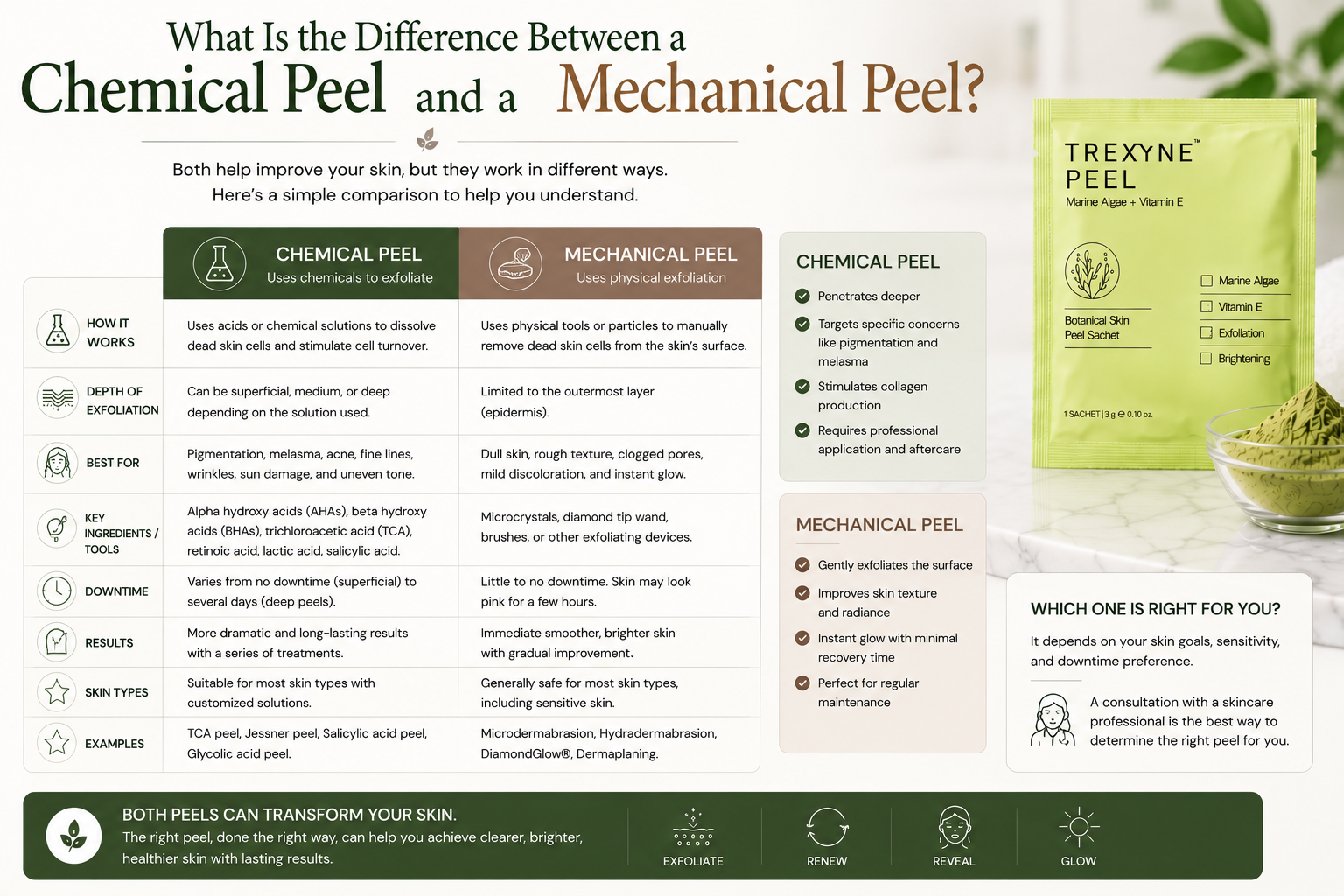
What Is the Difference Between a Chemical Peel and a Mechanical Peel?
A chemical peel uses active chemical agents to exfoliate the skin, triggering a controlled reaction within the skin’s layers to stimulate renewal. A mechanical peel achieves the same fundamental goal through physical action rather than chemical reaction, disrupting and resurfacing the skin without introducing any exfoliating chemicals. Both categories aim to accelerate cell turnover, improve skin tone and texture, and support a more even, refined complexion. The difference lies entirely in how they get there, and that difference has real clinical implications for which skin types and concerns each approach suits, what the recovery profile looks like, and what risks each carries. For practitioners evaluating options and for clients researching treatment types, understanding this distinction clearly is more useful than simply comparing individual products. The Trexyne Peel is a mechanical peel, and the clinical significance of that category is the subject of this post.
How Chemical Peels Work
Chemical peels apply one or more active chemical exfoliants to the skin surface to dissolve the bonds that hold dead or damaged skin cells together. This process causes the outer layers of the skin to shed, revealing fresher cells beneath and stimulating renewal in the layers below the treatment depth.
The chemical agents used in peels vary widely in their strength, their depth of penetration, and the degree of skin disruption they produce. Superficial peels work primarily within the stratum corneum and the outermost layers of the epidermis. Medium-depth peels penetrate to the mid-epidermis or the papillary dermis. Deep peels reach the reticular dermis and produce the most significant renewal alongside the most significant recovery burden.
The chemical reaction that makes these peels work is also what introduces their primary clinical risks. The reaction generates inflammation in the skin as part of how the renewal process is triggered. For many skin types this inflammation is temporary and manageable. For others, particularly Fitzpatrick types III to VI or skin with a history of post-inflammatory hyperpigmentation, this inflammatory response can trigger melanocyte overproduction and produce new pigmentation rather than resolving existing concerns. The chemical reaction, once initiated, also follows its own course with limited ability to be modified in real time once the agent is on the skin.
How Mechanical Peels Work
Mechanical peels achieve resurfacing through physical action rather than chemistry. The resurfacing effect is created by a physical mechanism interacting with the skin’s surface to create controlled disruption that stimulates renewal without any chemical reaction taking place.
Different mechanical approaches use different physical mechanisms. Microdermabrasion uses an abrasive surface to physically remove the outermost skin layer through friction. Dermaplaning uses a surgical blade to manually remove the stratum corneum and vellus hair. The Trexyne Peel uses marine-algae spicules to create controlled micro-channels in the skin through the physical structure of the spicules themselves.
What these approaches share is the absence of a chemical reaction in the skin. The resurfacing stimulus is physical. The skin responds to the mechanical disruption through its natural repair and renewal processes, and the resulting cell turnover produces the clinical outcomes associated with resurfacing, improved texture, more even tone, and progressive displacement of pigmented cells, through biological mechanisms rather than chemical ones.
The practitioner’s control over a mechanical resurfacing treatment is more direct than with a chemical one. The degree of disruption is determined by technique and by choices made during the session rather than by a chemical reaction that unfolds on its own timeline once initiated. This gives mechanical approaches an inherent predictability advantage, particularly for variable or sensitive skin types.
The Clinical Significance of the Inflammatory Difference
The most clinically important difference between chemical and mechanical peels is the inflammatory pathway each engages, or in the case of mechanical peels, does not engage.
Chemical peels generate inflammation as part of their mechanism. This is not incidental. For chemical resurfacing, the inflammatory response is integral to how the renewal stimulus works. The challenge arises when this inflammation triggers consequences the practitioner and client did not intend: post-inflammatory hyperpigmentation in susceptible skin, prolonged redness in reactive or sensitive skin, or a rebound worsening of conditions such as melasma that are themselves sensitive to inflammatory triggers.
Mechanical peels stimulate renewal without engaging the same chemical inflammatory cascade. The skin still undergoes a repair response following mechanical disruption, but the specific chemical pathway that drives the highest-risk inflammatory outcomes in sensitive and pigmentation-prone skin is not activated in the same way. This is why mechanical resurfacing is generally a more appropriate first-choice approach for clients with Fitzpatrick types III to VI, known PIH susceptibility, sensitive or reactive skin, or a history of difficult recoveries from chemical resurfacing.
It does not mean mechanical peels are without any recovery period or any risk. They are not. It means the risk profile differs in clinically meaningful ways from chemical approaches, particularly for the skin types most likely to have problematic outcomes from chemical resurfacing.
Depth of Effect: How the Two Categories Compare
Chemical peels can be formulated to work at a range of depths, from very superficial treatments that address only the stratum corneum through to deep treatments that penetrate to the reticular dermis. The depth is controlled primarily by the concentration and type of chemical agent used and the application time, and different depths produce very different clinical outcomes and recovery burdens.
Mechanical peels, including the Trexyne Peel, work within the epidermal layers. The micro-channels created by marine-algae spicules in the Trexyne Peel stimulate renewal at a depth that is effective for addressing epidermal pigmentation, surface texture, and general skin renewal without reaching the depth of effect that medium or deep chemical peels achieve. For concerns that require dermal intervention, mechanical peel approaches are not the appropriate tool.
This means chemical and mechanical peels are not always direct alternatives. For certain clinical objectives, particularly those involving significant structural skin change, medium or deep chemical resurfacing may be the more appropriate professional option. For the majority of pigmentation concerns treated in aesthetic practice, including post-inflammatory hyperpigmentation, solar lentigines, mild to moderate melasma, and general photodamage, the epidermal depth achievable through a well-structured course of mechanical resurfacing is appropriate and effective.
Recovery Profile: What Clients Experience With Each Approach
The recovery experience following chemical and mechanical peels differs in ways that are practically important for clients planning around treatment and for practitioners setting expectations.
Deep chemical peels produce the most significant recovery burden, with extended periods of visible shedding, redness, and skin sensitivity that can require several weeks of managed recovery. Medium-depth chemical peels produce several days to a couple of weeks of visible recovery. Superficial chemical peels generally involve minimal visible recovery, with mild redness that resolves within hours to a day or two.
Mechanical peels sit in a range comparable to superficial to light-medium chemical peels in terms of recovery profile, though the nature of that recovery differs. The Trexyne Peel is designed around predictable, manageable downtime. Clients typically experience redness and tightness in the first 48 hours, followed by light superficial shedding over the following days, with the skin settling by the end of the first week for most intensity levels within the tiered protocol.
The absence of a chemical reaction means the recovery is not driven by a chemical process resolving in the skin, but by the skin’s natural repair response to mechanical disruption. This produces a more consistent and predictable recovery profile across different clients than chemical resurfacing, where individual variation in how the skin responds to the chemical reaction can produce quite different outcomes from the same treatment applied at the same concentration.
Which Approach Suits Which Skin Concerns
The clinical decision between chemical and mechanical resurfacing should be guided by the specific concern being treated, the client’s skin type and history, and the risk-benefit calculation for that individual rather than by habit or familiarity with one approach.
Chemical resurfacing is generally more appropriate for clients with resilient, non-reactive skin types who are seeking the deeper or more pronounced renewal stimulus that medium or deep chemical peels provide, or for very superficial surface concerns where the speed and convenience of a quick chemical peel suits the clinical objective and the client’s tolerance.
Mechanical resurfacing, including the Trexyne Peel, is generally more appropriate for clients with Fitzpatrick types III to VI, known PIH susceptibility, sensitive or reactive skin, a history of difficult chemical peel recoveries, melasma or hormonally driven pigmentation, or any situation where minimising the inflammatory load of the resurfacing process is a clinical priority.
Neither approach is universally superior. The right choice is the one that matches the mechanism to the client’s skin biology and the concern being treated.
The Trexyne Peel Within the Mechanical Peel Category
The Trexyne Peel occupies a specific position within the mechanical resurfacing category. Unlike microdermabrasion, which achieves resurfacing through surface abrasion, the Trexyne Peel’s marine-algae spicule mechanism creates micro-channels that influence the skin at a depth suited to addressing epidermal pigmentation concerns alongside surface refinement. This makes it a more targeted option for pigmentation-focused treatment courses than standard microdermabrasion, while remaining within the mechanical category that avoids chemical inflammatory triggers.
The addition of stabilised Vitamin E in the formulation further differentiates it within the mechanical category, providing recovery support that is not a feature of surface abrasion approaches. The tiered protocol gives practitioners the clinical structure to progress intensity across a treatment course in a controlled, responsive way.
Practitioners interested in incorporating the Trexyne Peel into their mechanical resurfacing offer can explore the full product range through the Trexyne shop, or contact the team directly through the Trexyne contact page.
Choosing Between Categories in Practice
For practitioners who offer both chemical and mechanical resurfacing, the consultation process should determine which category is appropriate for each individual client rather than applying a default protocol across all presentations.
A client with a pigmentation concern who also has a history of PIH and a Fitzpatrick type IV skin tone is a candidate for mechanical resurfacing rather than chemical, regardless of what the practitioner is most practised with. A client with resilient, lighter skin seeking a single high-impact session for a specific occasion might be appropriate for a superficial chemical peel that produces an immediate visible result with minimal recovery.
The decision should be driven by clinical assessment, not by routine. Practitioners who develop clear decision criteria for when each category is appropriate will make better recommendations and produce better outcomes across their client base than those who default to the same approach regardless of the presenting concern and skin type.
More information on the Trexyne approach to professional botanical resurfacing is available on the Trexyne website.
Conclusion
Chemical peels and mechanical peels are distinct categories of professional resurfacing treatment that differ in their mechanism, inflammatory profile, depth of effect, and clinical risk in different skin types. Chemical peels use chemical agents to trigger a reaction in the skin, generating inflammation as part of the renewal process. Mechanical peels use physical action to stimulate renewal without this chemical reaction, producing a different risk profile that is particularly relevant for skin types and concerns most sensitive to inflammatory triggers. The Trexyne Peel is a mechanical resurfacing treatment using marine-algae spicules, with stabilised Vitamin E to support recovery and a tiered protocol that gives practitioners meaningful clinical control across a treatment course. For clients whose skin biology makes chemical resurfacing a higher-risk choice, or whose concerns are best addressed through a sustained mechanical resurfacing course with predictable downtime, the Trexyne Peel may offer a more considered route to a brighter, more even-looking complexion.
FAQs
Q: What is the difference between a chemical peel and a mechanical peel?
A chemical peel uses active chemical agents to exfoliate the skin through a chemical reaction. A mechanical peel achieves resurfacing through physical action without any chemical reaction taking place. Both stimulate cell turnover and skin renewal, but through different mechanisms with different clinical implications for skin type suitability, inflammatory risk, and recovery profile.
Q: Is a mechanical peel safer than a chemical peel?
Neither category is universally safer. The appropriate choice depends on the individual client’s skin type, concern, and history. For clients with Fitzpatrick types III to VI, known PIH susceptibility, or sensitive and reactive skin, mechanical resurfacing generally carries a lower risk of the inflammatory complications most associated with these skin types. For resilient skin types seeking deeper renewal, chemical resurfacing may be more appropriate.
Q: Is the Trexyne Peel a chemical peel or a mechanical peel?
The Trexyne Peel is a mechanical peel. It resurfaces through marine-algae spicules that create controlled micro-channels in the skin through physical action. No acids or chemical exfoliants are involved at any stage of the treatment.
Q: Who is better suited to a mechanical peel than a chemical peel?
Clients with Fitzpatrick types III to VI, a history of post-inflammatory hyperpigmentation, sensitive or reactive skin, melasma, or a difficult recovery from previous chemical resurfacing are generally better suited to mechanical resurfacing. The absence of a chemical inflammatory trigger reduces the specific risks most associated with these skin profiles.
Q: Do mechanical peels produce results as good as chemical peels?
For epidermal pigmentation concerns, texture, and general skin renewal, a well-structured course of mechanical resurfacing can produce results comparable to superficial to light-medium chemical peels. For concerns requiring deeper dermal intervention, medium or deep chemical peels achieve effects that mechanical peels do not. The appropriate comparison depends on the specific concern and what depth of effect is clinically indicated.
Q: How long is the recovery from a mechanical peel compared to a chemical peel?
Recovery from mechanical resurfacing, including the Trexyne Peel, is generally comparable to superficial chemical peels, with redness and tightness in the first 48 hours and light shedding over the following days, settling within a week for most clients. Deep chemical peels involve significantly longer and more demanding recovery periods. The Trexyne Peel’s recovery is designed to be predictable and manageable.
Q: Can I have both chemical and mechanical peels as part of my treatment plan?
A practitioner can design a treatment plan that incorporates both approaches for different purposes, such as mechanical resurfacing for a sustained pigmentation course and superficial chemical peels for surface maintenance between courses. Whether combining the two is appropriate depends on the individual’s skin type and concerns, and a practitioner assessment guides this decision.