Can Hormonal Birth Control Cause Skin Pigmentation?
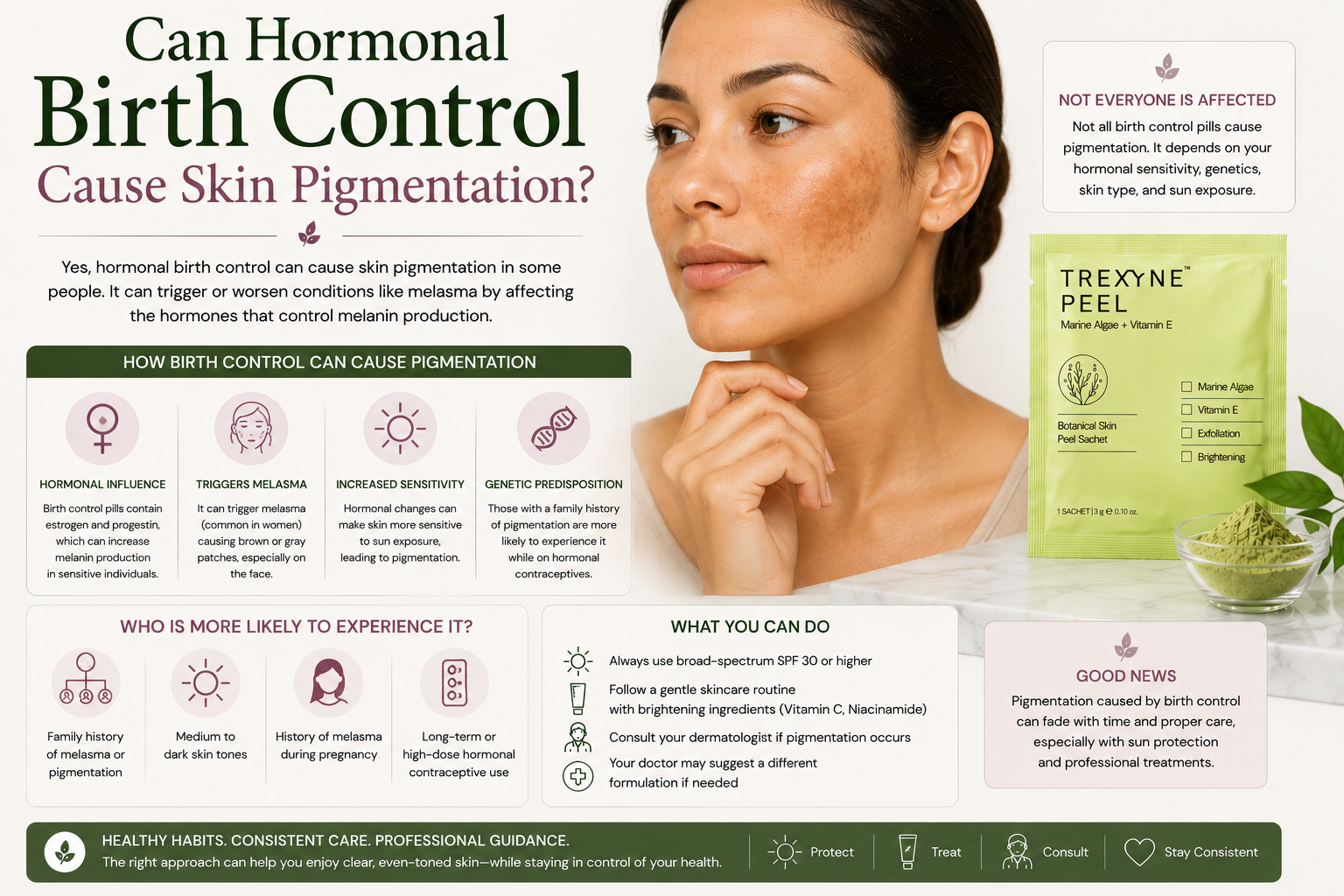
Yes, hormonal contraception can cause skin pigmentation, and it is one of the most common and underrecognised triggers for melasma in women who are not pregnant. The mechanism is the same as pregnancy-related chloasma: elevated oestrogen and progesterone sensitise melanocytes to UV radiation, prompting them to produce excess melanin in the areas most exposed to light. The result is the characteristic bilateral, diffuse patches across the cheeks, forehead, and upper lip that define melasma. Many women who develop pigmentation while on hormonal contraception do not immediately connect the two, particularly if their contraceptive use predates the pigmentation by several months. Understanding the link, and what can be done about the resulting skin changes, is clinically relevant both for practitioners managing pigmentation concerns and for clients trying to understand why their skin has changed. Professional resurfacing options such as the Trexyne Peel can form part of a management approach, though the relationship between the hormonal trigger and treatment timing requires careful consideration.
How Hormonal Contraception Triggers Pigmentation
Hormonal contraception, including combined oral contraceptives, progesterone-only pills, hormonal coils, implants, injections, and patches, all work by altering the hormonal environment to prevent ovulation or implantation. In doing so, they introduce sustained elevated levels of synthetic oestrogen, progesterone, or both into the body over extended periods.
These hormonal changes affect melanocytes in the same way that naturally elevated hormones during pregnancy do, by increasing melanocyte sensitivity to UV radiation. Melanocytes that have been primed by hormonal stimulus respond disproportionately to UV exposure, producing more melanin in specific areas than unpigmented skin would generate from the same degree of sun exposure.
The pigmentation tends to develop gradually rather than appearing suddenly. Many women notice their skin becoming uneven or developing patches over weeks or months of contraceptive use, often initially attributing the change to sun exposure or seasonal variation. The bilateral, symmetrical distribution across the central face is the most consistent clinical indicator that the pigmentation is hormonally driven rather than purely UV-related.
Not all hormonal contraceptive users develop melasma. Individual susceptibility depends on skin type, UV exposure habits, and the specific hormonal formulation used. Combined oral contraceptives containing oestrogen carry a higher risk than progesterone-only methods, though progesterone-only contraception can also produce pigmentation in susceptible individuals.
Which Contraceptive Methods Carry the Highest Risk
The risk of contraception-related pigmentation varies between different methods and formulations, and this is worth understanding both for practitioners advising clients and for clients making choices about contraception.
Combined oral contraceptives, which contain both synthetic oestrogen and progesterone, carry the highest documented risk of melasma among contraceptive methods. The oestrogen component is the primary driver of melanocyte sensitisation, and combined pills provide a sustained elevated oestrogen exposure that replicates, in modified form, the hormonal environment associated with pregnancy-related chloasma.
Progesterone-only methods, including the mini pill, hormonal coil, implant, and injection, carry a lower but still present risk. The absence of exogenous oestrogen reduces the primary melanocyte-sensitising stimulus, but progesterone itself has melanocyte-stimulating properties, and individual variation means some women on progesterone-only methods do develop visible pigmentation.
Contraceptive patches and vaginal rings deliver hormones transdermally or locally, but the systemic hormonal exposure is sufficient to produce melanocyte sensitisation in susceptible individuals.
The dose of synthetic oestrogen in combined oral contraceptives has reduced significantly over the decades since they were first introduced, and lower-dose formulations carry a reduced risk compared to higher-dose pills. However, even low-dose combined contraceptives are not without risk for women with Fitzpatrick types III to VI or a personal or family history of melasma.
Why UV Exposure Determines Whether Pigmentation Becomes Visible
Hormonal contraception sensitises melanocytes but does not directly produce visible pigmentation on its own. UV exposure is the environmental trigger that converts this hormonal priming into concentrated melanin deposits that are visible on the skin surface.
This explains a pattern that many clients observe: they may use the same contraceptive for years without developing obvious pigmentation, then notice patches appear during or after a summer of high UV exposure, a sunny holiday, or a period of spending more time outdoors. The hormonal trigger has been present throughout, but the UV exposure has increased to a level that reveals the heightened melanocyte sensitivity.
It also explains why rigorous daily SPF use is, for some women, sufficient to prevent visible pigmentation from developing even while using hormonal contraception that would otherwise predispose them to it. Consistently blocking the UV trigger means the hormonal sensitisation has less environmental input to work with, and melanocyte activity may not reach the threshold at which visible patches develop.
For women who have already developed contraception-related pigmentation, daily SPF use is essential both during any professional treatment course and as a long-term protective measure. Without consistent photoprotection, the hormonal trigger remains active and the UV amplifier continues to operate, meaning any improvement achieved through resurfacing is vulnerable to rapid reversal.
The Clinical Relationship Between Contraception and Melasma Management
For practitioners, understanding the relationship between a client’s contraceptive use and their skin pigmentation is essential clinical context before any treatment plan is designed. A client who presents with melasma and who is currently using a combined oral contraceptive has an active, ongoing hormonal trigger that will be working against the treatment throughout the course.
This does not mean professional resurfacing is futile for clients on hormonal contraception. It means realistic expectations need to reflect the presence of an active trigger, session progression may be slower and more variable than for clients without a hormonal driver, and the conversation about contraceptive options may be relevant to include in the management discussion.
Practitioners are not prescribers and do not advise clients to change their contraception. However, raising the hormonal trigger as a clinically relevant factor and encouraging the client to discuss contraceptive options with their GP or prescriber is appropriate clinical practice. Some clients may not have been told that their contraceptive could be contributing to their skin pigmentation, and simply providing this information is genuinely useful regardless of what they subsequently decide to do about it.
What Happens to Pigmentation if Contraception Is Changed or Stopped
For clients who do stop or change their hormonal contraception, the effect on melasma is variable and not always immediately positive. Some women find that their pigmentation begins to fade within several months of stopping or switching to a lower-oestrogen or progesterone-only method. Others find that the melasma persists largely unchanged, particularly if it has been present for a long time or if UV exposure has been significant during the period of contraceptive use.
The explanation for this variation is similar to why post-natal melasma does not always resolve spontaneously: melasma that has been present for an extended period, particularly if deep or mixed in its epidermal and dermal distribution, does not simply reverse when the hormonal trigger is withdrawn. The pigmented cells remain in place and need to be progressively displaced through cell turnover, whether natural or accelerated through professional resurfacing.
For clients who stop or change contraception and are then interested in professional treatment for the remaining pigmentation, the same principles that apply to post-natal melasma management apply here: allowing sufficient time for hormonal levels to stabilise, assessing the actual residual pigmentation once the acute hormonal stimulus has reduced, and then beginning a conservative resurfacing course with rigorous SPF support.
Where the Trexyne Peel Fits in Managing Contraception-Related Pigmentation
The Trexyne Peel is a relevant professional option for managing the pigmentation associated with hormonal contraception, for the same reasons it is appropriate for other forms of melasma. Its mechanical resurfacing mechanism avoids the chemical inflammatory trigger most likely to provoke a melanocyte rebound response in hormonally sensitised skin. Stabilised Vitamin E in the formulation supports the recovery phase, reducing the post-treatment inflammatory window during which melasma-prone skin is most vulnerable to further pigmentation stimulus.
The tiered protocol is particularly valuable for clients who are still using hormonal contraception during treatment, since their skin may be more variable and reactive session to session than that of clients whose hormonal trigger has been removed. Beginning conservatively and progressing based on the skin’s demonstrated response at each appointment, rather than following a predetermined intensity schedule, produces more reliable outcomes for this client group.
For clients who have stopped contraception and are waiting for hormonal levels to stabilise before beginning a resurfacing course, the Trexyne Peel is appropriate once the practitioner’s assessment confirms the skin is in a suitable state to proceed. Practitioners can find full product information and supply options via the Trexyne shop, or contact the team directly through the Trexyne contact page.
Practical Advice for Clients Managing This Concern
For clients who have noticed skin pigmentation that may be related to their hormonal contraception, there are several practical steps that can support their situation regardless of what they decide about their contraceptive use.
Starting or maintaining daily broad-spectrum SPF use is the single most impactful immediate step. UV exposure is the active trigger that converts hormonal sensitivity into visible pigmentation, and consistently blocking it limits how much the condition develops or worsens regardless of whether the hormonal factor changes.
Booking a consultation with a trained aesthetic practitioner allows for a proper assessment of the pigmentation type, depth, and distribution and for a realistic treatment plan to be designed around the individual’s circumstances, including their hormonal status and UV habits.
Discussing the hormonal connection with a GP or prescriber opens the possibility of a medication review if the client wishes to explore whether a different contraceptive approach might reduce the hormonal driver of their pigmentation.
More information on the Trexyne approach to professional botanical resurfacing is available on the Trexyne website.
Conclusion
Hormonal contraception can and does cause skin pigmentation by sensitising melanocytes to produce excess melanin in response to UV exposure, through the same pathway that drives pregnancy-related melasma. Combined oral contraceptives carry the highest risk, though progesterone-only methods can also produce pigmentation in susceptible individuals. The visible result is the same bilateral, diffuse pigmentation pattern associated with melasma, and it is managed in the same way: through rigorous daily SPF use, management of the hormonal trigger where appropriate, and professional resurfacing with a mechanism that avoids adding inflammatory stimulus to skin that is already reacting strongly to hormonal signals. The Trexyne Peel resurfaces through a purely mechanical mechanism with stabilised Vitamin E to support recovery, making it a more considered option for hormonally sensitised skin than chemical resurfacing alternatives. With appropriate timing, a conservative protocol, and consistent photoprotection, it may support meaningful visible improvement and a brighter, more even-looking complexion for clients whose pigmentation is driven by hormonal contraception.
FAQs
Q: Can hormonal birth control cause skin pigmentation?
Yes. Hormonal contraception, particularly combined methods containing oestrogen, sensitises melanocytes to UV radiation, causing them to produce excess melanin in response to sun exposure. The result is the characteristic symmetrical, diffuse pigmentation of melasma across the cheeks, forehead, and upper lip. Not all contraceptive users develop visible pigmentation, but susceptibility is higher in Fitzpatrick types III to VI and in those with a personal or family history of melasma.
Q: Which contraceptive pill is most likely to cause skin pigmentation?
Combined oral contraceptives containing synthetic oestrogen carry the highest documented risk of melasma among contraceptive methods. The oestrogen component is the primary driver of melanocyte sensitisation. Progesterone-only methods carry a lower but still present risk. Lower-dose combined pills carry less risk than higher-dose formulations, though none is entirely without risk for susceptible individuals.
Q: Will my skin pigmentation go away if I stop taking the pill?
For some women, stopping hormonal contraception leads to gradual fading of melasma over several months as hormonal levels normalise. For others, particularly those with long-standing or deep pigmentation, it persists and requires professional treatment to address. Consistent daily SPF use from the point of stopping contraception protects whatever spontaneous fading may occur from being reversed by ongoing UV exposure.
Q: Can I have a professional skin peel for pigmentation while on hormonal contraception?
Professional resurfacing while still using hormonal contraception is possible, but the active hormonal trigger means progress may be slower and more variable than for clients without this factor. A mechanical resurfacing approach that avoids inflammatory triggers is more appropriate for hormonally sensitised skin than chemical alternatives. Realistic expectations about the pace of improvement are essential, and daily SPF use throughout the course is non-negotiable.
Q: Does the Trexyne Peel work for contraception-related melasma?
The Trexyne Peel can form part of a professional management plan for contraception-related melasma. Its mechanical resurfacing mechanism avoids the inflammatory trigger most likely to provoke rebound pigmentation in hormonally sensitised skin. Stabilised Vitamin E supports recovery, and the tiered protocol allows conservative progression suited to skin where the hormonal trigger may still be partially active.
Q: Is daily SPF enough to prevent contraception-related pigmentation?
For some women, consistent rigorous daily SPF use is sufficient to prevent visible melasma from developing even while using hormonal contraception that would otherwise predispose them to it. UV exposure is the trigger that converts hormonal sensitisation into visible pigmentation, so blocking it consistently can limit how much the condition develops. However, very high UV exposure or significant individual susceptibility may mean visible pigmentation develops despite SPF use.
Q: Should I tell my GP about skin pigmentation related to my contraceptive?
Yes. Discussing contraception-related pigmentation with a GP or prescriber is appropriate, since they can assess whether a medication review or change of method is relevant given the client’s overall health and contraceptive needs. Aesthetic practitioners can raise the hormonal link as clinically relevant context, but decisions about contraceptive medication rest with the prescribing doctor rather than the aesthetic clinic.