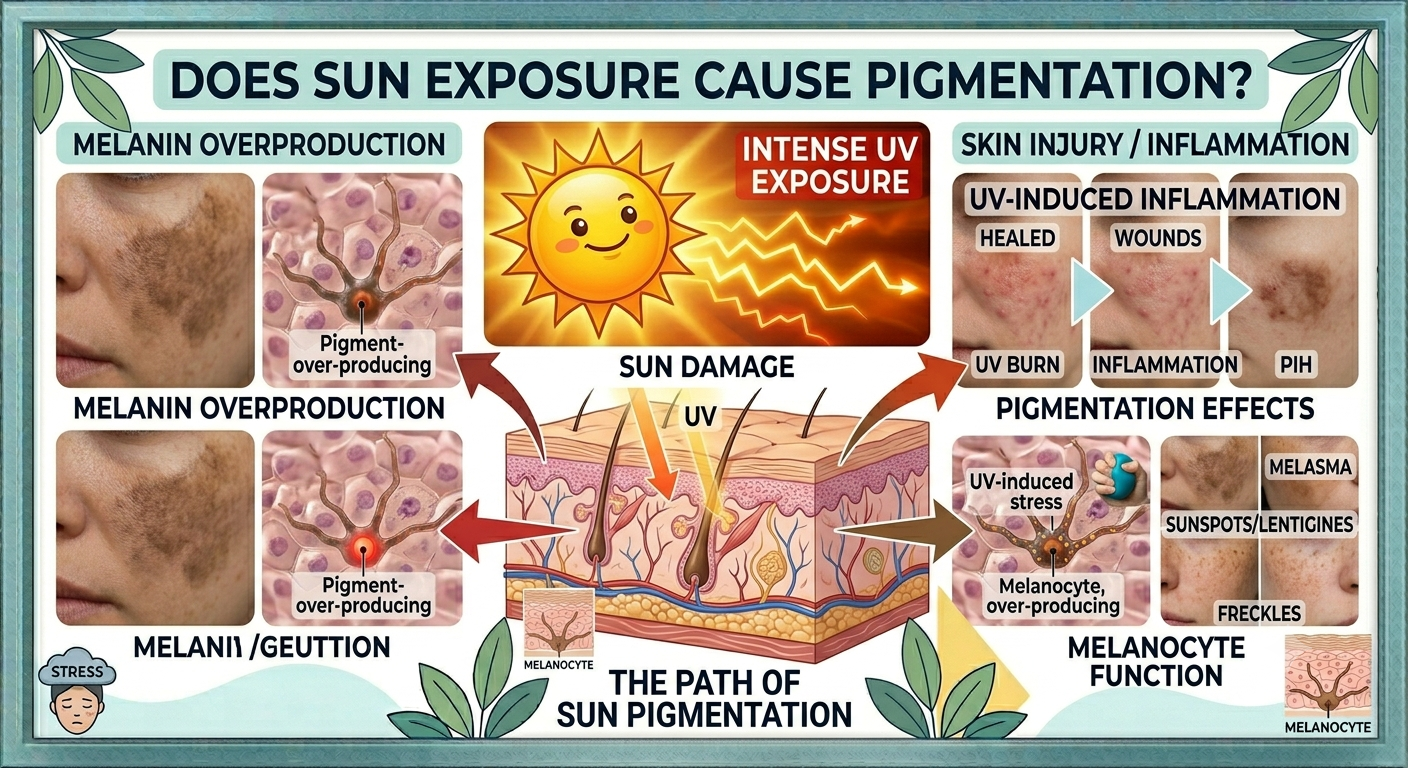
Does Sun Exposure Cause Pigmentation?
Yes, sun exposure is the single most common cause of pigmentation. When ultraviolet radiation from the sun reaches the skin, it activates a chain of biological responses that result in the production of excess melanin, the pigment responsible for the color of your skin. Over time, this causes the dark spots, uneven tone, and skin discoloration that many people want to treat. Understanding exactly how UV rays create pigmentation, which types of sun damage are most common, and what you can do to address them is the foundation of an effective treatment strategy. For those seeking professional results, the Trexyne Peel is a clinically applied chemical peel that directly targets the surface cells where sun-induced pigmentation is stored.
How UV Radiation Triggers Pigmentation
The skin has a built-in defense system against the damaging effects of ultraviolet radiation. When UV rays penetrate the epidermis, they reach specialized pigment-producing cells called melanocytes. These cells respond to the UV signal by ramping up production of melanin, the pigment that absorbs UV radiation and helps protect the DNA of surrounding skin cells from damage.
The enzyme at the center of this process is called tyrosinase. UV radiation activates tyrosinase, which then catalyzes the synthesis of melanin. The melanin is packaged into structures called melanosomes and transferred to adjacent keratinocytes, the main cells of the epidermis. As these cells migrate to the skin surface, they carry the melanin with them, producing the visible darkening effect we recognize as a tan or, with repeated exposure, as persistent dark spots.
In the short term, this response is protective. In the long term, it becomes the primary driver of pigmentation-related skin concerns.
The Difference Between UVA and UVB Rays
Not all UV radiation affects the skin in the same way. Understanding the distinction between UVA and UVB rays helps explain why sun-induced pigmentation develops even on days when you do not burn.
UVB Rays
UVB rays have a shorter wavelength and primarily affect the outermost layers of the skin. They are responsible for sunburn and are most intense between 10am and 4pm during sunny days. UVB rays are the main driver of acute sun damage and contribute significantly to the development of sunspots over time.
UVA Rays
UVA rays have a longer wavelength that penetrates more deeply into the skin, reaching the dermis below the epidermis. They are present at relatively consistent levels throughout the day, in all seasons, and even through glass and cloud cover. UVA rays are a major contributor to the gradual, cumulative pigmentation damage that builds up over years and decades. They also penetrate car windows and office glass, which is why people who commute or work near windows can develop facial pigmentation over time without ever spending time in direct midday sunlight.
This is why a broad-spectrum sunscreen that protects against both UVA and UVB radiation is essential. A product that only addresses UVB will leave the skin vulnerable to the longer-term pigmentation damage driven by UVA exposure.
Types of Sun-Induced Pigmentation
UV exposure does not create just one type of pigmentation. Several distinct conditions develop as a result of cumulative or acute sun damage.
Sunspots
Sunspots, also called solar lentigines, are the most common form of UV-induced pigmentation. They appear as small, flat, well-defined patches of darkened skin on areas that receive regular sun exposure, including the face, hands, chest, and shoulders. Unlike freckles, which fade in winter, sunspots persist and tend to deepen with ongoing UV exposure. They are most commonly seen from the mid-thirties onward, as cumulative damage becomes visible.
Tanning and Uneven Tone
A tan is not a sign of healthy skin. It is the visual result of the skin’s stress response to UV radiation. Over years of tanning, the skin develops an increasingly uneven distribution of melanin, leading to a patchy, inconsistent complexion that does not reflect the natural tone underneath.
Sun-Triggered Melasma
Melasma has multiple triggers, but UV exposure is one of the most significant. Even in people whose melasma is primarily driven by hormones, sun exposure almost always worsens it. The cheeks, forehead, upper lip, and nose are the most commonly affected areas, and the condition tends to darken markedly in summer or after outdoor activity.
Photo-Aging and Diffuse Discoloration
Beyond specific spots, decades of UV exposure contribute to a general mottling of the skin that makes the complexion look uneven, aged, and dull. This diffuse photo-aging effect is the background against which specific spots and patches develop, and it is what gives sun-damaged skin its characteristically inconsistent appearance.
Why Sun Damage Accumulates Even With Casual Exposure
One of the most important things to understand about UV-induced pigmentation is that it accumulates over a lifetime of exposure, not just from deliberate sunbathing. Most people receive the majority of their lifetime UV dose through incidental daily exposure, including:
- Walking to and from transportation
- Driving, particularly on the left side of the face for those driving vehicles with standard layouts
- Sitting near windows at work or at home
- Brief outdoor activities such as shopping, exercising, or eating outside
- Cloudy days, where up to 80 percent of UV radiation still reaches the skin
Each of these exposures is individually minor, but their cumulative effect over months and years is significant. People who are diligent about sunscreen only on beach days or during holidays are still accumulating meaningful UV damage on the other 300-plus days of the year.
Why Sun-Induced Pigmentation Is Hard to Treat Without Professional Help
Sunspots and UV-induced uneven tone are among the more treatable forms of pigmentation, but they still present challenges that topical products struggle to overcome on their own.
First, the melanin deposits in established sunspots have built up over years and are concentrated at levels that surface-active ingredients address only very slowly. Second, without rigorous sun protection, ongoing UV exposure continues to stimulate new melanin production faster than topical brightening ingredients can suppress it. The result is that people using serums and creams without adequate SPF often find their efforts yield little measurable improvement.
Professional treatments that physically remove the layers of skin where UV-induced pigmentation is stored produce more direct and measurable results. A professional pigmentation treatment administered in a clinical setting reaches the melanin deposits more effectively, shortens the treatment timeline, and, when combined with consistent sun protection, delivers improvement that topical products alone are unlikely to achieve.
How Trexyne Peel Addresses Sun-Induced Pigmentation
The Trexyne Peel is a professionally applied chemical peel specifically designed to address the kinds of surface and mid-level pigmentation that UV exposure creates. It works by applying an active solution to the skin that loosens the bonds between the outermost epidermal cells, triggering their controlled shedding. As these pigmented surface cells are cleared away, the fresher, more evenly toned skin beneath becomes visible.
At the same time, the exfoliation process signals the skin to accelerate its cell renewal cycle. New cells forming in the deeper epidermis replace the sun-damaged ones more quickly, shortening the time it takes for the skin surface to reflect the more even tone below. With each session in a structured treatment series, the cumulative reduction in visible pigmentation becomes more pronounced.
Because sun-induced pigmentation primarily sits in the epidermis, it tends to respond well and relatively quickly to professional exfoliation. Patients addressing sunspots and general UV-related uneven tone often notice visible improvement within two to three sessions, with continued improvement as the series progresses.
The Role of Sun Protection in Any Pigmentation Treatment
Sun protection is not an optional add-on to pigmentation treatment. It is the foundation on which every other intervention depends. Without it, UV exposure will continue to trigger new melanin production in the skin while treatment attempts to reduce existing discoloration. The result is a net zero at best.
A broad-spectrum sunscreen with SPF 30 or higher, applied every morning as the final step in a skincare routine, is the non-negotiable minimum. Reapplication every two hours during prolonged outdoor exposure is also important.
Additional protective measures that meaningfully reduce UV dose include:
- Wide-brimmed hats during outdoor activities
- UV-filtering window film for car and office windows
- Seeking shade during peak UV hours between 10am and 4pm
- Wearing UV-protective clothing for activities with extended sun exposure
Patients undergoing Trexyne Peel sessions should be particularly diligent about sun protection, as the skin is more sensitive to UV radiation during and after the peeling process. Your practitioner will provide specific aftercare guidance for this period.
What to Expect From Treating Sun-Induced Pigmentation With Trexyne Peel
Patients treating UV-related sunspots and uneven tone with Trexyne Peel typically follow a series of sessions spaced several weeks apart. The number of sessions in the initial series depends on the extent of the pigmentation, the depth of the discoloration, and the individual skin’s response.
After each session, the skin goes through a shedding phase of several days, during which the treated surface layer is gradually replaced. The skin appears progressively clearer and more even as the series advances. Sunspots become lighter and less defined, general uneven tone improves, and the skin takes on a more refreshed appearance overall.
After completing the initial series, periodic maintenance sessions spaced a few months apart help sustain the results and prevent significant new sun damage from accumulating. Combined with consistent daily SPF, this approach keeps the skin in its clearest, most even state long term.
Conclusion
Sun exposure is definitively one of the primary causes of pigmentation. UV radiation drives melanin production through a well-understood biological pathway, and the cumulative result of daily and seasonal exposure over a lifetime is the sunspots, uneven tone, and skin discoloration that affect so many people.
Treating sun-induced pigmentation effectively requires both professional intervention to address existing discoloration and rigorous sun protection to prevent new damage from forming. Advanced skin peel solutions like the Trexyne Peel provide the professional-grade exfoliation needed to clear UV-damaged surface cells and support a clearer, more even, and more protected complexion going forward.
Frequently Asked Questions
1. Does sun exposure directly cause pigmentation?
Yes. UV radiation from the sun activates an enzyme called tyrosinase in the skin’s melanocytes, triggering increased production of melanin. This excess melanin migrates to the skin’s surface and creates the visible dark spots, uneven tone, and areas of discoloration known as hyperpigmentation. Sun exposure is the single most common driver of pigmentation and contributes to almost every type of UV-related skin discoloration.
2. Does UV exposure through a window cause pigmentation?
Yes, particularly from UVA rays. UVA radiation has a longer wavelength that passes through glass, including car windows and office windows. While UVB rays, which cause sunburn, are largely blocked by standard glass, UVA rays are not. People who spend significant time near windows without sun protection can develop facial pigmentation on the side of the face that receives the most indirect UV exposure over time.
3. Can you get sun-induced pigmentation even on cloudy days?
Yes. Cloud cover does not block UV radiation effectively. Up to 80 percent of UV rays can penetrate through cloud cover and reach the skin. This is why consistent daily sunscreen use is recommended regardless of the weather, not just on visibly sunny days. Many people unknowingly accumulate significant UV exposure on overcast days because they do not take the same protective measures they would during clear weather.
4. How long does it take for sun exposure to cause visible pigmentation?
The timeline varies. A single session of intense unprotected sun exposure can cause acute darkening or the emergence of new spots within days in skin that is already predisposed. Cumulative low-level exposure, such as incidental daily outdoor time without SPF, builds up over months and years before producing visible spots or general unevenness. People often notice sun-induced pigmentation worsening during summer months when UV exposure increases.
5. Will sunspots fade on their own if I stay out of the sun?
Very gradually, and usually not completely without treatment. If UV exposure is significantly reduced, melanin production slows and the skin’s natural renewal cycle allows some surface pigmentation to fade over months. However, established sunspots rarely disappear entirely without active treatment. Professional options such as Trexyne Peel accelerate this process by removing the pigmented surface cells and stimulating faster skin renewal.
6. How does Trexyne Peel treat sun-induced pigmentation?
Trexyne Peel uses a professionally formulated chemical solution to loosen and remove the outer layers of the skin where UV-induced melanin is concentrated. This controlled exfoliation clears the discolored cells and signals the skin to produce new cells at a faster rate. Over a series of sessions, sunspots become lighter, uneven tone improves, and the skin appears cleaner and more balanced. Combined with daily SPF, the results are sustained and progressive.
7. Is one type of sunscreen better than another for preventing pigmentation?
Broad-spectrum sunscreens that protect against both UVA and UVB radiation are essential for preventing pigmentation. Physical sunscreens containing zinc oxide or titanium dioxide tend to offer strong broad-spectrum coverage and are well tolerated by sensitive skin. Chemical sunscreens can also be effective when they are specifically formulated for broad-spectrum protection. SPF 30 is the recommended minimum, and SPF 50 is preferable for higher UV exposure or sensitive skin. The best sunscreen is ultimately the one you will apply consistently every day.