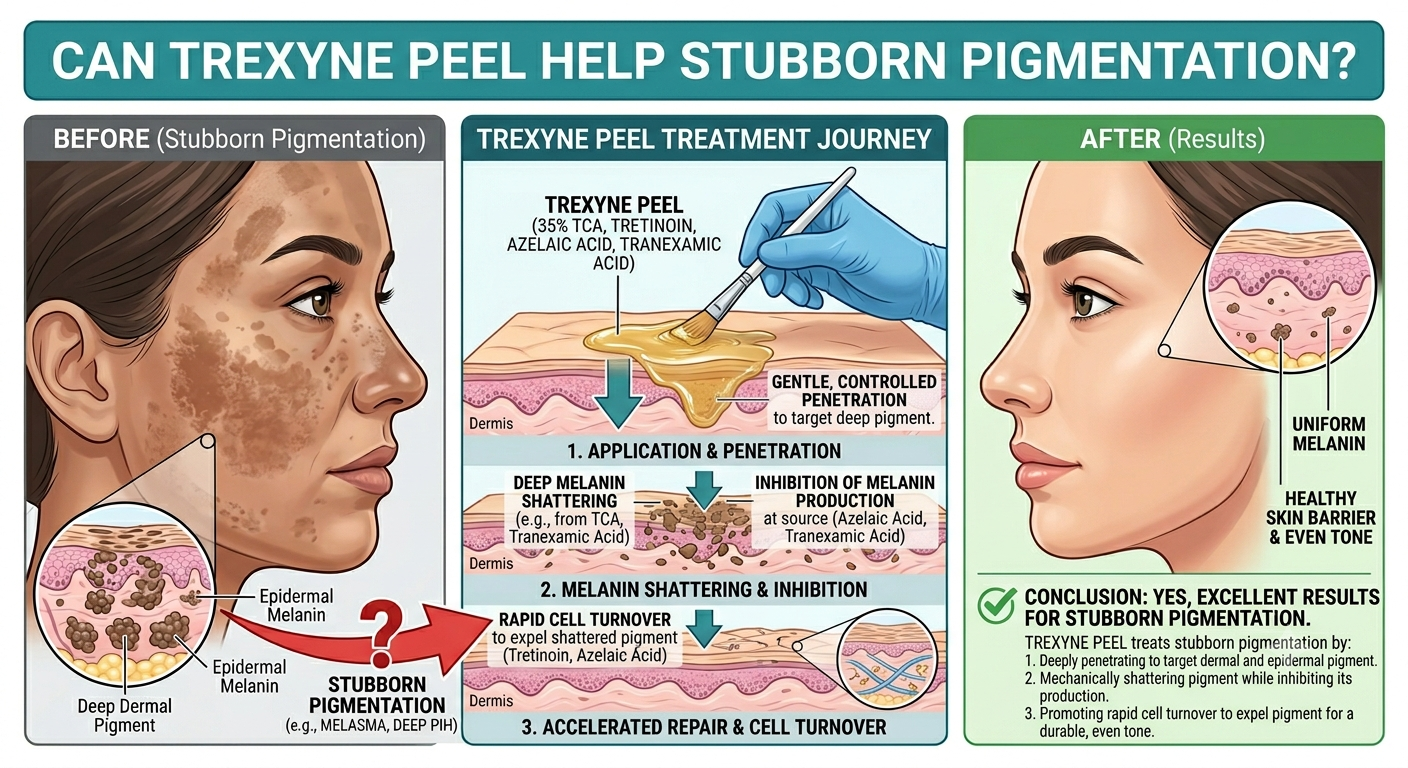
Can Trexyne Peel Help Stubborn Pigmentation?
Stubborn pigmentation is one of the most demoralizing skin concerns to deal with. You try the serums, you apply the SPF, you wait patiently, and the dark spots barely move. After months of effort with no meaningful change, it is natural to wonder whether anything will actually work. The answer, in most cases, is yes, but not everything works equally well, and not everything works at the same depth. The Trexyne Peel is a professionally applied chemical peel specifically designed for situations where topical products have reached their limit. It operates at a structural level, removing the layers of skin where stubborn pigmentation is stored and stimulating the skin’s renewal process in a way that serums and creams simply cannot replicate. This article explains what makes pigmentation stubborn, why it resists topical treatment, and how Trexyne Peel addresses it where other approaches have failed.
What Makes Pigmentation Stubborn?
Not all pigmentation is equally difficult to treat. A fresh post-acne mark sitting on the skin’s surface may fade with a good topical routine over a few months. What most people mean by stubborn pigmentation is the kind that has been present for a long time, that has settled deeper into the skin, or that is being continuously replenished by an ongoing trigger.
Several specific characteristics make pigmentation resistant to standard treatment.
Depth of the Melanin Deposits
Melanin accumulates across multiple layers of the epidermis. The deeper it has settled, the harder it is to reach with surface-acting products. Over-the-counter serums, however well formulated, deliver their active ingredients to the outermost skin layer. If the bulk of the pigmentation sits in the mid or lower epidermis, these products are not reaching the problem. This is the single most common reason why topical brightening routines produce minimal results for established discoloration.
Duration of the Pigmentation
Pigmentation that has been present for years has had time to consolidate and deepen. The longer melanin has been accumulating in an area, the more it becomes embedded in multiple cell layers rather than sitting primarily on the surface. Fresh marks respond more quickly to any intervention. Marks that have been present since a breakout two years ago or a holiday five years ago present a more significant challenge.
Ongoing Trigger
If the cause of the pigmentation is still active, new melanin production is continuously replenishing the discoloration faster than the skin can clear it. This is the defining challenge of melasma, where ongoing hormonal activity and daily UV exposure work together to keep melanin levels elevated in the affected areas. Treating the visible result without addressing the underlying trigger produces improvement that is temporary at best.
Slow Cell Turnover
In aging skin, the cycle through which pigmented surface cells are shed and replaced slows significantly. A renewal cycle that takes four to six weeks in younger skin may take eight to twelve weeks or longer in older skin. This means melanin-rich cells stay on the surface far longer, making the pigmentation look more fixed and darker than it would in faster-turning skin.
Why Topical Products Cannot Shift Stubborn Pigmentation
This is an important point, because many people interpret a lack of results from serums as evidence that their pigmentation cannot be treated. In most cases, the problem is not that the pigmentation is untreatable. The problem is that topical products are designed for a different level of intervention.
Over-the-counter brightening ingredients, including vitamin C, niacinamide, alpha arbutin, and azelaic acid, work by interfering with melanin production at the synthesis or transfer stage. They slow the rate at which new melanin is produced, which is genuinely useful for prevention and mild recent pigmentation. What they cannot do is physically remove the melanin that has already accumulated in the mid and lower epidermis after months or years of overproduction.
The concentration limits imposed on over-the-counter formulations for safety in unsupervised use also mean that even good products cannot reach the activity levels needed to make a meaningful dent in established discoloration. The gap between what these products can deliver and what established stubborn pigmentation requires is the reason so many people feel their skin has hit a wall.
How Trexyne Peel Works on Stubborn Pigmentation
The Trexyne Peel takes a completely different approach. Rather than trying to slow melanin production from the surface, it removes the layers of skin where the melanin is stored. This is a structural intervention, and it is what allows it to address discoloration that topical products have not been able to shift.
When the professionally formulated peel solution is applied to the skin by a trained practitioner, it dissolves the bonds between cells in the outermost epidermis, triggering controlled shedding of the surface layer. As these pigmented cells are cleared, the skin beneath, which has not accumulated the same level of discoloration, becomes visible. At the same time, the exfoliation signals the deeper layers to accelerate the production of new cells, shortening the renewal cycle and bringing fresh skin to the surface faster than natural turnover allows.
For stubborn pigmentation that has been building for years, this process does not clear everything in one session. But each session removes another layer, reduces the concentration of melanin in the treated area, and gives the skin a cleaner baseline to build from. Over a properly structured series, the cumulative improvement is meaningful and measurable, even for pigmentation that has resisted every product the patient has previously tried.
Which Types of Stubborn Pigmentation Respond to Trexyne Peel?
Long-Standing Post-Inflammatory Marks
Dark marks from acne that have been present for more than six months are among the most common types of stubborn pigmentation. By this point, the melanin has had time to settle across multiple skin layers, and topical products produce only marginal improvement. Trexyne Peel addresses these marks by removing the layers where the pigment is concentrated and accelerating the replacement cycle. Even marks that have been present for a year or two typically respond to a properly structured peel series.
Established Sunspots
UV-induced sunspots that have been accumulating for years are deeply embedded compared to fresh pigmentation. They do not fade with reduced sun exposure alone and require active removal of the cells where the melanin sits. Chemical exfoliation is one of the most direct and effective approaches for this type of pigmentation, and Trexyne Peel’s professionally calibrated formulation allows it to reach the depth needed for visible improvement.
Persistent Melasma
Melasma is the most challenging type of stubborn pigmentation because its triggers are ongoing. However, Trexyne Peel can still produce meaningful reduction in its visible appearance, particularly for the surface component that sits in the upper and mid epidermis. The treatment must be approached conservatively and combined with rigorous sun protection and, ideally, hormonal management. Used correctly, it is one of the more effective professional options available for melasma.
Diffuse Uneven Tone From Sun Damage
General unevenness across the face from years of UV exposure, without defined individual spots, is another form of stubborn pigmentation that responds to professional peeling. Topical products may improve the overall brightness modestly, but the underlying uneven melanin distribution requires more direct intervention. A Trexyne Peel series removes the layers of accumulated discoloration and produces a more consistent and even surface that topical products can then help maintain.
What a Realistic Treatment Plan Looks Like
Addressing stubborn pigmentation with Trexyne Peel is a process rather than a single event. A realistic treatment plan for established or persistent discoloration typically involves the following elements.
Initial consultation: A thorough skin assessment to identify the type and depth of pigmentation, assess skin type and tone, review relevant medical history, and design the treatment protocol.
Pre-treatment preparation: For patients with darker skin tones or reactive skin, a preparatory phase using topical ingredients to normalize melanocyte activity before the first peel session reduces the risk of post-treatment inflammation.
Treatment series: A structured series of sessions spaced three to four weeks apart, typically between four and eight sessions depending on the severity of the pigmentation and the skin’s response. Each session builds on the last.
Aftercare: Consistent daily SPF, gentle skincare during the recovery phase after each session, and avoidance of additional triggers between appointments.
Maintenance: Periodic sessions after the initial series to sustain the improvement and prevent new accumulation. For stubborn pigmentation with ongoing triggers, this phase is especially important.
Managing Expectations for Stubborn Pigmentation
Honesty about expectations is important. Stubborn pigmentation, by definition, is the kind that has resisted previous treatment and has had time to become established. A single peel session will not clear it entirely, and even a full series may not produce complete elimination in every case.
What Trexyne Peel consistently delivers is meaningful and visible improvement. Dark spots become lighter and less defined. Uneven tone becomes more consistent. The skin takes on a cleaner, more refreshed appearance. For many patients, the improvement after a professionally guided series exceeds anything they had achieved in years of topical treatment.
The combination of a professional pigmentation treatment series, daily sun protection, and a targeted home routine gives stubborn pigmentation the multi-pronged approach it requires. Managing expectations realistically means understanding that results take several sessions to build, but that the trajectory is one of progressive and meaningful improvement rather than the stagnation that topical-only approaches often produce.
The Critical Importance of Sun Protection for Stubborn Pigmentation
There is one habit that determines more than any other whether the results of a Trexyne Peel series are sustained or reversed: daily sun protection. For stubborn pigmentation, where melanocytes are already sensitized to UV stimulation, even routine daily exposure without SPF will continuously replenish the discoloration that the peel series is working to clear.
Patients who are disciplined about applying broad-spectrum SPF 30 or higher every morning find that their improvement holds and continues to develop between sessions. Those who are inconsistent find that each session’s results are partially offset by new pigmentation forming in the interim. Sun protection is not a supporting element of the treatment. It is a core component without which the full potential of the peel series cannot be realized.
Conclusion
Stubborn pigmentation feels permanent because the approaches most people use first, topical serums and brightening creams, are not designed to reach the depth at which established discoloration sits. They slow new melanin production but cannot remove the melanin that has already accumulated across multiple skin layers after months or years of overproduction.
The advanced skin peel solutions offered through Trexyne Peel address this gap directly. By removing the layers of skin where stubborn pigmentation is stored and stimulating faster renewal of fresh cells, they deliver the structural intervention that topical products cannot provide. For patients who have tried everything and feel their skin has stopped responding, a professionally guided Trexyne Peel series represents not just another option but a fundamentally different level of treatment, one that matches what their specific pigmentation actually requires.
Frequently Asked Questions
1. Can Trexyne Peel really help pigmentation that nothing else has shifted?
Yes, in most cases. The reason topical products fail to shift stubborn pigmentation is that they cannot reach the depth where established melanin is stored. Trexyne Peel works by physically removing the skin layers where this pigmentation sits, which is a fundamentally different approach. Even pigmentation that has resisted years of serum use typically shows visible improvement across a structured professional peel series, because the treatment is finally addressing the problem at the level it requires.
2. How many sessions of Trexyne Peel does stubborn pigmentation need?
Stubborn pigmentation generally requires more sessions than mild or recent discoloration. A typical initial series for established dark spots or long-standing post-acne marks involves five to seven sessions or more, spaced three to four weeks apart. Melasma and diffuse UV damage may require additional sessions. Your practitioner will assess your specific skin and design a series length matched to the depth and type of your pigmentation.
3. What makes melasma so stubborn and can Trexyne Peel help?
Melasma is stubborn because it is driven by ongoing hormonal activity and UV exposure, meaning the triggers that produce it are often continuously present. It also tends to affect deeper skin layers than other pigmentation types. Trexyne Peel can meaningfully reduce the visible appearance of melasma, particularly its surface component, but it works best as part of a broader plan that includes strict sun protection and hormonal management where applicable. Melasma requires ongoing maintenance rather than a one-time cure.
4. Will Trexyne Peel clear all of my stubborn pigmentation?
For most patients, a complete treatment series produces significant and visible improvement, but complete elimination is not guaranteed for all pigmentation types. Very deep dermal pigmentation or long-standing melasma with an active hormonal driver may show partial rather than complete clearing. What patients consistently achieve is meaningful reduction in the darkness and definition of their spots, a more even overall tone, and a visible improvement that exceeds what they experienced with topical products alone.
5. Can I speed up results from Trexyne Peel for stubborn pigmentation?
The most effective ways to accelerate results are consistent daily sun protection and strict aftercare following each session. These two habits protect each session’s work from being partially offset by new pigmentation and allow the skin to renew itself as cleanly as possible between appointments. Shortening the time between sessions is generally not advisable, as the skin needs adequate recovery time. Your practitioner may also recommend supporting topical ingredients between sessions to complement the peel’s effect.
6. Is Trexyne Peel suitable for stubborn pigmentation on darker skin tones?
Yes, when administered by a practitioner with specific expertise in treating diverse complexions. Stubborn pigmentation is particularly common in darker skin tones, where melanocytes are more reactive and post-inflammatory marks are more pronounced. The treatment requires a conservative, carefully calibrated approach to minimize the risk of additional post-inflammatory hyperpigmentation, but the results are achievable. A thorough consultation and pre-treatment preparation are especially important for patients with types IV through VI skin.
7. How do I maintain results after treating stubborn pigmentation with Trexyne Peel?
Maintaining results after treating stubborn pigmentation requires consistent daily broad-spectrum sunscreen, a targeted home skincare routine that includes ingredients that slow melanin production such as vitamin C and niacinamide, and periodic maintenance peel sessions to prevent significant new accumulation. For pigmentation with ongoing triggers like melasma, managing the hormonal driver is also part of the long-term strategy. Patients who commit to these habits find their results are durable and continue to improve over time.