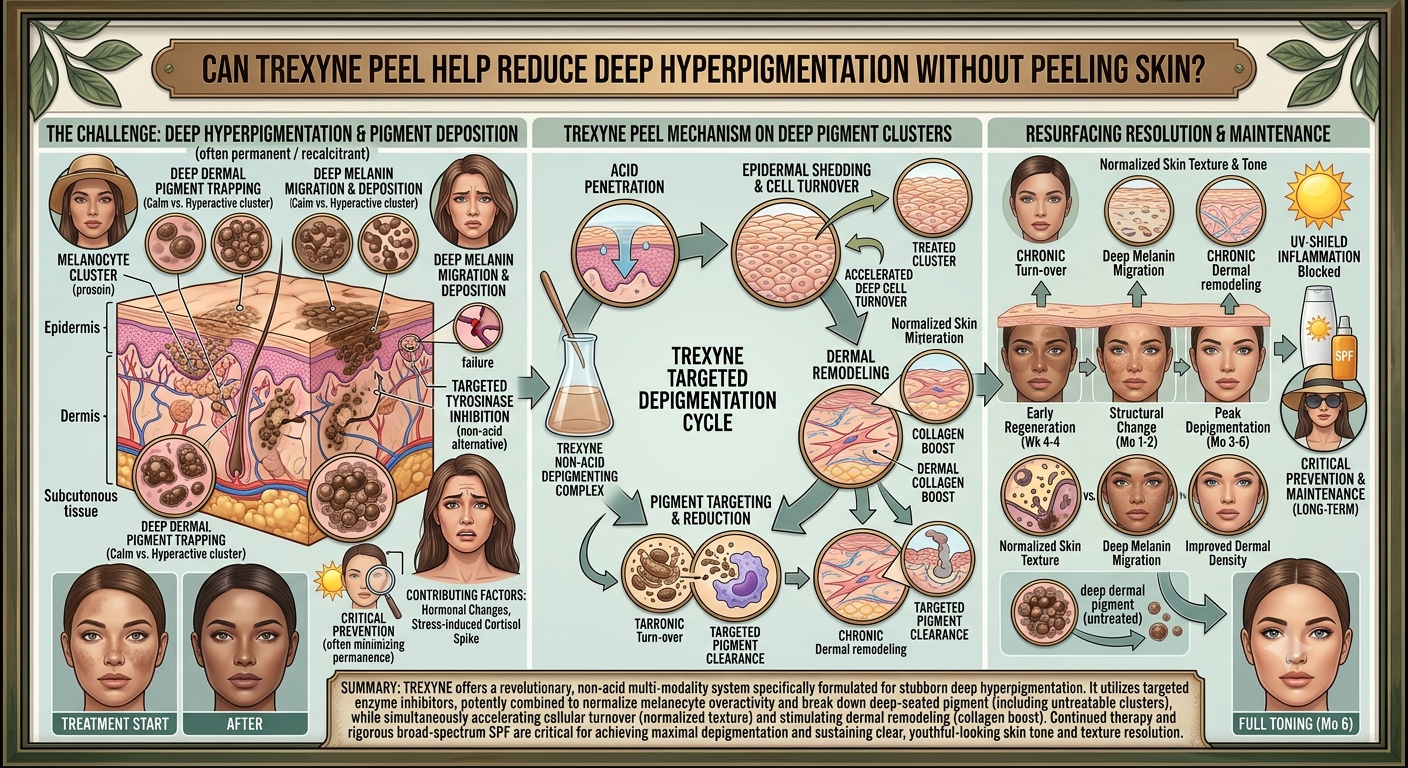
Can Trexyne Peel Help Reduce Deep Hyperpigmentation Without Peeling Skin
Yes, the Trexyne Peel can support visible improvement in hyperpigmentation without the obvious surface peeling that many clients associate with traditional resurfacing treatments. Because it works through a mechanical mechanism using marine algae spicules rather than chemical exfoliants, the skin’s response is generally more controlled and less dramatic in appearance, even while cell renewal is being actively stimulated beneath the surface. This is a common point of confusion for clients who assume visible flaking or peeling is a sign that a treatment is working. For practitioners explaining this distinction, the Trexyne Peel — Professional Algae Resurfacing Treatment offers a useful case study in how resurfacing can support skin renewal without relying on visible peeling as the marker of efficacy.
Why Clients Associate Peeling With Effective Treatment
There is a widespread assumption, often shaped by experience with stronger chemical resurfacing treatments, that visible peeling equals visible results. Clients sometimes arrive expecting flaking skin and judge a treatment’s success by how dramatically their skin sheds in the days following.
This assumption is worth addressing directly during consultation, because it shapes expectations and can affect how clients perceive a treatment that works differently. Visible peeling is a sign of significant surface disruption, not necessarily a marker of deeper or more effective cell renewal. Some of the most clinically meaningful resurfacing happens at a level the eye cannot fully observe, through accelerated cell turnover that does not always manifest as obvious shedding.
What “Deep Hyperpigmentation” Actually Means
Before addressing how treatment can help, it is worth clarifying what is meant by deep hyperpigmentation, since the term gets used loosely and the depth of pigmentation significantly affects how it responds to any resurfacing approach.
Epidermal vs. Dermal Depth
Pigmentation that sits within the epidermis, the outer layer of skin, is generally more accessible to surface-level resurfacing treatments. Pigmentation that has migrated into the dermis, the deeper layer beneath, is more resistant to surface treatment because the affected cells are further from where resurfacing creates its direct effect.
Many cases described by clients as “deep” pigmentation are actually well-established epidermal pigmentation that has simply been present for a long time and appears stubborn, rather than pigmentation that is dermal in nature. True dermal pigmentation is less common and tends to respond more slowly to any treatment approach, including resurfacing.
Why This Distinction Matters for Treatment Planning
Identifying the likely depth during consultation helps set realistic expectations. Established epidermal pigmentation, even when long-standing, can often show meaningful improvement with a structured resurfacing course. Pigmentation with a dermal component may show more gradual change and typically benefits from a longer-term management approach combined with consistent professional treatment.
How the Trexyne Peel Works on Hyperpigmentation Without Visible Peeling
The Trexyne Peel resurfaces the skin through a botanical, mechanical mechanism using marine algae spicules. These microscopic structures create controlled micro-channels across the skin surface when applied by a trained practitioner, stimulating the skin’s renewal response.
The Mechanism Behind a Controlled Response
Unlike chemical exfoliants that break down the bonds between skin cells through chemical reaction, often producing visible surface disruption and shedding as a direct part of the process, the spicules work through fine, precise physical contact. The renewal signal sent to the skin is mechanical rather than chemical, which generally produces a more measured visible response at the surface while still triggering the underlying cell turnover process that supports pigmentation improvement.
This means clients can experience the benefits of accelerated cell renewal, including the progressive shedding of pigmented surface cells over the course of treatment, without the dramatic visible flaking that some chemical approaches produce. The renewal is happening; it is simply less visually obvious in the days immediately following treatment.
Predictable Downtime by Design
The Trexyne Peel is specifically designed around predictable downtime. This is a deliberate feature of the formulation and mechanism, not an incidental side effect. For clients who cannot accommodate visible peeling or extended recovery time, whether due to work commitments or simply personal preference, this predictability is a significant practical advantage.
Stabilised Vitamin E and the Recovery Process
The Trexyne Peel formulation includes stabilised tocopherol, a form of Vitamin E that may support the skin’s recovery phase from the first application. This supports the skin through the renewal process initiated by the marine spicules, helping maintain skin integrity without requiring the kind of visible surface disruption that some clients have come to associate with active treatment.
For clients with hyperpigmentation, supporting the skin’s recovery is particularly relevant. Skin that is recovering well tends to respond more consistently to subsequent treatments within a course, which supports steadier cumulative improvement over time.
Why a Mechanical Mechanism May Suit Deep or Stubborn Hyperpigmentation
For clients with long-standing or stubborn hyperpigmentation, particularly those who have tried other approaches without success, the mechanical mechanism of the Trexyne Peel offers a specific clinical advantage worth understanding.
Reduced Risk of Compounding Inflammation
Pigmentation that has proven resistant to previous treatment is sometimes the result of an inflammatory cycle that has been inadvertently perpetuated by treatments that introduced additional inflammatory stimulus. Chemical exfoliation, by its nature, triggers an inflammatory response as part of how it works. In skin that is already prone to hyperpigmentation, this inflammatory signal can stimulate further melanocyte activity, working against the goal of the treatment.
The mechanical action of the Trexyne Peel avoids this specific chemical inflammatory pathway. This may make it a more suitable option for clients whose pigmentation has not responded well to chemical approaches, or who have experienced their pigmentation worsening after previous treatments.
Consistency Across a Treatment Course
Because the mechanism is predictable and the protocol is tiered, practitioners can apply consistent, controlled stimulus across multiple sessions without the variability that can sometimes occur with chemical formulations reacting differently to skin in different conditions. This consistency supports steady, cumulative improvement, which is particularly valuable for hyperpigmentation that has proven resistant to less consistent approaches.
The Tiered Protocol: Calibrating Intensity for Stubborn Pigmentation
The Trexyne Peel’s tiered protocol allows practitioners to match treatment intensity to the client’s skin type, pigmentation history, and tolerance. For deep or long-standing hyperpigmentation, this calibration is particularly important.
Starting Point Assessment
A thorough consultation should establish the likely depth and cause of the pigmentation, the client’s previous treatment history, and their skin’s general reactivity. This informs the starting intensity for the first session, which is typically conservative, particularly for clients with no prior experience of mechanical resurfacing or those with a history of reactive skin.
Progressive Calibration
As the course progresses and the practitioner observes how the skin responds, intensity can be increased incrementally. This progressive approach allows for more assertive treatment of stubborn pigmentation over time, without the risk of overwhelming the skin’s capacity to recover, which the absence of visible peeling actually supports, since the skin is not contending with the same level of surface disruption between sessions.
Setting Realistic Expectations for Deep Hyperpigmentation
Honest expectation-setting is essential when discussing deep or long-standing hyperpigmentation with clients, particularly those who may be hoping for rapid, dramatic visible change.
Visible Improvement vs. Visible Peeling
It is worth explaining clearly to clients that the absence of visible peeling does not mean the treatment is not working. Improvement from the Trexyne Peel tends to build progressively across a course, becoming visible as a gradual evening of skin tone rather than a single dramatic shedding event. This is a different experience to what some clients may expect, and framing it accurately from the outset prevents disappointment.
Timeframes for Deep Pigmentation
Pigmentation that has been present for years, or that has a likely dermal component, typically requires a longer course and more patience than recently developed surface pigmentation. Setting this expectation early helps clients commit to the full programme rather than judging results prematurely after one or two sessions.
Building a Course for Deep Hyperpigmentation
A structured course is particularly important for deep or stubborn hyperpigmentation, where cumulative treatment over time produces more reliable results than any single session.
Practitioners can review the available pack options for the Trexyne Peel via the Trexyne shop. Course packs of 10 and 20 treatments suit clients requiring a sustained programme, while a single vial allows for an initial assessment session before committing to a longer course. Each 30ml vial provides approximately 6 to 8 full-face treatments, supporting consistent course planning across multiple clients.
Appropriate spacing between sessions allows the skin to complete its renewal cycle before the next treatment, which supports steady progress without overwhelming the skin’s recovery capacity.
Supporting Factors Alongside Treatment
While the Trexyne Peel addresses the active resurfacing component of a hyperpigmentation programme, supporting factors remain essential to achieving and maintaining results, particularly for deep or stubborn pigmentation.
Consistent SPF use is non-negotiable. UV exposure can continue to stimulate melanocyte activity throughout a treatment course, working against the progress being made. Daily broad-spectrum SPF 30 minimum, rising to SPF 50 in higher exposure conditions, supports the resurfacing work being done in clinic.
A simplified, practitioner-guided home skincare routine can support recovery between sessions without introducing additional irritation. Clients should be guided away from harsh physical exfoliants or aggressive active ingredient combinations that could compound inflammation in skin that is already prone to hyperpigmentation.
For practitioners wanting to discuss specific cases of deep or treatment-resistant hyperpigmentation, the Trexyne team is available via the contact page.
Why Professional Application Matters Even More for Difficult Cases
Deep or stubborn hyperpigmentation requires more nuanced clinical judgement than straightforward surface pigmentation. Assessing likely depth, reviewing previous treatment history, identifying contributing factors that may have perpetuated the pigmentation, and calibrating the tiered protocol appropriately are all skills that sit within professional scope.
This is why the Trexyne Peel is designed for use exclusively by trained aesthetic professionals. The treatment’s value for difficult or long-standing cases depends significantly on the practitioner’s ability to assess and adapt the approach throughout the course, rather than applying a fixed protocol regardless of how the individual case presents.
More information about the Trexyne Peel and its suitability for different pigmentation presentations is available at Trexyne.com.
Conclusion
The Trexyne Peel can support meaningful improvement in hyperpigmentation, including more stubborn or long-standing presentations, without relying on visible surface peeling as a marker of effectiveness. Its mechanical mechanism, using marine algae spicules to create controlled micro-channels, stimulates cell renewal in a way that tends to produce a more measured visible response than chemical resurfacing approaches, while still supporting the progressive shedding of pigmented surface cells over a structured course.
Its stabilised Vitamin E may support the skin’s recovery phase, helping maintain consistent progress across multiple sessions, and its tiered protocol allows intensity to be calibrated carefully for deep or treatment-resistant pigmentation. Combined with consistent SPF use and a structured course tailored to the individual presentation, the Trexyne Peel may help clients achieve a progressively brighter, more even-looking complexion, even where pigmentation has proven difficult to address with other approaches.
Frequently Asked Questions
Q: Does the Trexyne Peel cause visible skin peeling after treatment?
The Trexyne Peel is designed around predictable downtime and does not rely on visible surface peeling as part of how it works. Its mechanical mechanism, using marine algae spicules, stimulates cell renewal through controlled physical action rather than the chemical reaction that drives visible flaking in some traditional peels. Clients can expect a more measured visible response while the underlying renewal process continues to support improvement in skin tone.
Q: Can deep or long-standing hyperpigmentation actually improve without visible peeling?
Yes. Visible peeling is not a reliable indicator of treatment effectiveness. Cell renewal and the progressive shedding of pigmented surface cells can occur without dramatic visible flaking, particularly with a mechanical resurfacing mechanism like the one used in the Trexyne Peel. Deep or long-standing pigmentation typically requires a structured course over time, with improvement building gradually rather than appearing as a single dramatic change.
Q: Why does the Trexyne Peel produce less visible peeling than other resurfacing treatments?
The Trexyne Peel uses marine algae spicules to create controlled micro-channels through a purely mechanical mechanism, rather than relying on chemical exfoliants that break down cellular bonds and often produce more visible surface disruption. This mechanical approach tends to stimulate skin renewal with a more measured surface response, which is a deliberate feature of how the treatment is formulated to deliver predictable downtime.
Q: Is the Trexyne Peel suitable for hyperpigmentation that has not responded to other treatments?
The Trexyne Peel’s mechanical mechanism may be particularly relevant for hyperpigmentation that has proven resistant to chemical approaches, since it avoids the additional inflammatory stimulus that chemical exfoliation can introduce. For some clients, this inflammatory stimulus may have inadvertently perpetuated their pigmentation in previous treatments. A thorough consultation reviewing prior treatment history helps determine whether this approach suits an individual case.
Q: How long does it take to see results from the Trexyne Peel on deep hyperpigmentation?
Results build progressively across a structured treatment course rather than appearing after a single session. Deep or long-standing pigmentation, particularly where a dermal component may be present, typically requires a longer course and more patience than recently developed surface pigmentation. Consistent SPF use and adherence to the full recommended course support more reliable and lasting improvement.
Q: Will my skin look red or irritated after a Trexyne Peel session?
The level of visible response after treatment depends on the intensity selected, which is calibrated to each client’s skin type and tolerance through the tiered protocol. The Trexyne Peel is designed for predictable downtime, and any visible response is generally more measured compared to chemical resurfacing approaches. Practitioners can adjust intensity at each session based on how the client’s skin has responded previously.
Q: Where can I find a practitioner who offers the Trexyne Peel for hyperpigmentation?
The Trexyne Peel is sold exclusively to verified practitioners and clinics and is not available for home use. Practitioners can view pricing and pack options, including single vials and course packs of 10 or 20 treatments, via the Trexyne shop. For further clinical information or to discuss treatment planning for hyperpigmentation, the Trexyne team can be contacted through the contact page.