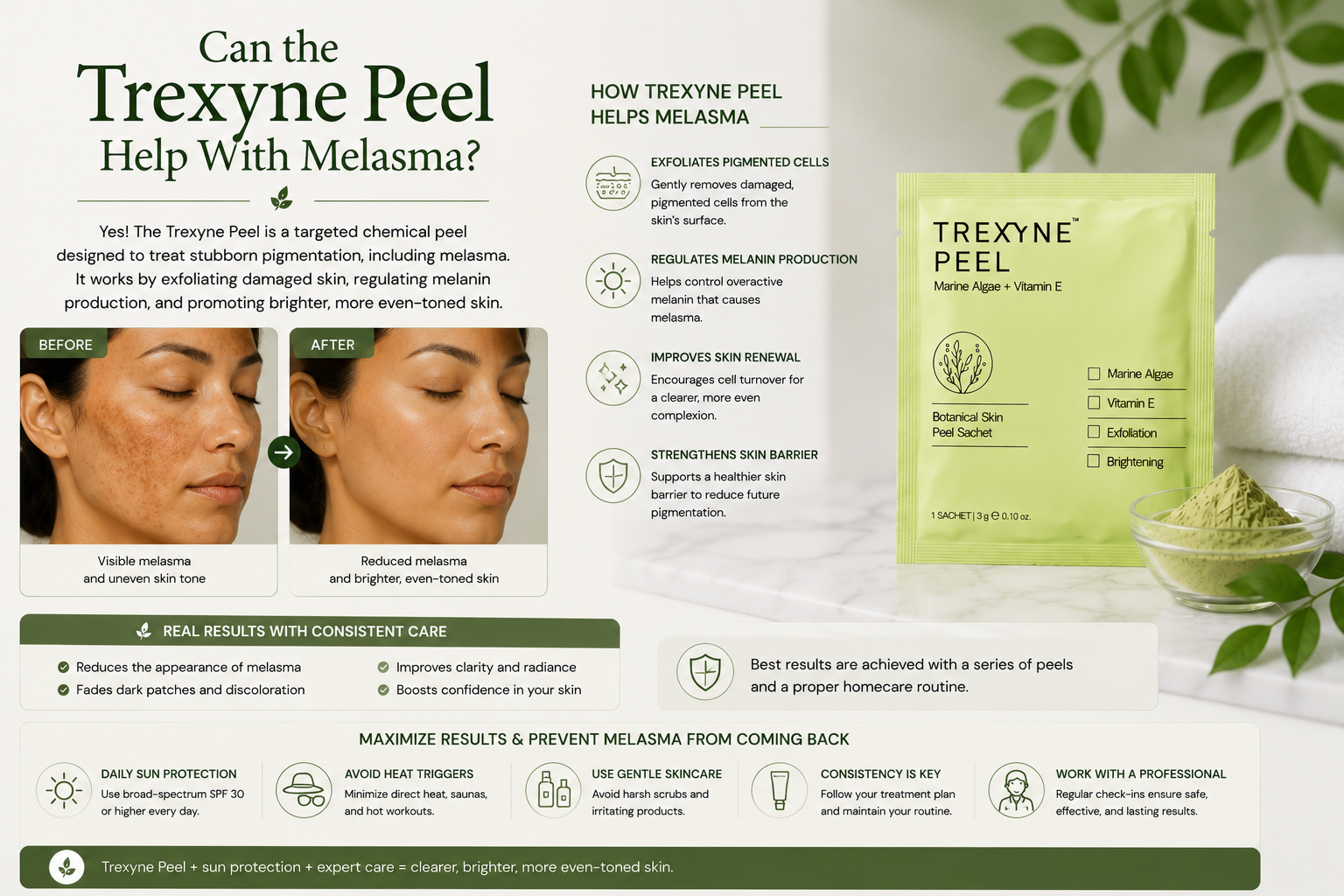
Can the Trexyne Peel Help With Melasma?
The Trexyne Peel can form part of a professional protocol for managing melasma, but it is important to approach this with the right clinical framing from the outset. Melasma is one of the more complex pigmentation concerns a practitioner will encounter, and no resurfacing treatment addresses it in the same way it addresses age spots or post-inflammatory hyperpigmentation. What the Trexyne Peel can offer is a mechanical resurfacing mechanism that avoids the chemical inflammatory trigger most likely to worsen melasma, combined with a tiered protocol that allows conservative, carefully managed progression across a treatment course. For practitioners and clients with realistic expectations and a clear understanding of what this condition requires, the Trexyne Peel may support visible improvement in epidermal melasma as part of a broader management approach that includes rigorous daily sun protection and, where applicable, appropriate medical oversight of the underlying hormonal factors.
Why Melasma Is Particularly Challenging to Treat
Melasma presents treatment challenges that other pigmentation types do not. The condition is driven by a combination of hormonal activity and UV exposure that sensitises melanocytes to overproduce pigment. Unlike age spots, which are caused by historical UV damage that can be substantially managed with consistent sun protection, melasma involves melanocytes that may remain actively stimulated throughout a treatment course.
This means that while resurfacing can progressively displace pigmented cells and support a more even skin tone, the underlying signal driving pigment production may not have been switched off. Progress can therefore be slower and less linear than with other pigmentation types, and results achieved can be partially undermined by ongoing UV exposure or hormonal activity between sessions if these are not actively managed.
Melasma can also involve pigment sitting in both the epidermal and dermal layers of the skin. Epidermal melasma, where pigment sits within the upper layers accessible to resurfacing, responds better to topical and resurfacing approaches than dermal melasma, where pigment has deposited deeper and is largely beyond the reach of surface-level intervention. Mixed presentations, involving both layers, produce partial responses to resurfacing that can be frustrating for clients who expect uniform improvement across the treatment area.
Practitioners who explain this clinical reality at consultation, before any sessions are booked, protect the client relationship and ensure the treatment plan is built on accurate expectations.
Why Mechanism Matters More for Melasma Than for Other Pigmentation
For age spots and most forms of post-inflammatory hyperpigmentation, the resurfacing mechanism matters primarily in terms of its risk profile for different skin types. For melasma, the mechanism becomes the central clinical decision because certain approaches actively risk worsening the condition rather than improving it.
Chemical resurfacing treatments generate an inflammatory response in the skin as part of their mechanism. In melasma-prone skin, this inflammatory trigger can restimulate melanocyte activity in exactly the areas being treated, producing new pigment as fast as or faster than the resurfacing is removing it. This phenomenon, sometimes described as a rebound response, is one of the reasons melasma has historically been difficult to manage with aggressive chemical resurfacing approaches.
A mechanical resurfacing mechanism, which stimulates cell turnover through physical action rather than chemical reaction, removes this specific inflammatory trigger from the equation. The skin still undergoes resurfacing and the renewal process is still stimulated, but without the chemical inflammatory cascade that can provoke melanocyte overproduction in hormonally sensitive skin.
This is the clinical basis for using the Trexyne Peel as a more considered option for melasma than acid-based alternatives. It is not that the Trexyne Peel cures melasma. It is that its mechanism avoids the rebound risk that makes chemical resurfacing so unpredictable for this specific condition.
How Vitamin E Supports the Melasma Treatment Protocol
The recovery phase following each resurfacing session is a period of heightened vulnerability for melasma-prone skin. Any residual inflammation during recovery can act as an additional trigger for melanin production in skin where melanocytes are already sensitised. A formulation that actively supports recovery rather than leaving it entirely to the skin’s own processes is therefore particularly relevant for this client group.
The Trexyne Peel includes stabilised tocopherol, a form of Vitamin E, which supports the skin’s recovery from the first application. By helping the skin move through the post-treatment repair phase more efficiently and with less residual inflammatory activity, this recovery support reduces the window during which unmanaged inflammation could trigger further melanin production in treated areas.
For practitioners building a melasma protocol, this recovery-supportive component of the formulation works alongside clinical aftercare guidance to minimise the inflammatory burden during each inter-session period.
Structuring a Trexyne Peel Protocol for Melasma
A melasma protocol built around the Trexyne Peel requires a more conservative and carefully graduated approach than a protocol for age spots or general pigmentation. The following principles guide a responsible clinical approach.
Begin at the lowest appropriate intensity within the tiered protocol and assess the skin’s response carefully at the first follow-up before progressing. Melasma skin that responds to the first session without sign of inflammatory reactivation of pigmentation gives the practitioner confidence to progress. Any sign of darkening or apparent worsening of the melasma pattern in the week following treatment should prompt a review of intensity and spacing before the next session.
Space sessions at the standard three to four week interval to give the skin sufficient time to complete its renewal cycle between treatments. For melasma clients, erring towards the longer end of this range, particularly in the early stages of the course, is a sensible default.
Make daily broad-spectrum SPF an absolute condition of the treatment course rather than a recommendation. UV exposure is the primary environmental amplifier of melasma activity, and a client who is not protecting their skin consistently between sessions is working against every session’s contribution to the overall result.
Assess whether any active hormonal factors are contributing to the melasma before and during the course. Hormonal contraception, pregnancy-related hormonal changes, or thyroid issues can all sustain or worsen melasma during treatment. Where appropriate, encourage the client to discuss these factors with their prescribing doctor alongside the aesthetic treatment.
What Realistic Progress Looks Like for Melasma Clients
Setting appropriate expectations for melasma clients is one of the most important parts of the consultation process. Clients who arrive expecting the same speed of visible improvement they might see for age spots or dullness are likely to feel disappointed by the more gradual and sometimes inconsistent progress that melasma produces.
Realistic progress for epidermal melasma over a well-managed treatment course typically involves a gradual, noticeable lightening of the affected patches over multiple sessions, with the most visible improvement becoming apparent when comparing photographs from the start and several sessions into the course rather than observing day-to-day changes. Some sessions may produce less visible progress than others, particularly if UV exposure or hormonal fluctuation has been higher during that inter-session period.
Clients should understand that the goal of treatment is management and visible improvement rather than permanent cure. Even after a successful course, melasma can return with renewed UV exposure or hormonal changes. Maintenance sessions and ongoing sun protection are the long-term tools for sustaining improvement rather than a single course delivering a permanent result.
Practitioners who communicate this honestly and compassionately at the outset, and then deliver consistent, well-managed sessions, tend to produce the best long-term client outcomes for this concern.
The Critical Role of Daily SPF in a Melasma Protocol
For any pigmentation concern, daily sun protection is important. For melasma, it is the single most influential factor in whether a professional treatment course produces and sustains visible results.
Without consistent daily SPF use, every session of resurfacing is partially countered by the ongoing UV stimulus that drives melanocyte overproduction in melasma skin. The net effect can be that results appear to plateau or regress between sessions, leaving both the client and the practitioner frustrated with apparent slow progress that is actually the result of inadequate sun protection rather than insufficient treatment.
A broad-spectrum formulation protecting against both UVA and UVB, applied every morning as the final step before any colour cosmetics, and reapplied during extended outdoor exposure, is the minimum requirement. Clients with significant outdoor UV exposure during their treatment course may need to combine topical SPF with additional physical protection to achieve adequate sun defence.
Practitioners interested in incorporating the Trexyne Peel into a structured melasma protocol can explore the full product range through the Trexyne shop or reach the team directly through the Trexyne contact page.
When to Consider Referring a Melasma Client
Not every melasma presentation is appropriate for management within the aesthetic clinic setting without additional medical input. Dermal melasma, where pigment sits in the deeper dermal layer beyond the reach of epidermal resurfacing, requires dermatological assessment and potentially different management approaches. A Wood’s lamp examination or dermatoscopy can help identify the depth of pigmentation and inform whether resurfacing is likely to produce meaningful improvement.
Clients with extensive, treatment-resistant melasma who have completed multiple courses without meaningful improvement should be referred for dermatological review before further aesthetic treatment is considered. There may be medical management options, including prescription topicals or systemic approaches to the hormonal trigger, that are more appropriate for these cases.
Clients who are currently pregnant should not receive any resurfacing treatment, regardless of mechanism, until after delivery and the end of breastfeeding if applicable. Melasma management in the context of active pregnancy is limited to rigorous sun protection and gentle home care.
More information on the Trexyne approach to professional botanical resurfacing is available on the Trexyne website.
Conclusion
The Trexyne Peel can contribute to the management of epidermal melasma by providing mechanical resurfacing that stimulates cell turnover without the chemical inflammatory trigger most likely to worsen the condition. Stabilised Vitamin E supports recovery between sessions, and the tiered protocol allows conservative, carefully managed progression suited to the sensitivity of melasma-prone skin. Results build gradually rather than dramatically, and sustained improvement depends on consistent daily SPF use, appropriate session spacing, and honest expectation-setting from the outset. The Trexyne Peel is not a cure for melasma, but for clients with epidermal or mixed melasma whose skin is ready for professional resurfacing, it offers a more clinically appropriate mechanism than acid-based alternatives. Used as part of a thoughtful, well-managed protocol, it may support visible improvement in melasma and contribute to a more even-looking complexion over the course of a sustained professional treatment plan.
FAQs
Q: Can the Trexyne Peel help with melasma?
The Trexyne Peel can form part of a professional management protocol for epidermal melasma. Its mechanical resurfacing mechanism avoids the chemical inflammatory trigger most likely to worsen melasma, and its tiered protocol allows conservative, carefully managed progression. Results build gradually, and consistent daily SPF use throughout the course is essential to protect progress between sessions.
Q: Why is melasma harder to treat with resurfacing than other pigmentation?
Melasma involves melanocytes that may remain actively stimulated by hormonal factors throughout a treatment course, meaning new pigment can be produced even as resurfacing displaces existing deposits. Chemical resurfacing can also trigger a rebound inflammatory response that worsens melasma. A mechanical approach reduces this specific risk but cannot neutralise the active hormonal driver entirely.
Q: How many sessions of the Trexyne Peel are needed for melasma?
Melasma typically requires a longer, more sustained course than other pigmentation types, with progress that is gradual and sometimes inconsistent. The exact number of sessions depends on the depth and extent of the pigmentation, how consistently sun protection is maintained, and whether hormonal triggers are active during the course. A practitioner assessment will set realistic expectations before treatment begins.
Q: Will melasma come back after a Trexyne Peel course?
Melasma can return after a successful course if UV exposure or hormonal changes restimulate melanocyte activity. This is why ongoing daily SPF use and periodic maintenance sessions are part of the long-term management plan rather than an optional extra. The goal of treatment is sustained management and visible improvement rather than permanent cure.
Q: Is the Trexyne Peel safe for melasma-prone skin?
The Trexyne Peel’s mechanical mechanism avoids the chemical inflammatory trigger that carries the highest risk of worsening melasma, making it a more considered option for this concern than acid-based resurfacing. Stabilised Vitamin E supports recovery, and the tiered protocol allows intensity to be matched carefully to the individual’s skin. A thorough consultation and conservative starting intensity are essential for this client group.
Q: Can I have the Trexyne Peel for melasma if I am on hormonal contraception?
Hormonal contraception can sustain melanocyte sensitivity in melasma-prone skin and may limit how much improvement is achievable through resurfacing while the hormonal trigger remains active. A practitioner will discuss this as part of the consultation and may suggest raising the topic with a prescribing doctor. Resurfacing can still be worthwhile, but expectations need to reflect the ongoing hormonal influence.
Q: When should a melasma client be referred to a dermatologist instead of treated aesthetically?
Clients with dermal melasma, extensive or treatment-resistant melasma, or those whose condition has worsened despite multiple professional treatment courses should be referred for dermatological assessment. Dermal melasma does not respond to epidermal resurfacing and requires a different management approach. Clients who are currently pregnant should also defer all resurfacing treatment until after delivery and breastfeeding.