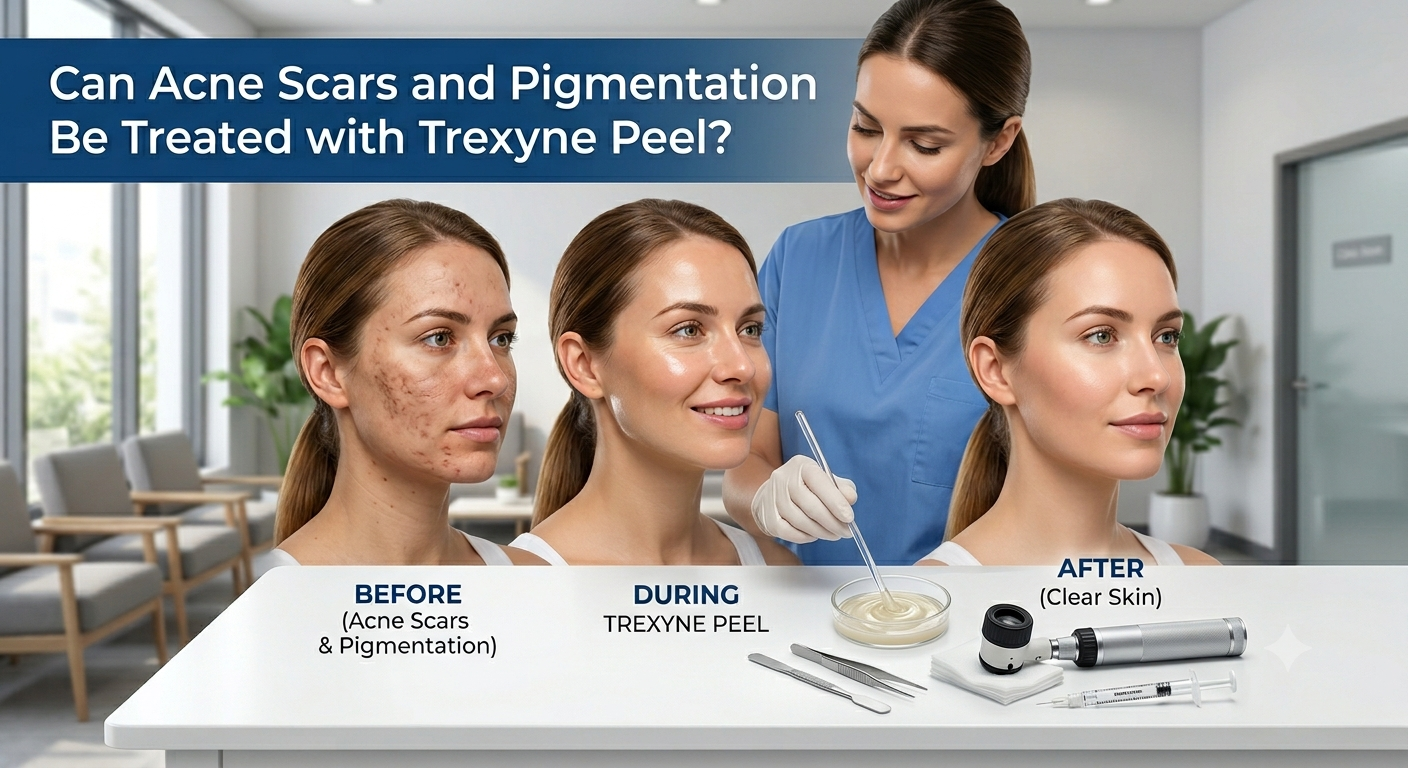
Can Acne Scars and Pigmentation Be Treated with Trexyne Peel?
Dealing with active acne breakouts is challenging enough, but the marks left behind long after the blemishes clear can be equally frustrating. Post-acne structural damage often presents as a dual concern: texturing changes (acne scars) and persistent dark spots (post-inflammatory hyperpigmentation, or PIH). For individuals seeking to resolve both concerns simultaneously without invasive procedures, clinical-grade chemical peels offer an established route. Specifically, the Trexyne Peel is a professional formulation designed to address both texture irregularities and pigment deposits, helping to smooth and clarify the skin canvas.
Understanding the Dual Challenge: Scars vs. Pigmentation
Before starting a corrective treatment plan, it is essential to distinguish between the two types of post-acne marks, as they sit at different levels within the skin tissue.
- Post-Inflammatory Hyperpigmentation (PIH): These are the flat pink, red, brown, or black marks left behind after an acne lesion heals. They occur because the localized inflammation triggers melanocytes to overproduce pigment in that specific spot. PIH sits primarily within the epidermal layers, making it highly responsive to chemical exfoliation.
- Atrophic Acne Scars: These are structural depressions in the skin—such as boxcar, rolling, or icepick scars—caused by a loss of collagen during the healing process of severe or cystic acne. Because structural scars involve damage to the deeper dermal architecture, treating them requires stimulating new collagen matrix production to plump the skin from within.
How Trexyne Peel Targets Post-Acne Discoloration (PIH)
The Trexyne Peel addresses post-inflammatory hyperpigmentation through accelerated, controlled cellular turnover. When applied by a practitioner, the clinical solution works across the upper layers of the epidermis, dissolving the cellular bonds that lock dark, melanin-heavy cells in place.
As the skin undergoes its natural shedding phase over the following days, these old, discolored cells flake off the surface. Simultaneously, the chemical peel signals the basal layer of the skin to accelerate the creation of fresh, unpigmented cells. Over a structured series of sessions, this process flushes out old pigment deposits, replacing them with a uniform, evenly toned layer of skin.
How Trexyne Peel Works to Improve Shallow Acne Scars
While superficial cosmetic products only coat the surface, a professional-strength peel penetrates deeply enough to trigger a structural remodeling response.
When the specialized chemical solution reaches the deeper layers of the epidermis and the upper border of the dermis, it induces a controlled micro-injury. This signal prompts the body’s natural wound-healing mechanism to go into high gear. Fibroblasts are activated, leading to a surge in fresh collagen and elastin production. As this new structural framework builds over several months, shallow depressions and rolling acne scars are gradually forced upward from underneath, resulting in a significantly smoother and more refined skin texture.
What to Expect from a Post-Acne Peel Treatment Protocol
Addressing combined texturing and pigment concerns is a progressive journey rather than a single event.
Clinical Consultation
Your practitioner will evaluate your specific skin type, the depth of your acne scarring, and the severity of your PIH. Because skin that has suffered from acne can remain sensitive, calibration of the peel depth is essential to avoid triggering new irritation.
The Series Structure
While dark marks might show great improvement within 2 to 3 sessions, structural changes in acne scars require more time. A typical protocol consists of a series of 4 to 6 sessions spaced roughly a month apart. This gives the skin matrix sufficient time to build collagen and recover between applications.
Post-Treatment Care
Following your practitioner’s aftercare guidance is crucial. Protecting the fresh, recovering skin with daily broad-spectrum SPF prevents the occurrence of secondary pigmentation and ensures that the newly forming collagen fibers develop correctly without UV disruption.
Choosing a Professional Pathway Over At-Home Alternatives
It can be tempting to attempt self-treatment using mild, over-the-counter exfoliating serums. However, home-use acids are strictly limited in concentration for consumer safety, meaning they can only provide superficial brightening and have virtually no impact on structural acne scars. Choosing an advanced, professional pigmentation treatment ensures that the active solutions are strong enough to reach the necessary depths to stimulate collagen remodeling while remaining safely controlled by an experienced professional.
Conclusion
A clinical-grade chemical peel can absolutely be used to treat both acne scars and post-inflammatory pigmentation effectively. By combining deep epidermal exfoliation with dermal collagen stimulation, the Trexyne Peel works double duty to clear away dark, lingering spots while progressively smoothing out superficial texturing depressions. With a dedicated treatment series, strict adherence to aftercare guidelines, and daily sun protection, you can move past the cycle of acne damage and achieve a clear, uniform, and smooth skin profile.
Frequently Asked Questions
1. Can Trexyne Peel treat deep icepick or severe rolling acne scars?
Trexyne Peel is highly effective for shallow, superficial rolling or boxcar scars and general texturing rough patches. However, deeply indented icepick or severe fibrotic scars extend deep into the dermis and usually require a multi-modality approach combining the peel with subcision, microneedling, or ablative laser therapies for optimal results.
2. Is it safe to get a Trexyne Peel if I still have active acne breakouts?
Mild, occasional blemishes are typically fine, and the peel can actually help clarify pores and reduce acne-causing bacteria. However, if you are experiencing severe, widespread cystic acne or have open, raw lesions, your practitioner will likely recommend calming the active inflammation with topical or medical therapies before applying a professional-strength chemical peel.
3. How soon will my post-acne dark spots start to fade after the peel?
You will typically see an initial brightening of post-acne dark marks (PIH) within 7 to 14 days after your first session, once the peeling and flaking phase concludes. The dark marks will continue to fade progressively with each subsequent session across your treatment series.
4. Will the peel cause more breakouts initially?
Some individuals experience a temporary phase known as “purging” after their initial session. Because the chemical solution accelerates cellular turnover, it can push microcomedones and blockages that were already forming deep within the pores to the surface faster. This usually resolves quickly, leaving cleaner skin behind.
5. Can Trexyne Peel be used on darker skin tones to treat acne marks safely?
Yes, when performed by a practitioner with specific expertise in diverse skin tones. Darker skin tones are highly prone to post-inflammatory hyperpigmentation if a peel is too aggressive. A professional will utilize a controlled, progressive approach to clear acne marks safely without triggering adverse pigment reactions.