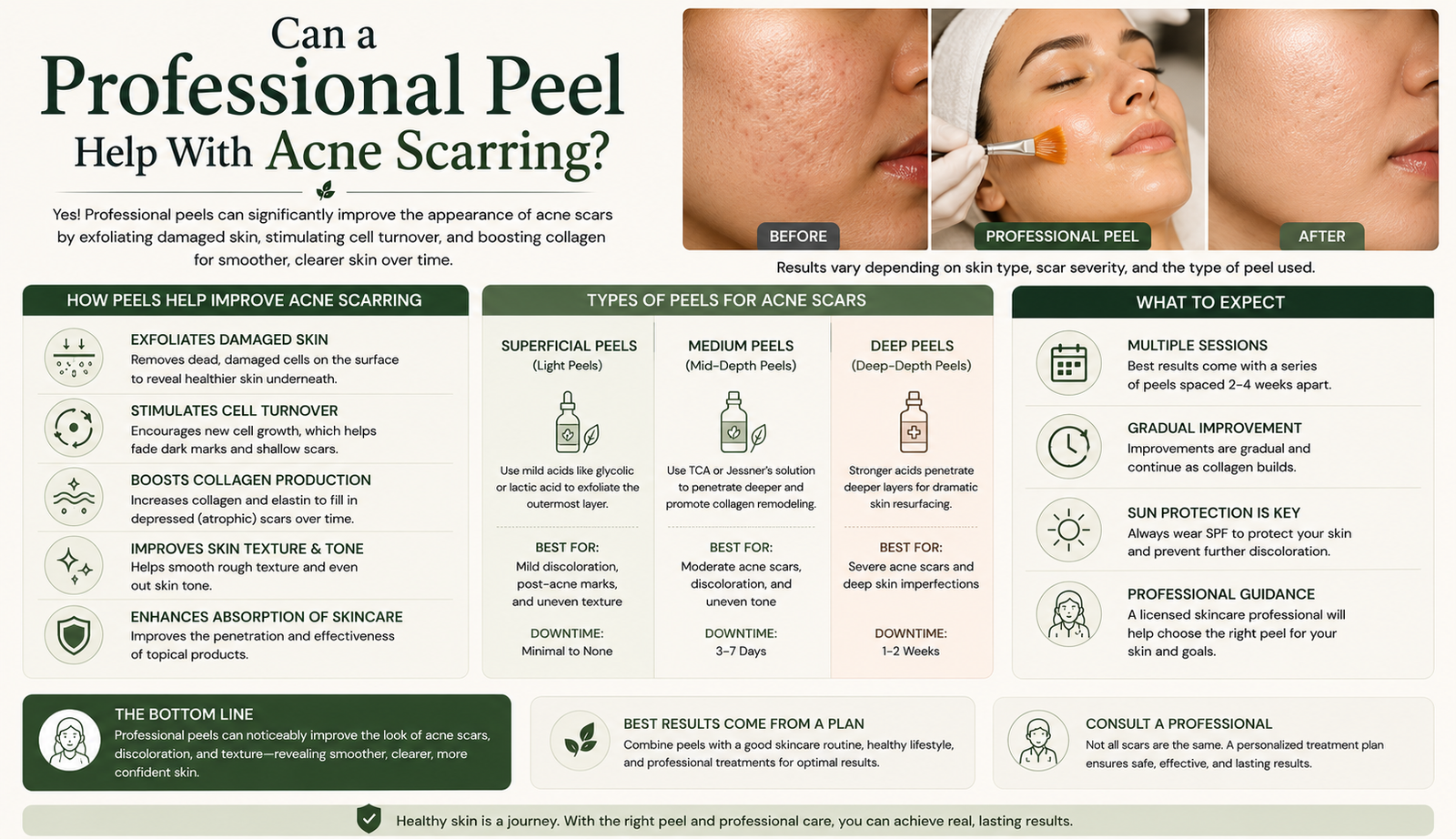
Can a Professional Peel Help With Acne Scarring?
The honest answer is that it depends on what type of acne scarring is being treated. Professional peels, including mechanical resurfacing options, can produce meaningful improvement in the surface appearance of mild to moderate atrophic scarring and in the post-inflammatory hyperpigmentation that accompanies or follows acne. They cannot structurally correct deep atrophic scars, fill depressed tissue, or remodel damaged collagen in the way that more invasive dermal interventions do. A practitioner who understands this distinction will give clients accurate expectations and recommend the right tools for the specific presentation in front of them. For the pigmentation component of post-acne skin and for surface-level texture refinement, professional resurfacing with a treatment such as the Trexyne Peel can form a meaningful part of the treatment plan. For deeper structural scars, it needs to sit alongside other approaches or be positioned appropriately within a staged treatment pathway.
Understanding the Different Types of Acne Scarring
Acne scarring is not a single condition. It encompasses several distinct presentations that form through different mechanisms and respond very differently to treatment. Getting the assessment right before making any treatment recommendation is the foundation of responsible management for this concern.
Atrophic scars are the most common type associated with acne and result from insufficient collagen production during the healing of a deep inflammatory lesion. The tissue that repairs the wound does not fully replace the volume of the original skin, leaving a depression. Within atrophic scarring, there are three main subtypes with different depths and clinical characteristics.
Ice pick scars are narrow, deep, sharply bordered channels extending into the dermis. They are named for the appearance of having been made by a sharp pointed instrument, and their depth makes them the most resistant of all atrophic scar types to surface-level treatment.
Boxcar scars have defined, steep vertical edges and a flat or slightly rounded base. They can be shallow or deep and tend to appear most prominently on the cheeks and temples. Shallow boxcar scars respond better to resurfacing than deep ones.
Rolling scars produce a wave-like, undulating skin surface through fibrous adhesions beneath the skin that tether the epidermis to the deeper tissue. They tend to appear as broad, shallow depressions that can look better or worse depending on how the skin is stretched.
Hypertrophic scars and keloids are raised rather than depressed, produced by excessive collagen formation during healing. These require a different treatment approach from atrophic scars and are outside the scope of resurfacing peels.
Post-inflammatory hyperpigmentation is not strictly a scar but is frequently present alongside or instead of structural scarring. It involves flat, discoloured marks left by the inflammatory response of acne rather than structural damage to the dermis, and it is the component of post-acne skin most responsive to professional resurfacing.
What Professional Peels Can Realistically Do for Acne Scarring
Professional resurfacing treatments work by stimulating epidermal renewal, accelerating cell turnover, and in the case of deeper chemical resurfacing, stimulating some degree of dermal collagen remodelling. What they can achieve for acne scarring depends on the depth and type of the scar.
For post-inflammatory hyperpigmentation, professional resurfacing is the most direct and appropriate treatment tool available. PIH involves melanin concentrated in the epidermis, which responds to accelerated cell turnover by being progressively displaced with fresh, unpigmented cells over a course of sessions. This is the component of post-acne skin where resurfacing produces the clearest, most consistent visible improvement.
For shallow atrophic scarring, particularly shallow boxcar scars and mild rolling scars where the structural change is limited in depth, professional resurfacing over a sustained course can produce a visible softening of the scar’s appearance. The mechanism is partly through the improved surface quality of the surrounding skin making scars less prominent by reducing contrast, and partly through the stimulation of epidermal renewal that can improve the texture of the scar base itself.
For deep atrophic scarring, including deep ice pick scars, deep boxcar scars, and pronounced rolling scars with significant dermal adhesion, professional peels alone are unlikely to produce the degree of structural improvement most clients are hoping for. The structural deficit extends into the dermis and requires interventions that work at that depth. Resurfacing can still be a useful part of the overall treatment plan for improving surface quality and PIH alongside other modalities, but it should not be positioned as a standalone solution for deep scarring.
The Trexyne Peel’s Role in Post-Acne Skin Treatment
The Trexyne Peel resurfaces through marine-algae spicules using a purely mechanical mechanism with no chemical exfoliants involved. For post-acne skin, this mechanical approach has specific clinical relevance because acne-prone skin that is also managing PIH is particularly vulnerable to the inflammatory trigger that chemical resurfacing generates. Any treatment that provokes an inflammatory response in this skin type carries a risk of producing new PIH even as it attempts to address existing marks.
The Trexyne Peel’s mechanism avoids this specific risk. The stabilised Vitamin E in the formulation supports recovery during the post-treatment window, and the tiered protocol allows the practitioner to match intensity to the current state of the skin at each session. For acne-prone skin that can vary considerably in its condition from one appointment to the next, this adjustability is a practical clinical advantage.
For the PIH component of post-acne skin, a sustained course of Trexyne Peel sessions can produce progressive, visible improvement in the dark marks that remain after breakouts have resolved. For mild surface texture issues and shallow scarring, the resurfacing stimulus can contribute to a gradual improvement in skin surface quality over the course. For deeper structural scarring, the Trexyne Peel supports the overall skin health and surface quality that creates the best environment for complementary treatments targeting the dermal component.
Staging Treatment for Post-Acne Skin
Clients with both PIH and structural acne scarring benefit from a staged approach that addresses the appropriate component with the appropriate tool rather than attempting to resolve everything simultaneously with a single treatment type.
A sensible staging approach typically begins with managing active acne before any resurfacing course starts. Treating skin that still has active, inflamed lesions with a resurfacing treatment carries the risk of spreading bacteria, disrupting active lesions, and producing PIH from the treatment itself in addition to any existing marks. Active acne should be at a manageable or controlled level before professional resurfacing is introduced.
Following active acne management, a course of professional mechanical resurfacing addresses the PIH and surface quality components. This improves the overall skin canvas and allows a clearer picture of the underlying structural scarring to emerge as the pigmentation fades. Many clients find that once their PIH has improved significantly, their structural scarring is less visually prominent than they had perceived it to be, because the combination of discolouration and texture was creating a more significant visual impact than either would alone.
For clients with deep structural scarring that remains a significant concern after the PIH has been addressed, additional modalities targeting the dermal component can then be introduced or considered. A practitioner who has managed the earlier stages of the pathway is well placed to advise on appropriate referral or complementary treatment at this point.
The Consultation as Clinical Foundation
For post-acne skin, the consultation before any treatment course is the moment at which the distinction between PIH, shallow scarring, and deep structural scarring is assessed and communicated. Clients often arrive with a general perception that their skin is badly scarred without having distinguished between the different components. A thorough consultation that separates these elements, explains what resurfacing can and cannot address, and sets out a staged pathway gives the client a clear and realistic picture.
This conversation is also when expectations need to be calibrated honestly. Deep atrophic scarring does not significantly resolve with resurfacing alone, and a client who invests in a course hoping for dramatic improvement in ice pick scars is likely to be disappointed. A client who understands that the course will address their PIH and surface quality, and that structural scarring may be a longer-term, multi-modality project, can engage with the treatment appropriately and measure their results accurately.
The assessment should also include checking for any active acne or early lesions on the day of each session. Resurfacing should not proceed over actively inflamed skin regardless of the broader treatment plan, and the practitioner should be prepared to defer or adjust any session where the skin’s current condition warrants it.
Practitioners looking to incorporate the Trexyne Peel into post-acne treatment protocols can find the full product range via the Trexyne shop, or contact the team directly through the Trexyne contact page.
When to Refer for Structural Scar Treatment
Clients with significant deep atrophic scarring who want meaningful improvement in the structural component of their scars should be informed clearly about what resurfacing can and cannot achieve, and should be referred to a practitioner with the appropriate skills and equipment for dermal-level scar treatment where relevant.
Dermatological or specialist aesthetic referral for structural acne scar treatment may be appropriate for clients with pronounced ice pick scars, significant rolling scars with dermal adhesion, or widespread deep boxcar scarring where the structural deficit is the primary concern. Resurfacing can continue to play a supportive role in overall skin quality management alongside these more targeted interventions.
A practitioner who can make appropriate referrals when the situation calls for it is providing genuinely good clinical care and will strengthen rather than undermine the client relationship by being transparent about the limits of what any single treatment approach can achieve.
More information on the Trexyne approach to professional botanical resurfacing is available on the Trexyne website.
Conclusion
Professional peels can meaningfully help with the post-inflammatory hyperpigmentation that accompanies and follows acne, and can produce visible improvement in mild to moderate surface-level atrophic scarring. They cannot structurally correct deep atrophic scars, and clients with significant ice pick, deep boxcar, or pronounced rolling scars should understand that resurfacing alone is unlikely to produce the degree of improvement they may be hoping for. A staged approach that addresses active acne first, then PIH and surface quality through a sustained resurfacing course, then the structural component through appropriate complementary modalities, produces the most reliable overall outcome. The Trexyne Peel is a well-suited option for the PIH and surface quality stages of this pathway, using a mechanical mechanism that avoids the inflammatory trigger most likely to worsen pigmentation in acne-prone skin, with stabilised Vitamin E to support recovery and a tiered protocol that adjusts to the variable condition of post-acne skin session by session. With honest expectations and a well-structured treatment plan, it may support meaningful improvement in post-acne skin and contribute to a clearer, more even-looking complexion over the course of a sustained professional programme.
FAQs
Q: Can a professional peel help with acne scarring?
It depends on the type of scarring. Professional peels can produce meaningful improvement in post-inflammatory hyperpigmentation and in the appearance of mild to moderate shallow atrophic scars. They are less effective for deep structural scarring, including ice pick scars and deep boxcar or rolling scars, where the structural deficit extends into the dermis and requires deeper interventions.
Q: What types of acne scars respond best to professional resurfacing?
Post-inflammatory hyperpigmentation responds best to professional resurfacing. Shallow atrophic scars, including shallow boxcar scars and mild rolling scars, can also show visible improvement in surface appearance over a sustained course. Deep ice pick scars and pronounced rolling scars with dermal adhesion are less responsive to surface-level resurfacing.
Q: Is the Trexyne Peel suitable for post-acne skin?
The Trexyne Peel’s mechanical mechanism avoids the chemical inflammatory trigger most likely to worsen PIH in acne-prone skin, making it a considered option for the pigmentation and surface quality components of post-acne skin treatment. The tiered protocol allows intensity to be adjusted based on the skin’s condition at each session, which is particularly valuable for acne-prone skin that can vary considerably between appointments.
Q: Should I treat PIH before structural acne scarring?
A staged approach generally works well, beginning with managing active acne, then addressing PIH and surface quality through professional resurfacing, then considering additional modalities for any remaining structural scarring. Many clients find their structural scars appear less prominent once PIH has been treated, because the combination of discolouration and texture was creating a greater visual impact than the texture alone.
Q: Can a peel help with ice pick scars?
Surface-level resurfacing, including mechanical peel approaches, is generally not effective for deep ice pick scars because their depth extends well into the dermis beyond the reach of epidermal resurfacing. Clients with prominent ice pick scarring should be referred for assessment of treatments that can address the structural deficit at the appropriate depth.
Q: Is it safe to have a professional peel if I still have active acne?
Resurfacing should not be applied to actively inflamed or broken-out skin. Active acne should be at a controlled or manageable level before a professional resurfacing course begins. The practitioner should assess the skin’s current condition at each appointment and defer or adjust any session where active inflamed lesions are present.
Q: How many sessions of the Trexyne Peel are needed for post-acne pigmentation?
The number of sessions depends on the depth and extent of the PIH, the individual’s skin response, and how consistently daily SPF is maintained between appointments. Visible improvement in PIH typically builds progressively across a course rather than appearing quickly, with more noticeable results often apparent from the middle sessions onwards. A practitioner assessment will provide a realistic recommendation.