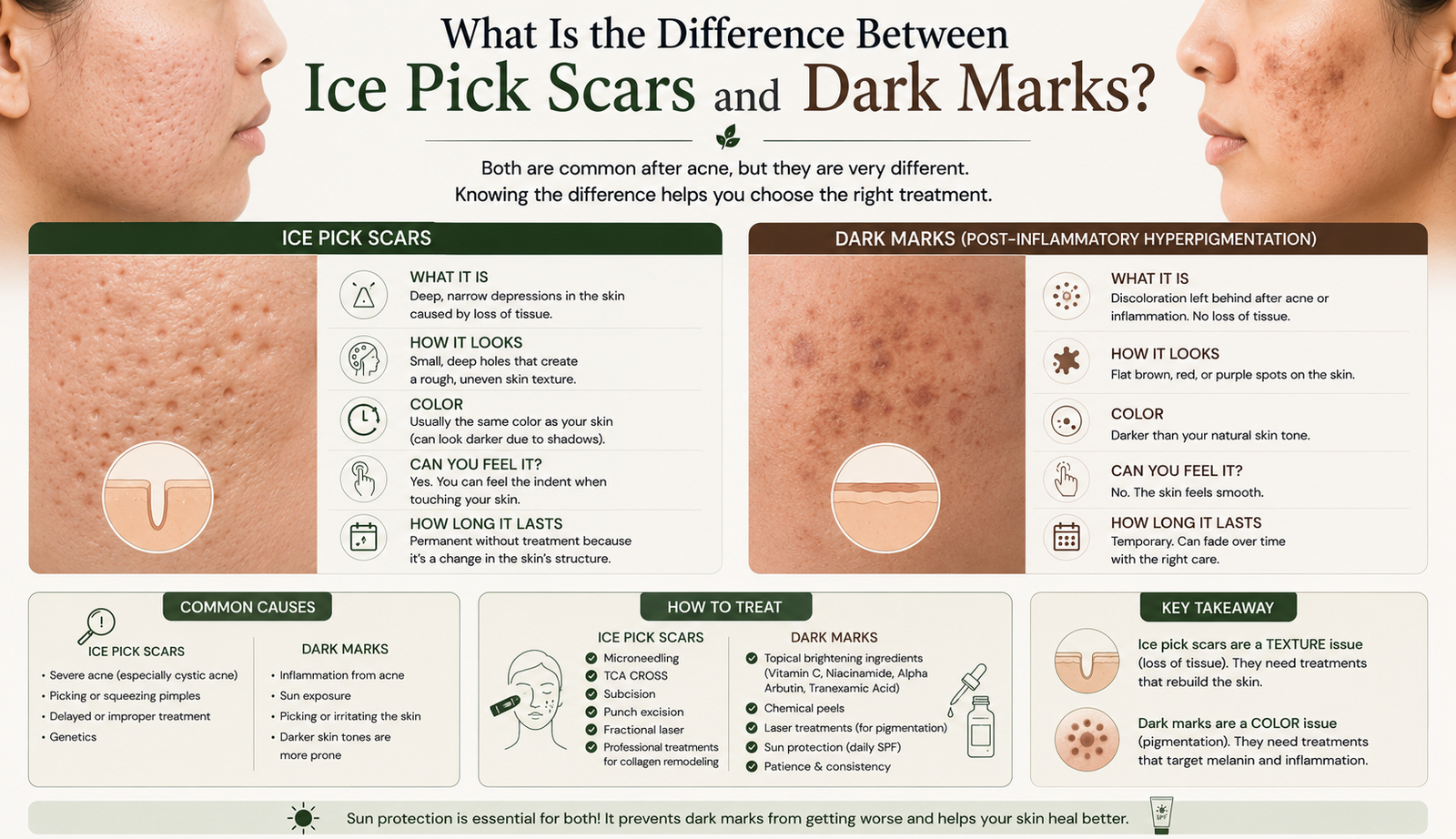
What Is the Difference Between Ice Pick Scars and Dark Marks?
Ice pick scars and dark marks are two of the most common concerns clients describe after acne, and they are frequently confused because they often appear on the same skin at the same time. The difference between them is fundamental: a dark mark is a change in pigmentation with no structural alteration to the skin’s surface, while an ice pick scar is a structural change involving a narrow, deep channel in the skin that extends into the dermis. They have different causes, different clinical presentations, and critically, different responses to treatment. Understanding this distinction matters enormously for anyone planning a treatment course, because the approaches that can meaningfully address dark marks are not the same as those required for ice pick scars, and confusing the two leads to mismatched treatment and unmet expectations. For the dark mark component of post-acne skin, professional resurfacing options such as the Trexyne Peel can support progressive improvement. For ice pick scars, the clinical picture is more complex and requires a different conversation.
What a Dark Mark After Acne Actually Is
A dark mark left by acne is clinically known as post-inflammatory hyperpigmentation, or PIH. It forms when the inflammatory response of an acne lesion triggers melanocytes in the surrounding skin to produce excess melanin. As the active lesion heals, this excess melanin deposits unevenly in the affected area, leaving a flat patch of discolouration that can range from light tan or pink in lighter skin tones to mid-brown, deep brown, or near-black in darker skin tones.
The most important clinical characteristic of a PIH mark is that it is flat. Running a clean finger across the surface of a PIH mark reveals no textural difference from the surrounding skin. The skin’s structural integrity is intact. There is no depression, no channel, and no damage to the dermis beneath. The change is entirely at the level of pigmentation within the epidermis rather than involving any structural disruption.
This flatness is not always obvious visually, particularly in photographs or in certain lighting conditions where the contrast between the mark and the surrounding skin can create a visual impression of depth that does not physically exist. The gentle tactile test of running a finger across the surface under good lighting is a reliable way to confirm that a dark mark is flat and therefore PIH rather than a structural scar.
PIH marks are not permanent in the way structural scars are. They fade over time with appropriate management. Their depth within the epidermis, how recently they formed, and the client’s UV exposure habits all influence how quickly they fade naturally, but unlike structural scars, they do not require interventions that work at the level of the dermis to address.
What an Ice Pick Scar Is
An ice pick scar is an atrophic scar, meaning it involves a loss of tissue rather than an excess of it. It forms when an acne lesion causes significant damage to the dermis during its inflammatory phase. As the wound heals, the body produces insufficient collagen to fully replace the volume of tissue that was destroyed, leaving a narrow, deep depression in the skin surface.
The term ice pick is a visual description: these scars resemble the mark that might be left by a sharp, pointed instrument. They are characteristically narrow at the skin’s surface, typically less than two millimetres in diameter, with steep, sharply defined walls that extend downward into the dermis. The depth of ice pick scars is what makes them so challenging to treat. They can extend to the middle and lower dermis, making them among the deepest of all atrophic scar types relative to their surface diameter.
On the skin’s surface, ice pick scars feel distinctly different from PIH marks. They are palpable as small indentations, and under raking light, which is light applied at a low angle across the skin surface, they cast shadows that make them clearly visible even when they might be less obvious in direct frontal lighting.
Unlike PIH marks, ice pick scars do not fade with time. The structural deficit in the dermis is permanent without intervention, and the intervention required to meaningfully improve them must work at a dermal level rather than through surface resurfacing alone.
Why Both Often Appear Together
One of the reasons these two presentations are so frequently confused is that they commonly occur on the same skin simultaneously, and sometimes at the same location. A single acne lesion can produce both a structural scar and post-inflammatory pigmentation as part of its healing process. The scar forms from the structural damage the lesion caused to the dermis, and the PIH forms from the inflammatory response in the surrounding skin.
When both are present in the same area, the visual impression is of significant, deep-looking damage that can appear more severe than either element would look on its own. The discolouration of the PIH can make the ice pick scar appear deeper and more prominent, and the texture of the scar can make the PIH appear more complex than a simple flat mark.
Separating the two components carefully at consultation, both visually and through palpation, gives the practitioner and the client a clearer picture of what they are actually dealing with and allows a more appropriate treatment plan to be designed for each element. Clients who have been assessed in this way often find that the visual impression they had of their skin was more pessimistic than the clinical reality.
How Treatment Differs for Each Presentation
The treatment pathways for PIH marks and ice pick scars are genuinely distinct, and this is the most clinically important implication of the distinction between them.
Post-inflammatory hyperpigmentation is an epidermal pigmentation concern. It responds to professional resurfacing approaches that accelerate cell turnover, progressively displacing pigmented cells with fresh, unpigmented ones over a course of sessions. The depth and duration of the pigmentation, the consistency of daily SPF use, and the individual’s skin response all influence the timeline for visible improvement. Consistent, well-spaced resurfacing sessions supported by rigorous photoprotection can produce meaningful, lasting improvement in PIH over the course of a sustained treatment programme.
Ice pick scars are structural. The depression in the skin surface cannot be filled or corrected by resurfacing at the epidermal level, because the deficit extends into the dermis. Surface resurfacing can improve the skin’s overall quality around and between scars, can address any accompanying PIH, and can gradually smooth the texture of the scar walls to a modest degree in some cases. It cannot, however, close the channel or restore the volume of tissue that the scar represents.
Interventions that address ice pick scars directly work at the dermal level or through physical techniques that alter the scar’s structure. These are specialist procedures beyond the scope of standard resurfacing courses and should be discussed with a practitioner who has specific expertise in structural scar treatment.
Where the Trexyne Peel Fits Into Post-Acne Treatment
The Trexyne Peel is a relevant professional option for the PIH component of post-acne skin. Its mechanical resurfacing mechanism avoids the chemical inflammatory trigger most likely to worsen pigmentation in acne-prone skin that is already susceptible to PIH. Stabilised Vitamin E in the formulation supports recovery, and the tiered protocol allows the practitioner to adjust intensity based on the skin’s condition at each session.
For clients with both PIH and ice pick scarring, the Trexyne Peel can address the pigmentation element while contributing to overall surface quality improvement. Many clients find that once their PIH has significantly faded, the visual impact of their ice pick scars changes. The discolouration was adding to the contrast that made the scars visible, and its reduction can make the remaining structural marks appear less prominent in everyday lighting and photography.
This does not mean the ice pick scars have been structurally corrected. It means the visual presentation of the skin has improved because one significant contributing element, the PIH, has been addressed. Clients who understand this distinction will evaluate the outcome of their resurfacing course accurately rather than concluding it failed because their structural scars remain.
Setting Accurate Expectations From the Start
The most common source of disappointment in post-acne skin treatment is a mismatch between what the client expected and what any given treatment can achieve. Clients who arrive hoping that a course of professional resurfacing will eliminate their ice pick scars are likely to feel the treatment did not work, even when the PIH has improved substantially.
The consultation is the moment to establish accurate expectations by separating the PIH and structural scarring components clearly, explaining what resurfacing can meaningfully address and what it cannot, and presenting a realistic picture of what visible improvement may look like over the proposed treatment course. A client who goes into treatment knowing that their dark marks can improve significantly through resurfacing while their structural scars require a different and more specialist approach is well positioned to engage with the course appropriately and to recognise genuine progress when it occurs.
Practitioners looking to incorporate the Trexyne Peel into their post-acne skin protocols can explore the full product range through the Trexyne shop, or contact the team directly through the Trexyne contact page.
When to Refer for Ice Pick Scar Treatment
Clients with significant ice pick scarring who want meaningful structural improvement should be referred to a practitioner with specific expertise in structural scar management rather than being offered standard resurfacing as a primary solution for this element of their concern.
This referral is not a clinical failure. It is the correct clinical response to a presentation that requires a different tool. Practitioners who are transparent about the limits of what resurfacing achieves for structural scarring, and who facilitate appropriate referral while managing the PIH and surface quality components themselves, provide genuinely good clinical care and maintain the trust of clients who might otherwise feel misled.
More information on the Trexyne approach to professional botanical resurfacing is available on the Trexyne website.
Conclusion
Ice pick scars and dark marks after acne are distinct clinical presentations that require different treatment approaches. Dark marks are flat, epidermal pigmentation changes caused by the inflammatory response to acne and respond progressively to professional resurfacing over a sustained treatment course. Ice pick scars are structural deficits in the dermis produced by collagen loss during deep inflammatory lesion healing and require interventions that work at a dermal level to produce meaningful structural correction. Both often appear together, and the visual impact of their combination is typically greater than either element would present on its own. The Trexyne Peel is a well-suited option for the PIH component, using a mechanical resurfacing mechanism that avoids the inflammatory trigger most likely to worsen post-acne pigmentation, supported by stabilised Vitamin E for recovery and a tiered protocol that adapts to the variable condition of post-acne skin. Addressing the PIH element through a well-managed resurfacing course can meaningfully improve the overall appearance of post-acne skin and support a clearer, more even-looking complexion, even where structural ice pick scarring remains a separate longer-term concern.
FAQs
Q: What is the difference between ice pick scars and dark marks after acne?
Dark marks, or post-inflammatory hyperpigmentation, are flat discolourations caused by excess melanin production during the inflammatory healing of acne lesions. They involve no structural change to the skin. Ice pick scars are narrow, deep structural depressions caused by collagen loss during deep acne lesion healing. They extend into the dermis and are palpable as small indentations in the skin surface.
Q: Can a professional peel help with dark marks from acne?
Yes. Post-inflammatory hyperpigmentation is an epidermal pigmentation concern that responds progressively to professional resurfacing over a course of sessions. Treatments such as the Trexyne Peel support cell turnover through a mechanical mechanism that avoids the inflammatory trigger most likely to worsen PIH in acne-prone skin, making it a considered option for this component of post-acne skin treatment.
Q: Can a professional peel improve ice pick scars?
Surface-level resurfacing cannot structurally correct ice pick scars because their depth extends into the dermis, beyond the reach of epidermal resurfacing. Resurfacing can improve overall skin quality and surface texture around scars and can address accompanying PIH, which may reduce the visual contrast that makes scars more prominent. Structural correction of ice pick scars requires interventions that work at a dermal level.
Q: How do I know if I have PIH marks or ice pick scars?
PIH marks are completely flat. Running a finger across them reveals no textural difference from the surrounding skin. Ice pick scars are palpable as small depressions and appear as distinct indentations under angled or raking light. Both can be present simultaneously on the same skin, and a practitioner can help separate the two components through clinical assessment.
Q: Will my dark marks fade on their own without treatment?
PIH marks can fade naturally over time as cell turnover brings the pigmented cells progressively towards the surface. However, natural fading can take many months or even years, particularly in darker skin tones where PIH tends to be more pronounced and persistent. Professional resurfacing significantly accelerates this process, and consistent daily SPF use prevents UV exposure from deepening existing marks or producing new ones.
Q: Do ice pick scars get better over time?
Ice pick scars do not fade or improve on their own the way PIH marks can, because they represent a permanent structural deficit in the dermis rather than a pigmentation change. Without intervention at a dermal level, they remain largely unchanged. However, the appearance of ice pick scars can be less prominent when PIH in the same area is addressed, because the discolouration was contributing to their visual impact.
Q: Should I treat my dark marks before my ice pick scars?
A staged approach generally makes clinical sense. Managing active acne first, then addressing PIH through a professional resurfacing course, then considering structural scar treatment for any remaining ice pick scars produces the clearest picture at each stage and allows the most appropriate tool to be applied to each component in sequence. Treating PIH first also means any structural scar treatment proceeds on skin with better overall quality and a reduced inflammatory baseline.