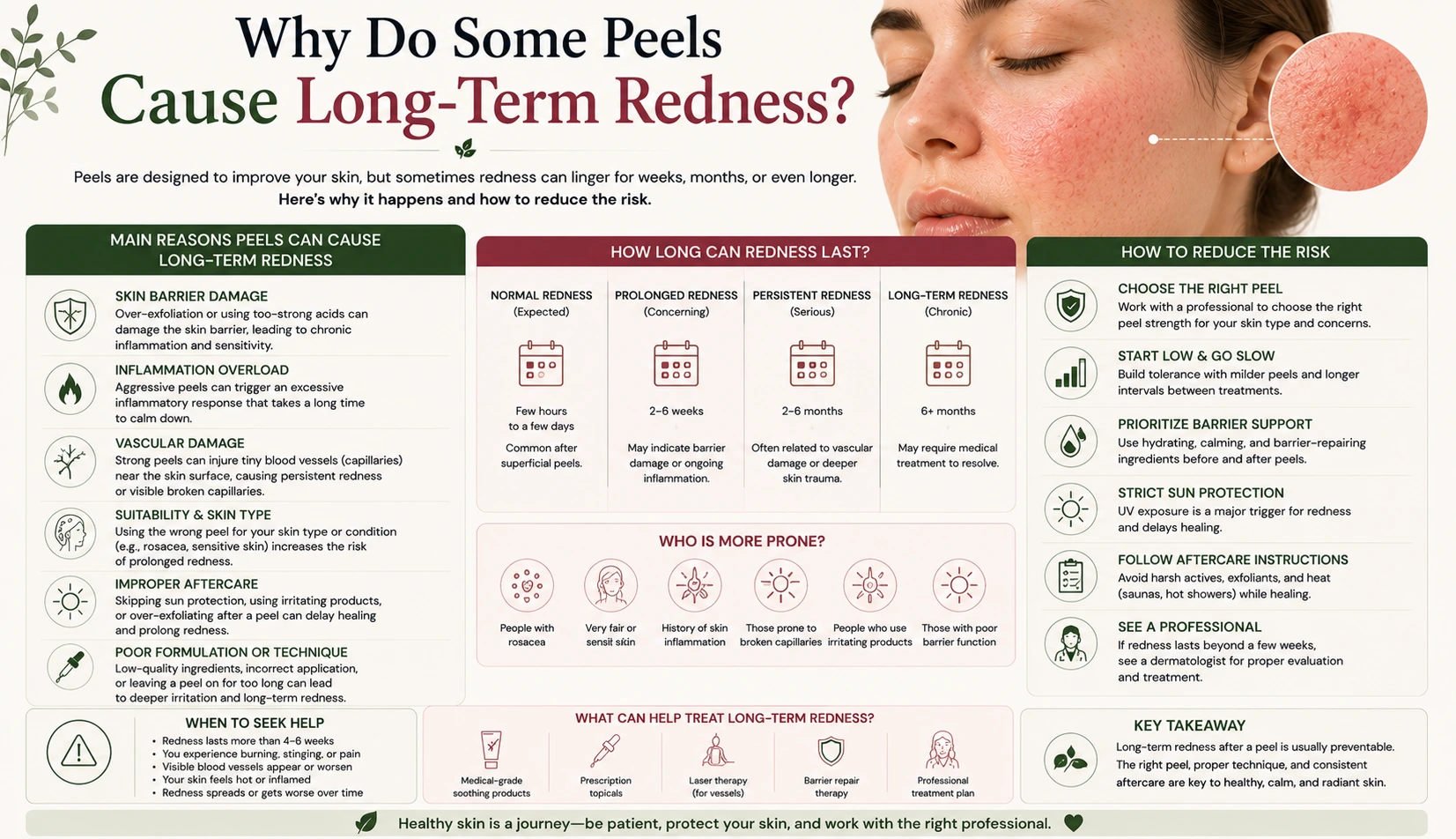
Why Do Some Peels Cause Long-Term Redness?
Long-term redness after a professional peel is not simply a sign that the skin is still healing. In many cases it indicates that the treatment triggered an inflammatory response the skin’s barrier was not equipped to resolve efficiently, and that this response has become self-sustaining rather than self-limiting. Understanding why this happens, and which clinical factors make it more likely, is essential for practitioners selecting treatments and for clients trying to understand their own skin’s behaviour. The underlying mechanisms vary, but they share a common thread: the inflammatory load placed on the skin exceeded what its recovery capacity could manage within a normal timeframe. For practitioners evaluating treatment options, the mechanism of the peel itself is one of the most influential factors in whether long-term redness is a likely outcome. Options such as the Trexyne Peel are designed to resurface without the chemical inflammatory trigger that most commonly drives this outcome in susceptible skin.
What Long-Term Redness After a Peel Actually Represents
Temporary redness in the first few days after a resurfacing session is an expected and normal part of the repair response. Blood vessels dilate in the treated area as part of the inflammatory process that initiates renewal, and this produces the visible flush that most clients experience in the immediate post-treatment window. This is not a concern. It is the skin doing what it should.
Long-term redness, where visible flushing persists for weeks or months after a peel rather than settling within the first week or two, represents something different. It indicates that the inflammatory process initiated by the treatment has not resolved cleanly. Instead of completing its cycle and allowing the blood vessels to return to their resting state, the inflammatory response is continuing at a level that maintains visible redness in the skin surface.
This sustained inflammation is not a neutral waiting state. Persistent inflammation in the skin has consequences: it maintains elevated barrier permeability, keeps the skin in a reactive and sensitive condition, and in susceptible skin types, continues to stimulate melanocyte activity in a way that can produce post-inflammatory hyperpigmentation alongside the redness. Understanding why the inflammatory cycle has not resolved is the first step towards choosing a treatment approach less likely to produce this outcome.
How Chemical Resurfacing Generates Inflammation
The primary reason some peels cause long-term redness is that chemical exfoliation generates a chemical reaction in the skin as part of its mechanism, and this reaction is intrinsically inflammatory. The acid or exfoliating agent applied to the skin dissolves intercellular bonds and triggers a wound-like response in the tissue. The skin treats this chemical disruption as a form of controlled injury and initiates an inflammatory cascade to manage it.
In skin with a healthy, intact barrier and good recovery capacity, this inflammatory response is temporary. The skin works through the cycle, completes its renewal, and the inflammation resolves along with it. In skin with a compromised barrier, a high intrinsic inflammatory sensitivity, or a reduced capacity for efficient repair, the same chemical disruption can trigger a response that exceeds the skin’s ability to resolve it within a normal timeframe.
The depth and concentration of the chemical agent directly influences how significant this inflammatory burden is. Deeper or more concentrated peels generate more inflammation. But even superficial chemical peels can produce persistent redness in skin that is poorly equipped to manage the inflammatory response, because the issue is not only the magnitude of the trigger but the skin’s capacity to resolve it.
Skin Types Most Vulnerable to Long-Term Post-Peel Redness
Several skin profiles carry a significantly higher risk of developing long-term redness following chemical resurfacing. Understanding these helps practitioners identify clients who warrant a different treatment approach before a difficult outcome occurs rather than after.
Sensitive and reactive skin types are the most consistently at-risk group. These skins have a compromised barrier that cannot contain inflammatory responses as effectively as a healthy, resilient barrier. They are more permeable to irritants, more responsive to inflammatory triggers, and less capable of resolving inflammation quickly. When a chemical resurfacing treatment adds a significant inflammatory load on top of an already-reactive baseline, the result is often redness that extends well beyond the expected recovery window.
Skin with a history of rosacea or seborrhoeic dermatitis is particularly vulnerable. These conditions are already associated with chronic low-level inflammation and vascular reactivity. Chemical peeling in these skin types can exacerbate the underlying vascular reactivity and produce a prolonged inflammatory response that may worsen the underlying condition as well as producing visible post-peel redness.
Clients who arrive for treatment with a compromised barrier, whether from over-exfoliation with home-use actives, recent aggressive treatments, significant stress, or environmental factors, present a higher inflammatory baseline than their general skin type would suggest. A treatment that would be well tolerated by the same skin in a better-maintained state can produce persistent redness when applied to a compromised barrier.
Clients who use retinoids or other prescription skin treatments that thin the stratum corneum and increase skin sensitivity are at higher risk if these have not been paused for an appropriate period before treatment. The thinned barrier provides less protection against the chemical reaction, and the skin’s sensitivity is elevated beyond its usual baseline.
The Role of Barrier Disruption in Prolonging Redness
Barrier disruption is both a consequence of aggressive chemical resurfacing and a mechanism by which the resulting redness is prolonged. When a peel compromises the skin barrier, transepidermal water loss increases significantly. The skin loses moisture faster than it can replenish it, which creates a state of chronic low-grade stress that maintains elevated inflammatory activity.
This is a self-perpetuating cycle: the treatment disrupts the barrier, barrier disruption maintains inflammation, inflammation prevents efficient barrier repair, and the compromised barrier continues to sustain the inflammatory state. Breaking this cycle requires allowing the skin to recover without further disruption, supporting barrier function with appropriate products, and removing any ongoing irritant including UV exposure that is adding to the inflammatory load.
The length of time this cycle continues depends on the severity of the original disruption, the skin’s inherent recovery capacity, and how well the aftercare period is managed. In some cases it resolves over several weeks with appropriate management. In others, where the disruption was significant and the barrier recovery is slow, it can persist for months.
How the Trexyne Peel Approaches This Differently
The Trexyne Peel resurfaces through marine-algae spicules that create controlled micro-channels in the skin surface through a purely mechanical process. No chemical reaction takes place in the skin during treatment. Because the resurfacing effect is achieved through physical rather than chemical action, the treatment does not initiate the chemical inflammatory cascade that drives the most significant post-peel redness in susceptible skin.
This does not mean the Trexyne Peel involves no recovery period. Any resurfacing treatment creates some degree of controlled disruption that requires the skin to respond and repair. What changes is the nature and intensity of that disruption. Without a chemical reaction generating an inflammatory cascade in the skin, the recovery period involves a less pronounced and more predictable inflammatory response, which is why the treatment is designed around the principle of predictable, manageable downtime rather than the more variable recovery associated with chemical resurfacing.
Stabilised Vitamin E in the formulation supports the skin’s recovery phase from the first application. This active recovery support during the post-treatment window reduces the period during which the skin is managing repair with its barrier temporarily compromised. For clients whose skin history suggests they may be vulnerable to prolonged post-peel redness, this recovery-supportive component of the formulation addresses one of the key factors that allows redness to persist.
The Tiered Protocol as a Risk Management Tool
The Trexyne Peel’s tiered protocol is a direct clinical tool for managing the risk of over-treatment in susceptible skin. By allowing practitioners to match intensity to the individual’s skin condition at each appointment, rather than applying a fixed treatment depth regardless of the skin’s current state, it significantly reduces the risk of triggering a response that exceeds the skin’s recovery capacity.
For clients with a history of long-term post-peel redness from previous treatments, beginning at the most conservative tier and observing the skin’s recovery carefully before progressing provides a real-time assessment of what that individual’s skin can manage. A first session that recovers cleanly and settles within the expected window tells the practitioner that the skin can tolerate this mechanism at this intensity. That information supports confident, graduated progression in subsequent sessions without the risk of repeating the experience that produced the previous prolonged redness.
Practitioners who have previously managed difficult post-chemical peel recoveries in their clients will find that this tiered, responsive approach to intensity produces a more reliable and safer progression through a resurfacing course.
Practitioners interested in stocking the Trexyne Peel can explore the full range through the Trexyne shop, or contact the team directly through the Trexyne contact page.
What Practitioners Can Do to Reduce the Risk of Long-Term Redness
Regardless of the treatment selected, several clinical practices consistently reduce the risk of long-term post-peel redness, and they apply whether the peel is chemical or mechanical in mechanism.
Thorough pre-treatment assessment is the foundation. Identifying barrier compromise, assessing the client’s sensitivity history, reviewing current medications and skincare, and checking for recent aggressive treatments or significant UV exposure before any session proceeds gives the practitioner the information needed to make an appropriate intensity decision rather than applying a standard protocol regardless of the individual’s current state.
Ensuring active home-care products have been paused for an appropriate period before treatment reduces the inflammatory baseline the skin is carrying into the session. Clients on retinoids, prescription actives, or strong at-home exfoliants are presenting with a more sensitised starting point than their general skin type might suggest.
Post-treatment aftercare guidance that is specific, written, and appropriately cautious protects the recovery period. Daily SPF, simplified routine, heat avoidance, and no active skincare during the recovery window are the pillars of good post-peel aftercare and reduce the risk of secondary irritation prolonging the inflammatory response.
More information on the Trexyne approach to professional botanical resurfacing is available on the Trexyne website.
Conclusion
Long-term redness after a peel typically reflects an inflammatory response that exceeded the skin’s capacity to resolve it efficiently, most commonly driven by the chemical inflammatory cascade that acid-based resurfacing generates as part of its mechanism. Susceptible skin types including sensitive, reactive, rosacea-prone, and barrier-compromised presentations are at the highest risk of this outcome from chemical resurfacing. Changing the resurfacing mechanism to avoid the chemical inflammatory trigger is the most substantive clinical response to this pattern. The Trexyne Peel resurfaces through marine-algae spicules without chemical exfoliants, includes stabilised Vitamin E to support recovery during the post-treatment window, and uses a tiered protocol that allows intensity to be matched conservatively to each individual’s skin. For clients and practitioners who have encountered long-term redness as a pattern from chemical resurfacing, this approach may offer a more predictable recovery profile and a brighter, more even-looking complexion without the inflammatory complications that have made resurfacing difficult in the past.
FAQs
Q: Why do some skin peels cause long-term redness?
Long-term redness after a peel usually occurs because the chemical inflammatory response generated by the treatment exceeded the skin’s capacity to resolve it within a normal recovery window. This is most common in sensitive, reactive, or barrier-compromised skin types where the inflammatory load from chemical resurfacing cannot be managed efficiently, leading to a self-sustaining inflammatory state rather than a self-limiting one.
Q: How long is normal redness after a professional peel?
Mild redness in the first few days after a resurfacing session is a normal part of the repair response. Redness that extends beyond one to two weeks, or that fluctuates rather than steadily improving, is beyond the expected recovery range for most treatments and suggests the inflammatory response has not resolved cleanly. This warrants a review of both the treatment approach and the aftercare being followed.
Q: Can sensitive skin have a professional peel without long-term redness?
Yes, with the right treatment mechanism and intensity. A mechanical resurfacing approach that avoids the chemical inflammatory trigger can significantly reduce the risk of long-term redness in sensitive skin. Starting conservatively within a tiered protocol and building gradually based on the skin’s demonstrated tolerance further reduces this risk.
Q: Does the Trexyne Peel cause less redness than chemical peels?
The Trexyne Peel’s mechanical mechanism does not generate a chemical reaction in the skin, removing the primary driver of the most significant post-peel inflammatory responses. Some temporary redness during recovery is normal and expected, but the recovery profile tends to be more predictable and manageable than chemical resurfacing for the skin types most vulnerable to prolonged redness.
Q: What should I do if my skin is still red weeks after a peel?
Simplify your skincare to a gentle cleanser, fragrance-free moisturiser, and daily SPF. Avoid all active products, heat sources, and UV exposure. Contact your practitioner for a clinical assessment if the redness is worsening rather than improving or if it has not begun to settle after two weeks. A change in resurfacing approach may be appropriate for any future treatment.
Q: Can rosacea-prone skin have a professional peel?
Rosacea involves chronic vascular reactivity and low-level inflammation that makes chemical resurfacing a higher-risk choice. A mechanical approach that avoids chemical inflammatory triggers is generally more appropriate for rosacea-prone skin. A thorough consultation and conservative starting intensity are essential, and treatment should not proceed during an active rosacea flare. Dermatological input before aesthetic resurfacing may be appropriate for some presentations.
Q: Is long-term post-peel redness the same as post-inflammatory hyperpigmentation?
They are different but can coexist. Long-term redness reflects sustained vascular dilation and ongoing inflammation. Post-inflammatory hyperpigmentation is a melanin-based pigmentation change that can develop in susceptible skin types as a consequence of the same inflammatory response. In darker skin tones, both can be present simultaneously following a peel that triggered more inflammation than the skin could resolve cleanly.