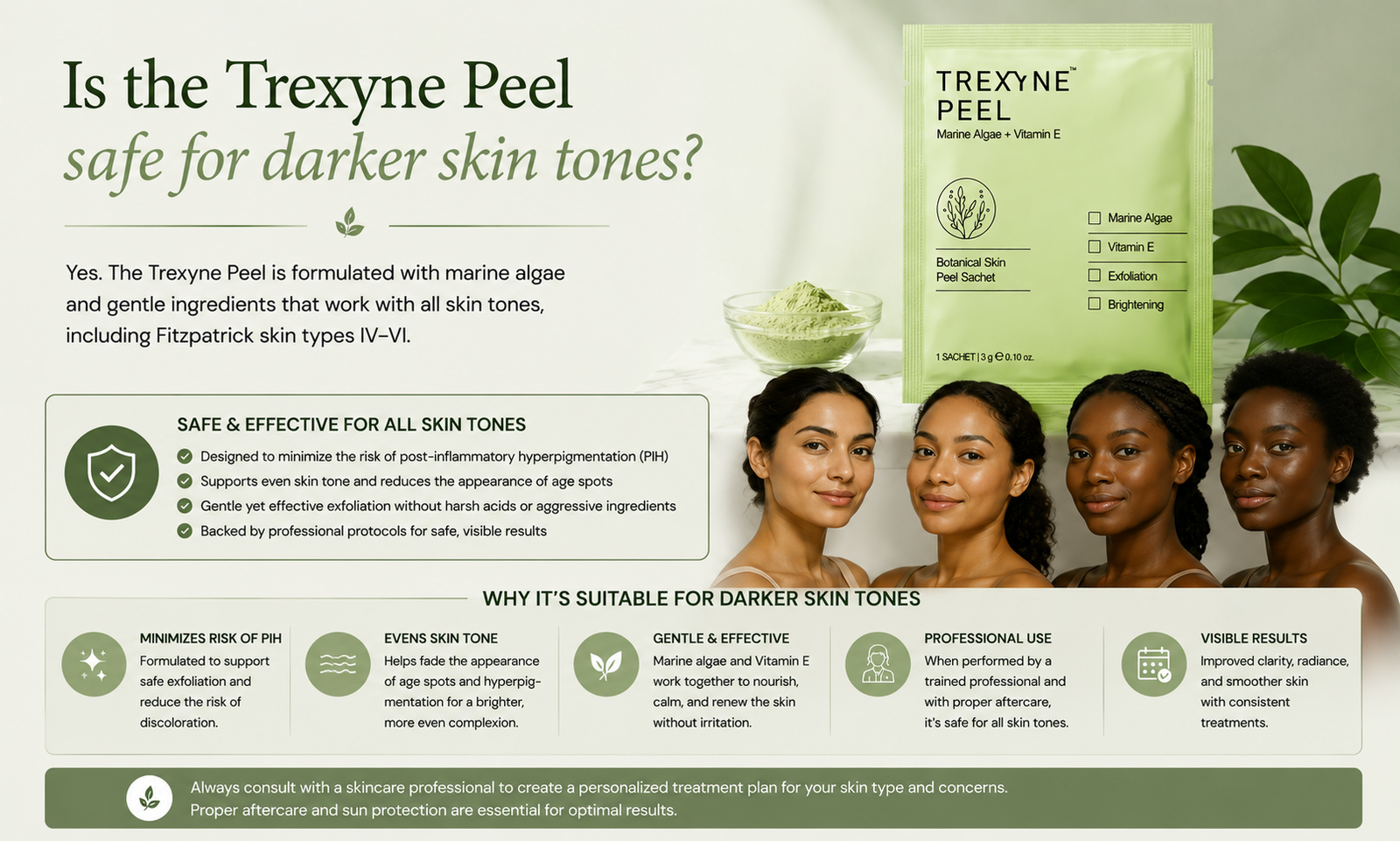
Is the Trexyne Peel Safe for Darker Skin Tones?
This is one of the most important questions a practitioner can ask before recommending any resurfacing treatment to a client with a medium, olive, brown, or dark skin tone. The short answer is that the Trexyne Peel’s mechanical mechanism makes it a more considered option for darker skin tones than acid-based resurfacing, precisely because it does not generate the chemical inflammatory response that carries the highest risk of post-inflammatory hyperpigmentation in Fitzpatrick skin types III to VI. That said, no resurfacing treatment is without risk for any skin type, and individual suitability is always determined at consultation by a trained practitioner rather than assumed from skin tone alone. The Trexyne Peel is a professional treatment designed exclusively for use by verified aesthetic practitioners who carry out that assessment as a matter of course before every session.
Why Skin Tone Matters in Resurfacing Treatment Selection
The Fitzpatrick scale classifies skin into six types based on how the skin responds to UV exposure, from very fair skin that always burns and never tans at type I through to deeply pigmented skin that never burns at type VI. This classification is clinically useful in resurfacing because it correlates broadly with melanocyte activity and, importantly, with the likelihood of a post-inflammatory hyperpigmentation response to treatments that generate inflammation in the skin.
Melanocytes produce melanin as a protective response to UV radiation and also in response to inflammatory signals within the skin. In Fitzpatrick types III to VI, melanocytes tend to be more numerous and more reactive than in lighter skin types. This means the inflammatory response generated by a resurfacing treatment is more likely to trigger a significant melanin overproduction response, producing post-inflammatory hyperpigmentation that can be more visible, more persistent, and harder to resolve than the original concern the treatment was intended to address.
This is not a reason to exclude darker skin tones from resurfacing entirely. It is a reason to select the treatment mechanism with particular care.
The Core Risk: Post-Inflammatory Hyperpigmentation
Post-inflammatory hyperpigmentation, or PIH, is the central concern when resurfacing darker skin tones. It develops when inflammation, whether from a breakout, a skin injury, or a treatment that generated more inflammatory response than the skin could manage smoothly, triggers melanocytes to overproduce pigment in the affected area. The resulting patches are flat, discoloured, and can range from reddish-brown to deep brown or near-black depending on the depth of melanin deposition and the client’s skin tone.
In darker skin types, PIH can be more pronounced and longer-lasting than in lighter skin. The higher baseline melanocyte activity means the pigmentation response to the same inflammatory stimulus is often stronger. Dark patches that develop after a resurfacing treatment in a Fitzpatrick type V or VI client can take considerably longer to fade than the same outcome in a type II client, and in some cases they become a more prominent concern than whatever the original treatment was addressing.
Understanding this dynamic is why the practitioner community has historically approached resurfacing on darker skin tones cautiously, and why the mechanism of the treatment, not just the intensity, matters so much in this clinical context.
Why a Mechanical Mechanism Changes the Risk Profile
The Trexyne Peel resurfaces through marine-algae spicules that create controlled micro-channels in the skin’s surface through a purely physical process. No acids are involved. No chemical reaction takes place in the skin during treatment. Because the resurfacing is achieved through physical rather than chemical action, the treatment does not engage the same inflammatory cascade that acid-based resurfacing generates as part of its mechanism.
For darker skin tones, this difference is clinically meaningful. The primary route by which resurfacing triggers PIH in susceptible skin is the chemical inflammatory response. Removing that chemical trigger does not eliminate all risk, since any resurfacing creates some degree of controlled disruption that the skin needs to recover from. However, it removes the specific mechanism most closely associated with PIH provocation in Fitzpatrick types III to VI.
This is why the Trexyne Peel sits in a different clinical category from acid-based peels when darker skin tones are the patient population being discussed. The question is not simply whether the treatment is gentle enough. It is whether the mechanism itself is appropriate for skin that responds to inflammatory signals with a heightened melanin response.
Vitamin E and Recovery in Melanin-Rich Skin
Recovery management matters as much as treatment selection for darker skin tones. The period following any resurfacing treatment is when the skin is most vulnerable to the triggers that can provoke PIH. Unprotected UV exposure during recovery, additional irritation from product use, or heat sources that generate further skin stress can all contribute to a melanin response during the healing phase even when the treatment itself was well tolerated.
The Trexyne Peel includes stabilised tocopherol, a form of Vitamin E, which supports the skin’s recovery phase from the first application. For clients with higher melanocyte reactivity, recovery support within the formulation itself reduces the period during which the skin is managing repair without adequate support. A skin that recovers efficiently and with less residual inflammation is less likely to produce a PIH response in the post-treatment window.
This recovery-supportive component of the formulation is relevant for all skin types but carries particular clinical weight when treating clients whose skin is more sensitive to inflammatory triggers during recovery.
The Tiered Protocol as a Safety Mechanism
One of the most practically useful features of the Trexyne Peel for practitioners working with darker skin tones is the tiered protocol that allows intensity to be matched to the individual client’s skin condition at each appointment. For Fitzpatrick types III to VI, beginning at a conservative intensity and progressing only as the skin demonstrates its tolerance is not simply a cautious preference. It is the correct clinical approach.
Starting conservatively generates real information about how that individual’s skin responds to the treatment at this particular intensity. It allows the practitioner to observe the recovery, check for any early signs of a pigmentation response, and make an informed decision about whether and how much to increase intensity at the next session. This session-by-session calibration is far more appropriate for PIH-prone skin than committing to a fixed intensity from the outset.
The tiered protocol is only useful, however, when the person applying it has the training to read the skin’s response accurately and act on what they observe. This is one of the reasons the Trexyne Peel is restricted to verified practitioners and clinics rather than available for self-administration.
The Importance of Starting Conservatively
For a client with a Fitzpatrick type IV skin tone who is considering their first resurfacing treatment, the first session of a Trexyne Peel course should be approached as an opportunity to gather information about that skin’s response rather than to achieve maximum resurfacing output. A conservative first session that recovers without complication tells the practitioner that the skin can tolerate this mechanism at this intensity. That is clinically valuable information that supports confident progression in subsequent sessions.
A first session that produces an unexpected response, even a mild one, signals that further caution is warranted before intensity is increased. This kind of responsive protocol management is what makes a professional treatment fundamentally different from a home-use product applied without oversight.
Consultation Priorities for Darker Skin Tone Clients
When a client with a darker skin tone attends a consultation for resurfacing, the consultation itself needs to cover specific ground beyond the standard skin assessment. PIH history is the most important starting point. Has the client experienced visible darkening after previous treatments, breakouts, or skin injuries? How pronounced was it and how long did it take to resolve? This history is the most direct indicator of their individual PIH risk and shapes the protocol from the first session.
Current skin condition and barrier integrity should also be assessed. A client whose skin is already inflamed or whose barrier is compromised before treatment begins is at higher risk of a PIH response than a client whose skin is in a stable, settled state. If the skin is not in a suitable condition to proceed, deferring the session is the correct decision.
The consultation is also the appropriate moment to discuss the central role of daily SPF use throughout the treatment course. UV exposure is the most significant amplifier of PIH risk between sessions and after the course is complete. A practitioner who communicates this clearly and specifically, rather than as a general afterthought, is setting the client up for the best possible outcome.
Setting Honest Expectations With Darker Skin Tone Clients
Clients with darker skin tones have often been told by previous practitioners that resurfacing is not suitable for them, or have had experiences of PIH after previous treatments that have made them cautious. Both of these histories require honest, transparent communication rather than blanket reassurance.
Explaining clearly that the Trexyne Peel’s mechanism is different from the treatments that previously caused problems, and specifically why that mechanical difference matters for their skin type, is more persuasive and more responsible than simply saying this treatment is safe. Clients who understand the clinical reasoning behind the treatment selection are better positioned to engage with the protocol, follow aftercare guidance consistently, and evaluate their own progress accurately.
Practitioners looking to incorporate a professional botanical peel into their protocols for darker skin tones can explore the full product range via the Trexyne shop, or reach the team directly through the Trexyne contact page.
When to Refer On
For clients with very deep or persistent PIH, or with pigmentation patterns that could suggest conditions requiring dermatological assessment such as melasma with a dermal component, onward referral before resurfacing is the appropriate course. Similarly, if a client presents with pigmented lesions that do not fit the expected pattern of PIH or sun damage, a dermatological review should precede any resurfacing treatment regardless of skin tone.
Clinical responsibility for darker skin tone clients includes knowing when to refer rather than simply selecting a gentler treatment and proceeding regardless. The most credible practitioners are those who are as clear about the limits of their clinical remit as they are about what they can offer.
More information on the Trexyne approach to professional botanical resurfacing is available on the Trexyne website.
Conclusion
The Trexyne Peel is a more clinically appropriate resurfacing option for darker skin tones than acid-based alternatives, primarily because its mechanical mechanism does not generate the chemical inflammatory response that carries the highest risk of triggering post-inflammatory hyperpigmentation in Fitzpatrick types III to VI. Stabilised Vitamin E supports recovery from the first application, reducing the post-treatment window during which the skin is most vulnerable to PIH provocation. The tiered protocol allows trained practitioners to match intensity conservatively to the individual client’s skin and build gradually based on demonstrated tolerance. None of this removes the need for thorough consultation, honest expectation-setting, and meticulous aftercare guidance for this client group. Used correctly by a trained professional, the Trexyne Peel may offer darker skin tone clients a more predictable and better-tolerated path to a brighter, more even-looking complexion than chemical resurfacing has historically been able to provide.
FAQs
Q: Is the Trexyne Peel safe for darker skin tones?
The Trexyne Peel’s mechanical mechanism avoids the chemical inflammatory trigger most closely associated with post-inflammatory hyperpigmentation in Fitzpatrick types III to VI, making it a more considered option for darker skin tones than acid-based resurfacing. Individual suitability is assessed by a trained practitioner at consultation, taking into account the client’s PIH history, current skin condition, and treatment goals.
Q: Why do darker skin tones have a higher risk of PIH after resurfacing?
Darker skin tones have higher baseline melanocyte activity and a stronger melanin response to inflammatory signals. When resurfacing generates inflammation in the skin, melanocytes in these skin types are more likely to overproduce pigment in the treated area, producing post-inflammatory hyperpigmentation that can be more pronounced and longer-lasting than in lighter skin types.
Q: What makes the Trexyne Peel’s mechanism safer for PIH-prone skin?
The Trexyne Peel resurfaces through marine-algae spicules via a purely mechanical mechanism with no chemical exfoliants involved. This removes the chemical inflammatory trigger that is the primary route by which acid-based resurfacing provokes PIH in susceptible skin. The formulation also includes stabilised Vitamin E to support recovery, reducing the post-treatment period during which the skin is most vulnerable to a melanin response.
Q: Can clients with Fitzpatrick type V or VI skin have the Trexyne Peel?
Suitability for any individual client is assessed at consultation by a trained practitioner who reviews PIH history, current skin condition, and other relevant factors. The Trexyne Peel’s tiered protocol allows intensity to begin conservatively and build based on the skin’s demonstrated tolerance, which is the appropriate approach for clients at higher risk of PIH.
Q: How important is daily SPF for darker skin tone clients having the Trexyne Peel?
Daily broad-spectrum SPF use is essential throughout and after a Trexyne Peel course for all skin types, but it carries particular clinical weight for darker skin tones. UV exposure between sessions can amplify PIH risk by stimulating melanocyte activity in treated areas. Consistent sun protection is one of the most significant factors in how well and how safely a treatment course progresses.
Q: What should practitioners discuss at consultation before treating a darker skin tone client?
Key consultation priorities include a thorough PIH history, current skin condition and barrier integrity, any previous resurfacing experiences and how the skin responded, current prescription or active product use, and a clear discussion of the role of daily SPF throughout the course. Setting accurate expectations and explaining the clinical rationale for the mechanical mechanism is also essential for this client group.
Q: Where can practitioners find guidance on using the Trexyne Peel for darker skin tones?
Practitioners can explore the full product range and stocking options via the Trexyne shop, or contact the Trexyne team directly through the contact page for further guidance on incorporating the treatment into protocols for Fitzpatrick types III to VI.