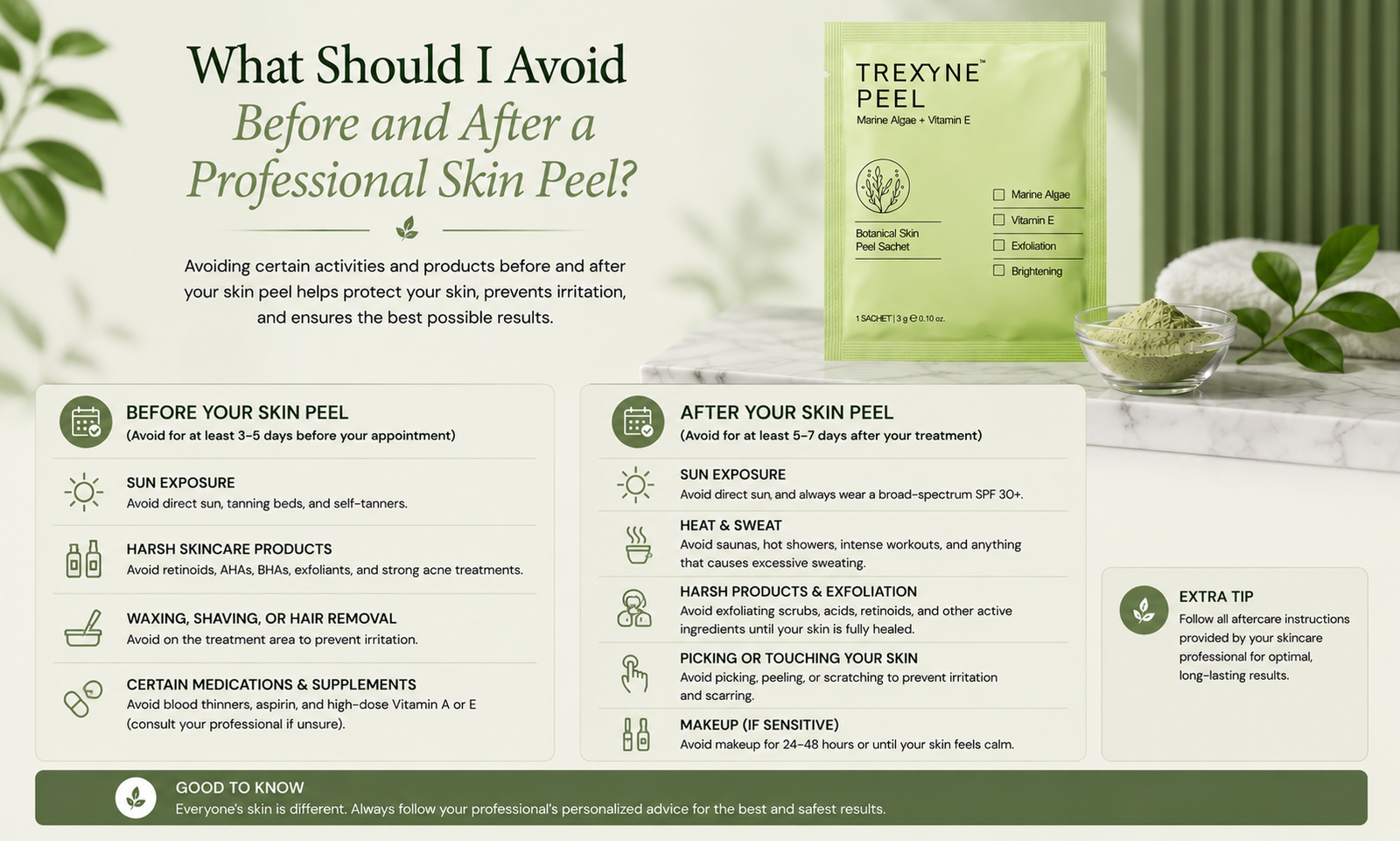
What Should I Avoid Before and After a Professional Skin Peel?
What you do in the days before and after a professional skin peel has a direct influence on how well the treatment works and how smoothly your skin recovers. Practitioners who brief clients thoroughly on both sides of this window consistently see better outcomes than those who focus only on the treatment itself. Before a session, the priority is presenting skin that is in the best possible condition to tolerate resurfacing: barrier intact, not inflamed, and free from products or recent procedures that could compromise safety or results. After a session, the priority shifts to protecting the skin while it repairs and renews. The Trexyne Peel is a mechanical resurfacing treatment with a predictable recovery profile, but the pre- and post-treatment guidance that surrounds it is just as important as the treatment itself. This post covers both windows in practical, specific terms.
Why Pre-Treatment Preparation Matters
The skin that arrives at a resurfacing appointment is the skin that undergoes the treatment. If that skin is already compromised, sensitised, or carrying active inflammation from recent product use or procedures, the treatment is being applied to a less resilient starting point. This can increase the risk of an exaggerated recovery response, uneven results, or a longer-than-expected healing period.
Pre-treatment preparation is not complicated, but it requires clients to make specific changes to their routine in the days leading up to their appointment rather than carrying on as normal until the day. The most common pre-treatment mistakes happen simply because no one told the client clearly what to stop doing or when. Written guidance sent ahead of the appointment removes this ambiguity and reduces the risk of a preventable complication.
Avoid Active Skincare Products in the Week Before
Active skincare products include retinoids, vitamin C, exfoliating acids, AHAs, BHAs, and any product that is specifically designed to stimulate skin turnover or increase cell renewal. These products all increase skin sensitivity to some degree, and using them close to a resurfacing appointment means the skin arrives at the session in a more reactive state than it would otherwise be.
For retinoids in particular, most practitioners recommend pausing use for at least five to seven days before a resurfacing treatment. Retinoids thin the stratum corneum over time and can make the skin significantly more responsive to resurfacing than a client’s normal skin type would suggest. Failing to pause them before treatment is one of the most common reasons for an unexpectedly strong recovery response in clients whose skin appeared resilient at previous appointments.
Exfoliating acids at home should be paused for a similar period. A client who has been double-cleansing with an acid toner every evening and then undergoes professional resurfacing without a break in that routine is presenting skin that has already been partially disrupted at the surface. The professional treatment on top of this increases the risk of over-treatment even when the intensity selected seems appropriate for that skin type.
Avoid Waxing, Threading, and Hair Removal Procedures
Waxing, threading, and other hair removal procedures that involve physical contact with the skin surface should be avoided in the days immediately before a resurfacing treatment. These procedures create micro-trauma in the skin and leave the treated area more reactive and vulnerable than usual. Applying resurfacing to skin that is already experiencing this kind of surface disruption increases the risk of irritation and can produce uneven results in the treated area.
Laser or IPL hair removal should also be avoided in the weeks around a resurfacing appointment. The combination of two energy-based or physically disruptive treatments in close proximity is never advisable, and the practitioner administering the peel needs to know about any recent procedures when assessing the skin before treatment.
Avoid Sun Exposure and Sunbeds Before Treatment
Sun exposure in the days before a resurfacing treatment increases the skin’s baseline sensitivity and can introduce UV-related inflammation that compromises how the skin tolerates the session. Clients who arrive with visible sun exposure, a suntan, or the early redness of mild sunburn from recent outdoor activity or sunbed use should have their treatment deferred until the skin has settled.
This applies to gradual, cumulative exposure as well as obvious burn. A client who has spent a week outdoors on holiday and whose skin looks healthy and tanned is still presenting skin that is more reactive and more melanocyte-active than skin that has been consistently protected. Practitioners should ask about recent sun exposure at every pre-treatment assessment rather than relying on visual appearance alone.
Clients should be advised to apply daily broad-spectrum SPF consistently in the weeks leading up to their first session and throughout the entire treatment course.
Avoid Certain Prescription Medications Without Disclosure
Some prescription medications affect how the skin responds to resurfacing treatments and need to be disclosed at consultation before any session proceeds. Isotretinoin, commonly prescribed for acne, significantly thins and sensitises the skin and is a contraindication for professional resurfacing. Most practitioners require a waiting period of at least six months after completing an isotretinoin course before resurfacing is considered.
Some antibiotics, blood thinners, and certain hormonal medications can also affect skin sensitivity or healing. Clients should be encouraged to disclose all current medications at consultation rather than only the ones they consider relevant to skincare. It is the practitioner’s clinical responsibility to assess this information and make the appropriate decision about whether to proceed.
What to Avoid Immediately After a Session
The post-treatment window is where many of the most impactful mistakes happen, and where clear guidance from the practitioner makes the biggest difference. The skin following a resurfacing session has been intentionally disrupted and is in an active repair state. It is more vulnerable to irritants, UV damage, and inflammatory triggers than it would be in its normal condition.
The first 48 hours after treatment are the most critical. During this period the skin is working hardest to begin its repair response, and anything that interferes with this process can extend the recovery timeline or trigger an adverse reaction.
Avoid All Active Skincare Products After Treatment
The post-treatment routine should be stripped back entirely to a gentle cleanser, a fragrance-free moisturiser, and daily broad-spectrum SPF. All active products, including retinoids, vitamin C serums, exfoliating acids, and treatment-focused serums of any kind, should be paused until the skin has fully settled. For most clients this means a minimum of one to two weeks before reintroducing anything active, and even then reintroduction should be gradual and one product at a time.
Clients who are accustomed to a complex skincare routine can find this simplification difficult. Framing the stripped-back approach as an active, intentional part of the treatment rather than a passive waiting period helps with compliance. The skin is doing significant work during recovery, and reducing the number of ingredients it has to process supports that work rather than impeding it.
The Trexyne Peel supports recovery from the first application through stabilised Vitamin E in its formulation, which means the skin is not left entirely unaided during the repair process. The aftercare routine supports and reinforces this, rather than replacing it.
Avoid Heat in All Forms After Treatment
Heat is one of the most underestimated post-treatment triggers. It causes blood vessels near the skin surface to dilate, which prolongs visible redness and can extend the period during which the skin feels reactive and warm. In the days following a resurfacing session, clients should avoid:
- Hot showers and baths: use lukewarm water only when washing the face
- Saunas and steam rooms
- Intense cardiovascular exercise that significantly raises core body temperature
- Direct heat sources including standing over a hot hob or sitting very close to open fires
- Hot drinks held close to the face for extended periods
Cold is generally better tolerated than heat during recovery. If the skin feels uncomfortable, a cool (not ice-cold) flannel applied briefly can offer relief without the risk of prolonged vessel dilation that heat creates.
Avoid UV Exposure After Treatment
Freshly resurfaced skin is significantly more vulnerable to UV damage than intact skin. The outer layers that normally provide a degree of physical protection have been deliberately disrupted, and the skin is more reactive to UV stimulus than usual. UV exposure in the days after treatment can produce visible burning on skin that would not normally burn in the same conditions, and it is one of the most direct ways to trigger post-inflammatory hyperpigmentation in susceptible skin types.
Daily broad-spectrum SPF of at least factor 30 applied every morning is non-negotiable throughout the recovery period and for the duration of the treatment course. This includes overcast days, short outdoor journeys, and driving. UV exposure does not require bright sunshine to affect recovering skin.
Practitioners looking to build a robust pre- and post-treatment guidance document for clients receiving the Trexyne Peel can find the full product range and additional resources via the Trexyne shop, or reach the team through the Trexyne contact page. More information on the Trexyne approach to professional botanical resurfacing, including the treatment mechanism and protocol, is available on the Trexyne website.
Avoid Picking, Rubbing, or Interfering With Peeling Skin
As the skin moves through the renewal process in the days following treatment, some degree of superficial shedding or light flaking is normal and expected. This is the outer layers of disrupted cells being replaced by the newer cells beneath, and it is a visible sign that the renewal process is working as it should.
Picking at peeling skin, rubbing the face vigorously when cleansing or drying, or using any physical exfoliant to try to accelerate the shedding process all disrupt the natural shedding sequence and can produce uneven results. In some cases, physical interference with peeling skin can remove cells that have not yet fully separated, which creates a raw surface that takes longer to heal and is more prone to scarring or pigmentation changes.
The skin sheds in its own time. The practitioner’s role is to support that process, and the client’s role is to allow it to happen without interference.
Conclusion
What clients do in the days before and after a professional skin peel has a direct impact on the safety, comfort, and quality of the result. Before treatment, the priorities are presenting skin that is barrier-intact and free from recent disruption: no active skincare products for at least a week, no waxing or hair removal procedures, no recent sun exposure, and full disclosure of any relevant medications. After treatment, the priorities are protecting the recovering skin from anything that could extend inflammation or trigger a pigmentation response: a stripped-back routine, daily SPF without exception, heat avoidance, and leaving peeling skin to shed naturally. The Trexyne Peel is designed around predictable, manageable downtime, and thorough pre- and post-treatment guidance from the treating practitioner gives clients the best possible chance of a smooth recovery and a brighter, more even-looking complexion as the course progresses.
FAQs
Q: What should I stop using on my skin before a professional peel?
Pause all active skincare products including retinoids, vitamin C, exfoliating acids, and AHAs or BHAs for at least five to seven days before your appointment. These products increase skin sensitivity and can make the skin more reactive to resurfacing than expected. Your practitioner will advise on the specific pause period based on what you are using.
Q: Can I go in the sun before a professional skin peel?
Avoid significant sun exposure and sunbeds in the days before a resurfacing treatment. UV exposure increases the skin’s baseline sensitivity and can introduce inflammation that compromises how well the skin tolerates the session. If you have recently had significant sun exposure, your practitioner may defer the treatment until the skin has settled.
Q: What skincare can I use after a professional peel?
In the days immediately following a peel, keep your routine stripped back to a gentle fragrance-free cleanser, a simple fragrance-free moisturiser, and daily broad-spectrum SPF. Avoid all active products until the skin has fully settled, then reintroduce one product at a time. Your practitioner will provide specific guidance based on your skin’s response to treatment.
Q: How long should I avoid exercise after a professional skin peel?
Intense cardiovascular exercise that significantly raises core body temperature should be avoided for at least 48 hours after a resurfacing session. Heat generated by exercise dilates blood vessels near the skin surface and can prolong redness and extend the recovery period. Light activity is generally fine once the initial recovery response has settled.
Q: Why can’t I pick at peeling skin after a professional peel?
Superficial shedding in the days after resurfacing is a normal part of the renewal process. Picking at or removing peeling skin before it is ready to shed naturally disrupts the repair sequence and can cause uneven results, a raw surface that takes longer to heal, or changes in pigmentation. Allow the skin to shed in its own time and avoid using any physical exfoliant during recovery.
Q: Do I need to use SPF after a professional skin peel?
Yes, daily broad-spectrum SPF is non-negotiable after any resurfacing treatment. Freshly resurfaced skin is more vulnerable to UV damage, and UV exposure during recovery can trigger post-inflammatory hyperpigmentation in susceptible skin and undermine the results of the treatment. Apply SPF every morning without exception for the duration of the treatment course.
Q: How long before a peel should I stop using retinol?
Most practitioners advise pausing retinoids for at least five to seven days before a resurfacing session. Retinoids thin the stratum corneum and increase skin sensitivity, which can cause a stronger than expected recovery response if the skin is still under their influence at the time of treatment. Check with your practitioner for specific guidance based on the strength of the retinoid you are using.