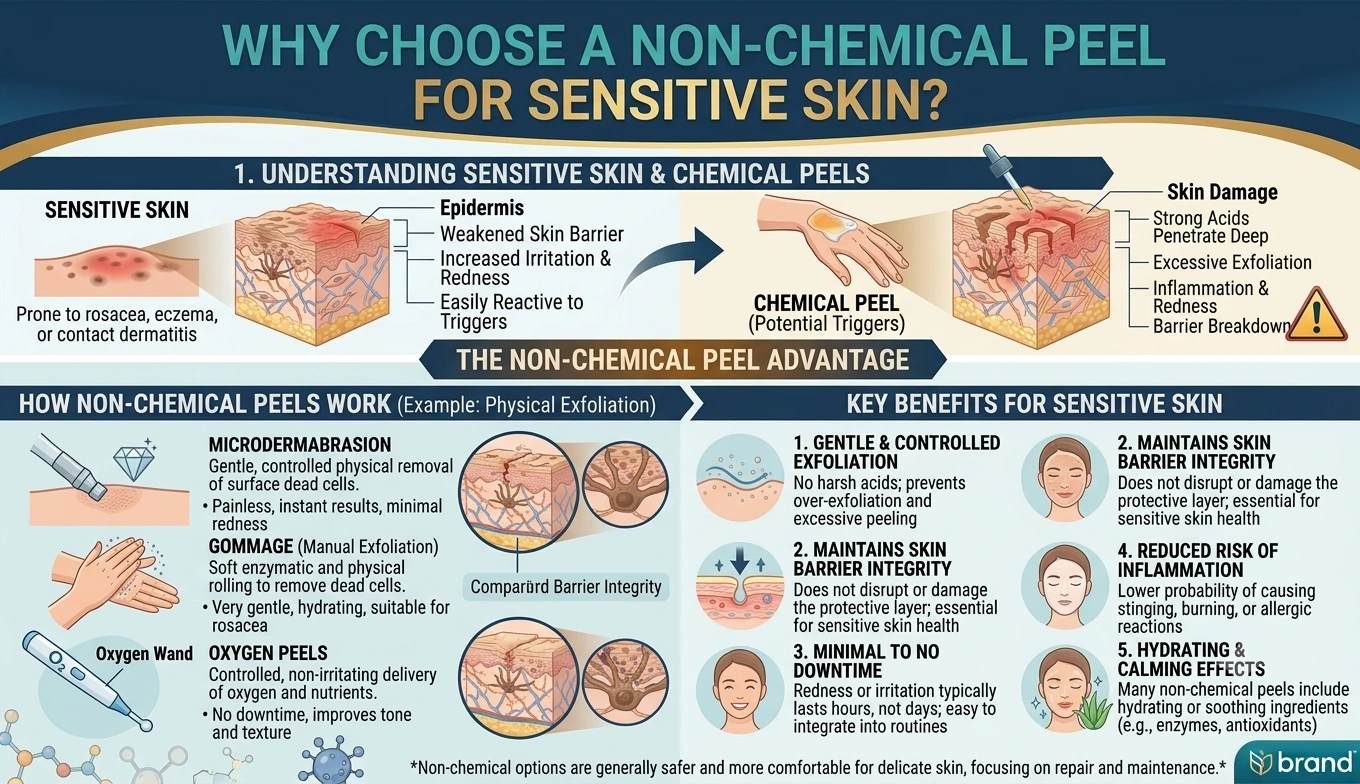
Why Choose a Non-Chemical Peel for Sensitive Skin?
Sensitive skin needs resurfacing that works with its natural barrier rather than against it, which is why a non-chemical peel is often the safer starting point for reactive or easily irritated clients. Traditional peels rely on acids to break down the skin’s surface layers, and this can leave sensitive skin red, tight, and unpredictable for days. A mechanical approach, by contrast, resurfaces the skin through controlled physical exfoliation rather than chemical penetration. This is the principle behind the Trexyne Peel, a professional treatment built around marine-algae spicules and stabilised Vitamin E. For practitioners working with sensitive-skin clients, understanding this distinction is the first step towards recommending treatments that deliver results without unnecessary risk.
What Does “Sensitive Skin” Actually Mean in a Clinical Setting?
Sensitive skin is not a single condition. It is a term practitioners use to describe skin that reacts more readily than average to environmental triggers, active ingredients, or physical stimulation. Clients with sensitive skin often report stinging, tightness, visible redness, or flushing after using products that other clients tolerate without issue.
In clinic, this presentation can stem from a compromised skin barrier, rosacea-prone tendencies, thin or fair skin types, or simply a history of reacting to strong actives. Whatever the root cause, the common thread is a reduced tolerance threshold. This matters enormously when choosing a resurfacing treatment, because the mechanism behind that treatment can be the difference between a comfortable, effective session and one that sets the skin back.
Why This Matters for Treatment Selection
Practitioners assessing a new client for resurfacing work need to look beyond the desired outcome and consider how the skin is likely to respond to the method itself. A client asking for smoother, brighter skin may still be a poor candidate for an aggressive chemical protocol if their barrier function is already weakened.
A thorough consultation should always cover past reactions to skincare products, any diagnosed skin conditions, current medication use, and general lifestyle factors such as sun exposure and stress levels. Sensitive skin can also fluctuate seasonally, so a client who tolerated a treatment well in the past may respond differently during colder months when the barrier is naturally more compromised. Building this kind of detailed picture before recommending any resurfacing treatment helps practitioners move away from a one-size-fits-all approach and towards something genuinely suited to the skin in front of them on that particular day.
The Problem With Traditional Chemical Peels on Reactive Skin
Chemical peels work by using acids to penetrate the skin and encourage controlled shedding of the outer layers. For many skin types, this can be an effective way to address texture, tone, and dullness. But for sensitive or reactive skin, the depth of penetration and the chemical nature of the process can be harder to control precisely.
Reactions can include prolonged redness, unexpected sensitivity, or a longer recovery window than anticipated. Because chemical exfoliation works below the surface, the intensity of the reaction is not always easy to predict in advance, particularly in clients who have not had extensive peel history.
This is one of the main reasons practitioners are increasingly looking towards non-chemical, mechanical alternatives for their more delicate clients. A treatment that works on the surface through physical exfoliation rather than chemical penetration gives the practitioner more visible control throughout the session.
There is also the question of client anxiety. Many sensitive-skin clients arrive at a consultation having already had a poor experience with a chemical treatment elsewhere, whether that was excessive stinging during application or days of unexpected flaking afterwards. This history often makes them hesitant to try resurfacing again, even though they may still want the improvements in texture and tone that a good peel can offer. Being able to explain a genuinely different mechanism, one that does not rely on acids at all, can make a real difference in rebuilding a client’s confidence in professional treatment.
How a Mechanical, Non-Chemical Peel Works
A non-chemical peel achieves resurfacing through physical means rather than through acid-based chemical exfoliation. In the case of the Trexyne Peel, this is achieved using marine-algae spicules, which create controlled micro-channels across the skin’s surface. There are no acids involved in this process and no chemical exfoliants of any kind.
This mechanical action allows the practitioner to work with a method that is, in principle, easier to titrate to the individual client. Because the mechanism is physical rather than chemical, the depth and intensity of the treatment can be matched more closely to what the skin can tolerate on the day, rather than relying on a fixed chemical concentration that behaves the same way regardless of the client sitting in the chair.
Why Marine-Algae Spicules Are Different From Acids
Marine-algae spicules work through direct, controlled contact with the skin’s surface. This is fundamentally different from an acid, which diffuses into the skin and initiates a chemical reaction that continues even after it has been neutralised. With a mechanical approach, the action stops when the physical exfoliation stops, which gives practitioners a more immediate sense of control during application.
For clients who are curious about the science behind this, it can help to explain that this is a botanical mechanism rather than a chemical one. The spicules originate from marine algae and work purely through physical contact with the skin’s surface, without triggering the kind of chemical cascade associated with acid-based products. This distinction is often reassuring for clients who have specifically sought out a non-chemical option, and it also explains why the treatment can be adjusted so precisely through the tiered protocol.
Vitamin E’s Role in Supporting Skin Recovery
Any resurfacing treatment, chemical or mechanical, creates a temporary disruption to the skin’s surface. What happens immediately afterwards matters just as much as the resurfacing itself, particularly for sensitive skin types that may be more prone to prolonged redness or discomfort.
The Trexyne Peel is infused with stabilised Vitamin E, which is included specifically to support the skin’s recovery phase from the very first application. Vitamin E is a well-established antioxidant that is associated with supporting the skin’s natural resilience following a resurfacing treatment. For sensitive skin, this additional layer of support can be a meaningful part of why a treatment feels comfortable rather than harsh.
Practitioners working with sensitive-skin clients often place a lot of weight on what happens in the hours and days after a treatment, not just during the session itself. A client’s overall satisfaction with a resurfacing treatment is shaped heavily by how their skin feels once they leave the clinic. Including a stabilised form of Vitamin E within the formulation means this recovery support is built directly into the treatment itself, rather than being left entirely to whatever aftercare products the client happens to use at home.
Predictable Downtime and Why It Matters for Sensitive Clients
One of the biggest concerns practitioners hear from sensitive-skin clients is uncertainty about downtime. Clients want to know how their skin will look and feel in the days following treatment, especially if they have work commitments or social events planned.
Because the Trexyne Peel uses a tiered protocol, practitioners can match treatment intensity to the client’s skin type and expectations. This means a first-time client with reactive skin can be treated more conservatively, while a client with a longer treatment history and better tolerance can move through the tiers at a pace suited to their skin.
Building Confidence Through Consistency
Predictable downtime is not only about comfort. It is also about trust. When a client knows roughly what to expect after a treatment, they are more likely to return for the consistent, ongoing sessions that produce visible long-term improvement. This is particularly valuable for sensitive-skin clients who may have previously avoided resurfacing treatments altogether out of fear of an unpredictable reaction.
From a practice management perspective, predictable downtime also makes it easier to plan a realistic treatment calendar with each client. Rather than leaving unpredictable gaps between sessions to allow for an uncertain recovery period, practitioners can space appointments with more confidence, which supports better long-term adherence to a treatment plan. Clients who understand roughly what their skin will look like a day or two after treatment are also more likely to book with sensitive social events in mind, such as an appointment scheduled comfortably ahead of a wedding or a work event rather than too close to it.
Who Is a Good Candidate for a Non-Chemical Approach?
Not every sensitive-skin client will respond the same way, but there are common profiles where a non-chemical peel tends to be a sensible starting point:
- Clients with a history of reacting to chemical exfoliants or strong actives
- Clients with rosacea-prone or easily flushed skin
- Clients who are new to professional resurfacing and want a gentler introduction
- Clients who need to avoid extended downtime due to work or lifestyle commitments
- Clients with thinner or more fragile skin who may be more susceptible to barrier disruption
Practitioners should always carry out a full consultation before selecting any treatment protocol, but these profiles are a useful starting point when discussing options with a sensitive-skin client.
It is worth noting that sensitivity is not always a permanent trait. Some clients experience temporary sensitivity following other treatments, changes in medication, or periods of environmental stress such as harsh winter weather or excessive sun exposure. In these cases, a non-chemical approach can serve as a useful bridge, allowing the client to continue working towards their skincare goals without placing additional demands on skin that is already under strain. Once the underlying sensitivity has settled, some clients may be reassessed for other treatment options, though many choose to continue with a mechanical approach simply because of how comfortable and predictable they find it.
Structuring a Tiered Protocol for Reactive Skin Types
A tiered approach allows practitioners to build a treatment plan gradually rather than committing to a single fixed intensity. For a sensitive-skin client, this typically means starting at the lowest appropriate tier and assessing the skin’s response before considering any progression.
This staged structure gives both the practitioner and the client confidence. The practitioner can observe exactly how the skin responds at each stage, and the client can build trust in the process without feeling like they have been exposed to more than their skin was ready for. Over a series of sessions, many sensitive-skin clients find they can gradually tolerate slightly higher tiers as their skin’s resilience improves.
Clinics interested in structuring these protocols correctly can find full product specifications and tier information on the Trexyne shop page.
Documentation plays an important role here too. Keeping detailed notes on how each client responded at each tier, including any redness, sensitivity, or comments the client made about the sensation during treatment, allows practitioners to build an accurate picture over time. This record becomes especially valuable for sensitive-skin clients, as it removes any guesswork from future sessions and allows the practitioner to make evidence-based decisions about whether to hold at the current tier or progress gradually.
What Clients Can Expect During and After Treatment
Setting realistic expectations is an essential part of any resurfacing consultation, particularly for sensitive skin. During the Trexyne Peel treatment, clients may notice a light physical sensation as the marine-algae spicules work across the skin’s surface. This is generally well tolerated, and because the mechanism is mechanical rather than chemical, most clients describe the sensation as controlled and mild rather than intense.
Immediately afterwards, some mild redness is normal and typically settles within a short window, though individual recovery times can vary. Because Vitamin E is incorporated into the formulation, many practitioners find that the skin’s recovery phase feels more comfortable compared with more aggressive resurfacing methods. Clients should always be advised to follow their practitioner’s aftercare guidance closely, particularly around sun protection in the days following treatment.
It also helps to talk clients through what they should and should not expect to see in the days following treatment. Because the mechanism is mechanical rather than chemical, visible peeling is generally less dramatic than clients might expect from a traditional chemical peel. This can actually work in favour of client satisfaction, particularly for those with busy social calendars who want subtle, professional results without an obvious “just had a treatment” appearance. Setting this expectation clearly during the consultation avoids any disappointment from clients who may associate visible flaking with a treatment “working”.
Why Practitioners Are Increasingly Choosing Botanical, Non-Chemical Options
Across the professional skincare sector, there has been a noticeable shift towards treatments that offer resurfacing benefits without the unpredictability that can come with chemical exfoliation. Sensitive-skin clients represent a growing share of any clinic’s client base, and offering a reliable, mechanically-based option broadens the range of clients a practitioner can confidently treat.
The Trexyne Peel is sold strictly to verified practitioners and clinics, which reflects its positioning as a professional treatment rather than a home-use product. This exclusivity also means practitioners can be confident that clients are not attempting to replicate the treatment outside a clinical setting, which supports safer, more controlled outcomes.
Clinics considering adding a non-chemical peel to their treatment menu can find further details on the Trexyne homepage or get in touch directly via the Trexyne contact page to discuss practitioner access and training requirements.
Offering a genuinely non-chemical option also gives practitioners a clear talking point when marketing their services to a client base that is increasingly researching treatments online before booking. Many clients now arrive at a consultation already having searched for terms like non-chemical peel or sensitive skin resurfacing, having read about the difference between acid-based and mechanical treatments. Being able to speak confidently about a botanical mechanism, and to explain exactly how it differs from a traditional peel, positions a practitioner as knowledgeable and trustworthy from the very first conversation.
Making the Right Choice for Sensitive Skin
Choosing between a chemical and non-chemical peel ultimately comes down to matching the treatment mechanism to the individual skin in front of you. For clients whose skin reacts easily, a mechanical, botanical approach offers a way to work towards smoother, more refined-looking skin without introducing the added variable of chemical exfoliation.
This does not mean chemical peels are inappropriate for every client, but for those with a genuine sensitivity profile, a non-chemical alternative like the Trexyne Peel offers a more considered starting point. Practitioners who build this option into their treatment menu often find it opens the door to clients who had previously avoided resurfacing altogether.
Conclusion
Sensitive skin reacts more readily to irritation, which makes the mechanism behind any resurfacing treatment an important consideration. Chemical peels work through acid-based exfoliation, and while effective for many, this process can be harder to predict on reactive skin. A mechanical, non-chemical approach works differently, using physical exfoliation to resurface the skin without acids or chemical penetration.
The Trexyne Peel reflects this approach, combining marine-algae spicules with stabilised Vitamin E to support both the resurfacing process and the skin’s recovery phase. With a tiered protocol, practitioners can match intensity to each client’s tolerance, helping sensitive skin work towards a brighter, more even-looking complexion at a pace that feels controlled and comfortable throughout.
Frequently Asked Questions
Q: Is a non-chemical peel safer than a chemical peel for sensitive skin?
A non-chemical peel is generally considered a gentler starting point for sensitive skin, as it works through physical exfoliation rather than chemical penetration. This can make the treatment easier to control and may reduce the likelihood of an unpredictable reaction, though a full consultation with a qualified practitioner is always recommended.
Q: What is the main difference between a chemical peel and the Trexyne Peel?
Chemical peels use acids to exfoliate the skin from within. The Trexyne Peel uses marine-algae spicules to create controlled micro-channels through a purely mechanical mechanism, with no acids or chemical exfoliants involved at any stage.
Q: Can rosacea-prone skin tolerate a mechanical resurfacing treatment?
Many rosacea-prone clients find a mechanical approach more comfortable than chemical exfoliation, as the treatment intensity can be matched to their tolerance through a tiered protocol. Individual suitability should always be assessed during a professional consultation.
Q: How much downtime should sensitive-skin clients expect after a non-chemical peel?
Downtime with the Trexyne Peel tends to be more predictable than with chemical alternatives, thanks to its tiered protocol. Some mild redness may occur, but many clients find recovery more comfortable due to the inclusion of stabilised Vitamin E in the formulation.
Q: Why does Vitamin E matter in a resurfacing treatment for sensitive skin?
Vitamin E is an antioxidant associated with supporting the skin’s natural recovery process. In the Trexyne Peel, stabilised Vitamin E is included to support this recovery phase from the first application, which can be particularly valuable for reactive or easily irritated skin.
Q: Is the Trexyne Peel suitable for home use?
No. The Trexyne Peel is sold exclusively to verified aesthetic practitioners and clinics and should only be administered by a trained professional in a clinical setting.
Q: How do practitioners decide the right treatment tier for a sensitive-skin client?
Practitioners typically begin with the lowest appropriate tier for a new or reactive-skin client, assessing the skin’s response before considering any progression. This tiered structure allows the intensity to be matched closely to each individual’s tolerance over a series of sessions.