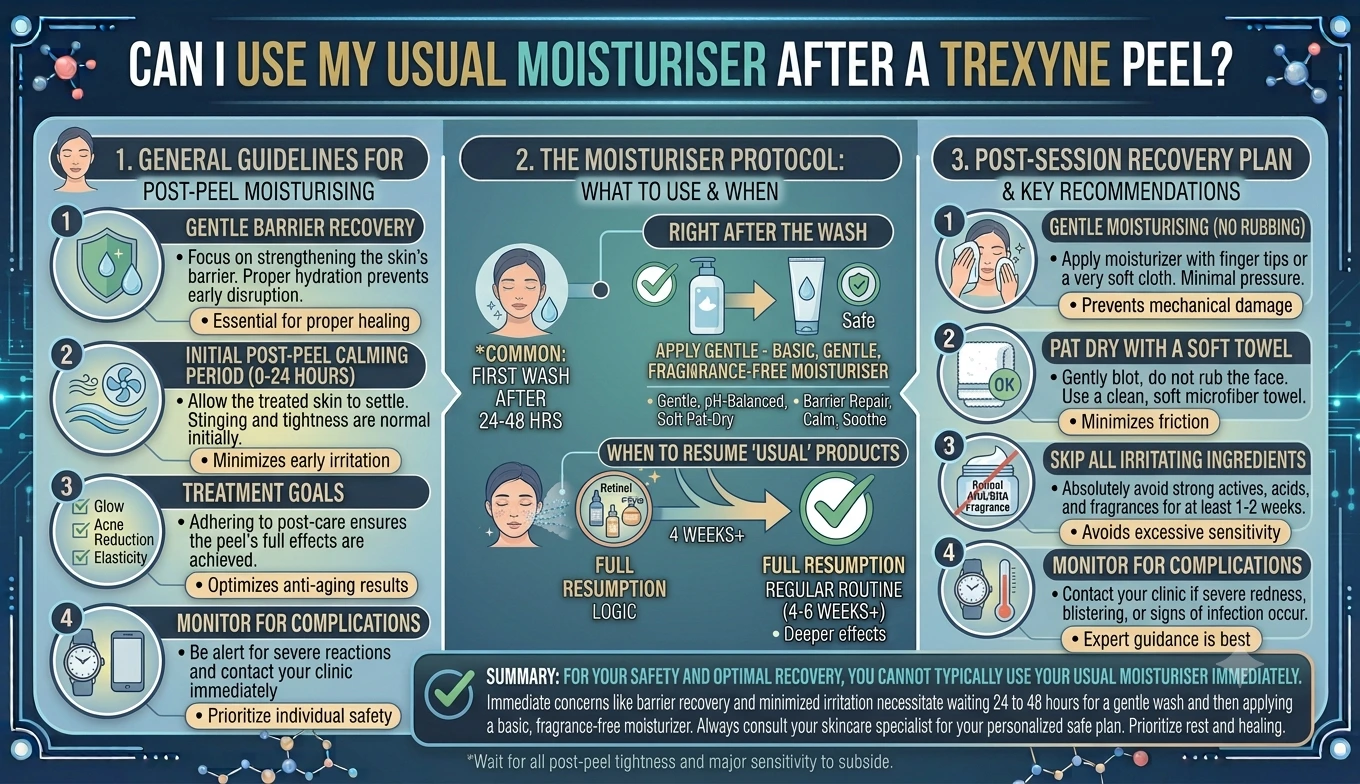
Can I Use My Usual Moisturiser After a Trexyne Peel?
Clients often ask this question within minutes of finishing their treatment, and it deserves a clear answer. In most cases, yes, a usual moisturiser can still be used after a Trexyne Peel, but the timing and the formulation matter more than people expect. The skin has just been through a controlled resurfacing process, so its barrier behaves differently for a short period afterwards. Understanding what changes, and for how long, helps you guide clients towards better results and fewer complaints about tightness or sensitivity. The Trexyne Peel works through a purely mechanical, botanical mechanism using marine-algae spicules and stabilised Vitamin E, which means aftercare advice differs from what many practitioners are used to giving after acid-based treatments. This article walks through exactly what to tell clients, why their regular moisturiser might need a short pause or a swap, and how to build aftercare guidance that protects results.
Why Aftercare Questions Matter So Much After a Peel
Aftercare is where a lot of good treatments lose their shine. A well-performed peel can be undone by the wrong product applied too soon, or by a client assuming their usual routine is safe to resume immediately.
The Skin’s State Immediately After Treatment
Right after a session, the skin surface has gone through controlled micro-channelling from the marine-algae spicules. This is a mechanical action, not a chemical one, so there is no acid to neutralise and no pH consideration. Even so, the surface is more permeable than usual for a window of time, which changes how it reacts to whatever is applied next.
Setting Expectations Before the Client Leaves
The best time to cover moisturiser questions is before the client leaves the clinic, not after they message you three days later confused about stinging. A short, written aftercare card reduces confusion and repeat questions.
What Happens to the Skin Barrier After a Trexyne Peel
The skin barrier is the outermost defence system, and it plays a central role in how comfortable the days after treatment feel.
Barrier Function in the First 24 to 48 Hours
Following the mechanical resurfacing action, the skin’s barrier function is temporarily altered. This is a normal and expected part of the renewal process, not a sign that anything has gone wrong. The stabilised Vitamin E within the formulation supports the recovery phase from the first application, which can help reduce how dramatic this window feels for most clients.
Why This Affects Product Absorption
Because the barrier is more permeable straight after treatment, whatever is applied next absorbs more readily. This is exactly why a rich, heavily fragranced, or actives-loaded moisturiser used every other day of the year might feel too much in this specific window.
Should Clients Wait Before Applying Their Usual Moisturiser?
This is the practical heart of the question, and the honest answer depends on the moisturiser itself.
Simple, Fragrance-Free Formulas
If a client’s usual moisturiser is simple, fragrance-free, and free from strong active ingredients, it can often be reapplied the same day, sometimes within a few hours of treatment. There is nothing in the mechanical nature of the Trexyne Peel that demands a lengthy product-free period the way some other resurfacing approaches might.
Moisturisers With Actives or Fragrance
Moisturisers containing strong actives, essential oils, or heavy fragrance are best paused for a day or two. The temporarily heightened permeability of the skin means these ingredients can penetrate more intensely than the client is used to, which sometimes shows up as redness, tingling, or a feeling of tightness that was not there before.
A Simple Rule of Thumb for Practitioners
A useful guide to give clients: if the product feels gentle enough for a baby’s skin, it is probably fine straight away. If it smells strong, tingles slightly on application normally, or is marketed as an “active treatment” moisturiser, hold off for 24 to 48 hours.
Choosing the Right Type of Moisturiser Post-Treatment
Not every moisturiser is created equal, and this matters more than usual in the days following a peel.
Look for Simplicity Over Actives
The best post-treatment moisturisers tend to have short ingredient lists. Ceramides, glycerin, and basic emollients do the job without adding complexity the skin does not need while it recovers.
Avoid Overloading the Skin
Clients sometimes assume that “more moisture” means “more product,” layering several serums and creams in the days after treatment. This is rarely helpful. A single, well-chosen moisturiser applied consistently supports the skin far better than a stacked routine.
Texture Matters Too
A lightweight lotion can feel more comfortable than a dense, occlusive cream in the first day or so, particularly for clients whose skin tends to feel warm or slightly swollen after treatment. As the days pass and any initial sensitivity settles, richer textures are usually well tolerated again.
Ingredients to Avoid in the Days Following Treatment
Aftercare advice is as much about what to avoid as what to use.
Retinoids and Exfoliating Actives
Retinoids, alpha and beta hydroxy actives found in other skincare products, and physical scrubs should be paused for several days after treatment. These ingredients increase cell turnover and can be too much for skin that is already in an active renewal phase following the mechanical resurfacing.
Fragrance and Essential Oils
Strongly fragranced moisturisers, including those with essential oils, are a common cause of post-peel discomfort. The temporarily heightened sensitivity of freshly treated skin means fragrance compounds that were never an issue before can suddenly cause stinging or flushing.
Alcohol-Based Toners and Astringents
While this article focuses on moisturisers, it is worth mentioning to clients that alcohol-heavy toners and astringents used before moisturiser can dry and irritate the skin at exactly the wrong moment. Simplifying the entire routine, not just the moisturiser step, gives better results.
How Long Should the Adjusted Routine Continue?
Clients want a timeline, and giving one helps them feel in control of their own recovery.
The First 48 Hours
This is the window where the skin is most reactive. Simple, fragrance-free moisturising, gentle cleansing, and daily sun protection are the priorities. Anything more complex can wait.
Days Three to Seven
Most clients notice their skin settling into a calmer rhythm by day three or four. This is usually when a slightly richer moisturiser, if needed, can be reintroduced without issue.
Returning to a Full Routine
By the end of the first week, most clients can return to their usual moisturiser and broader routine, though reintroducing stronger actives like retinoids is often best done gradually rather than all at once. Every client’s protocol may vary slightly depending on the intensity level used, since Trexyne’s tiered protocol allows intensity to be matched to skin type and client expectation.
Signs a Client Should Delay Their Usual Moisturiser Further
Sometimes the standard timeline needs adjusting, and knowing the signs helps practitioners give better guidance.
Persistent Redness or Warmth
If a client reports that their skin still feels warm or looks flushed beyond the first day or two, it is worth advising them to stick with the simplest possible moisturiser a little longer before reintroducing their usual product.
Tightness That Does Not Ease With Moisture
Occasional tightness is normal, but if it persists even after moisturising, this can be a sign the current product is not rich enough for that particular skin’s needs during recovery, or that the skin needs another day of a gentler formula before anything more complex is reintroduced.
Unexpected Reactions
Any unusual stinging, small bumps, or a reaction that was not present before treatment is worth reviewing. Encourage clients to reach out through the clinic’s usual contact channel or via Trexyne’s contact page if they are unsure whether what they are experiencing is a normal part of recovery.
Building Client Confidence Through Clear Aftercare Guidance
Aftercare advice is not just about the products used. It is about how confident the client feels in the days following treatment.
Why Clarity Reduces Anxiety
A client who understands why their skin feels a certain way is far less likely to panic or reach for the wrong product out of worry. Explaining the mechanical, non-chemical nature of the Trexyne Peel, and why the skin behaves the way it does afterwards, builds trust in the process.
Written Aftercare Cards Work Better Than Verbal Advice Alone
Clients rarely remember everything said to them immediately after a treatment, especially if they are slightly self-conscious about how their skin looks in that moment. A simple printed or digital aftercare card covering moisturiser choice, ingredients to avoid, and a rough timeline saves a great deal of back-and-forth communication later.
Positioning Trexyne as Part of a Considered Protocol
Clients respond well when they understand that the Trexyne Peel sits within a considered, professional protocol rather than being a standalone quick fix. Practitioners exploring the full range of options can browse the Trexyne shop or visit the Trexyne homepage for more on how the treatment fits into a broader clinic offering.
Practical Tips for Practitioners Advising Clients
A few practical habits make a real difference to how smoothly the aftercare period goes.
Ask About Current Products Before Treatment
Knowing what a client already uses at home means you can advise them accurately on day one, rather than guessing after the fact. This also flags any strong actives that should be paused in advance.
Recommend a Patch Test for New Products
If a client wants to try a new moisturiser during their recovery period rather than sticking with something familiar, a small patch test on the jaw or neck the day before wider use is a sensible precaution.
Keep a Simple Product on Hand in Clinic
Having a fragrance-free, simple moisturiser available in clinic to send clients home with, or to recommend by name, removes guesswork for clients who are not sure what counts as “gentle enough.”
Conclusion
Most clients can return to their usual moisturiser fairly soon after a Trexyne Peel, but the first day or two calls for a simpler approach if their regular product contains fragrance, strong actives, or a heavy texture. The skin’s barrier is temporarily more permeable following the mechanical resurfacing action, and the stabilised Vitamin E within the treatment supports the recovery phase from the very first application. Giving clients a clear, honest timeline for reintroducing their normal routine, along with a short list of ingredients to avoid in the meantime, makes the whole recovery period feel far more manageable. With the right guidance, the days after a Trexyne Peel can support a brighter, more even-looking complexion rather than becoming a source of unnecessary worry.
FAQs
Q: Can I use my usual moisturiser straight after a Trexyne Peel? If your usual moisturiser is simple and fragrance-free, it can often be used the same day. If it contains strong actives or fragrance, it is best to wait 24 to 48 hours.
Q: How long should I avoid retinol after a Trexyne Peel? Most practitioners advise pausing retinoids for several days after treatment, as the skin is in an active renewal phase and does not need additional turnover pressure during this time.
Q: Why does my skin feel more sensitive to my moisturiser after a peel? The skin’s barrier is temporarily more permeable following the mechanical resurfacing action, which means ingredients that were fine before can feel stronger for a short period.
Q: What type of moisturiser is best after a Trexyne Peel? A simple, fragrance-free moisturiser with basic emollients or ceramides is usually the safest choice in the first day or two, with richer or more active formulas reintroduced gradually.
Q: Is it normal for my skin to feel tight after a Trexyne Peel? Mild tightness in the first day or so is common and usually eases with consistent, gentle moisturising. Persistent tightness that does not settle is worth mentioning to your practitioner.
Q: When can I go back to my full skincare routine after treatment? Most clients can return to their full usual routine by the end of the first week, though stronger actives are often best reintroduced gradually rather than all at once.
Q: Does the Trexyne Peel require special skincare products afterwards? No specific product range is required. The main guidance is to keep the routine simple and fragrance-free for the first day or two while the skin settles, then resume your usual products as tolerated.