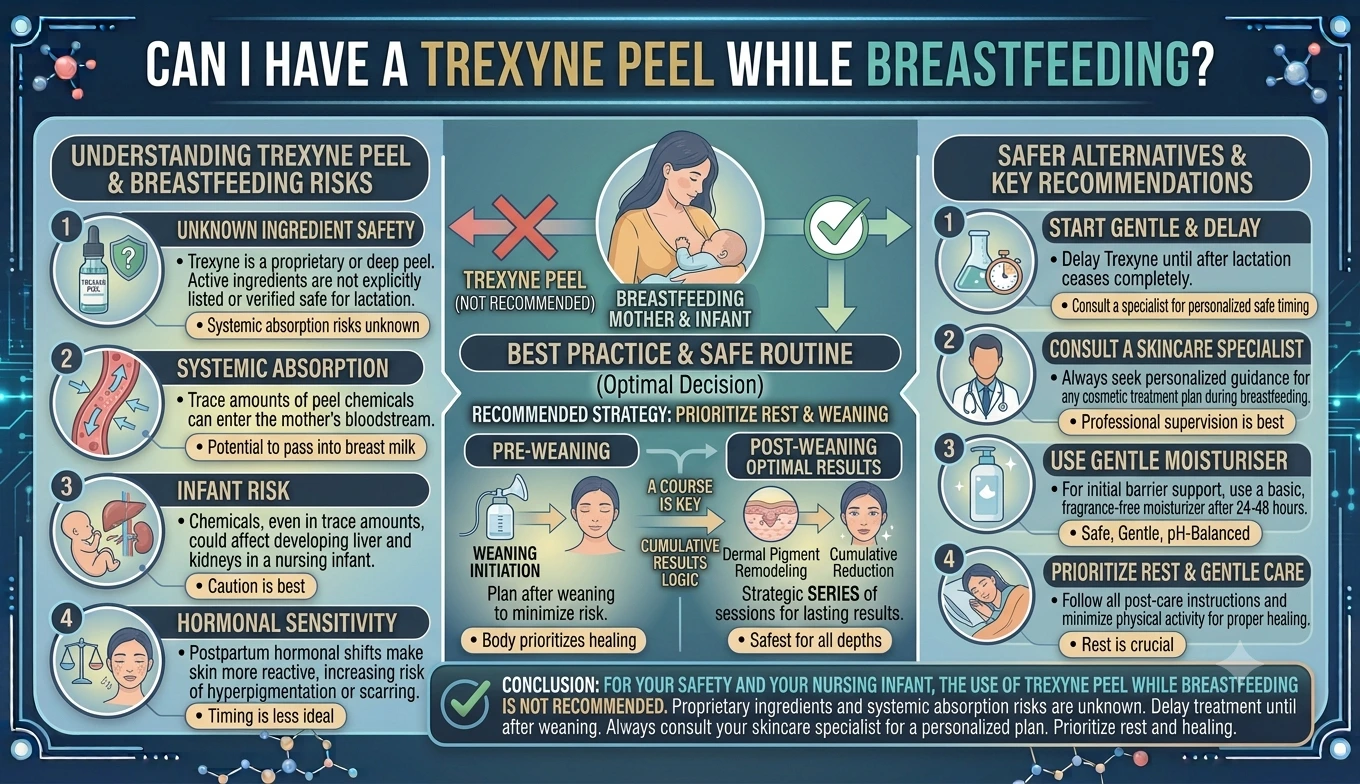
Can I Have a Trexyne Peel While Breastfeeding?
If you are breastfeeding and considering a Trexyne Peel, the safest first step is to discuss it with both your healthcare provider and your treating practitioner before booking any session. Because Trexyne Peel works through a mechanical resurfacing action using marine-algae spicules rather than any chemical process, it differs from acid-based treatments in how it interacts with the skin. However, decisions around aesthetic treatments during breastfeeding should always involve a conversation with a qualified professional who understands your individual health circumstances. Every client’s situation is different, and a practitioner offering Trexyne Peel will want to talk through your medical history, skin sensitivity, and any concerns before recommending a course of action. This article looks at what practitioners typically consider when a breastfeeding client asks about aesthetic treatments, how Trexyne Peel’s mechanical mechanism differs from chemical peels, and what questions are worth raising in a consultation.
Why Breastfeeding Clients Ask About Aesthetic Treatments
Pregnancy and breastfeeding often bring noticeable changes to the skin. Hormonal shifts can affect pigmentation, texture, and overall tone, and many clients feel keen to address these changes once breastfeeding is underway or coming to an end. This is a completely understandable motivation, and it explains why questions about treatment timing come up so often in consultations.
At the same time, breastfeeding clients are usually more cautious than most about anything applied to their skin, and rightly so. This caution extends to aesthetic treatments, skincare products, and anything that might have an unknown effect during this period.
Many new parents also find that the time and energy available for self-care during this stage of life is limited. When a window does open up for an aesthetic appointment, clients often want reassurance that the treatment chosen is a sensible one for their current circumstances, rather than something that adds unnecessary uncertainty to an already busy period.
The Importance of a Cautious, Individual Approach
There is no single answer that applies to every breastfeeding client. Skin sensitivity, overall health, and personal comfort levels vary considerably. This is why a one-to-one consultation matters more than general guidance found online. A practitioner can ask the right questions and make a considered recommendation based on the individual in front of them.
It is worth remembering that two clients at a similar stage of breastfeeding can have very different skin responses and very different comfort levels with proceeding. One client might feel entirely at ease booking a session once cleared by her GP, while another might prefer to wait several more months. Neither approach is more correct than the other. The consultation exists precisely to accommodate this variation.
How Trexyne Peel’s Mechanism Differs From Chemical Peels
Trexyne Peel is not a chemical peel. It works through a purely mechanical mechanism, using marine-algae spicules to create controlled micro-channels in the skin’s surface. There is no acid involved and no chemical exfoliation taking place. Stabilised Vitamin E is included in the formulation to support the skin’s recovery phase from the first application.
This mechanical approach is one of the reasons practitioners often describe Trexyne Peel as having predictable downtime, since a tiered protocol allows the intensity to be matched to skin type and client expectation. It is worth explaining this distinction clearly to breastfeeding clients, since many arrive at a consultation assuming that all peels work in the same chemical way.
Clients who have researched aesthetic treatments online often come across a great deal of general information about chemical peels and their use during breastfeeding. It is easy for this information to become conflated with treatments that work differently, such as Trexyne Peel. Taking a few extra minutes in consultation to clarify this distinction helps the client make sense of what she has read elsewhere and understand why it may or may not apply to the treatment being discussed.
Why This Distinction Still Doesn’t Replace Medical Advice
Even though Trexyne Peel avoids chemical exfoliation, this does not automatically mean it is appropriate for every breastfeeding client without further discussion. Any aesthetic treatment involves some interaction with the skin’s surface, and a practitioner should never assume suitability without first understanding the client’s full health picture. Recommending a medical check-in alongside the aesthetic consultation is standard good practice.
A practitioner explaining this distinction should also be careful not to present it as a guarantee of suitability. The mechanical nature of the treatment is a relevant piece of information for the client and her healthcare provider to consider, not a substitute for their own judgement.
Questions a Practitioner Should Ask Before Treating a Breastfeeding Client
A thorough consultation should cover several areas before any decision is made about proceeding with treatment.
General health and medical history Understanding any relevant medical conditions, medications, or recent health changes helps build a complete picture before considering any aesthetic treatment.
Skin sensitivity since giving birth Many clients notice their skin has become more reactive or sensitive during breastfeeding. This is useful information when deciding on treatment intensity.
Timing since birth Some practitioners prefer to wait until breastfeeding has been established for a certain period, or until it has finished, though this varies by individual circumstance and should be discussed openly.
Client comfort level Ultimately, the client’s own comfort with proceeding matters a great deal. Some breastfeeding clients feel ready to explore aesthetic treatments, while others prefer to wait. Both approaches are entirely valid.
Any previous reactions to aesthetic treatments If a client has had sensitivity issues with past treatments, even unrelated ones, this is worth noting before deciding on an appropriate intensity level for a first session.
Current skincare routine Understanding what products a client is already using day to day helps a practitioner anticipate how the skin might respond and whether any temporary adjustments to the routine would be sensible around the treatment date.
Why Waiting Is Sometimes the Right Choice
For some clients, the most sensible option is to wait until breastfeeding has finished before booking a Trexyne Peel session. This is not a reflection of the treatment being unsuitable in a general sense. It simply reflects a cautious, individual approach that puts the client’s peace of mind first. Practitioners should never pressure a client into proceeding if she feels uncertain.
In some cases, a client may arrive at a consultation fully intending to proceed, only to decide during the discussion that she would rather wait. This should always be treated as a perfectly reasonable outcome. A good consultation is not measured by whether it leads to a booked treatment, but by whether it leads to a decision the client feels genuinely comfortable with.
What Happens During a Trexyne Peel Consultation
Every client considering Trexyne Peel, whether breastfeeding or not, should go through a proper consultation before treatment begins. This typically includes a discussion of skin history, current concerns, and any relevant health factors.
For breastfeeding clients specifically, this consultation becomes even more important. A practitioner should take the time to explain how the mechanical mechanism works, what the tiered protocol involves, and what recovery typically looks like, while also being clear that final suitability depends on individual medical guidance.
A well-run consultation also gives the practitioner an opportunity to observe the client’s skin directly rather than relying solely on a verbal description. This visual assessment, combined with the client’s own account of how her skin has behaved recently, tends to produce a more reliable basis for deciding on an appropriate approach than either factor alone.
The Role of Patch Testing
Patch testing can form a useful part of the consultation process for clients who are uncertain about how their skin might respond. This gives both the practitioner and the client more confidence before committing to a full treatment session.
A patch test is a relatively low-commitment way for a breastfeeding client to gather more information before making a final decision. It does not remove the need for medical guidance, but it can be a helpful additional data point in an already careful decision-making process.
General Considerations for Aesthetic Treatments During Breastfeeding
Beyond Trexyne Peel specifically, there are some broader principles that tend to guide aesthetic practice during breastfeeding.
Prioritising open communication Clients should feel comfortable asking questions and raising concerns at any point in the process. A good practitioner welcomes this rather than rushing through the consultation.
Avoiding assumptions Every breastfeeding journey looks different. Practitioners should avoid assuming that what worked for one client will automatically apply to another.
Encouraging medical input Aesthetic practitioners are not medical doctors, and it is entirely appropriate to encourage clients to check with their GP, midwife, or health visitor if they have any doubts about proceeding with a treatment while breastfeeding.
Documenting the conversation Keeping clear consultation notes helps ensure that any decision made is well informed and properly recorded, which benefits both the client and the practitioner.
Respecting the client’s pace Some clients want to make a decision quickly, while others want time to think things over or speak with their healthcare provider before committing. Both approaches deserve equal respect from the practitioner.
How Trexyne Peel’s Tiered Protocol Supports Individualised Care
One practical advantage of Trexyne Peel is its tiered protocol, which allows practitioners to match treatment intensity to the individual in front of them. For a breastfeeding client who has been medically cleared and feels ready to proceed, this flexibility can support a more cautious, gradual approach rather than committing to a single fixed intensity.
Practitioners can explore the different treatment options and packages available on the Trexyne shop page, which outlines how sessions are structured and priced.
Why Flexibility Matters for First-Time Breastfeeding Clients
A client returning to aesthetic treatments after having a baby may feel her skin is more reactive than before. Starting with a lower intensity session, and adjusting based on how the skin responds, is often a sensible way to reintroduce professional treatments without overwhelming the skin.
This gradual approach can also help build the client’s confidence in the treatment itself. Seeing how her skin responds to a lower intensity session first can make it easier to decide, together with her practitioner, whether a higher intensity option might suit her in future sessions.
What to Expect if You Decide to Proceed
If, after speaking with your healthcare provider and practitioner, you decide to go ahead with a Trexyne Peel, the process typically follows the same general structure as any other client’s treatment. Your practitioner will select an appropriate intensity level, talk through what to expect afterwards, and provide aftercare guidance suited to your skin.
Because the mechanism is mechanical rather than chemical, recovery tends to be relatively predictable, though your practitioner may suggest some additional precautions specific to your circumstances as a breastfeeding client.
Aftercare Considerations Worth Discussing
Aftercare conversations should cover simple, practical points such as gentle cleansing, appropriate moisturising, and daily sun protection. Any breastfeeding-specific concerns, such as product choice around the chest or neck area if treatment extends there, should also be discussed directly with your practitioner.
It is also worth discussing practical logistics around the appointment itself, such as timing the session around feeding schedules where possible, so that the client does not feel rushed either before or after treatment. A relaxed, unhurried appointment tends to make for a more comfortable overall experience.
Balancing Self-Care With Caution During Breastfeeding
Many breastfeeding clients feel a degree of guilt around prioritising their own appearance or wellbeing during this stage of life. Practitioners can play a supportive role simply by acknowledging that wanting to feel good about your skin is entirely reasonable, while still encouraging the appropriate level of caution before proceeding with any treatment.
This balance between self-care and caution is really the heart of the conversation around aesthetic treatments during breastfeeding. Neither extreme, rushing into treatment without proper consideration or avoiding all aesthetic care indefinitely out of excessive caution, serves the client particularly well. A thoughtful, individualised consultation sits somewhere sensibly in between.
When to Seek Further Guidance
If you have any uncertainty at all about whether a Trexyne Peel is appropriate for you while breastfeeding, the most sensible step is to pause and ask further questions rather than proceeding. Both your practitioner and your healthcare provider are there to support that decision-making process, and there is no obligation to book a session before you feel fully informed. Clinics and practitioners looking to discuss client suitability further can reach out through the Trexyne contact page.
Conclusion
Deciding whether to have a Trexyne Peel while breastfeeding is a personal decision that should always involve input from a healthcare provider alongside a thorough practitioner consultation. Trexyne Peel’s mechanical mechanism, built around marine-algae spicules and stabilised Vitamin E, differs meaningfully from chemical peel treatments, but this distinction does not replace individual medical guidance. Every breastfeeding client’s circumstances are different, and taking the time to ask questions, consider timing, and prioritise comfort leads to a more informed decision. For clients who do proceed, Trexyne Peel’s tiered protocol may help support a more even-looking, refreshed complexion, matched carefully to individual skin needs. More information on the treatment and practitioner network can be found on the Trexyne homepage.
FAQs
Q: Is Trexyne Peel safe to have while breastfeeding?
This depends on individual circumstances, and any decision should involve discussion with a healthcare provider as well as a qualified practitioner before proceeding.
Q: Why should I talk to my doctor before having a peel while breastfeeding?
A healthcare provider understands your personal medical history and can offer guidance specific to your situation, which an aesthetic practitioner is not qualified to provide on its own.
Q: Does Trexyne Peel use any chemicals that could affect breastfeeding?
Trexyne Peel is not a chemical peel. It uses a mechanical mechanism involving marine-algae spicules rather than acids or chemical exfoliants.
Q: How long should I wait after giving birth before having a Trexyne Peel?
Timing varies by individual, and this is something to discuss directly with your practitioner and healthcare provider during a consultation.
Q: What happens during a Trexyne Peel consultation for a breastfeeding client?
The consultation typically covers medical history, skin sensitivity since giving birth, and personal comfort levels, alongside an explanation of how the treatment works.
Q: Can I have a lower intensity Trexyne Peel while breastfeeding?
Trexyne Peel’s tiered protocol allows practitioners to adjust intensity based on individual needs, though any decision to proceed should still follow appropriate medical guidance.
Q: Should I wait until I’ve finished breastfeeding to have aesthetic treatments?
Some clients prefer to wait, while others feel ready sooner. This is a personal choice best made after discussing it with your healthcare provider and practitioner.