Is It Safe to Have a Trexyne Peel While Pregnant?
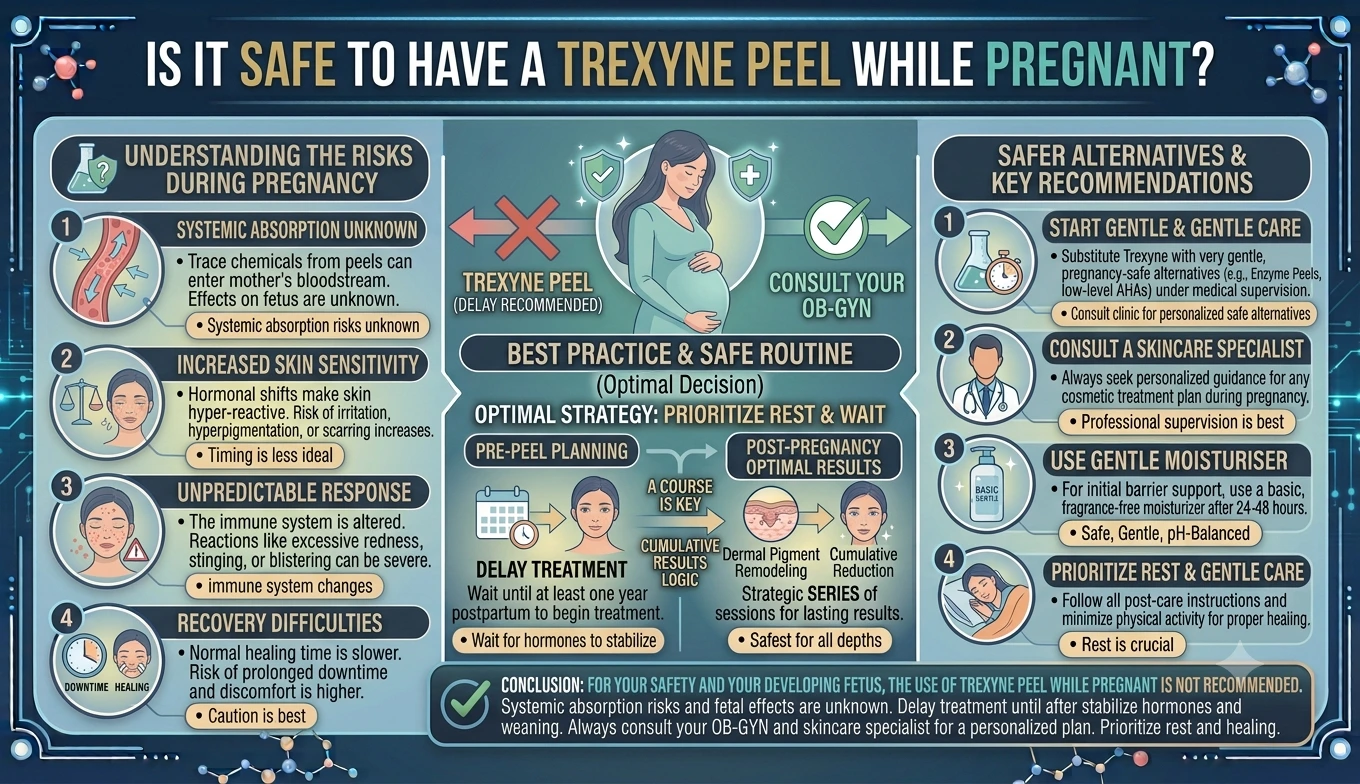
If you are pregnant, the safest approach is to pause any peel treatment, including the Trexyne Peel, and speak with your midwife or GP alongside your practitioner before booking. This is not because any specific ingredient is known to be unsafe, but because pregnancy changes the skin in ways that make caution the sensible default, and most reputable clinics will advise waiting until after your pregnancy and any breastfeeding period has ended. The Trexyne Peel works through a mechanical resurfacing mechanism using marine-algae spicules and stabilised Vitamin E, with no acids involved, but professional aesthetic treatments of any kind are generally approached carefully during pregnancy. This is standard, sensible practice across the aesthetics industry, and it reflects good clinical judgement rather than any particular concern unique to this treatment. Below, we explain why this precaution exists, what changes in your skin during pregnancy, and what questions to ask your practitioner before, during and after this stage of your life.
Why Pregnancy Changes the Approach to Peel Treatments
Pregnancy brings significant hormonal shifts that affect the skin in ways that are not always predictable. Skin that has always tolerated treatments well can suddenly become more reactive, more prone to pigmentation, or simply more sensitive than usual. This unpredictability is one of the main reasons practitioners tend to take a cautious approach to any resurfacing treatment during this time.
It is also worth remembering that most professional treatments, not just peels, are approached with extra care during pregnancy. This is standard practice across the aesthetics industry rather than something specific to any one brand or product. Reputable clinics will always prioritise your wellbeing and that of your baby over proceeding with a treatment that could wait.
This does not mean your skin concerns are any less valid during pregnancy. Many clients notice changes such as dullness, uneven tone or textural changes during this time, and it is entirely understandable to want to address them. The key is simply timing, and finding a practitioner who is honest about what can and cannot be safely offered while you are expecting.
It can also help to remember that pregnancy is temporary, even when it does not always feel that way. Any pause in your treatment plan is just that, a pause, rather than a permanent change to your skincare journey. Many clients find that returning to a familiar clinic once the time is right feels like picking up a conversation rather than starting again from scratch.
A good practitioner will also be honest if their clinic’s policy is more cautious than another clinic’s approach, since guidance can vary between practices. Asking directly, rather than assuming, is always the clearest way to understand where your own clinic stands.
Understanding How the Trexyne Peel Works
Before deciding how to approach treatment timing, it helps to understand exactly what the Trexyne Peel involves. Knowing the mechanism behind a treatment allows you to have a more informed conversation with your practitioner and your GP or midwife, even during a period when the treatment itself is on hold.
A Mechanical Mechanism, Not a Chemical One
The Trexyne Peel is a precision botanical treatment built around marine-algae spicules and stabilised Vitamin E. It resurfaces and refines the skin through a purely mechanical mechanism, creating controlled micro-channels without the use of acids or chemical exfoliants. This sets it apart from chemical peels, which rely on acids to loosen the bonds between dead skin cells.
Even though the treatment does not involve chemical exfoliation, this alone does not automatically make it appropriate during pregnancy. Any treatment that resurfaces the skin, whether mechanical or chemical, involves a controlled level of intervention, and pregnancy is a time when many practitioners prefer to avoid any resurfacing procedure as a precaution, regardless of the mechanism involved.
This is an important distinction to understand, because it is easy to assume that a non-chemical treatment must automatically be gentler or safer in every context. In reality, caution during pregnancy is applied broadly across resurfacing treatments as a category, rather than being assessed purely on whether acids are involved.
Understanding how a treatment works is still useful information to have, because it helps you have an informed conversation with your practitioner about timing and future planning, even if the treatment itself is paused for now. Knowing the mechanism also means you can ask more specific questions when you do return to treatment after your pregnancy.
Why Many Practitioners Recommend Caution During Pregnancy
There is no absolute rule that applies to every clinic or every client, which is exactly why this is a conversation to have directly with a qualified professional rather than something to assume either way. Many practitioners simply prefer to err on the side of caution during pregnancy, recommending that resurfacing treatments are paused until after the baby is born and, in many cases, after breastfeeding has finished.
This cautious approach reflects the broader responsibility practitioners hold. Skin can behave differently during pregnancy, healing responses can vary, and comfort during treatment may not be the same as it was before. Rather than take an unnecessary risk with an elective, non-essential treatment, most clinics choose to postpone.
It is also worth noting that comfort during a session can be affected by pregnancy in ways that have nothing to do with the treatment itself. Longer appointments, certain positions, or simply feeling more tired than usual can all make an elective treatment less appealing during this period, even before considering skin sensitivity.
If your usual clinic offers the Trexyne Peel and you are pregnant, expect a considerate, honest conversation rather than automatic refusal without explanation. A trustworthy practitioner will talk through the reasoning with you and help you plan for when treatment can safely resume.
Common Skin Changes During Pregnancy
Hormonal Pigmentation and Sensitivity
Many people notice changes in pigmentation during pregnancy, sometimes referred to as the pregnancy mask, along with increased overall skin sensitivity. These changes are driven by hormonal fluctuations and can affect how the skin responds to any kind of treatment, including those that would normally be well tolerated.
Some clients also notice their skin becomes drier or oilier than usual, or that areas which were previously balanced become more reactive. Because these changes can shift throughout pregnancy, and often continue to settle in the months afterwards, timing any resurfacing treatment for after this period tends to give a clearer, more consistent picture of your skin.
It is worth mentioning that these changes affect everyone differently. Some clients notice very little difference in their skin throughout pregnancy, while others see more pronounced shifts. There is no single pattern that applies to everyone, which is another reason a personalised conversation with your practitioner matters more than general assumptions.
Being aware of these common changes can help you understand why a practitioner might suggest waiting, and can also help you set realistic expectations for when you do return to treatment after pregnancy.
What Should I Ask My Practitioner If I Am Pregnant?
If you are pregnant and interested in the Trexyne Peel for the future, it is worth having an honest conversation with your practitioner now rather than waiting until after your pregnancy. Ask them what their clinic’s policy is on treating pregnant or breastfeeding clients, and whether this applies to all peel treatments or varies by protocol.
You can also ask what alternative, non-resurfacing skincare support they might recommend in the meantime, and how soon after birth or breastfeeding they would typically welcome you back for a Trexyne Peel consultation. Many clinics are happy to keep a note of your interest and follow up with you once it is appropriate to book.
It is also sensible to mention this conversation to your midwife or GP, particularly if you have any specific skin concerns or medical history they should be aware of. They can offer guidance tailored to your individual pregnancy and overall health.
Some clients find it helpful to ask their practitioner whether they can stay in touch during pregnancy, perhaps through occasional check-ins, so that the relationship continues even while treatment is paused. This can make returning to the clinic afterwards feel much more straightforward, since your practitioner will already have context on your situation.
Is It Safe to Have a Peel While Breastfeeding?
This is one of the most common follow-up questions clients ask once their baby has arrived. Just as with pregnancy, there is no confirmed evidence pointing to a specific risk from the Trexyne Peel’s mechanical mechanism during breastfeeding, but caution remains the standard, sensible approach recommended across the industry.
The same cautious approach that applies during pregnancy generally extends into the breastfeeding period. Many practitioners recommend waiting until breastfeeding has finished before resuming resurfacing treatments, again as a precaution rather than because of any confirmed specific risk.
Hormonal changes can continue well into the breastfeeding period, meaning your skin may still be settling even after your baby is born. Waiting until your hormones and skin have stabilised often makes for a more predictable and satisfying treatment experience once you do return.
Every feeding journey is different, and some people breastfeed for a shorter or longer period than others. Rather than working to a fixed timeline, it is more useful to think of this as a decision to revisit once breastfeeding has come to a natural end, whenever that happens to be for you.
As with pregnancy, this is a decision best made in conversation with your practitioner and your GP or midwife, who can advise based on your individual circumstances.
What Are the Alternatives While I Wait?
While you wait for the right time to resume peel treatments, there is still plenty you can do to support your skin. A consistent, gentle skincare routine focused on hydration and sun protection can help maintain overall skin health during pregnancy and beyond.
Speak to your practitioner about non-resurfacing options that may be suitable in the meantime, such as gentle cleansing routines, hydrating serums or facials that do not involve mechanical or chemical exfoliation. You can browse the wider Trexyne shop range or get in touch through the contact page to ask what your clinic recommends for this period.
Many clients find this waiting period a good opportunity to focus on foundational skincare habits, such as diligent sun protection, which can support your results once you are ready to return to more active treatments like the Trexyne Peel.
This period can also be a useful time to simply observe how your skin behaves as your pregnancy progresses. Keeping a note of any changes you notice, whether that is pigmentation, dryness or sensitivity, can be a helpful reference to share with your practitioner once you are ready to book your next consultation.
When Can I Resume Peel Treatments After Pregnancy?
There is no single answer that applies to everyone, since timing depends on your individual recovery, whether you are breastfeeding, and any advice from your GP or midwife. Many clinics suggest waiting until breastfeeding has finished and your hormones have had time to settle before booking a resurfacing treatment.
When you are ready, book a fresh consultation rather than assuming your previous treatment plan still applies. Your skin may have changed during pregnancy, so your practitioner will want to reassess before recommending a protocol for the Trexyne Peel. This ensures the intensity and approach genuinely suit your skin as it is now, rather than how it was before you became pregnant.
Some clients find their skin concerns have changed after pregnancy, whether that is new areas of pigmentation, textural changes or general dullness. A fresh assessment allows your practitioner to tailor a plan around your current skin rather than relying on outdated notes.
It is also worth asking whether your practitioner recommends easing back in gradually, rather than resuming at the same intensity you were previously used to. Given the amount your body has been through, starting gently and building up as your skin responds is often the more comfortable and considered approach.
How to Prepare for a Consultation During or After Pregnancy
Whether you are enquiring while pregnant to plan ahead, or booking a consultation once you are ready to resume treatment, preparation helps the conversation run smoothly. Be ready to discuss your pregnancy and breastfeeding timeline, any skin changes you have noticed, and any relevant medical history.
Arriving with clear, honest information helps your practitioner give you the most useful guidance, whether that is confirming when to expect a follow-up or beginning a fresh assessment of your skin. There is no need to feel rushed through this conversation, and a good practitioner will be happy to take the time needed.
It is also worth bringing a list of any skincare products you are currently using, along with questions about how soon a tiered protocol like the Trexyne Peel could be introduced and what results might realistically look like given your current skin condition.
If you are attending the consultation with a young baby, do not hesitate to ask the clinic what to expect in terms of appointment length and whether they can accommodate any practical needs. A considerate clinic will want your consultation to feel relaxed rather than rushed, particularly during what can be a busy and tiring time.
Questions Worth Raising
Ask whether your practitioner recommends any preparatory skincare in the weeks before your first session back, and whether they suggest starting at a gentler intensity given the changes your skin may have gone through.
It is also reasonable to ask how your practitioner will document any changes they notice in your skin compared with before your pregnancy, so that your ongoing treatment plan reflects where your skin is now rather than where it used to be.
What Should I Ask About Returning to Peels Postpartum?
The postpartum period is a significant transition, both physically and emotionally, and it is worth approaching your return to treatment with the same patience you would apply to any other part of recovery. Rushing back before you and your skin feel ready rarely leads to the best outcome.
Returning to a resurfacing treatment after pregnancy is often a gradual process rather than picking up exactly where you left off. Ask your practitioner whether they recommend starting with a lower intensity within the tiered protocol, and how they will monitor your skin’s response across your first few sessions back.
It is also fair to ask how downtime might differ now compared with before your pregnancy, since sensitivity levels can vary. The predictable nature of the Trexyne Peel protocol, with intensity matched to skin type and client expectation, can make this transition back to treatment feel more manageable and better paced to your current skin.
Finally, ask what aftercare adjustments might be worth making now, particularly if your skincare routine has changed since becoming a parent. A practitioner who takes the time to reassess your full routine, not just the treatment itself, is generally offering a more considered, personalised service.
It can also help to ask how your practitioner will pace your course of treatments going forward. Rather than resuming the exact plan you followed before pregnancy, many practitioners prefer to treat this as a new starting point, building intensity gradually as your skin shows how it responds.
Choosing a Practitioner You Can Trust Through This Stage
Pregnancy is a good test of how genuinely client-focused a clinic is. A practitioner who prioritises your wellbeing over a booking will be upfront about pausing treatment, rather than proceeding simply because you are keen to continue your skincare journey. This kind of honesty is worth valuing and remembering.
If you are searching for a clinic offering the Trexyne Peel for the first time while pregnant, it is entirely reasonable to ask about their policy on treating pregnant and breastfeeding clients as part of your initial enquiry. This can save you time and help you find a practitioner who communicates clearly from the outset.
A trustworthy clinic will also be happy to stay in contact, offer general skincare guidance suited to pregnancy, and welcome you back warmly once the time is right. This kind of ongoing relationship often makes for a much more comfortable and reassuring experience than starting fresh with an unfamiliar practitioner after your baby arrives.
Conclusion
Pregnancy is a time when caution around any resurfacing treatment, including the Trexyne Peel, is the standard and sensible approach recommended by most practitioners. This reflects general good practice across the aesthetics industry rather than a specific concern about the treatment itself, which works through a mechanical mechanism using marine-algae spicules and stabilised Vitamin E, without acids or chemical exfoliants.
If you are pregnant or breastfeeding and interested in the Trexyne Peel, the best next step is an honest conversation with your practitioner and your GP or midwife about timing. Once you are ready to return, a fresh consultation and a tiered approach can help support a brighter, more even-looking complexion at a pace that suits your skin.
There is no need to feel that pausing your skincare goals during this time means giving them up altogether. With patience and the right guidance, most clients find they can return to treatment once the time is right, with a plan that reflects their skin as it is now.
Frequently Asked Questions
Q: Is the Trexyne Peel definitely unsafe during pregnancy?
There is no confirmed evidence of a specific risk associated with the mechanical mechanism used in the Trexyne Peel. However, most practitioners recommend pausing any resurfacing treatment during pregnancy as a general precaution, and this is standard practice across the aesthetics industry rather than a concern unique to this treatment. Speaking directly with your practitioner and GP or midwife is always the best way to get guidance suited to your own situation.
Q: Can I have a Trexyne Peel while breastfeeding?
Many practitioners recommend waiting until breastfeeding has finished before resuming resurfacing treatments, since hormonal changes can continue during this period. Speak with your practitioner and GP or midwife about the right timing for your individual circumstances.
Q: Why do practitioners recommend waiting to have peel treatments during pregnancy?
Pregnancy causes hormonal changes that can make skin more sensitive or unpredictable in how it responds to treatment. Practitioners generally prefer to avoid elective resurfacing procedures during this time as a precaution, prioritising client wellbeing over proceeding with a treatment that can simply wait until a more settled stage.
Q: How soon after giving birth can I book a Trexyne Peel?
This depends on your individual recovery and whether you are breastfeeding. Many clinics recommend waiting until breastfeeding has finished and hormones have settled before booking a fresh consultation to reassess your skin and suitability. There is no fixed timeline that applies to everyone, so a personalised conversation with your practitioner is the best way to plan your return.
Q: What can I do for my skin during pregnancy if I cannot have a peel?
A gentle, consistent skincare routine focused on hydration and sun protection can support your skin during this time. Speak to your practitioner about non-resurfacing options, or visit the Trexyne shop to see what other products may suit your routine while you wait. Many clients find this a good opportunity to build strong, foundational skincare habits ahead of returning to more active treatments.
Q: Will my skin need a different Trexyne Peel protocol after pregnancy?
Possibly. Skin can change during and after pregnancy, so practitioners typically recommend a fresh consultation before resuming the Trexyne Peel. This allows the intensity and protocol to be matched to your current skin rather than how it was before pregnancy.
Q: Who should I speak to before booking a peel treatment during or after pregnancy?
Speak with both your GP or midwife and a qualified aesthetic practitioner. Your GP or midwife can advise on your individual health circumstances, while your practitioner, reachable through the contact page, can explain the clinic’s specific approach to treating pregnant or breastfeeding clients.