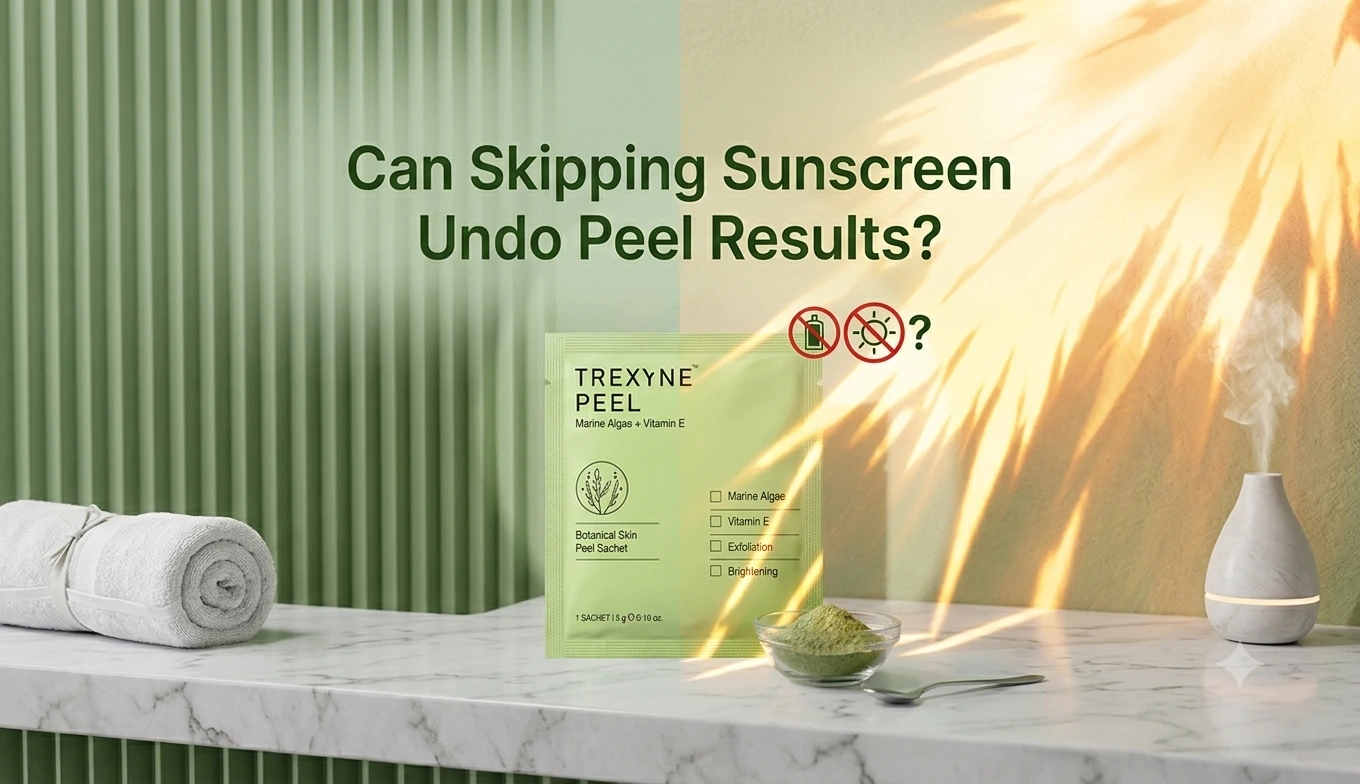
Can Skipping Sunscreen Undo Peel Results?
Yes, skipping sunscreen after a professional peel can undo much of the benefit the treatment was designed to deliver. Even when a peel works through a gentle, non-chemical mechanism, freshly resurfaced skin is more reactive to UV exposure for a period afterwards. Unprotected sun exposure during this window can trigger renewed pigmentation, uneven tone, and a dull complexion, effectively reversing the progress a client paid for.
This is one of the most common questions clients ask after booking a Trexyne Peel – Professional Algae Resurfacing Treatment, and it is a fair one. Understanding why sunscreen matters so much after resurfacing helps practitioners set realistic expectations and helps clients protect their results. This article looks at the relationship between UV exposure and post-peel skin, and how a consistent SPF routine supports the outcome of any professional treatment.
Why Sun Protection Matters After Any Professional Peel
Skin that has just been through a resurfacing treatment is in an active renewal phase. The outer layers are refreshing, and new skin cells are more exposed than usual. This makes the skin more responsive to external stressors, particularly UV light.
Sunlight triggers melanin production as a natural defence mechanism. On skin that has recently undergone resurfacing, this response can be more pronounced. Practitioners often see this played out in clinic: two clients with near-identical treatment plans can have very different results simply because one wore SPF diligently and the other did not.
This isn’t unique to any single type of peel. It applies broadly across professional skin treatments, which is why sunscreen guidance is considered a non-negotiable part of aftercare rather than an optional extra.
The Skin’s Renewal Window
Most professional treatments create a renewal window that lasts several days to a couple of weeks, depending on the intensity of the protocol used. During this time, skin is generally more porous to environmental stress and less equipped to self-regulate pigmentation.
How Peels Affect the Skin’s Natural Defences
A peel’s job is to encourage the skin to let go of dull, uneven surface cells and support the arrival of fresher ones underneath. While this process can leave the complexion looking brighter and smoother, it temporarily reduces some of the skin’s natural buffering capacity.
The skin barrier, which usually helps regulate moisture and filter out some environmental aggressors, is in a state of adjustment after resurfacing. This is completely normal and expected. However, it does mean the skin is less able to self-protect against UV in the days that follow.
This is why aftercare advice usually goes beyond “use sunscreen” and moves into specifics: how often to reapply, what SPF level to choose, and how long to maintain heightened vigilance. Clients who understand the reasoning behind these instructions are far more likely to follow them properly.
What Happens When Sunscreen Is Skipped Post-Peel
When UV protection is skipped after a resurfacing treatment, several things can happen, and none of them align with what the client is paying for.
Rebound pigmentation. Melanocytes can become more reactive after resurfacing. Unprotected sun exposure may prompt them to overproduce pigment, sometimes leading to patches that are darker than what was there before treatment.
Prolonged redness or sensitivity. UV exposure can extend the recovery window, meaning the skin stays reactive for longer than expected, which can be uncomfortable for the client and frustrating for the practitioner trying to manage expectations.
Uneven texture. Renewal works best in a calm, protected environment. Sun exposure can disrupt this process, sometimes leaving texture looking patchier rather than more refined.
Diminished brightness. One of the main reasons clients seek out resurfacing treatments is a brighter, more even-looking complexion. Skipping SPF can directly undermine this goal, sometimes within days of treatment.
None of these outcomes are guaranteed, but the risk is real enough that most clinics treat sunscreen compliance as central to aftercare rather than a courtesy reminder.
Understanding the Trexyne Peel’s Mechanical Mechanism
The Trexyne Peel works differently to more familiar chemical-based options. It is built around marine-algae spicules that create controlled micro-channels in the skin’s surface through a purely mechanical action. There are no acids involved, and it does not rely on chemical exfoliation.
This mechanical approach is designed to give practitioners a more predictable framework to work within. Rather than relying on chemical penetration, the treatment is tiered so that intensity can be matched to the client’s skin type and expectations. The formula also includes stabilised Vitamin E, which is included to support the skin’s recovery phase from the very first application.
Why the Mechanism Still Requires Sun Discipline
It is a common misconception that a mechanical treatment carries less need for aftercare than other options. In reality, any treatment that encourages skin renewal, mechanical or otherwise, creates a period where the skin benefits from extra protection. The absence of acids in the Trexyne Peel does not remove the need for SPF; it simply means the aftercare conversation can focus on renewal support rather than chemical sensitivity.
Why Predictable Downtime Still Requires Sun Discipline
One of the features practitioners often highlight about the Trexyne Peel is its predictable downtime. The tiered protocol allows for a treatment plan that suits the client’s skin type and lifestyle, without the extended recovery some resurfacing options require.
Predictable downtime is a genuine advantage for busy clients, but it should never be mistaken for a reason to skip aftercare basics. A shorter or more manageable recovery period still involves renewal, and renewal still calls for sun protection. Practitioners should be clear with clients that “predictable” refers to the treatment experience, not a green light to bypass SPF.
This distinction matters because clients sometimes assume that a gentler-feeling treatment needs less aftercare discipline. Reinforcing that sunscreen use is essential regardless of downtime length helps avoid disappointing results later.
The Role of Vitamin E in Supporting Recovery
Stabilised Vitamin E is included in the Trexyne Peel formulation to support the skin’s recovery phase. Vitamin E is well recognised in skincare for its role in supporting the skin during periods of change, and its inclusion from the first application is designed to work alongside the mechanical resurfacing process.
While Vitamin E can support recovery, it is not a substitute for sun protection. The two serve different purposes: one supports the skin’s internal recovery process, and the other shields the skin from an external stressor that can undo that same recovery. Practitioners should frame these as complementary parts of an aftercare routine rather than interchangeable options.
Setting Client Expectations Around Ingredients
Clients sometimes ask whether an ingredient like Vitamin E means they can be more relaxed about sun exposure. This is worth addressing directly in consultation, as it is a reasonable but incorrect assumption. Being clear about what each element of the treatment and aftercare routine actually does helps avoid confusion later.
Building a Sun-Safe Aftercare Routine for Clients
A strong aftercare routine is one of the simplest ways to protect the results of any resurfacing treatment. For clients who have had a Trexyne Peel, a straightforward routine tends to work best, since simplicity supports consistency.
Daily broad-spectrum SPF. This should be non-negotiable, applied every morning regardless of the weather or season, and reapplied through the day if the client is outdoors for extended periods.
Gentle cleansing. Harsh cleansers can undo some of the calm the skin needs during renewal, so a mild, non-stripping option is usually advisable in the days following treatment.
Avoiding direct midday sun. Even with SPF applied, minimising direct exposure during peak UV hours supports a smoother recovery.
Hats and physical barriers where practical. For clients spending time outdoors, a wide-brimmed hat adds a layer of protection that sunscreen alone may not fully provide.
Clinics offering the Trexyne Peel can browse the full range available in the shop to build a complete aftercare protocol that pairs well with the treatment.
Common Client Mistakes After a Resurfacing Treatment
Even with good intentions, clients often make small mistakes that reduce the benefit of their treatment. Recognising these patterns helps practitioners address them proactively in consultation.
Assuming indoor days do not need SPF. UV can pass through windows, and clients working near a bright office window or driving frequently are still exposed.
Reapplying too infrequently. A single morning application is rarely enough, particularly for anyone spending real time outdoors.
Choosing the wrong SPF product. Some clients reach for whatever is in the cupboard rather than a product suited to freshly treated skin, which can lead to irritation or inadequate protection.
Underestimating cloudy days. UV rays penetrate cloud cover, and clients sometimes skip SPF on grey days, assuming there is no risk.
Stopping SPF use too soon. Renewal does not end the moment visible redness fades, and clients sometimes drop their guard before the skin has fully settled.
How Practitioners Can Reinforce Sunscreen Compliance
Getting clients to follow aftercare advice consistently is as much about communication as it is about the instructions themselves. A few approaches tend to work well in clinic.
Explain the “why,” not just the “what.” Clients who understand that pigmentation can rebound without SPF are more likely to take the advice seriously than those simply told to “wear sunscreen.”
Provide written aftercare notes. A simple printed or emailed summary gives clients something to refer back to once they have left the clinic.
Follow up. A short message a few days after treatment can remind clients to stay consistent and gives them a chance to ask questions.
Address any concerns during consultation. Practitioners considering the Trexyne Peel for their client base can reach out via the contact page to discuss protocol and aftercare guidance in more detail.
Long-Term Skin Goals: Protecting Your Investment in Treatment
Clients invest time and money into professional resurfacing treatments because they want visible, lasting improvement. Sunscreen is one of the most cost-effective ways to protect that investment, yet it is often the step that gets overlooked.
Framing SPF as part of the treatment plan, rather than a separate suggestion, tends to shift how seriously clients treat it. Practitioners who build this into their consultation and aftercare documentation from the outset generally see more consistent compliance and, in turn, more satisfied clients returning for repeat treatments.
For clinics exploring resurfacing options for their client base, more information on the full treatment approach is available on the Trexyne homepage.
Conclusion
Sun exposure and freshly resurfaced skin do not mix well. Skipping sunscreen after any professional peel, including a mechanical treatment like the Trexyne Peel, can undermine the very results the client came in for, from rebound pigmentation to reduced brightness and uneven texture. The Trexyne Peel’s marine-algae spicule mechanism and stabilised Vitamin E formulation are designed to support a controlled, predictable renewal process, but that process still depends on the client protecting their skin afterwards. A consistent, well-explained sunscreen routine, paired with clear aftercare communication from the practitioner, gives clients the best chance of enjoying a brighter, more even-looking complexion that lasts well beyond the appointment itself.
FAQs
Q: How long after a peel should I avoid sun exposure?
Most practitioners advise heightened sun caution for at least one to two weeks after a resurfacing treatment, though this can vary depending on the client’s skin type and the intensity of the protocol used. Daily SPF should continue well beyond this window as part of an ongoing routine.
Q: Can sunscreen alone protect peeled skin from pigmentation?
SPF is one of the most effective tools for reducing pigmentation risk, but it works best alongside other habits such as avoiding peak sun hours and using physical barriers like hats. No single step guarantees protection, but consistent SPF use significantly lowers the risk.
Q: Does the Trexyne Peel require different sun protection than a chemical peel?
The general principle is the same. Any treatment that encourages skin renewal benefits from diligent SPF use afterwards. The Trexyne Peel works through a mechanical mechanism rather than chemical exfoliation, but the skin still goes through a renewal phase that calls for sun discipline.
Q: What SPF level is recommended after a professional peel?
A broad-spectrum SPF of 30 or higher is generally recommended for clients recovering from resurfacing treatments, applied daily and reapplied through the day if the client is outdoors for extended periods.
Q: Can indoor UV exposure still affect peeled skin?
Yes. UV rays can pass through windows, so clients who spend long hours near bright windows or driving are still exposed, even without direct outdoor sun. This is why SPF is recommended daily, not just on sunny outdoor days.
Q: Will pigmentation caused by skipping sunscreen after a peel go away on its own?
It may fade gradually over time, but this is not guaranteed and can take considerably longer than the original treatment recovery. Consistent sun protection going forward is the most reliable way to support even-toned skin and avoid further rebound pigmentation.
Q: Is Vitamin E enough to protect skin without sunscreen after a peel?
No. Vitamin E is included in the Trexyne Peel formulation to support the skin’s recovery phase, but it does not replace the protective role of sunscreen against UV exposure. Both play different, complementary roles in a proper aftercare routine.