Can a Single Peel Session Remove Pigmentation Completely?
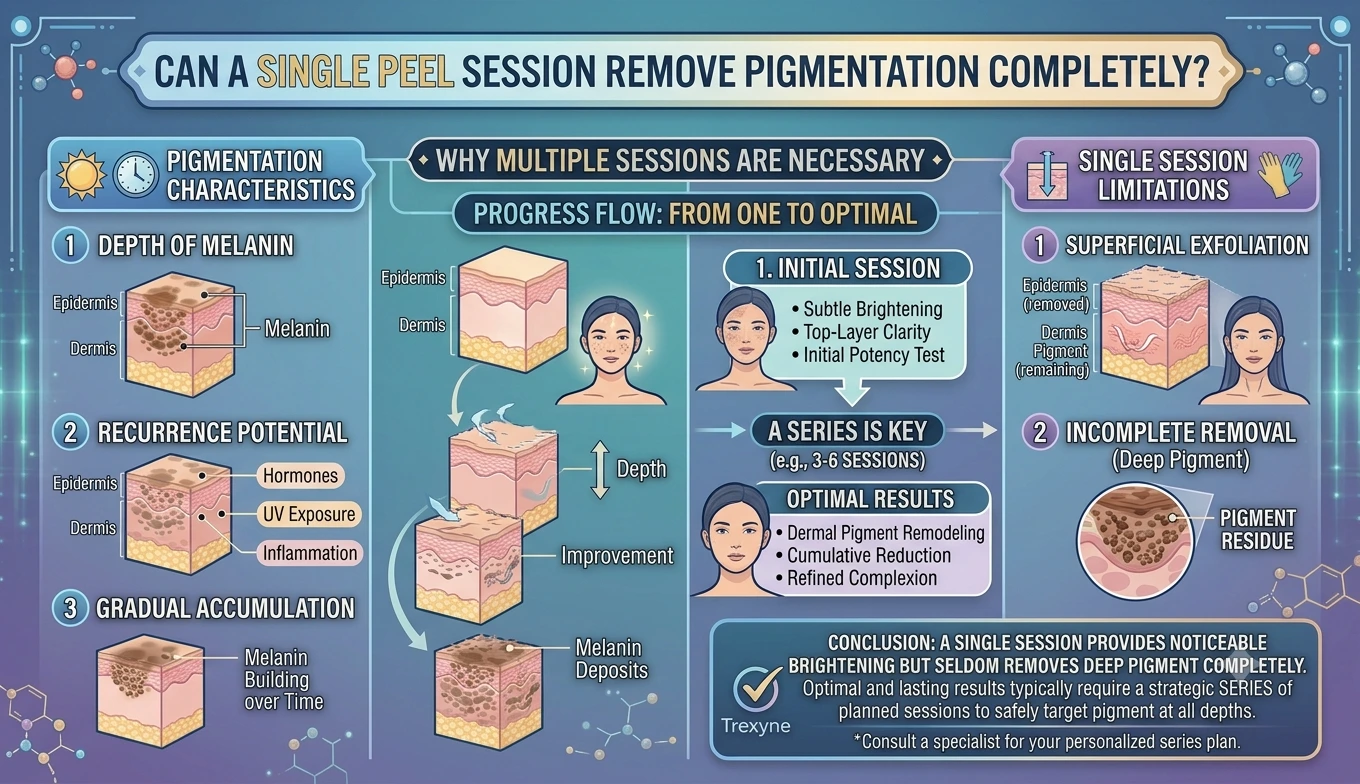
No, a single peel session cannot remove pigmentation completely, and any practitioner who promises this is setting a client up for disappointment. Pigmentation forms in layers, often over years of sun exposure, hormonal changes or inflammation, and it responds best to a structured course of treatments rather than one dramatic session. What a well-chosen peel can do, from the very first appointment, is begin to soften the appearance of uneven tone and support the skin’s natural renewal process. The Trexyne Peel is designed with this reality in mind, offering a mechanical resurfacing approach that clinics can build into a realistic, client-friendly protocol rather than a one-off quick fix.
Why Pigmentation Rarely Clears in One Session
How pigment actually forms
Pigmentation is the result of melanin being produced unevenly across the skin. This can happen after prolonged sun exposure, following a spot or breakout, during hormonal shifts such as pregnancy or the use of certain contraceptives, or simply as part of the skin’s response to inflammation. Melanin does not sit in one neat, accessible layer. It can be distributed through several depths of the epidermis, and in some cases the upper dermis, which means a single treatment is very unlikely to reach every affected cell in one pass.
Practitioners who have worked with pigmentation clients for any length of time will recognise this pattern. A patch that looks uniform to the eye is often made up of pigment sitting at different depths and different concentrations. Some of it responds quickly to resurfacing. Some of it takes considerably longer to fade, simply because it is further from the surface and has been established for longer.
The skin renewal cycle takes time
Skin does not turn over overnight. The natural renewal cycle, where new cells move from the deeper layers of the epidermis up to the surface, typically takes several weeks, and this cycle tends to slow further as clients get older. Because resurfacing treatments work in step with this cycle, results build gradually across a course rather than appearing instantly after one visit. A treatment can only encourage and support the process, it cannot override the biological timeline that the skin follows.
Explaining this cycle to clients early on helps set expectations that match how skin genuinely behaves. Clients who understand the renewal timeline tend to be more patient, more consistent with aftercare, and ultimately more satisfied with their results by the end of a course.
What a Single Trexyne Peel Session Can Realistically Achieve
A first session with the Trexyne Peel can begin the process of refining texture and supporting a more even-looking complexion, but it is best understood as the opening step of a wider plan rather than a finished result. The treatment works through marine-algae spicules that create controlled micro-channels in the skin, encouraging the natural resurfacing process without any chemical exfoliants involved at any stage. Alongside this, stabilised Vitamin E is infused into the treatment to support the skin’s recovery phase from that very first application.
Clients often notice that their skin looks fresher and feels smoother within days of a single session, which is a genuinely positive early sign and worth highlighting during the consultation. This is different, though, from the deeper, more even-looking pigmentation improvement that tends to build with repeated sessions over a planned course.
Managing the gap between visible texture change and pigmentation change
One of the more common misunderstandings clients bring into clinic is assuming that smoother-feeling skin automatically means pigmentation has faded. Texture and tone are related, but they are not the same thing, and they do not always change at the same pace. A practitioner who explains this distinction clearly, ideally before the first session even begins, helps the client interpret their results accurately rather than feeling underwhelmed by early progress that is genuinely on track.
Why a Course of Treatments Works Better Than One-Off Sessions
Cumulative, gradual improvement
Each Trexyne Peel session builds on the last. Because the mechanism is mechanical rather than chemical, practitioners can adjust intensity gradually across a course, allowing the skin to be resurfaced in a controlled and progressive way. This layered approach tends to support a more even-looking tone over time, rather than attempting to force rapid change in a single appointment where the skin has not yet had the chance to prepare.
Working with the skin’s tolerance
Pushing for maximum results in a single session increases the risk of irritation, particularly for clients with sensitive or reactive skin, or those who have not had a resurfacing treatment before. A tiered protocol, which is one of the defined features of the Trexyne Peel, allows practitioners to match intensity to skin type and client expectation. This tiered structure is part of what makes a course-based approach both more comfortable and more sustainable for the client, and it also gives the practitioner room to adjust the plan if the skin responds differently than anticipated.
Consistency builds trust
There is also a relationship benefit to a course-based approach. Clients who return for a series of appointments build a rapport with their practitioner, and that ongoing relationship makes it easier to spot changes early, address any concerns quickly, and keep the plan on track. A single session rarely allows for this kind of continuity.
Setting Realistic Client Expectations Before Treatment
The consultation conversation
Before any session begins, it is worth having an honest conversation about timelines. Clients who arrive expecting an overnight transformation are far more likely to feel let down, even when the treatment itself has gone well and is progressing exactly as expected. Framing the plan around a course, rather than a single visit, protects both the client’s confidence in the process and the practitioner’s professional reputation over the long term.
It helps to walk clients through what they might expect after the first session, the middle of the course, and the later sessions, so they have a rough mental map of the journey. This kind of transparency tends to reduce anxious follow-up questions between appointments and builds trust in the process as a whole.
Photographs and progress tracking
Taking consistent, well-lit photographs before each session gives both practitioner and client a clear, objective way to track change. Pigmentation improvement can be subtle from one week to the next, and photographs often reveal progress that is harder to notice day to day in the mirror, where lighting and mood can easily distort perception.
Keeping these images in a consistent format, same angle, same lighting, same distance from the face, makes comparisons far more reliable across the length of a course. Many practitioners find that reviewing these photographs together with the client at each visit is one of the most reassuring parts of the appointment.
How Marine-Algae Spicules Support Skin Renewal
The Trexyne Peel’s botanical mechanism relies on marine-algae spicules, which create controlled micro-channels across the treated area. This is a mechanical process from start to finish, with no chemical exfoliants involved at any stage of the treatment. Because the mechanism works through physical, controlled micro-channelling rather than chemical penetration, practitioners can calibrate pressure and coverage session by session, which supports a more predictable, professional-only treatment pathway.
This approach also means the treatment can be tailored across a client’s course. Early sessions might focus on gentler coverage to assess how the skin responds, with later sessions building on that foundation as tolerance and results are reviewed together. For clients who are new to resurfacing treatments, this gradual build-up can make the whole experience feel far less daunting than they may have anticipated.
Why a mechanical mechanism suits pigmentation-prone skin
Skin that is already dealing with pigmentation can sometimes be more reactive than average, particularly if the pigmentation has developed as a result of previous inflammation. A mechanical mechanism, where the practitioner has direct control over pressure and coverage, offers a degree of precision that supports a more considered, client-specific approach across a course of treatments.
The Role of Vitamin E in the Recovery Phase
Stabilised tocopherol, the form of Vitamin E used in the Trexyne Peel, is infused into the treatment to support the skin’s recovery phase from the very first session. Recovery matters just as much as the resurfacing step itself, and it is often the part of the process that clients notice most directly in the days immediately following treatment. Skin that is well supported after treatment tends to settle more comfortably, which in turn supports the client’s ability to return for the next session in the course on schedule.
Why recovery support matters for a course of treatments
A client who experiences a smoother, more comfortable recovery after each session is more likely to stay committed to the full course rather than dropping off after one or two visits. Predictable downtime, another defined feature of the Trexyne Peel, gives clients a clearer picture of what to expect between appointments, which supports consistency across the treatment plan and makes it easier to schedule sessions around work and social commitments.
Factors That Influence How Many Sessions Are Needed
Depth and history of the pigmentation
Pigmentation that has built up over many years, or that sits deeper within the skin, typically needs more sessions than pigmentation that has appeared more recently. A thorough consultation, including a review of sun exposure history, previous treatments, and any relevant hormonal factors, helps practitioners set a realistic session count from the outset rather than guessing based on appearance alone.
Skin type and tolerance
Every client’s skin responds differently. Some clients tolerate a faster pace between sessions, while others need longer intervals to allow full recovery before the next treatment. This is exactly why the tiered protocol built into the Trexyne Peel is so useful in practice, as it lets practitioners personalise the plan rather than applying a single approach to every client who walks through the door.
Lifestyle and ongoing sun exposure
Pigmentation can be influenced by ongoing sun exposure, so clients who spend a lot of time outdoors, or who are inconsistent with daily SPF, may need a longer course or more spaced-out maintenance sessions. Discussing daily habits at consultation, not just at the point of booking, gives a clearer sense of how a course is likely to progress and helps set a session count that reflects real-world behaviour rather than best-case assumptions.
Client goals and realistic outcomes
Not every client is aiming for the same endpoint. Some want a noticeable improvement for a specific event, while others are working towards a longer-term maintenance plan. Clarifying this early helps the practitioner recommend a course length that matches what the client genuinely wants, rather than a generic number of sessions that may not suit their particular goals.
Previous treatment history
Clients who have had other resurfacing treatments in the past may respond differently to a new protocol than those who are starting from scratch. Understanding what has been tried before, what worked, and what caused irritation gives the practitioner a much clearer starting point when planning a Trexyne Peel course, and it can help avoid repeating an approach that has not suited the client previously.
Building a Professional Peel Protocol for Pigmentation Clients
Structuring the initial consultation
A strong protocol begins well before the first treatment. Reviewing the client’s skin history, current products, medical background, and expectations allows the practitioner to recommend a course length and interval that suits their specific presentation of pigmentation. This is also the point at which any concerns about suitability should be raised and discussed openly.
Spacing sessions appropriately
Because the Trexyne Peel works mechanically and supports predictable downtime, practitioners can space sessions in a way that allows the skin to complete its renewal cycle between appointments. This spacing is central to a protocol that respects how skin actually works, rather than one built around unrealistic promises of rapid transformation.
Reviewing progress at each stage
Building in a short review at each session, comparing photographs and discussing how the skin has responded, allows the protocol to be adjusted as needed. Some clients may need additional sessions, while others progress more quickly than expected. Flexibility within a structured course tends to produce the most satisfying results overall, and it also gives clients confidence that their individual response is being genuinely monitored rather than following a rigid, one-size-fits-all script.
Common Myths About Peels and Pigmentation
“A stronger peel will always work faster”
It is a common assumption that increasing intensity automatically speeds up results. In practice, pushing the skin harder than it can comfortably tolerate often leads to irritation, which can temporarily disrupt the very renewal process the treatment is meant to support. The tiered protocol built into the Trexyne Peel exists precisely to avoid this trap, allowing intensity to be matched to what the skin can genuinely handle at each stage of the course.
“If my skin isn’t peeling, the treatment isn’t working”
Visible flaking is not a reliable measure of how well a treatment is working. The Trexyne Peel works through controlled micro-channelling rather than a dramatic, visible shedding process, and meaningful renewal can be taking place beneath the surface even when the outward signs are subtle. Practitioners are often best placed to reassure clients on this point, using photographs and skin assessments rather than surface appearance alone.
“Once pigmentation fades, it’s gone for good”
Pigmentation can return if the original triggers, such as unprotected sun exposure, are not managed going forward. This is why aftercare and ongoing SPF use are discussed as part of a complete protocol, not as an optional extra. A course of Trexyne Peel sessions can support a more even-looking complexion, but maintaining that result over time depends on the client’s daily habits as well.
Supporting Results Between Sessions
The work does not stop when a client leaves the clinic. Daily SPF use, gentle skincare, and avoiding unnecessary sun exposure between sessions all play a role in supporting the results of a Trexyne Peel course. Practitioners who take time to explain simple aftercare guidance often see their clients arrive at each subsequent session with skin that is better prepared to respond well to the next stage of treatment.
Simple, practical advice tends to work best. Reminding clients to reapply SPF through the day, to avoid picking at any flaking skin, and to keep their routine gentle in the days after a session can make a meaningful difference to how comfortably they move through the course. Clients who feel equipped with clear, manageable guidance are also more likely to stick to the plan from start to finish.
Product recommendations within the clinic’s remit
Practitioners are often well placed to recommend gentle, non-irritating skincare for clients to use at home between sessions. This does not need to be complicated. A simple routine of cleansing, hydrating, and daily SPF is usually enough to support the skin without interfering with the renewal process the course is designed to encourage. Overloading the skin with active ingredients between sessions can sometimes work against the very results the client is hoping to see.
Maintenance After the Course Is Complete
Once a client has completed their planned course, the conversation naturally shifts towards maintenance. Some clients are happy with the improvement they have achieved and choose to focus on protecting it with consistent SPF and a simple skincare routine. Others prefer to book occasional maintenance sessions, spaced further apart than the original course, to help sustain a more even-looking complexion over the months that follow.
This is also a good point to revisit photographs from the start of the course alongside the most recent images. Seeing the full journey side by side is often more meaningful for clients than comparing week to week, and it can be a useful moment to discuss whether any further sessions would be worthwhile or whether the current result meets their goals.
Booking guidance for practitioners interested in stocking the Trexyne Peel, along with pricing and pack sizes, is available through the shop, and any specific questions about building a pigmentation protocol can be directed through the contact page.
Conclusion
Pigmentation is rarely a simple, one-layer concern, and it develops for a range of reasons including sun exposure, hormonal changes and past inflammation. Because of this, no single peel session can realistically clear it completely, no matter how effective the treatment is. What matters far more is a structured, professionally guided course, built around a treatment that respects how skin naturally renews itself. The Trexyne Peel offers exactly this kind of foundation, working through marine-algae spicules to create controlled micro-channels and infusing stabilised Vitamin E to support recovery from the very first session. Across a well-planned course, with realistic expectations set from the outset, this mechanical, professional-only treatment can support a visibly brighter, more even-looking complexion over time.
FAQs
Q: How many Trexyne Peel sessions are usually needed to improve pigmentation?
This varies by client, but most pigmentation concerns respond best to a planned course rather than a single visit. The exact number of sessions depends on how deep and long-standing the pigmentation is, along with individual skin tolerance, which is why a proper consultation is so important before starting.
Q: Will my skin look worse before pigmentation starts to improve?
Some clients notice temporary redness or mild flaking as the skin moves through its renewal cycle after a session. This is generally short-lived and part of the expected recovery phase, though every client’s experience can differ slightly depending on skin type and how many sessions they have already had.
Q: Is the Trexyne Peel suitable for all types of pigmentation?
The Trexyne Peel’s tiered protocol allows practitioners to match intensity to individual skin type and presentation, which supports a more personalised approach. A thorough consultation with a trained practitioner is the best way to determine suitability for a specific case.
Q: How long should I wait between Trexyne Peel sessions for pigmentation?
Spacing between sessions depends on how the skin responds and how quickly it completes its natural renewal cycle. A practitioner will typically recommend an interval that allows full recovery before the next treatment is carried out.
Q: Can I speed up pigmentation results by having sessions closer together?
Rushing sessions closer together is not usually recommended, as it does not allow the skin enough time to renew and recover fully between treatments. A steady, well-spaced course tends to support more comfortable and consistent results.
Q: Does sun exposure affect how well a peel course works for pigmentation?
Yes, ongoing sun exposure can influence how pigmentation responds to treatment, which is why consistent daily SPF is such an important part of supporting results between sessions.
Q: Where can I find a practitioner offering the Trexyne Peel for pigmentation concerns?
The Trexyne Peel is sold exclusively to verified practitioners and clinics. You can browse the full range via the shop or get in touch through the contact page for guidance on finding a suitable clinic. More information on the brand is available on the Trexyne homepage.
Q: Should I stop having Trexyne Peel sessions once my pigmentation looks even?
Many clients choose to move onto a maintenance schedule once their course is complete, rather than stopping altogether. Spaced-out maintenance sessions, combined with consistent SPF use, can help support the more even-looking complexion achieved during the original course.